
Digital Identity Verification Market Report 2026
Global Outlook – By Component (Solutions, Services), By Technology (Biometric Verification, Biometric Authentication, Document Verification, Video Verification, Artificial Intelligence (AI) And Machine Learning (ML) Integration, Other Technologies), By Deployment Mode (Cloud-Based, On-Premises), By Application (Identity Management, Access Control, Fraud Prevention, Customer Onboarding, Compliance And Regulatory Requirements, Remote User Verification), By End-User (Banking, Financial Services, And Insurance (BFSI), Government And Defense, Healthcare, Retail And E-commerce, Information Technology And Telecommunications, Other End-Users) – Market Size, Trends, Strategies, and Forecast to 2030
Digital Identity Verification Market Overview
• Digital Identity Verification market size has reached to $14.78 billion in 2025 • Expected to grow to $32.48 billion in 2030 at a compound annual growth rate (CAGR) of 17% • Growth Driver: The Expansion Of Digital Banking Fueling The Growth Of The Market Due To Increasing Need For Secure And Seamless Transactions • Market Trend: Advancements In Biometric Authentication For Enhanced Digital Identity Verification • North America was the largest region in 2025 and Asia-Pacific is the fastest growing region.What Is Covered Under Digital Identity Verification Market?
Digital identity verification is the process of authenticating a person’s digital identity to ensure it accurately reflects their real-world identity. It uses sophisticated technologies and data validation techniques to verify personal details. This process plays a vital role in preventing identity fraud while upholding trust, regulatory compliance, and security within digital environments. The main components of digital identity verification are solutions and services. The solution delivers end-to-end digital identity verification by integrating biometrics, document validation, AI-driven fraud detection, and database checks across software, hardware, and services. It utilizes various technologies such as biometric verification, biometric authentication, document verification, video verification, artificial intelligence (AI), and machine learning (ML) integration, and others, with different deployment modes that are cloud-based and on-premises. It is applicable in several applications such as identity management, access control, fraud prevention, customer onboarding, compliance and regulatory requirements, and remote user verification and is used by various end-users, including banking, financial services, and insurance (BFSI), government and defense, healthcare, retail and e-commerce, information technology and telecommunications, and others.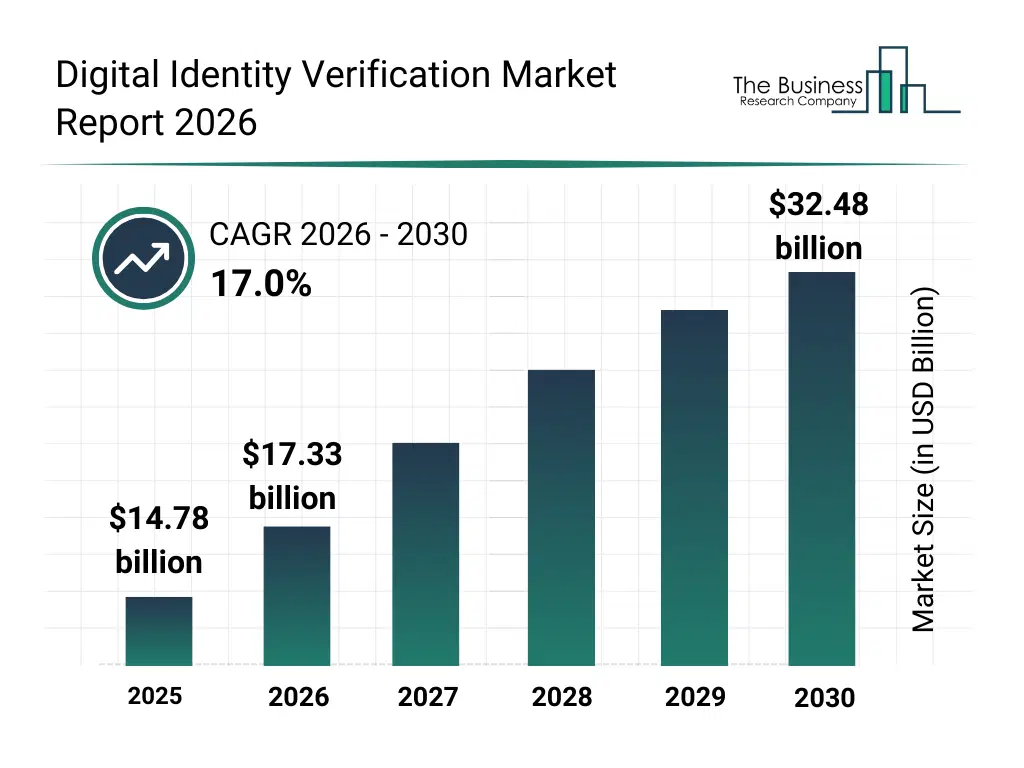
What Is The Digital Identity Verification Market Size and Share 2026?
The digital identity verification market size has grown rapidly in recent years. It will grow from $14.78 billion in 2025 to $17.33 billion in 2026 at a compound annual growth rate (CAGR) of 17.2%. The growth in the historic period can be attributed to rise in online fraud incidents, early digital banking adoption, regulatory kyc requirements, growth of online services, demand for secure authentication.What Is The Digital Identity Verification Market Growth Forecast?
The digital identity verification market size is expected to see rapid growth in the next few years. It will grow to $32.48 billion in 2030 at a compound annual growth rate (CAGR) of 17.0%. The growth in the forecast period can be attributed to expansion of digital financial services, stricter compliance regulations, adoption of biometric technologies, growth of remote onboarding, integration of AI verification tools. Major trends in the forecast period include biometric based identity verification, remote digital kyc processes, AI driven fraud detection, document and liveness verification, seamless user authentication systems.
Global Digital Identity Verification Market Segmentation
1) By Component: Solutions, Services 2) By Technology: Biometric Verification, Biometric Authentication, Document Verification, Video Verification, Artificial Intelligence (AI) And Machine Learning (ML) Integration, Other Technologies 3) By Deployment Mode: Cloud-Based, On-Premises 4) By Application: Identity Management, Access Control, Fraud Prevention, Customer Onboarding, Compliance And Regulatory Requirements, Remote User Verification 5) By End-User: Banking, Financial Services, And Insurance (BFSI), Government And Defense, Healthcare, Retail And E-commerce, Information Technology And Telecommunications, Other End-Users Subsegments: 1) By Solutions: Identity Authentication, Identity Verification, Identity Document Verification, Biometrics, Liveness Detection, Risk And Compliance Solutions, Identity Proofing, Fraud Detection And Prevention 2) By Services: Consulting, Integration And Implementation, Training And Education, Identity Monitoring, Technical Support, Outsourced Verification ServicesWhat Is The Driver Of The Digital Identity Verification Market?
The expansion of digital banking is expected to propel the growth of the digital identity verification market going forward. Digital banking involves providing financial services via online platforms, allowing users to manage their banking needs anytime and from any location. The rise of digital banking is driven by the growing need for convenience, allowing customers to manage their accounts, make transactions, and access services anytime, anywhere, improving accessibility and user experience. Digital identity verification strengthens security in digital banking by using biometrics, passwords, or authentication apps to confirm user identity. It helps prevent fraud, ensures compliance, and enables secure, seamless transactions, fostering customer trust. For instance, in January 2024, according to the European Central Bank, a Germany-based central bank of the European Union countries, the number of contactless card payments in the first half of 2023 increased by 24.3% from 20.9 billion in the first half of 2022, with the corresponding total value rising by 25.9% to €0.5 trillion ($545.27 billion). Therefore, the expansion of digital banking is driving the growth of the digital identity verification industry.Key Players In The Global Digital Identity Verification Market
Major companies operating in the digital identity verification market are Oracle Corporation, SAP SE, Mastercard Inc., Thales Group S.A., LexisNexis Risk Solutions Group, Experian PLC, Equifax Inc., IDEMIA LLC, Ping Identity Corporation, Jumio Inc., OneSpan Inc., Mitek Systems Inc., Trulioo, Verrif, Shufti Pro, Socure, Sumsub, AU10TIX, Aware Inc., Idology Inc.
This chart is for illustrative purposes; the full report includes a detailed competitor analysis and comprehensive overview of the top 10 companies in the market.
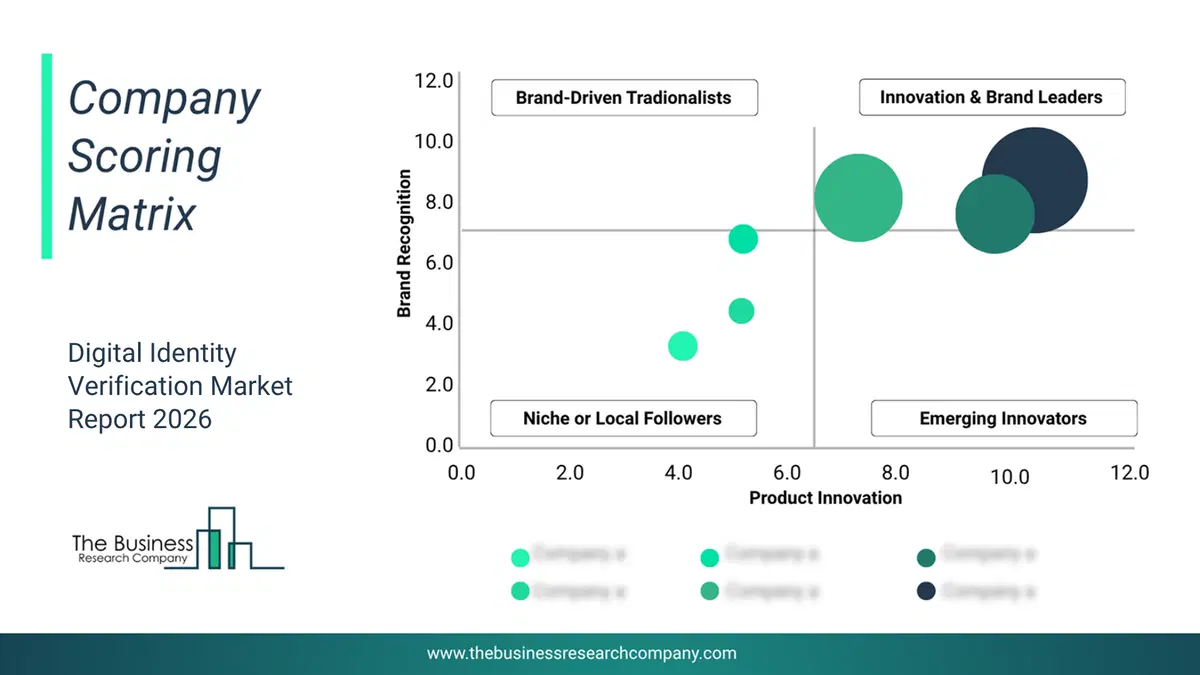
This chart maps companies by product innovation and brand strength, with bubble size indicating relative revenue, helping identify market leaders, challengers, and niche players. This is an illustrative chart; the full report provides a complete and accurate competitive analysis.
Global Digital Identity Verification Market Trends and Insights
Major companies operating in the digital identity verification market are focused on developing advanced technologies such as biometric authentication to enhance security and streamline user verification processes. Biometric authentication is a security process that verifies a person's identity using unique biological characteristics, such as fingerprints, facial recognition, or iris scans, which provides a highly secure and efficient way to confirm identity by ensuring that only authorized individuals can access specific systems or services. For instance, in October 2024, Jumio, a US-based identity verification company, launched Jumio Liveness, a next-generation liveness detection technology. It is designed to combat advanced fraud tactics such as deepfakes and injection attacks while maintaining a seamless user experience. The AI-driven solution employs cutting-edge biometric and anti-spoofing techniques, including real-time behavior analysis and ISO 30107-3 compliance, ensuring that users are physically present and genuine during identity verification. This innovation enhances fraud prevention without adding complexity, making it ideal for industries requiring rigorous security standards.What Are Latest Mergers And Acquisitions In The Digital Identity Verification Market?
In April 2024, Entrust Corp., a US-based software and credential company, acquired Onfido for an undisclosed amount. Through this acquisition, Entrust aims to strengthen its identity-centric security portfolio by integrating Onfido’s advanced artificial intelligence-powered identity verification capabilities, enabling organizations to deliver secure, digital-first experiences while combating rising threats such as deepfakes and complying with global regulations. Onfido is a UK-based technology company that provides automated digital identity verification technology.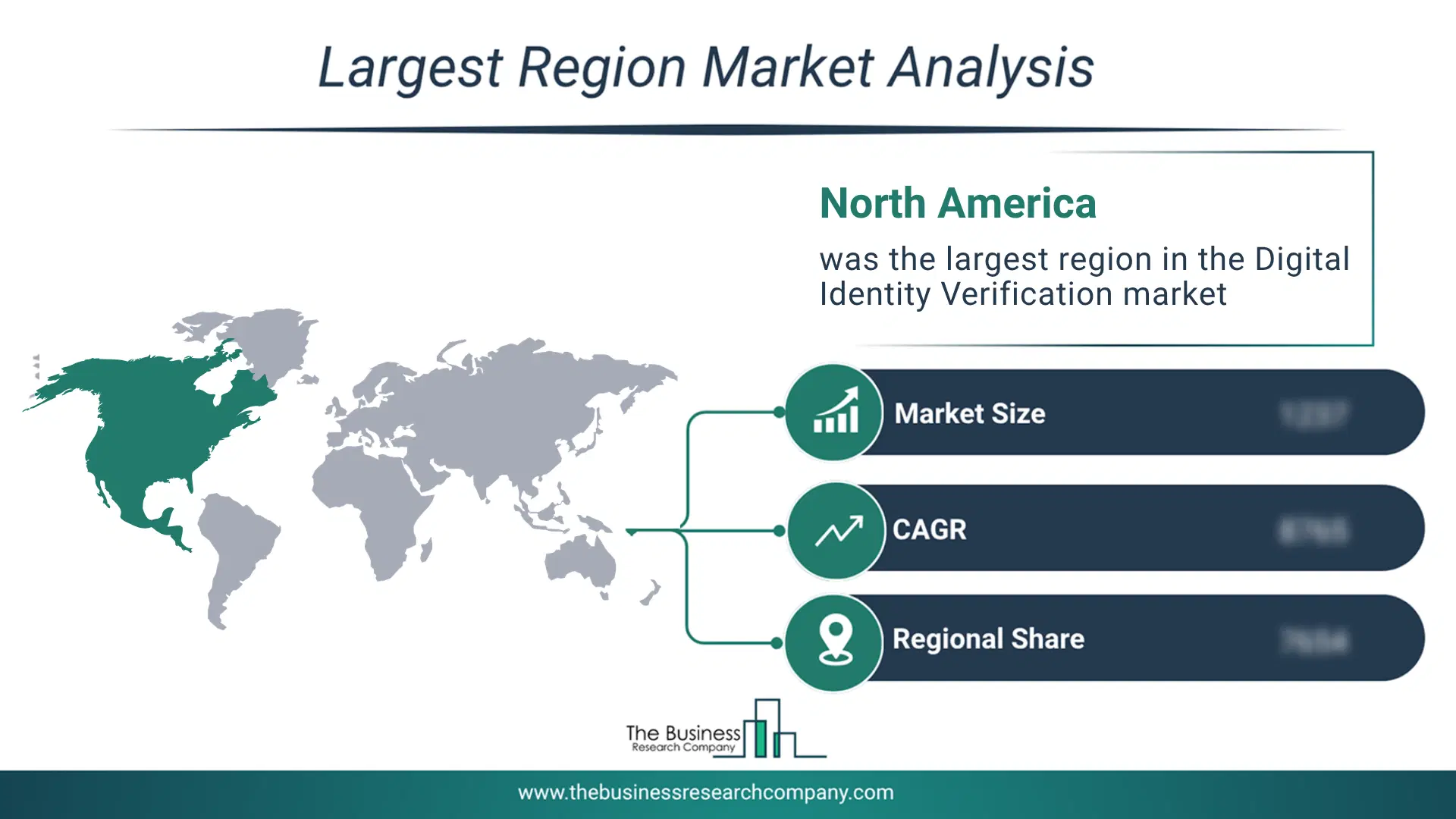
Regional Insights
North America was the largest region in the digital identity verification market in 2025. Asia-Pacific is expected to be the fastest-growing region in the forecast period. The regions covered in this market report are Asia-Pacific, South East Asia, Western Europe, Eastern Europe, North America, South America, Middle East, Africa. The countries covered in this market report are Australia, Brazil, China, France, Germany, India, Indonesia, Japan, Taiwan, Russia, South Korea, UK, USA, Canada, Italy, Spain.What Defines the Digital Identity Verification Market?
The digital identity verification market includes revenues earned by entities by providing services such as liveness detection, age verification, fraud detection, and risk scoring. The market value includes the value of related goods sold by the service provider or included within the service offering.How is Market Value Defined and Measured?
The market value is defined as the revenues that enterprises gain from the sale of goods and/or services within the specified market and geography through sales, grants, or donations in terms of the currency (in USD unless otherwise specified). The revenues for a specified geography are consumption values that are revenues generated by organizations in the specified geography within the market, irrespective of where they are produced. It does not include revenues from resales along the supply chain, either further along the supply chain or as part of other products.
This chart presents market attractiveness based on a quantitative evaluation of growth, competition, strategic alignment, and risk, offering a clear view of opportunity areas for decision-making. This chart is for illustrative purposes; the full report contains the complete analysis.

This chart highlights the Total Addressable Market (TAM) by estimating the maximum revenue opportunity using an assumption-driven approach, supporting strategic planning and opportunity sizing across markets. The chart is illustrative; the full report provides a more comprehensive analysis.
What Key Data and Analysis Are Included in the Digital Identity Verification Market Report 2026?
The digital identity verification market research report is one of a series of new reports from The Business Research Company that provides market statistics, including industry global market size, regional shares, competitors with the market share, detailed market segments, market trends and opportunities, and any further data you may need to thrive in the digital identity verification industry. The market research report delivers a complete perspective of everything you need, with an in-depth analysis of the current and future state of the industry.Digital Identity Verification Market Report Forecast Analysis
| Report Attribute | Details |
|---|---|
| Market Size Value In 2026 | $17.33 billion |
| Revenue Forecast In 2030 | $32.48 billion |
| Growth Rate | CAGR of 17% from 2026 to 2030 |
| Base Year For Estimation | 2025 |
| Actual Estimates/Historical Data | 2020-2025 |
| Forecast Period | 2026 - 2030 |
| Market Representation | Revenue in USD Billion and CAGR from 2026 to 2030 |
| Segments Covered | Component, Technology, Deployment Mode, Application, End-User |
| Regional Scope | Asia-Pacific, Western Europe, Eastern Europe, North America, South America, Middle East, Africa |
| Country Scope | The Countries Covered In This Market Report Are Australia, Brazil, China, France, Germany, India, Indonesia, Japan, Taiwan, Russia, South Korea, Uk, Usa, Canada, Italy, Spain. |
| Key Companies Profiled | Oracle Corporation, SAP SE, Mastercard Inc., Thales Group S.A., LexisNexis Risk Solutions Group, Experian PLC, Equifax Inc., IDEMIA LLC, Ping Identity Corporation, Jumio Inc., OneSpan Inc., Mitek Systems Inc., Trulioo, Verrif, Shufti Pro, Socure, Sumsub, AU10TIX, Aware Inc., Idology Inc. |
| Customization Scope | Request for Customization |
| Pricing And Purchase Options | Explore Purchase Options |