

Contact Us
  Search
The Business Research Company Logo
Digital Infrastructure Global Market Opportunities And Strategies To 2035
Published :July 2026
Pages :398
Format :PDF
Delivery Time :2-3 Business Days
Why 2-3 days? We update the report with the latest data and news before delivery. Let us know if you need us to expedite.
Report Price :$4,490.00

Digital Infrastructure Global Market Opportunities And Strategies To 2035

By Component (Hardware, Software, Service), By Deployment Type (On-Premise, Cloud), By Enterprise Size (Small And Medium Enterprises (SMEs), Large Enterprises.), By Application (Healthcare, Banking, Financial Services And Insurance (BFSI), Information Technology And Telecommunications, Retail And E-Commerce, Government And Defense, Manufacturing, Energy And Utilities, Other Applications), And By Region, Opportunities And Strategies – Global Forecast To 2035

Digital Infrastructure Market Definition

Digital infrastructure refers to the foundational technology systems, networks and facilities that enable the creation, storage, processing, transmission and management of digital data and services across organizations, governments and consumers. It includes components such as data centers, cloud computing platforms, telecommunications networks, fiber-optic connectivity, servers, storage systems, cybersecurity solutions, edge computing infrastructure and internet exchange facilities. The primary purpose of digital infrastructure is to support seamless digital communication, data processing, connectivity and access to online services, enabling businesses and societies to operate efficiently in an increasingly digital economy. The digital infrastructure market consists of sales by entities (organizations, sole traders and partnerships) by providing hardware, software and services that support digital communication, data processing, storage, networking and cloud-based operations.
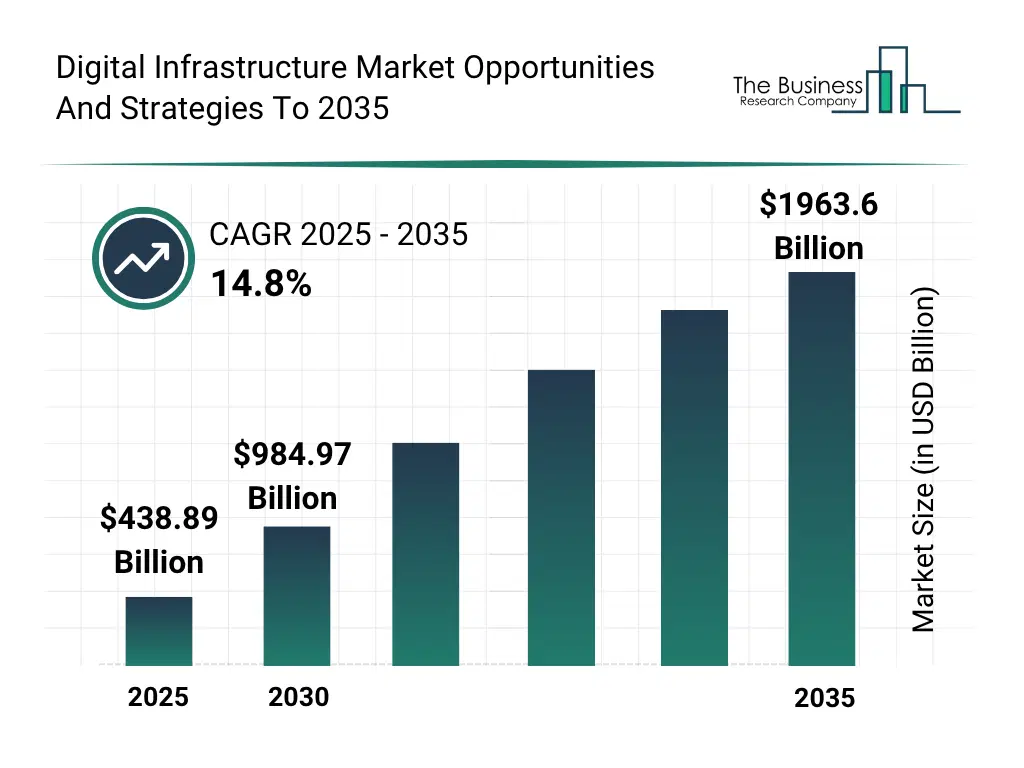
Digital Infrastructure Global Market Opportunities And Strategies To 2035 Market Size and growth rate 2026 to 2030: Graph

Digital Infrastructure Market Size

The global digital infrastructure market reached a value of nearly $438,890.0 million in 2025, having grown at a compound annual growth rate (CAGR) of 20.7% since 2020. The market is expected to grow from $438,890.0 million in 2025 to $984,974.7 million in 2030 at a rate of 17.5%. The market is then expected to grow at a CAGR of 14.8% from 2030 and reach $1,963,600.7 million in 2035. Growth in the historic period resulted from increasing consumption of streaming media and digital content services, expansion of digital payment ecosystems, increasing global mobile internet penetration and increasing adoption of remote work, digital collaboration and virtual enterprise operations. Factors that negatively affected growth in the historic period were high capital investment requirements and data privacy and protection laws. Going forward, rising demand for cloud computing services and hyperscale data centers, government-led digital transformation and smart infrastructure programs, increasing demand for low-latency network infrastructure and increasing adoption of artificial intelligence and big data analytics will drive the growth. Factors that could hinder the growth of the digital infrastructure market in the future include cybersecurity risk exposure and impact of trade wars and tariffs.
Research Expert

Book your 30 minutes free consultation with our research experts

Digital Infrastructure Market Segmentation

The digital infrastructure market is segmented by component, by deployment type, by enterprise size, by distribution channel.

By Component –
The digital infrastructure market is segmented by component into:
    • a) Software
    • b) Hardware
    • c) Services
The hardware market was the largest segment of the digital infrastructure market segmented by component, accounting for 49.0% or $214,946.5 million of the total in 2025. Going forward, the software segment is expected to be the fastest-growing segment in the digital infrastructure market segmented by component, at a CAGR of 21.1% during 2025-2030.

By Deployment Type –
The digital infrastructure market is segmented by deployment type into:
    • a) On-Premise
    • b) Cloud
The on-premise market was the largest segment of the digital infrastructure market segmented by deployment type, accounting for 58.2% or $255,408.4 million of the total in 2025. Going forward, the cloud segment is expected to be the fastest-growing segment in the digital infrastructure market segmented by deployment type, at a CAGR of 24.0% during 2025-2030.

By Enterprise Size –
The digital infrastructure market is segmented by enterprise size into:
    • a) Small And Medium Enterprises (SMEs)
    • b) Large Enterprises
The large enterprises market was the largest segment of the digital infrastructure market segmented by enterprise size, accounting for 73.1% or $320,928.3 million of the total in 2025. Going forward, the small and medium enterprises (SMEs) segment is expected to be the fastest growing segment in the digital infrastructure market segmented by enterprise size, at a CAGR of 21.1% during 2025-2030.

By Application –
The digital infrastructure market is segmented by application into:
  1. a) Healthcare
  2. b) Banking, Financial Services And Insurance (BFSI)
  3. c) Information Technology And Telecommunications
  4. d) Retail And E-Commerce
  5. e) Government And Defense
  6. f) Manufacturing
  7. g) Energy And Utilities
  8. h) Other Applications
The information technology and telecommunications market was the largest segment of the digital infrastructure market segmented by application, accounting for 21.3% or $93,427.1 million of the total in 2025. Going forward, the information technology and telecommunications segment is expected to be the fastest-growing segment in the digital infrastructure market segmented by application, at a CAGR of 21.7% during 2025-2030.

By Geography - The digital infrastructure market is segmented by geography into:
      o Asia Pacific
      • China
      • India
      • Japan
      • Australia
      • Taiwan
      • South Korea
      o South East Asia
      • Indonesia
      o North America
      • USA
      • Canada
      o South America
      • Brazil
      o Western Europe
      • France
      • Germany
      • UK
      • Italy
      • Spain
      o Eastern Europe
      • Russia
      o Middle East
      o Africa
North America was the largest region in the digital infrastructure market, accounting for 36.1% or $158,348.4 million of the total in 2025. It was followed by Asia Pacific, Western Europe and then the other regions. Going forward, the fastest-growing regions in the digital infrastructure market will be Asia Pacific and Africa where growth will be at CAGRs of 21.2% and 17.8% respectively. These will be followed by Middle East and Western Europe where the markets are expected to grow at CAGRs of 17.7% and 17.1% respectively.

Digital Infrastructure Market Drivers

The key drivers of the digital infrastructure market include: Rising Demand For Cloud Computing Services And Hyperscale Data Centers During the forecast period, rising demand for cloud computing services and hyperscale data centers is expected to driver the digital infrastructure market. As enterprises migrate workloads to public clouds and consumer applications like streaming, AI training and IoT generate exponential data growth, hyperscale data centers defined by their ability to scale out efficiently beyond traditional facilities must be built in greater numbers and larger sizes. This directly propels expansion in digital infrastructure through several mechanisms: first, each hyperscale facility demands high-capacity fiber optic connectivity and subsea cables to link regions and reduce latency. Second, it requires upgraded power grids, backup energy systems and advanced cooling solutions to handle immense electricity loads. Third, the distributed nature of cloud services pushes growth in edge data centers and colocation hubs to bring compute closer to users. The rising demand for cloud computing services and hyperscale data centers growth contribution during the forecast period in 2026 is 1.5%.

Digital Infrastructure Market Restraints

The key restraints on the digital infrastructure market include: Cybersecurity Risk Exposure During the forecast period, cybersecurity risk exposure restricted the growth of the digital infrastructure market. When organizations or governments face heightened cyber threats, they often delay or scale back digital transformation projects due to concerns over financial losses, regulatory penalties and reputational damage. For instance, a successful attack on smart grid infrastructure or a healthcare data hub can erode public trust and lead to costly shutdowns, discouraging further investment in new digital assets. Moreover, meeting stringent security compliance standards forces infrastructure operators to allocate significant budgets toward firewalls, encryption, intrusion detection systems and continuous monitoring, resources that might otherwise be used for network expansion or technology upgrades. This risk-driven caution slows the deployment of high-speed broadband, edge data centers and 5G networks, as each new component must undergo rigorous security validation. In essence, unresolved cybersecurity vulnerabilities create both financial and operational friction, directly restraining the pace and scale of digital infrastructure growth. Growth affected by the cybersecurity risk exposure during the forecast period in 2026 is -2.5%.

Digital Infrastructure Market Competitive Landscape

Major Competitors are:

  • Amazon Inc.
  • Microsoft Corporation
  • Google LLC
  • Alibaba Group Holding Limited
  • Tencent Holdings Ltd.
  • Other Competitors Include:

  • NTT Inc.
  • International Business Machines Corporation
  • Oracle Corporation
  • Cisco Systems Inc.
  • AT&T Inc.
  • Huawei
  • China Telecom (eCloud)
  • Dahua
  • Kedacom
  • Tencent
  • Baidu
  • NEC Corporation
  • Samsung Electronics
  • SK Hynix
  • Intel Corporation
  • Micron Technology Inc.
  • NVIDIA Corporation
  • Hewlett Packard Enterprise Company
  • Digital Realty Trust Inc.
  • AkamAI Technologies Inc.
  • Broadcom Inc.
  • Fujitsu Limited
  • Equinix Inc.
  • Digital Realty Trust Inc.
  • Hitachi Vantara LLC.
  • GDS Holdings Ltd.
  • NEXTDC Ltd.
  • Cloudflare Inc.
  • Zayo Group
  • CoreSite
  • Wind River Systems Inc.
  • Orange S.A.
  • OVHcloud
  • Iliad Group
  • Deutsche Telekom
  • Bechtle AG
  • Nagarro SE
  • INWIT
  • TIM Enterprise
  • Walhalla Cloud
  • BT Group
  • Telecom
  • Movistar
  • IFX Networks
  • Ascenty
  • ODATA
  • AZLOGICA
  • Claro
  • Cirion Technologies
  • Cloudflare Inc.
  • E-INFRA
  • Rostechnologies (Rostec)
  • MTS Web Services
  • T-Mobile
  • Data4
  • Hewlett Packard Enterprise Company
  • Hitachi LLC.
  • AkamAI Technologies Inc.
  • Dell Technologies Inc.
  • CoreWeave Inc.
  • Need data on a specific region in this market?

    Opportunities And Recommendations In The Digital Infrastructure Market

    Opportunities – The top opportunities in the digital infrastructure market segmented by component will arise in the hardware segment, which will gain $206,314.0 million of global annual sales by 2030. The top opportunities in the digital infrastructure market segmented by deployment type will arise in the cloud segment, which will gain $353,769.4 million of global annual sales by 2030. The top opportunities in the digital infrastructure market segmented by enterprise size will arise in the large enterprise segment, which will gain $356,256.3 million of global annual sales by 2030. The top opportunities in the digital infrastructure market segmented by application will arise in the information technology and telecommunications segment, which will gain $155,613.5 million of global annual sales by 2030. The digital infrastructure market size will gain the most in the USA at $136,387.6 million. Recommendations- To take advantage of the opportunities, The Business Research Company recommends the digital infrastructure companies to focus on vertically integrated AI infrastructure platforms, focus on contract advisory and risk optimization capabilities, focus on lifecycle-integrated risk management solutions, focus on AI-ready hyperscale data center expansion, focus on software-driven digital infrastructure solutions, focus on expansion of cloud-based digital infrastructure solutions, expand in emerging markets, continue to focus on developed markets, focus on expansion of multi-regional digital distribution networks, focus on value-based and flexible pricing models, focus on industry-led thought leadership and enterprise engagement, focus on strategic partnerships and ecosystem-based promotion and focus on scalable digital infrastructure solutions for SMEs.
    Chat with us