

Digital Isolator Market Report 2026
Global Outlook – By Technology (Capacitive Coupling, Magnetic Coupling, Giant Magnetoresistive, Other Technologies), By Data Rate (Up to 25 Mbps, 25 – 75 Mbps, Above 75 Mbps ), By Channel (2 Channel, 4 Channel, 6 Channel, 8 Channel, Other Channels ), By Insulation (Polyimide-Based, Silicon Dioxide (Sio,-Based, Other Insulations ), By Industry Vertical (Automotive, IT And Telecommunications, Aerospace And Defense, Consumer Electronics, Energy And Power, Other Industries) – Market Size, Trends, Strategies, and Forecast to 2030
Digital Isolator Market Overview
• Digital Isolator market size has reached to $2.54 billion in 2025 • Expected to grow to $3.52 billion in 2030 at a compound annual growth rate (CAGR) of 6.8% • Growth Driver: Increasing Adoption Of Internet Of Things (IoT) Devices • Market Trend: Advanced Isolators For Ensuring Compatibility • Asia-Pacific was the largest region and fastest growing region.What Is Covered Under Digital Isolator Market?
Digital isolators refer to integrated devices designed to offer significant isolation when transmitting digital and analog signals. They play a pivotal role in ensuring a distinct barrier between the electronic setup and its users. These isolators find extensive applications in electronic circuitry, predominantly in industrial electronic devices to shield both the system and its users from potential high-voltage threats. The main technology of digital isolator are capacitive coupling, magnetic coupling, giant magnetoresistive and other technologies. Capacitive coupling refers to the transfer of energy within an electrical network or between distant networks by means of displacement current between circuit nodes, induced by the electric field. The various data rate involved are up to 25 mbps, 25 – 75 mbps and above 75 mbps which consists of 2 channel, 4 channel, 6 channel, 8 channel and other channels with insulation based on polyimide, silicon dioxide (sio2) and other insulations which are used by automotive, it and telecommunications, aerospace and defense, consumer electronics, energy and power and other industries.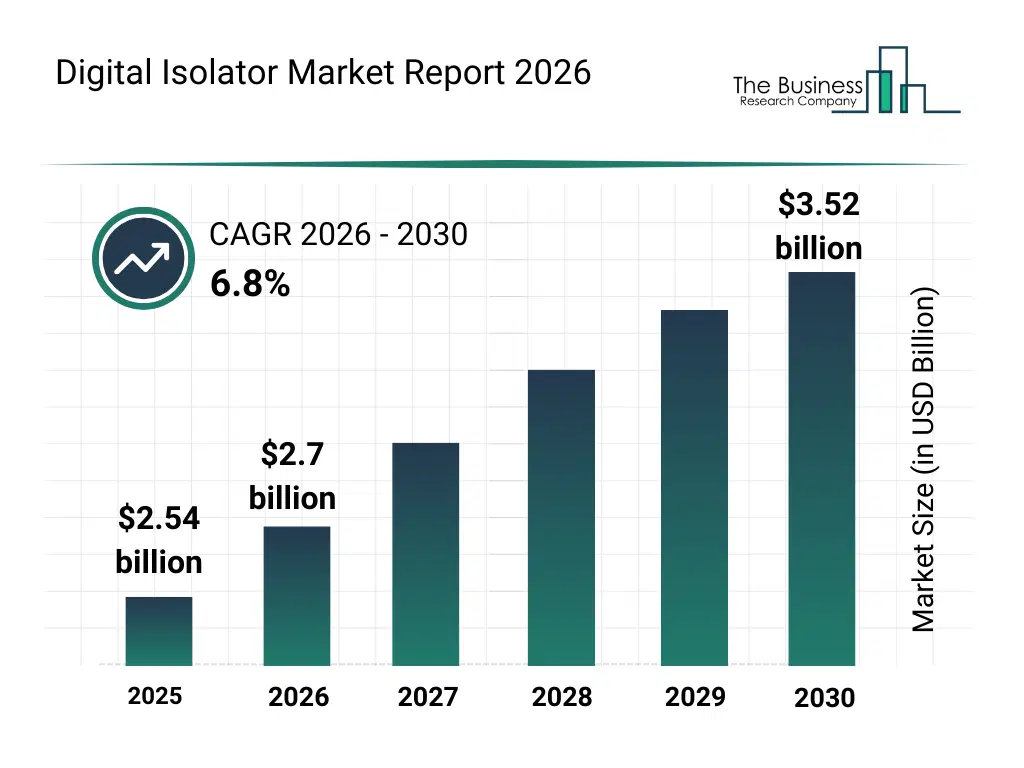
What Is The Digital Isolator Market Size and Share 2026?
The digital isolator market size has grown strongly in recent years. It will grow from $2.54 billion in 2025 to $2.7 billion in 2026 at a compound annual growth rate (CAGR) of 6.5%. The growth in the historic period can be attributed to expansion of industrial electronics manufacturing, growth in power electronics adoption, increasing use of isolation in safety-critical systems, availability of advanced semiconductor fabrication, rising demand for high-voltage protection.What Is The Digital Isolator Market Growth Forecast?
The digital isolator market size is expected to see strong growth in the next few years. It will grow to $3.52 billion in 2030 at a compound annual growth rate (CAGR) of 6.8%. The growth in the forecast period can be attributed to increasing electrification of industrial systems, rising adoption of electric vehicles and charging infrastructure, expansion of smart grid technologies, growing focus on cybersecurity and system safety, increasing integration of digital isolators in advanced electronics. Major trends in the forecast period include increasing adoption of high-speed digital isolation solutions, increasing demand for compact and low-power isolators, growing integration in industrial automation systems, expansion of isolation solutions for electric vehicles, enhanced focus on signal integrity and safety.Tariff Impact On Digital Isolator Market
Tariffs are affecting the digital isolator market by increasing costs for imported semiconductor wafers, advanced packaging materials, fabrication equipment, and testing components required for high-performance isolator production. Automotive, industrial automation, and energy sectors in North America and Europe are most impacted due to reliance on imported semiconductor components, while Asia-Pacific manufacturers face cost volatility and export-related pressures. These tariffs have increased component prices and affected supply continuity for electronic manufacturers. At the same time, tariffs are accelerating investments in domestic semiconductor fabrication, local assembly, and innovation in cost-efficient digital isolation technologies.
Global Digital Isolator Market Segmentation
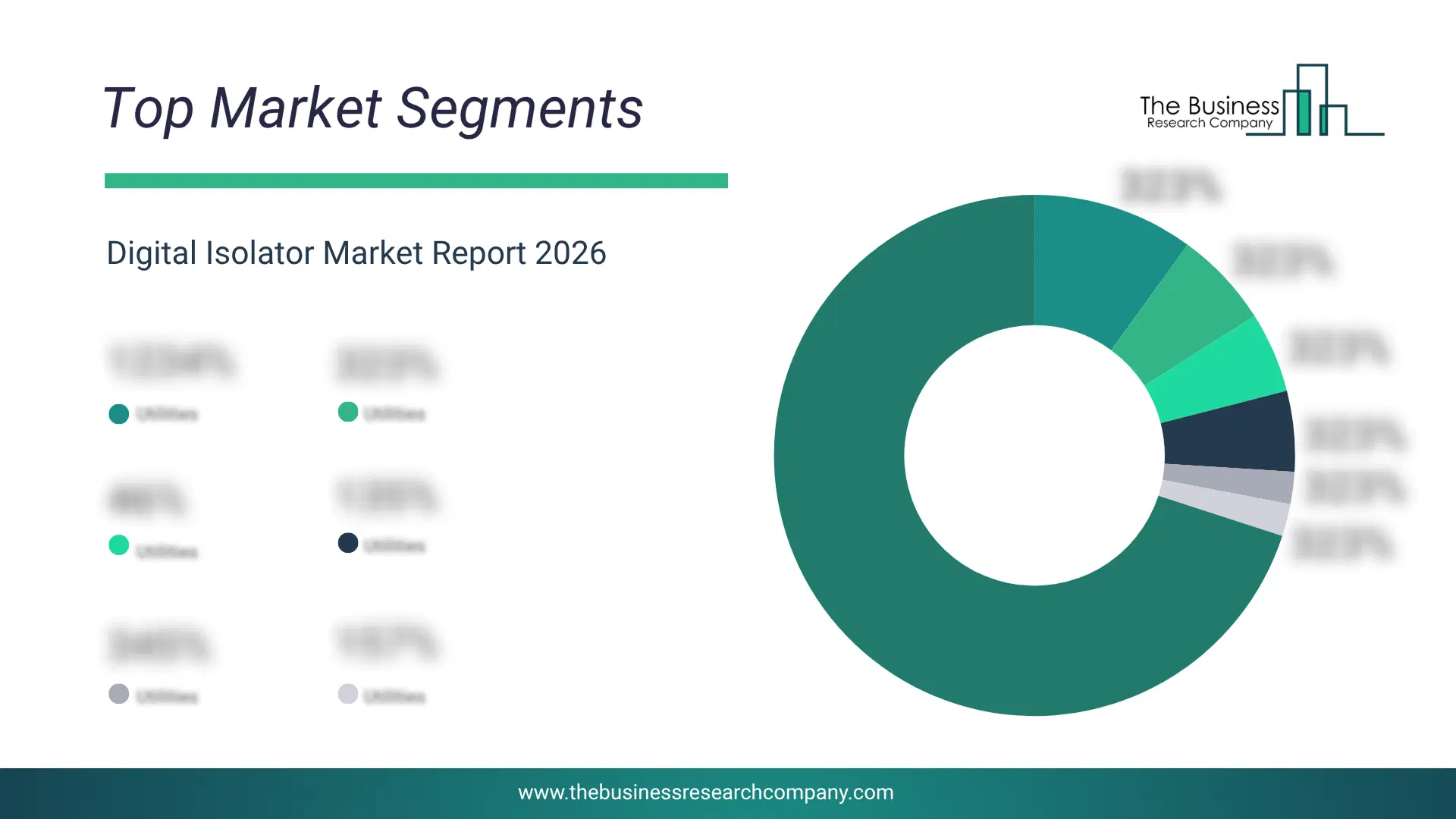
1) By Technology: Capacitive Coupling, Magnetic Coupling, Giant Magnetoresistive, Other Technologies 2) By Data Rate: Up to 25 Mbps, 25 – 75 Mbps, Above 75 Mbps 3) By Channel: 2 Channel, 4 Channel, 6 Channel, 8 Channel, Other Channels 4) By Insulation: Polyimide-Based, Silicon Dioxide (Sio2)-Based, Other Insulations 5) By Industry Vertical: Automotive, IT And Telecommunications, Aerospace And Defense, Consumer Electronics, Energy And Power, Other Industries Subsegments: 1) By Capacitive Coupling: High-Speed Capacitive Digital Isolators, Low-Power Capacitive Digital Isolators 2) By Magnetic Coupling: Transformer-Based Digital Isolators, GMR Or Spin-Valve-Based Digital Isolators 3) By Giant Magnetoresistive (GMR): Standard GMR Digital Isolators, High-Noise-Immunity GMR Digital Isolators 4) By Other Isolation Technologies: Optocoupler-Based Digital Isolators, Piezoelectric-Based Digital IsolatorsWhat Are The Drivers Of The Digital Isolator Market?
The increasing adoption of internet of things (IoT) devices is expected to propel the growth of the digital isolator market going forward. Internet of Things (IoT) devices refer to physical objects embedded with sensors, software, and connectivity features, enabling them to collect and exchange data over the internet. Internet of Things (IoT) devices use digital isolators to enhance data integrity, reliability, and security by providing electrical isolation between different components and subsystems. For instance, in August 2025, according to the European Commission, a Belgium-based government body, in 2024, 70.9% of individuals in the EU used devices connected to the internet. Therefore, the increasing adoption of internet of things (IoT) devices and sensors is driving the growth of the digital isolator industry. The increasing demand for automation is expected to propel the growth of the digital isolator market going forward. Automation is the use of technology, machines, or systems to perform tasks with minimal human intervention, improving efficiency and accuracy. The demand for automation is rising as companies aim to boost efficiency, lower human errors, and cut operational expenses while maintaining high-quality output. Digital isolators enable automation by ensuring fast, safe signal transmission between electronic components while protecting systems from electrical noise and surges. For instance, in September 2024, according to the International Federation of Robotics (IFR), a Germany-based non-profit organization, reported that industrial robot installations in the UK rose by 51%, reaching 3,830 units, while in the Americas, over 50,000 units were installed for the third consecutive year, totaling 55,389 units in 2023. Therefore, the increasing demand for automation is driving the growth of the digital isolator industry.Key Players In The Global Digital Isolator Market
Major companies operating in the digital isolator market are Texas Instruments Inc., Analog Devices Inc., Infineon Technologies AG, Broadcom Inc., STMicroelectronics NV, NXP Semiconductors N.V., Renesas Electronics Corporation, Skyworks Solutions Inc., Vicor Corporation, NVE Corporation, Silicon Laboratories Inc., ROHM Semiconductor, ON Semiconductor, Murata Manufacturing Co., Ltd., Toshiba Electronic Devices & Storage Corporation, Panasonic Corporation, Maxim Integrated, Vishay Intertechnology, Inc., ISOBAUD, Inc., NOVOSENSE Microelectronics Co., Ltd.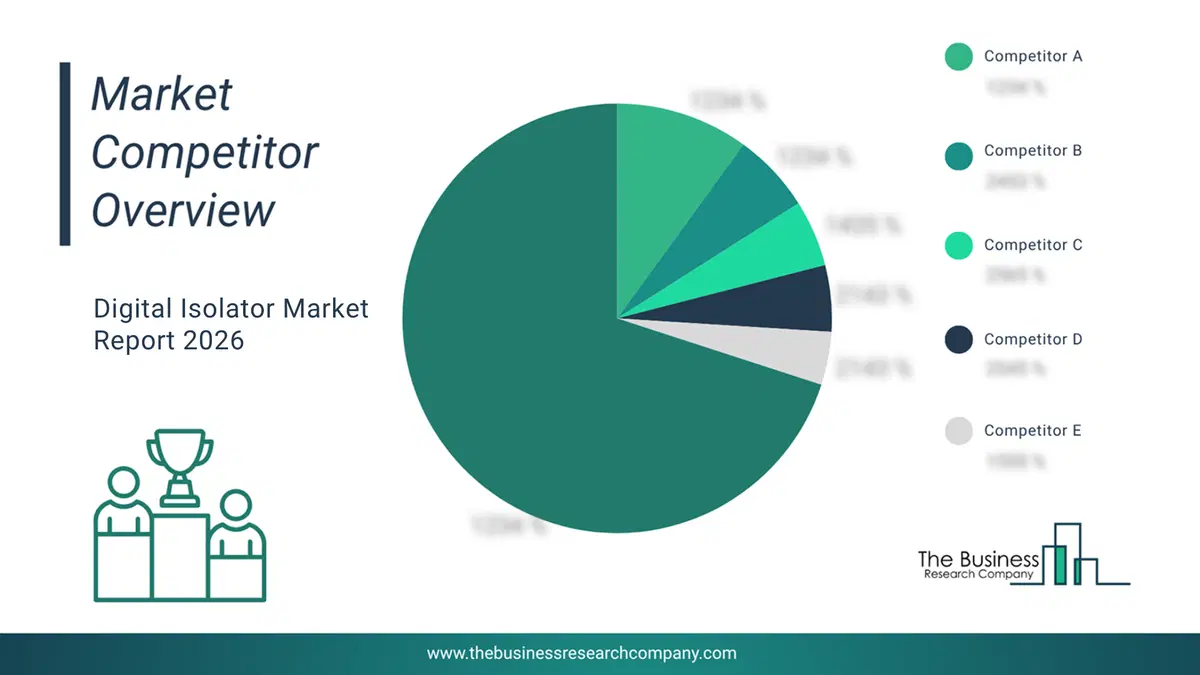
This chart is for illustrative purposes; the full report includes a detailed competitor analysis and comprehensive overview of the top 10 companies in the market.
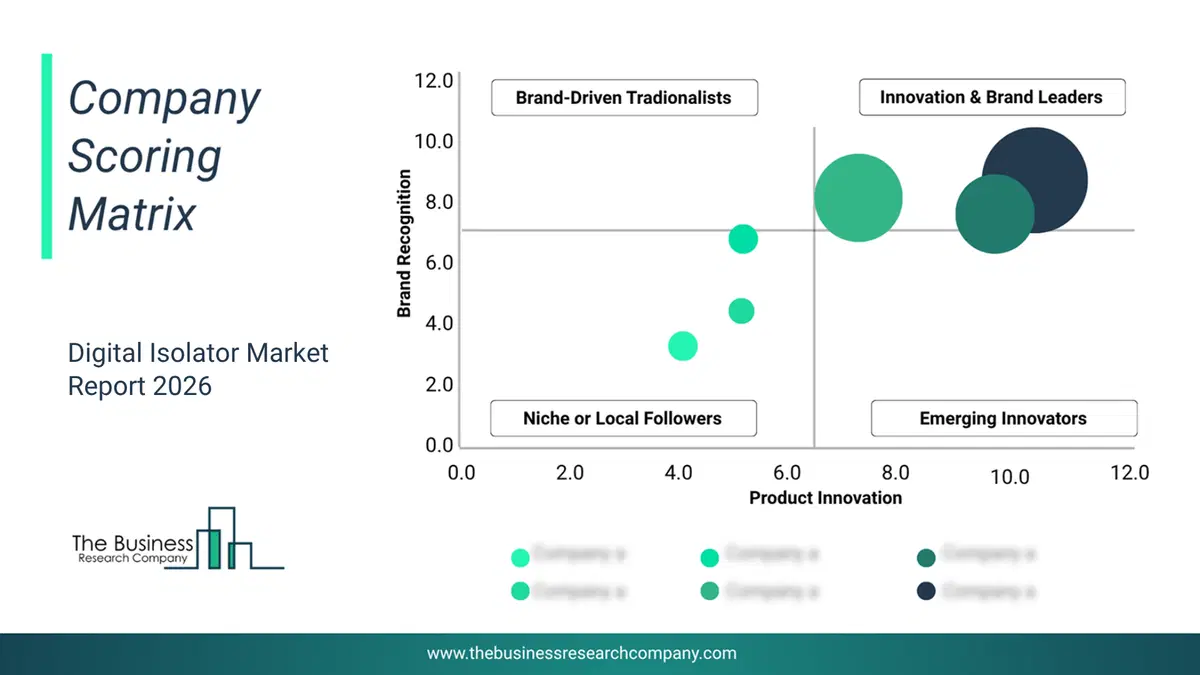
This chart maps companies by product innovation and brand strength, with bubble size indicating relative revenue, helping identify market leaders, challengers, and niche players. This is an illustrative chart; the full report provides a complete and accurate competitive analysis.
Global Digital Isolator Market Trends and Insights
Major companies operating in the digital isolator market are developing advanced products such as ISOFACE 2DIBx4xxF to enhance reliability, efficiency, and safety in various environments and thereby drive revenues in the market. For instance, in June 2023, Infineon Technologies, a Germany-based designer, manufacturer, and supplier of semiconductors launched ISOFACE 2DIBx4xxF, a dual-channel digital high-voltage isolator. The ISOFACE devices utilize Infineon's patented coreless transformer (CT) isolation technology, including multiple channel configurations, dependable default output states, and flexible input thresholds along with output activation configurations. This CT technology approach offers robust resistance to system noise, showcasing a CMTI exceeding 100 kV/μs. This range of digital isolators can handle isolation voltages up to 3000 V RMS, ensuring stable operations in interference-prone settings and consistent data transfers. This dual-channel first-generation model, 2DIBx4xxF, supports transmission speeds reaching 40 Mbit/s, maintaining signal clarity across diverse temperatures and production variations.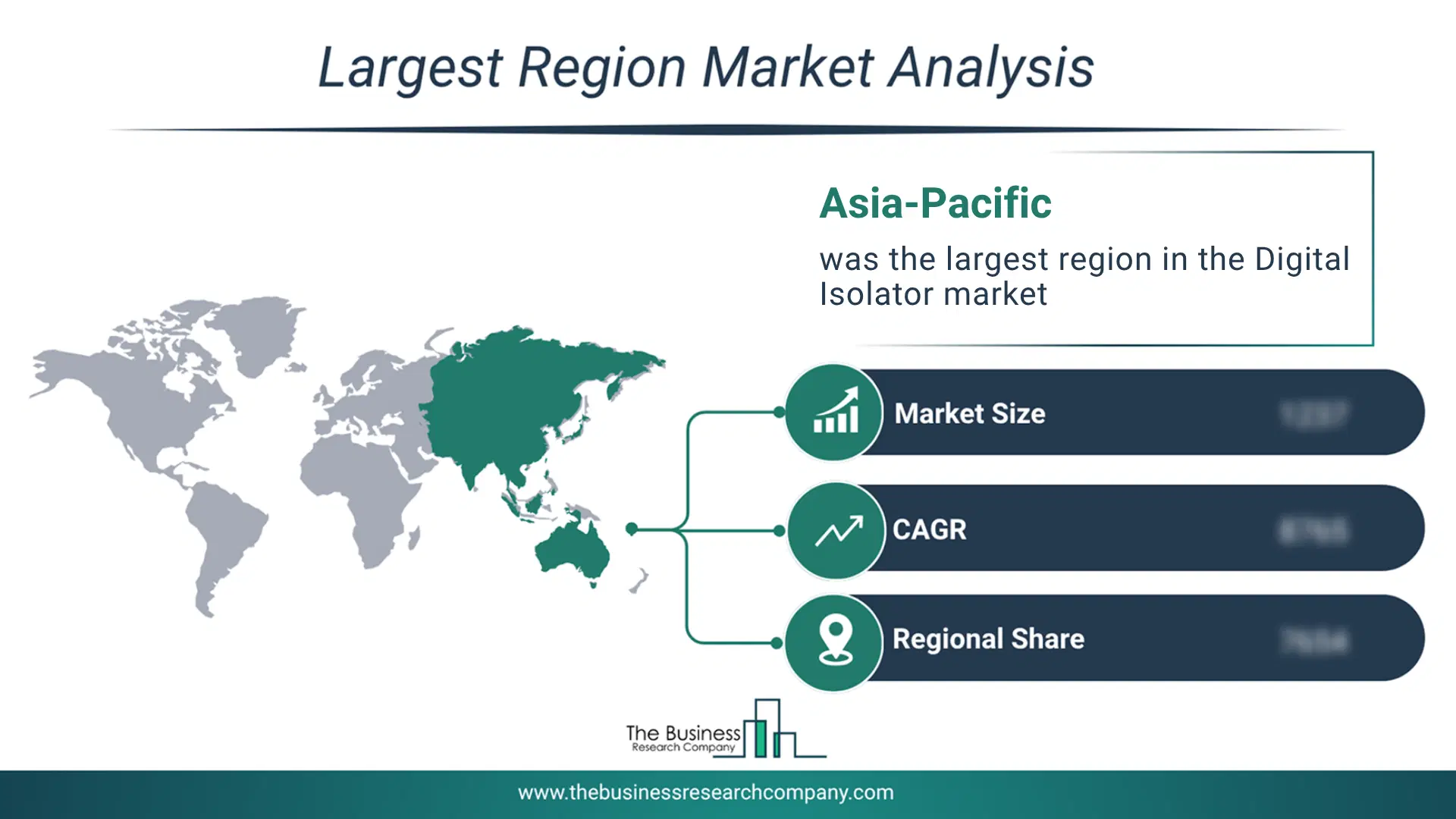
Regional Outlook
Asia-Pacific was the largest region in the digital isolator market in 2025. Asia-Pacific is expected to be the fastest-growing region in the forecast period. The regions covered in this market report are Asia-Pacific, South East Asia, Western Europe, Eastern Europe, North America, South America, Middle East, Africa The countries covered in this market report are Australia, Brazil, China, France, Germany, India, Indonesia, Japan, Taiwan, Russia, South Korea, UK, USA, Canada, Italy, Spain.What Defines the Digital Isolator Market?
The digital isolator market includes revenues earned by entities by providing services such as capacitive coupling, giant magnetoresistive (GMR), and magnetic coupling. The market value includes the value of related goods sold by the service provider or included within the service offering. Only goods and services traded between entities or sold to end consumers are included. The digital isolator market consists of sales of systems such as optocouplers, capacitive couplers, and transformer-based isolators. Values in this market are ‘factory gate’ values, that is the value of goods sold by the manufacturers or creators of the goods, whether to other entities (including downstream manufacturers, wholesalers, distributors, and retailers) or directly to end customers. The value of goods in this market includes related services sold by the creators of the goods.How is Market Value Defined and Measured?
The market value is defined as the revenues that enterprises gain from the sale of goods and/or services within the specified market and geography through sales, grants, or donations in terms of the currency (in USD unless otherwise specified). The revenues for a specified geography are consumption values that are revenues generated by organizations in the specified geography within the market, irrespective of where they are produced. It does not include revenues from resales along the supply chain, either further along the supply chain or as part of other products.
This chart presents market attractiveness based on a quantitative evaluation of growth, competition, strategic alignment, and risk, offering a clear view of opportunity areas for decision-making. This chart is for illustrative purposes; the full report contains the complete analysis.

This chart highlights the Total Addressable Market (TAM) by estimating the maximum revenue opportunity using an assumption-driven approach, supporting strategic planning and opportunity sizing across markets. The chart is illustrative; the full report provides a more comprehensive analysis.
What Key Data and Analysis Are Included in the Digital Isolator Market Report 2026?
The digital isolator market research report is one of a series of new reports from The Business Research Company that provides market statistics, including industry global market size, regional shares, competitors with the market share, detailed market segments, market trends and opportunities, and any further data you may need to thrive in the digital isolator industry. The market research report delivers a complete perspective of everything you need, with an in-depth analysis of the current and future state of the industry.Digital Isolator Market Report Forecast Analysis
| Report Attribute | Details |
|---|---|
| Market Size Value In 2026 | $2.7 billion |
| Revenue Forecast In 2030 | $3.52 billion |
| Growth Rate | CAGR of 6.8% from 2026 to 2030 |
| Base Year For Estimation | 2025 |
| Actual Estimates/Historical Data | 2020-2025 |
| Forecast Period | 2026 - 2030 |
| Market Representation | Revenue in USD Billion and CAGR from 2026 to 2030 |
| Segments Covered | Technology, Data Rate, Channel, Insulation, Industry Vertical |
| Regional Scope | Asia-Pacific, Western Europe, Eastern Europe, North America, South America, Middle East, Africa |
| Key Companies Profiled | Texas Instruments Inc., Analog Devices Inc., Infineon Technologies AG, Broadcom Inc., STMicroelectronics NV, NXP Semiconductors N.V., Renesas Electronics Corporation, Skyworks Solutions Inc., Vicor Corporation, NVE Corporation, Silicon Laboratories Inc., ROHM Semiconductor, ON Semiconductor, Murata Manufacturing Co., Ltd., Toshiba Electronic Devices & Storage Corporation, Panasonic Corporation, Maxim Integrated, Vishay Intertechnology, Inc., ISOBAUD, Inc., NOVOSENSE Microelectronics Co., Ltd. |
| Customization Scope | Request for Customization |
| Pricing And Purchase Options | Explore Purchase Options |