

Digital Substation Market 2025
By Voltage Level (Low Voltage, Medium Voltage, High Voltage), By Type (Transmission, Distribution), By Module (Fiber Optics Communication Network, Supervisory Control And Data Acquisition, Hardware), By Industry Vertical (Power Generation, Metal And Mining, Oil And Gas, Transportation And Logistics, Defense And Aerospace, Process And Manufacturing, Other Industry Verticals), By Equipment Type (Intelligent Electronic Devices (LEDs), Digital Relays, Merging Units (MUs), Phasor Measurement Units (PMUs), SCADA Systems, Remote Terminal Units (RTUs), Communication Systems, Other Equipment Types), And By Region, Opportunities And Strategies – Global Forecast To 2035
Digital Substation Market Definition
A digital substation is an advanced electrical substation that leverages digital technologies for the automation, protection, control and monitoring of power systems. Unlike conventional substations, digital substations utilize intelligent electronic devices (IEDs), communication protocols such as IEC 61850 and fiber-optic communication networks to enable efficient data exchange and system operation. These substations play a critical role in modern power grids by enhancing operational efficiency, enabling remote monitoring, reducing maintenance needs and improving overall reliability and safety. The digital substation market consists of sales, by entities (organizations, sole traders, or partnerships), of digital substation that are utilized by electric utilities, independent power producers, industrial facilities, renewable energy operators and infrastructure sectors such as railways, airports and defense installations. They are deployed across the power value chain from generation and transmission to distribution and are used both in newly developed projects (Greenfield) and retrofitted installations (brownfield) to modernize aging infrastructure. Their usage is continuous, supporting round-the-clock operation in normal, emergency and maintenance conditions and enabling integration with supervisory control systems and remote command centers.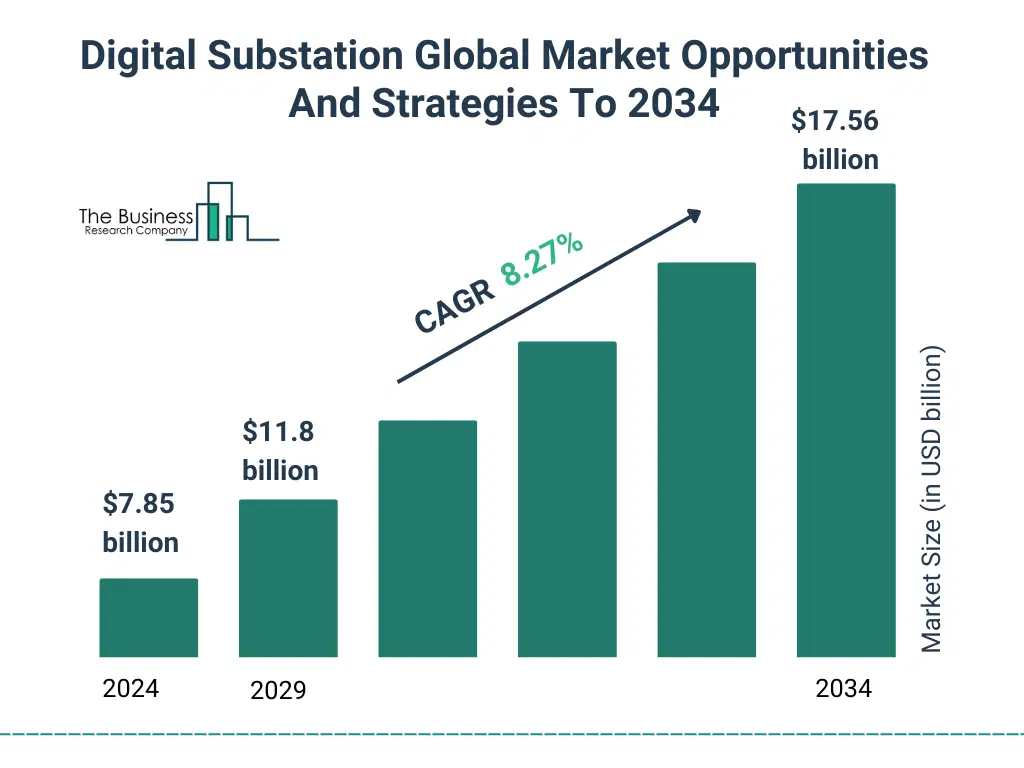
Digital Substation Market Size
The global digital substation market reached a value of nearly $7,854.50 million in 2024, having grown at a compound annual growth rate (CAGR) of 5.74% since 2019. The market is expected to grow from $7,854.50 million in 2024 to $11,803.55 million in 2029 at a rate of 8.49%. The market is then expected to grow at a CAGR of 8.27% from 2029 and reach $17,559.35 million in 2034. Growth in the historic period resulted from the growing investments in grid automation programs, rising electricity demand, expansion of smart city initiatives and integration of large-scale renewables. Factors that negatively affected growth in the historic period were shortage of skilled professionals and cybersecurity concerns. Going forward, the increasing cross-border energy trade, expansion in EV charging infrastructure, shift from conventional to smart substations and demand for real-time grid monitoring and automation will drive the growth. Factors that could hinder the growth of the digital substation market in the future include integration and infrastructure challenges, high upfront capital costs and impact of trade war and tariff.Digital Substation Market Drivers
The key drivers of the digital substation market include: Demand For Real-Time Grid Monitoring And Automation During the forecast period, the demand for real-time grid monitoring and automation will propel the growth of the digital substation market. As the electrical grid becomes more complex with the integration of distributed energy resources (DERs), electric vehicles (EVs) and renewable energy sources, there is an increasing need for advanced systems that can provide real-time data analysis, fault detection and automated responses to grid disturbances. Digital substations equipped with advanced sensors, communication networks and control systems enable utilities to monitor grid conditions in real-time, optimize power flow and enhance system reliability and resilience. These capabilities are essential for maintaining grid stability and ensuring the efficient delivery of electricity to consumers. The digital substation market is set to experience significant growth during this period, driven by the increasing demand for real-time grid monitoring and automation to support the modernization of the electric grid. The demand for real-time grid monitoring and automation contribution during the forecast period in 2024 is 1.00%.Digital Substation Market Restraints
The key restraints on the digital substation market include: High Upfront Capital Costs High upfront capital costs are restricting the growth of the digital substation market during the forecast period. Digital substations require significant investment in advanced technologies, including automation systems, communication networks and protection devices. These initial costs can be a barrier for utilities, especially in regions with limited budgets or competing infrastructure priorities. Moreover, the complexity of integrating these technologies into existing infrastructure adds to the financial burden. As a result, utilities may delay or scale back digital substation projects, opting for traditional substations that require lower initial investment. Consequently, high upfront capital costs are slowing the adoption of digital substations and limiting market expansion, particularly in areas where budget constraints are more pronounced. Growth affected by high upfront capital costs during the forecast period in 2024 is -2.06%.Digital Substation Market Trends
Major trends shaping the digital substation market include: Next-Generation Smart Metering Platforms Drive Real-Time Grid Intelligence And Sustainability Companies operating in the digital substation market are collaborating to introduce next-generation smart metering platforms that enhance real-time visibility and predictive grid management, enabling utilities to improve fault detection, optimize energy use and support the transition to more sustainable grid operations. For instance, in April 2025, Chugoku Electric Power, a Japan-based electric utility company, has partnered with Sense, a US-based grid edge intelligence firm, to develop and launch a high-resolution smart metering platform in Japan. This collaboration aims to develop advanced smart meters capable of processing data at up to 1MHz, enabling utilities to detect issues such as object-on-wire and arc faults in real time. The platform AMI 2.0, will incorporate distributed processing and real-time networking, creating a sensing, computing and control system tailored for Japan's modern electric grid. The partnership involves localizing Sense's software and developing retrofit sensors with chips able to handle high-resolution data for the Japanese market. These smart meters will enhance grid visibility, support demand response and power forecasting and provide consumers with personalized insights to save energy and costs. Deployment of Fully Digital Substations with Fiber-Optic Connectivity, Real-Time Monitoring and Smart Control Key companies are accelerating the deployment of fully digital substations that employ fiber-optic communication, intelligent monitoring and advanced control devices. These innovations respond to the demands of modern grids: integrating renewables, improving fault detection, lowering maintenance overhead and improving reliability. For instance, in June 2024, Bharat Heavy Electricals Ltd (BHEL), an India-based largest engineering and manufacturing company, commissioned its first digital substation in India using 420 kV Fibre-Optical Current Transformers (FOCTs) and IEC 61850-compliant Intelligent Electronic Devices (IEDs). This substation uses fiber-optic sensing for current measurement, standardized digital communication to facilitate data exchange among protection/control devices and enables condition-based monitoring. Essential features include real-time status monitoring, minimized cabling via fiber optics (which reduces signal distortion and electromagnetic interference), quicker fault detection and response and smoother integration into wider network control systems.Opportunities And Recommendations In The Digital Substation Market
Opportunities – The top opportunities in the digital substation markets segmented by voltage level will arise in the medium voltage segment, which will gain $1,831.20 million of global annual sales by 2029. The top opportunities in the digital substation markets segmented by type will arise in the distribution segment, which will gain $2,420.37 million of global annual sales by 2029. The top opportunities in the digital substation markets segmented by module will arise in the hardware segment, which will gain $1,964.15 million of global annual sales by 2029. The top opportunities in the digital substation markets segmented by industry vertical will arise in the power generation segment, which will gain $2,013.05 million of global annual sales by 2029. The top opportunities in the digital substation markets segmented by equipment type will arise in the intelligent electronic devices (IEDs) segment, which will gain $1,204.27 million of global annual sales by 2029. The digital substation market size will gain the most in China at $810.75 million. Recommendations- To take advantage of the opportunities, The Business Research Company recommends the digital substation companies to focus on high-resolution sensing and real-time grid intelligence, focus on scaling digital substation capabilities through fiber-optic systems and standardized controls, focus on integrated multifunction digital substation devices, focus on software-defined automation and grid resilience to drive adoption, focus on advanced protection relay enhancements and remote capability expansion, focus on integrated digital twin deployment and performance optimization, focus on high voltage digital substation solutions, focus on transmission segment expansion, focus on accelerating growth in the SCADA segment, focus on power generation opportunities, focus on SCADA systems segment to capture highest growth potential, expand in emerging markets, focus on expanding distribution channels, focus on strategic price structures to strengthen value and adoption, integrated promotion to strengthen market visibility and trust, targeted promotion to accelerate buyer decision cycles and scale adoption and focus on strengthening workforce capabilities to build trust with end users.
Digital Substation Market Segmentation
The digital substation market is segmented by voltage level, by type, by module, by industry vertical and by equipment type.By Voltage level –
The digital substation market is segmented by voltage level into:
- a) Low Voltage
- b) Medium Voltage
- c) High Voltage
By Type –
The digital substation market is segmented by type into:
- a) Transmission
- b) Distribution
By Module –
The digital substation market is segmented by module into:
- a) Fiber Optics Communication Network
- b) Supervisory Control And Data Acquisition
- c) Hardware
By Industry Vertical –
The digital substation market is segmented by industry vertical into:
- a) Power Generation
- b) Metal And Mining
- c) Oil And Gas
- d) Transportation And Logistics
- e) Defense And Aerospace
- f) Process And Manufacturing
- g) Other Industry Verticals
By Equipment Type –
The digital substation market is segmented by equipment type into:
- a) Intelligent Electronic Devices (IEDs)
- b) Digital Relays
- c) Merging Units (MUs)
- d) Phasor Measurement Units (PMUs)
- e) Scada Systems
- f) Remote Terminal Units (RTUs)
- g) Communication Systems
- h) Other Equipment Types
By Geography - The digital substation market is segmented by geography into:
- • China
- • India
- • Japan
- • Australia
- • Indonesia
- • South Korea
- • USA
- • Canada
- • Brazil
- • France
- • Germany
- • UK
- • Italy
- • Spain
- • Russia
-
o Asia Pacific
o Africa