

Digital Twin For Aero Engines Market Report 2026
Global Outlook – By Component (Software, Services), By Engine Type (Turbofan Engines, Turboprop Engines, Turboshaft Engines, Turbojet Engines), By Deployment Mode (Cloud-Based, On-Premises, Hybrid Cloud), By Application (Engine Design And Development, Predictive Maintenance, Performance Monitoring, Fleet Management, Maintenance Repair And Overhaul), By End User (Commercial Aviation, Military And Defense, Original Equipment Manufacturers, Maintenance Repair And Overhaul Providers) – Market Size, Trends, Strategies, and Forecast to 2030
Digital Twin For Aero Engines Market Overview
• Digital Twin For Aero Engines market size has reached to $1.7 billion in 2025 • Expected to grow to $6.46 billion in 2030 at a compound annual growth rate (CAGR) of 30.5% • Growth Driver: Expansion Of Commercial Aircraft Fleets Fueling The Growth Of The Market Due To Increasing Demand For Real-Time Engine Monitoring And Predictive Maintenance • Market Trend: Advancements In Digital Twin Technology Enhance Real-Time Aero Engine Health Monitoring And Predictive Maintenance • North America was the largest region in 2025 and Asia-Pacific is the fastest growing region.What Is Covered Under Digital Twin For Aero Engines Market?
A digital twin for aero engines is a virtual representation of a physical aircraft engine that mirrors its behavior and condition using real-time operational data and engineering models. It enables continuous simulation, analysis, and optimization of engine performance throughout its lifecycle. A digital twin for aero engines helps improve reliability, efficiency, and operational decision-making by providing a dynamic digital counterpart of the engine. The main components of digital twin for aero engines include software and services. Software refers to digital solutions that create virtual representations of aero engines to simulate, monitor, and analyze engine performance and operational conditions. These solutions are used for turbofan engines, turboprop engines, turboshaft engines, and turbojet engines, and are deployed through cloud-based, on-premises, and hybrid cloud modes. The key applications include engine design and development, predictive maintenance, performance monitoring, fleet management, and maintenance repair and overhaul, while the end-users include commercial aviation, military and defense, original equipment manufacturers, and maintenance repair and overhaul providers.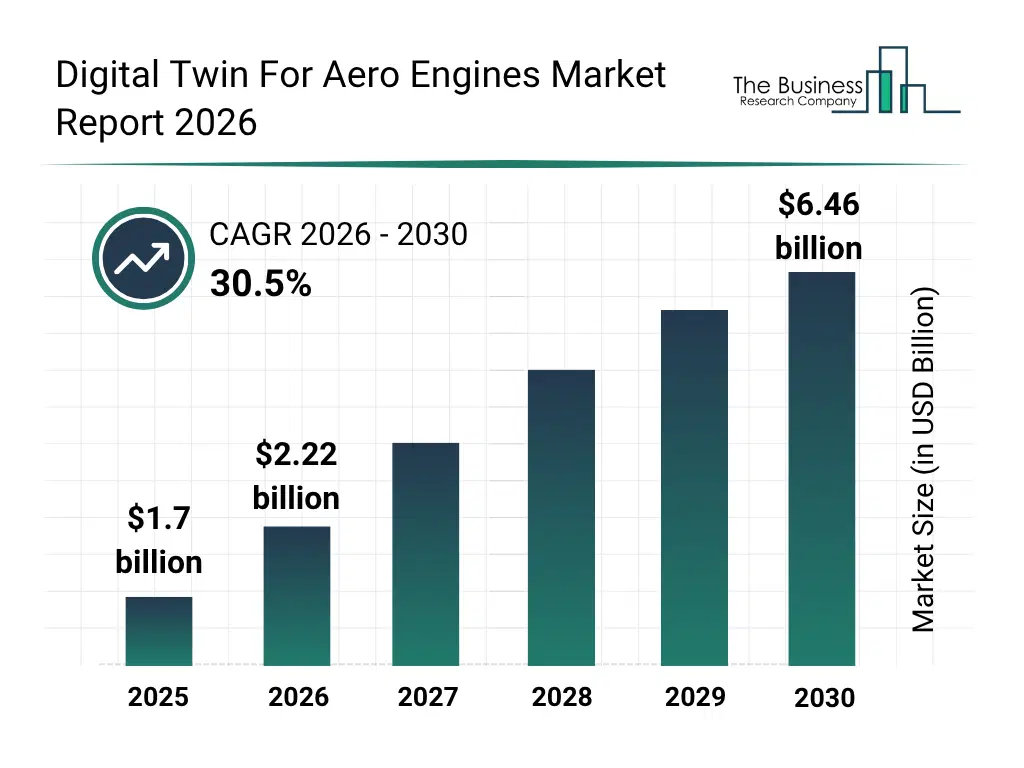
What Is The Digital Twin For Aero Engines Market Size and Share 2026?
The digital twin for aero engines market size has grown exponentially in recent years. It will grow from $1.7 billion in 2025 to $2.22 billion in 2026 at a compound annual growth rate (CAGR) of 31.0%. The growth in the historic period can be attributed to increasing demand for aircraft engine reliability, growing complexity of aero-engine systems, rising aircraft fleet utilization, increasing emphasis on predictive maintenance, higher demand for engine performance optimization.What Is The Digital Twin For Aero Engines Market Growth Forecast?
The digital twin for aero engines market size is expected to see exponential growth in the next few years. It will grow to $6.46 billion in 2030 at a compound annual growth rate (CAGR) of 30.5%. The growth in the forecast period can be attributed to expansion of digital twin applications across engine lifecycle stages, increasing demand for real-time engine health assessment, growing adoption of virtual engine testing, rising need for fleet-level engine performance insights, increasing integration of digital twins with MRO workflows. Major trends in the forecast period include increasing adoption of physics-based engine modeling, growing focus on digital twin validation and certification, expansion of engine-specific digital twin customization, increasing use of digital twins across engine design verification, broader adoption of lifecycle-based engine performance simulation.Tariff Impact On Digital Twin For Aero Engines Market
Tariffs are impacting the digital twin for aero engines market by increasing the cost of imported computing hardware, sensors, data acquisition equipment, and semiconductor-based components required for digital twin development and deployment. This is raising implementation costs and potentially slowing adoption among aerospace OEMs and MRO providers, particularly in regions dependent on imported technology such as Asia-Pacific and Europe. Hardware-intensive applications such as real-time engine monitoring, simulation platforms, and predictive maintenance solutions are most affected due to global supply chain dependencies. However, tariffs are also encouraging local technology development, supplier diversification, and investment in domestic aerospace digital infrastructure, creating greater long-term resilience in the market.
Global Digital Twin For Aero Engines Market Segmentation
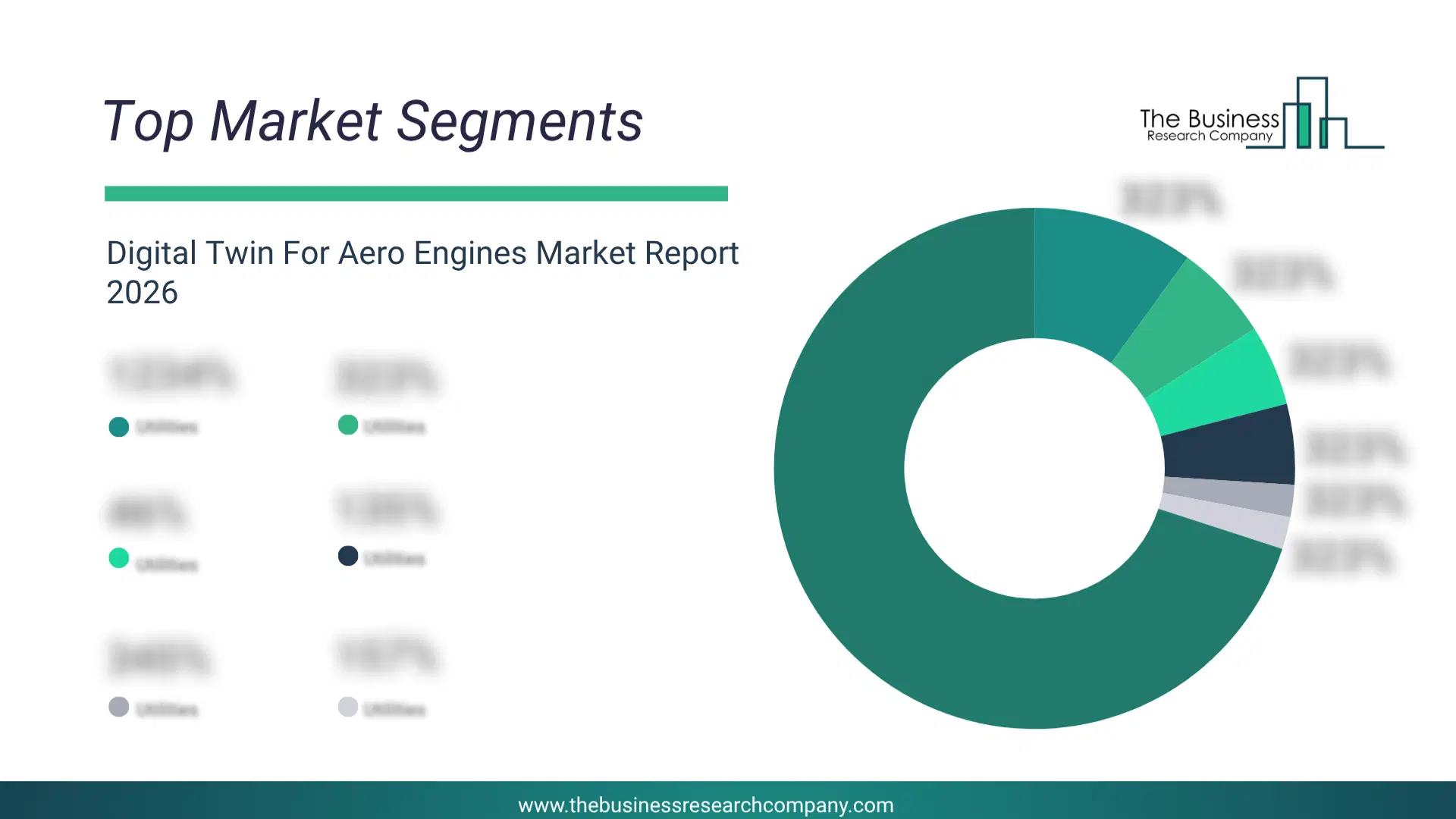
1) By Component: Software, Services 2) By Engine Type: Turbofan Engines, Turboprop Engines, Turboshaft Engines, Turbojet Engines 3) By Deployment Mode: Cloud-Based, On-Premises, Hybrid Cloud 4) By Application: Engine Design And Development, Predictive Maintenance, Performance Monitoring, Fleet Management, Maintenance Repair And Overhaul 5) By End User: Commercial Aviation, Military And Defense, Original Equipment Manufacturers, Maintenance Repair And Overhaul Providers Subsegments: 1) By Software: Digital Twin Platform Software, Simulation And Modeling Software, Predictive Analytics Software, Engine Performance Monitoring Software 2) By Services: Consulting Services, Implementation And Integration Services, Training Services, Maintenance And Support ServicesWhat Is The Driver Of The Digital Twin For Aero Engines Market?
The expansion of commercial aircraft fleets worldwide is expected to propel the growth of the digital twin for the aero-engine market going forward. Commercial aircraft fleets comprise the aircraft operated by airlines for passenger and cargo transportation across domestic and international routes. The expansion of commercial aircraft fleets is increasing due to the sustained growth in global air travel demand and the need for airlines to enhance operational capacity and fleet efficiency. The expansion of commercial aircraft fleets supports digital twins for aero engines by generating continuous operational and performance data that enables real-time engine monitoring, predictive maintenance, and lifecycle optimization. For instance, in August 2025, according to the International Air Transport Association (IATA), a Canada-based nonprofit organization, the global commercial fleet comprised 35,550 aircraft, including 30,300 active aircraft, resulting in continued fleet expansion over the coming years to meet rising air travel demand. Therefore, the expansion of commercial aircraft fleets worldwide is driving the growth of the digital twin for the aero-engine market.Key Players In The Global Digital Twin For Aero Engines Market
Major companies operating in the digital twin for aero engines market are Microsoft Corporation, Amazon Web Services Inc, NVIDIA Corporation, International Business Machines Corporation, Accenture plc, Rolls-Royce plc, Dassault Systèmes SE, Capgemini SE, Infosys Limited, HCL Technologies Limited, Hexagon AB, Cadence Design Systems Inc, PTC Inc, The MathWorks Inc, Aras Corporation, Maya HTT Ltd, Siemens AG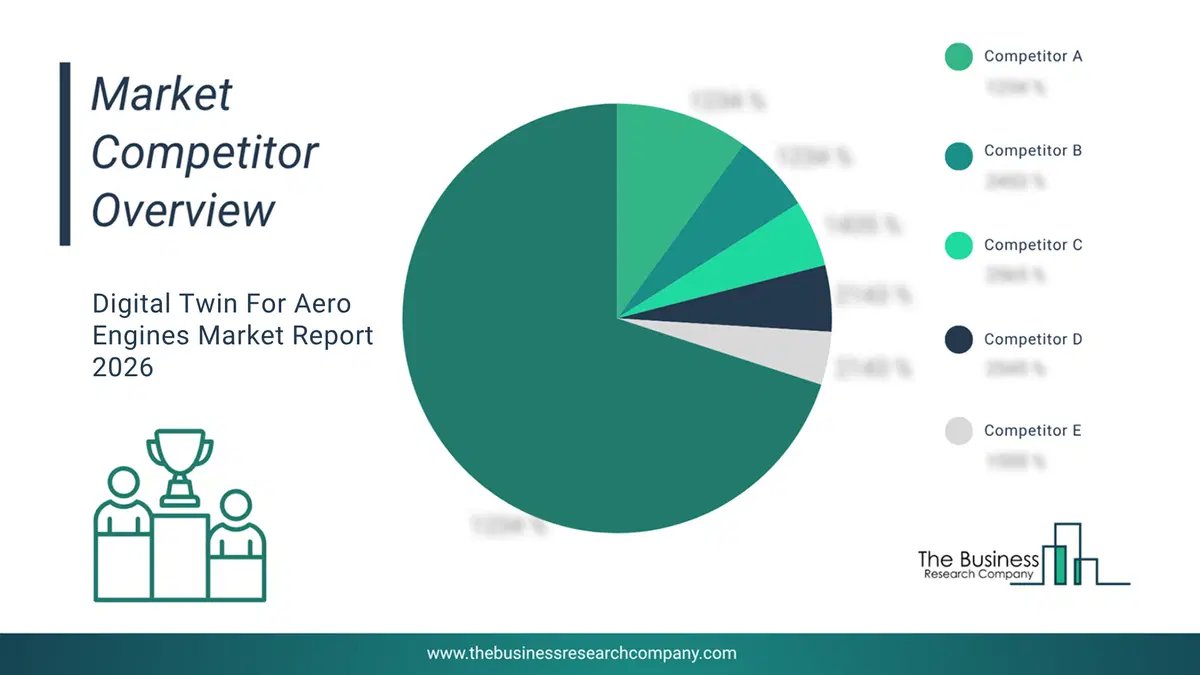
This chart is for illustrative purposes; the full report includes a detailed competitor analysis and comprehensive overview of the top 10 companies in the market.
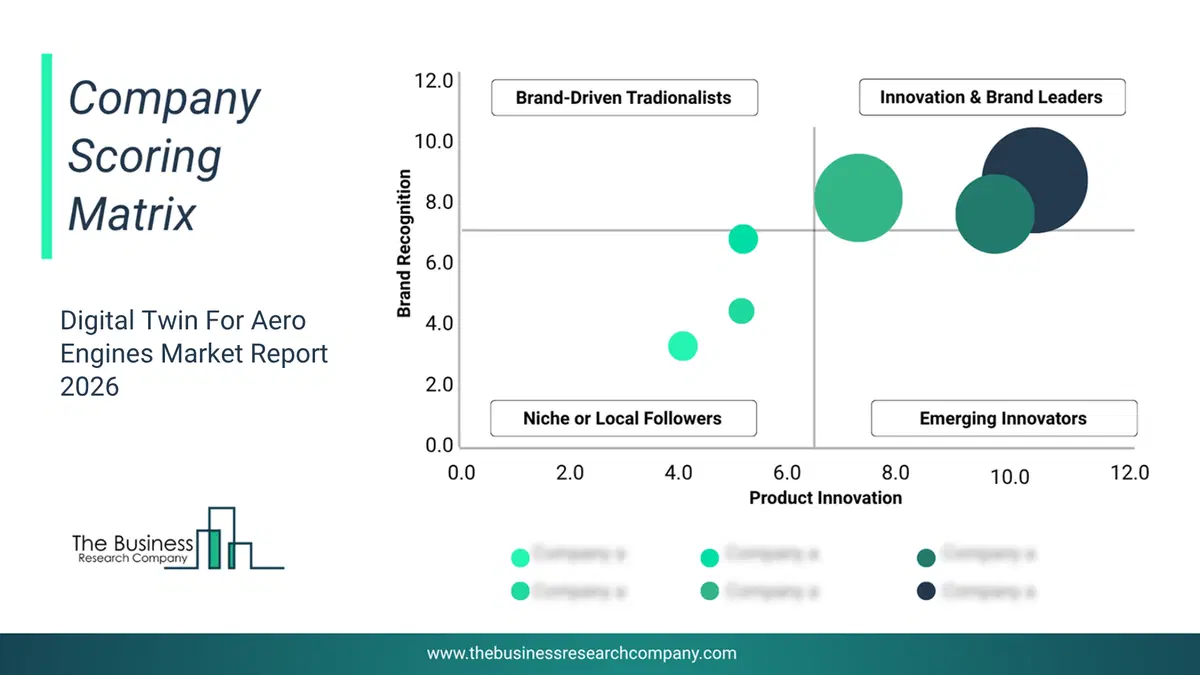
This chart maps companies by product innovation and brand strength, with bubble size indicating relative revenue, helping identify market leaders, challengers, and niche players. This is an illustrative chart; the full report provides a complete and accurate competitive analysis.
Global Digital Twin For Aero Engines Market Trends and Insights
Major companies operating in the digital twin for the aero engine market are focusing on developing advanced solutions, such as physics-informed digital twins, to enhance real-time engine health monitoring, predict potential failures, improve flight safety, and reduce maintenance turnaround time. Physics-informed digital twins are virtual replicas that combine real-time operational data with physics-based models to simulate, monitor, and predict the performance and potential failures of physical systems. For instance, in August 2026, a four-member student team from the National Institute of Technology Karnataka (NITK), Surathkal, an India-based engineering and research institution, won Aerothon 2026, a national aerospace hackathon organized by Hindustan Aeronautics Limited (HAL) and IIT Indore, by developing a “Physics-Informed Digital Twin for Real-Time Four-Stage Turbojet Health Monitoring.” The solution processes real-time sensor data from a turbojet engine and uses machine learning to predict specific engine failure modes before they occur, supporting improved flight safety and reduced turnaround time for engine manufacturers, maintenance providers, and airlines.What Are Latest Mergers And Acquisitions In The Digital Twin For Aero Engines Market?
In March 2025, Siemens AG, a Germany-based technology company, completed the acquisition of Altair Engineering Inc. for an enterprise value of approximately $10 billion. Through this acquisition, Siemens aims to enhance its digital twin capabilities by integrating Altair’s simulation, high-performance computing, data science, and artificial intelligence technologies into the Siemens Xcelerator platform, strengthening digital engineering and simulation capabilities for complex products and systems. Altair Engineering Inc. is a US-based software company that provides digital twin solutions applicable to aero engines.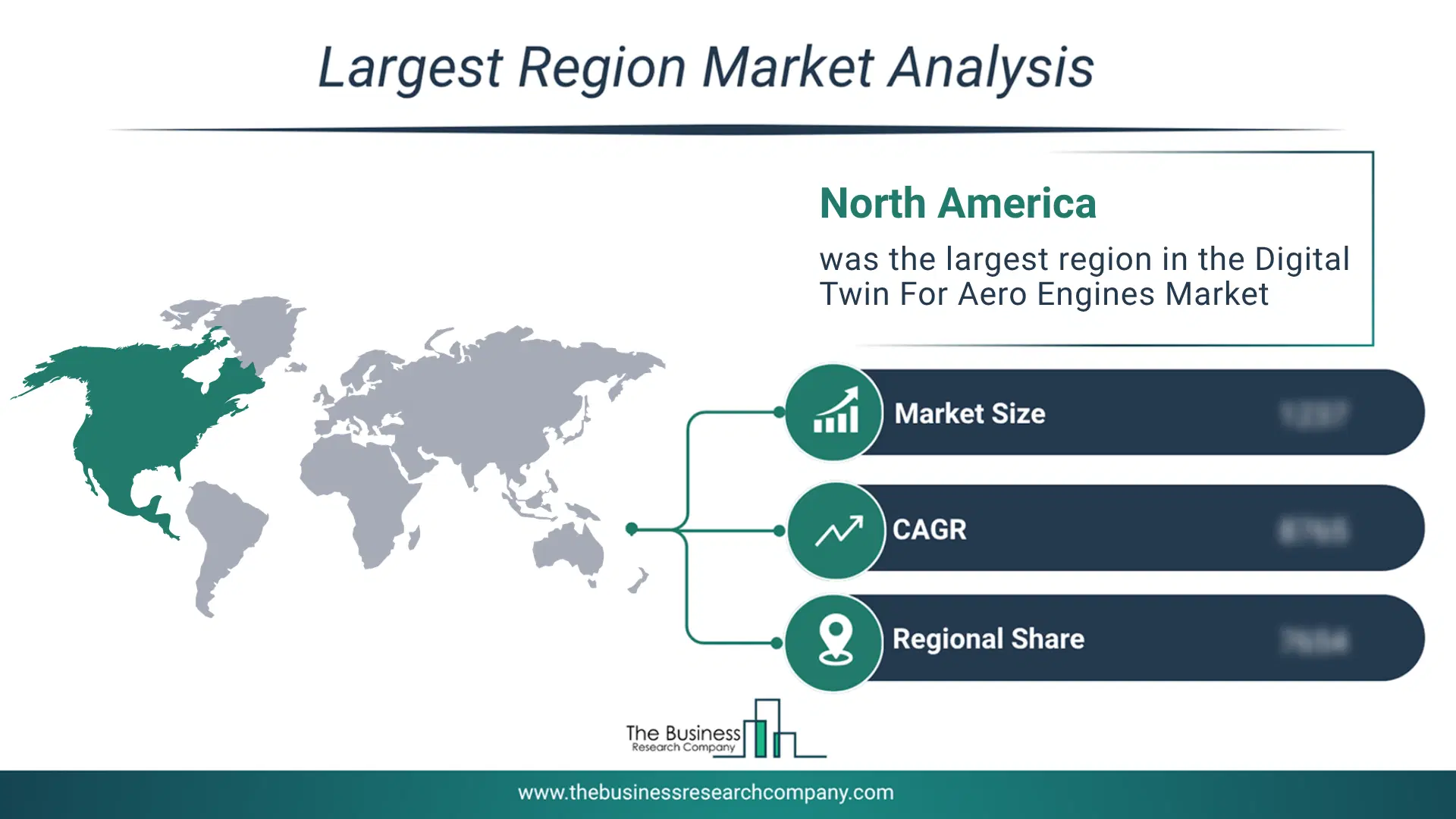
Regional Outlook
North America was the largest region in the digital twin for aero engines market in 2025. Asia-Pacific is expected to be the fastest-growing region in the forecast period. The regions covered in this market report are Asia-Pacific, South East Asia, Western Europe, Eastern Europe, North America, South America, Middle East, Africa. The countries covered in this market report are Australia, Brazil, China, France, Germany, India, Indonesia, Japan, Taiwan, Russia, South Korea, UK, USA, Canada, Italy, Spain.What Defines the Digital Twin For Aero Engines Market?
The digital twin for aero engines market consists of revenues earned by entities by providing services such as engine health diagnostics, virtual testing and simulation, failure analysis and root cause investigation, lifecycle optimization, and operational decision support. The market value includes the value of related goods sold by the service provider or included within the service offering. Only goods and services traded between entities or sold to end consumers are included.How is Market Value Defined and Measured?
The market value is defined as the revenues that enterprises gain from the sale of goods and/or services within the specified market and geography through sales, grants, or donations in terms of the currency (in USD unless otherwise specified). The revenues for a specified geography are consumption values that are revenues generated by organizations in the specified geography within the market, irrespective of where they are produced. It does not include revenues from resales along the supply chain, either further along the supply chain or as part of other products.
This chart presents market attractiveness based on a quantitative evaluation of growth, competition, strategic alignment, and risk, offering a clear view of opportunity areas for decision-making. This chart is for illustrative purposes; the full report contains the complete analysis.

This chart highlights the Total Addressable Market (TAM) by estimating the maximum revenue opportunity using an assumption-driven approach, supporting strategic planning and opportunity sizing across markets. The chart is illustrative; the full report provides a more comprehensive analysis.
What Key Data and Analysis Are Included in the Digital Twin For Aero Engines Market Report 2026?
The digital twin for aero engines market research report is one of a series of new reports from The Business Research Company that provides market statistics, including industry global market size, regional shares, competitors with the market share, detailed market segments, market trends and opportunities, and any further data you may need to thrive in the digital twin for aero engines industry. The market research report delivers a complete perspective of everything you need, with an in-depth analysis of the current and future state of the industry.Digital Twin For Aero Engines Market Report Forecast Analysis
| Report Attribute | Details |
|---|---|
| Market Size Value In 2026 | $2.22 billion |
| Revenue Forecast In 2030 | $6.46 billion |
| Growth Rate | CAGR of 30.5% from 2026 to 2030 |
| Base Year For Estimation | 2025 |
| Actual Estimates/Historical Data | 2020-2025 |
| Forecast Period | 2026 - 2030 |
| Market Representation | Revenue in USD Billion and CAGR from 2026 to 2030 |
| Segments Covered | Component, Engine Type, Deployment Mode, Application, End User |
| Regional Scope | Asia-Pacific, Western Europe, Eastern Europe, North America, South America, Middle East, Africa |
| Country Scope | The countries covered in the report are Australia, Brazil, China, France, Germany, India, Indonesia, Japan, Taiwan, Russia, South Korea, UK, USA, Canada, Italy, Spain. |
| Key Companies Profiled | Microsoft Corporation, Amazon Web Services Inc, NVIDIA Corporation, International Business Machines Corporation, Accenture plc, Rolls-Royce plc, Dassault Systèmes SE, Capgemini SE, Infosys Limited, HCL Technologies Limited, Hexagon AB, Cadence Design Systems Inc, PTC Inc, The MathWorks Inc, Aras Corporation, Maya HTT Ltd, Siemens AG |
| Customization Scope | Request for Customization |
| Pricing And Purchase Options | Explore Purchase Options |