

Digital Twin Market Report 2026
Global Outlook – By Type (Product Digital Twin, Process Digital Twin, System Digital Twin), By Technology (IoT, Blockchain, Artificial Intelligence and Machine Learning, Extended Reality and Other Technology, Big Data Analytics), By Application (Manufacturing, Energy and Power, Aerospace, Automotive, Transportation, Other Applications) – Market Size, Trends, Strategies, and Forecast to 2030
Digital Twin Market Overview
• Digital Twin market size has reached to $28.9 billion in 2025 • Expected to grow to $122.24 billion in 2030 at a compound annual growth rate (CAGR) of 32.4% • Growth Driver: Healthcare Sector's Influence On The Growing Demand For Digital Twins In The Market • Market Trend: Innovations In Hydrogen Digital Twin Technology • North America was the largest region in 2025 and Asia-Pacific is the fastest growing region.Market Gains By 2030 – Top Opportunities By Segment
Market Gain identifies the most promising market opportunities by highlighting the segments or products expected to generate the highest incremental revenue growth over the next five years.
What Is Covered Under Digital Twin Market?
The digital twin refers to a digital virtual representation of an object or system that spans its lifecycle, is updated from real-time data, and assists decision-making via simulation, machine learning, and reasoning. It will assist engineers and operators in understanding not only how items currently work, but also how they will perform in the future. This software or solution can create these predictions by analyzing data from linked sensors and combining it with information from other sources. The main types of digital twins include product digital twins, process digital twins, and system digital twins. The product digital twin is used as a virtual version of a real product or process to understand and predict the performance characteristics of the physical equivalent. These solutions bring together data from all stages of the product and manufacturing lifecycles. The technologies used in digital twins include IoT and IIoT, artificial intelligence and machine learning, extended reality and other technology, big data analytics, and 5g. The applications of digital include manufacturing, energy & power, aerospace, oil & gas, automobile, transportation, and other applications.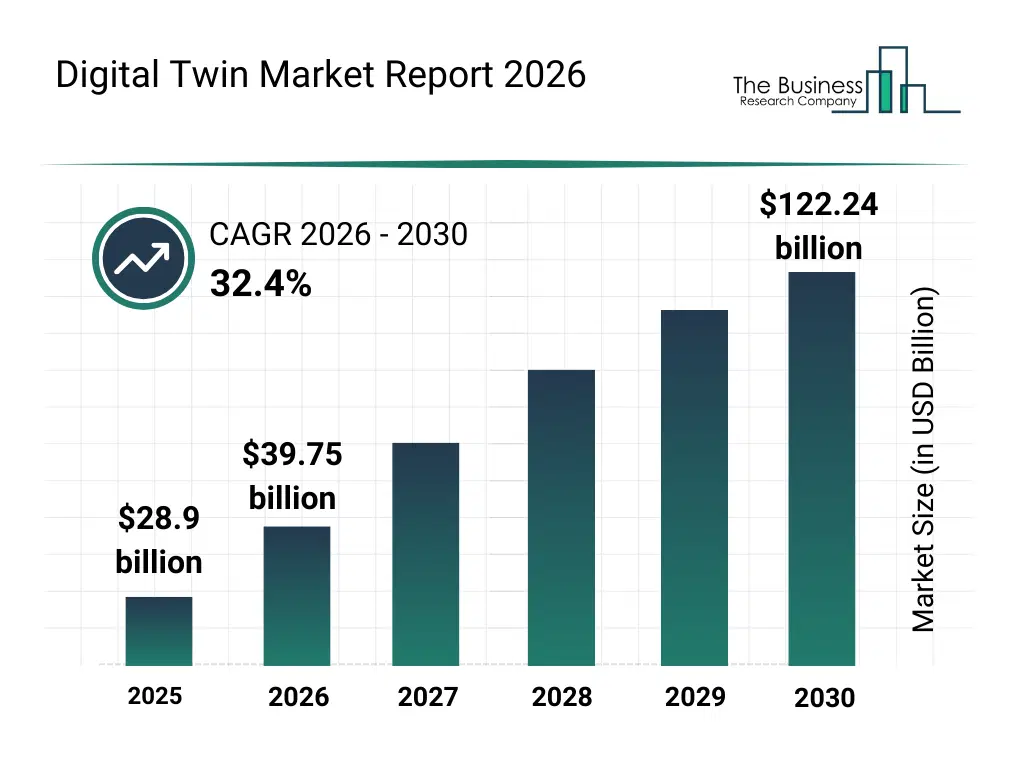
What Is The Digital Twin Market Size and Share 2026?
The digital twin market size has grown exponentially in recent years. It will grow from $28.9 billion in 2025 to $39.75 billion in 2026 at a compound annual growth rate (CAGR) of 37.6%. The growth in the historic period can be attributed to adoption of industrial iot, need for asset performance optimization, growth of simulation software, expansion of connected sensors, increasing system complexity.What Is The Digital Twin Market Growth Forecast?
The digital twin market size is expected to see exponential growth in the next few years. It will grow to $122.24 billion in 2030 at a compound annual growth rate (CAGR) of 32.4%. The growth in the forecast period can be attributed to integration of AI driven simulations, expansion of smart manufacturing, growth of infrastructure digitalization, adoption of 5G connectivity, rising demand for real time decision support. Major trends in the forecast period include real time asset simulation, predictive maintenance modeling, lifecycle performance optimization, integrated physical digital systems, virtual prototyping and testing.
Global Digital Twin Market Segmentation
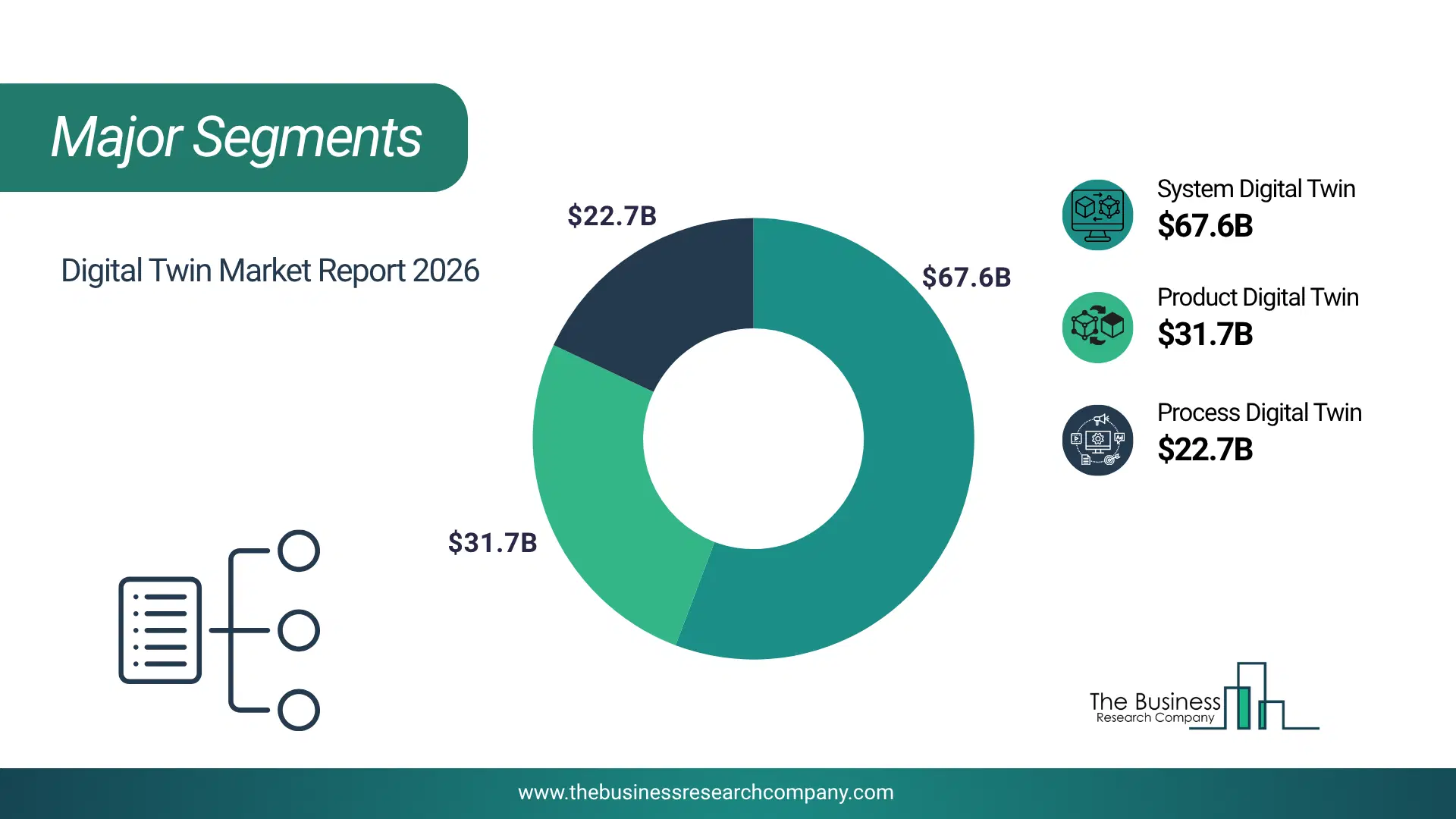
1) By Type: Product Digital Twin, Process Digital Twin, System Digital Twin 2) By Technology: IoT, Blockchain, Artificial Intelligence and Machine Learning, Extended Reality and Other Technology, Big Data Analytics 3) By Application: Manufacturing, Energy and Power, Aerospace, Automotive, Transportation, Other Applications Subsegments: 1) By Product Digital Twin: Virtual Prototyping, Performance Monitoring, Lifecycle Management 2) By Process Digital Twin: Workflow Simulation, Process Optimization, Predictive Maintenance 3) By System Digital Twin: Infrastructure Modeling, Network Performance Analysis, Integrated System Simulation The top segments in the digital twin market will be: • System Digital Twin will reach $67.5 billion by 2030. • Product Digital Twin will reach $31.65 billion by 2030. • Process Digital Twin will reach $22.63 billion by 2030.What Is The Driver Of The Digital Twin Market?
The increasing demand for digital twins in healthcare is expected to drive the digital twin market during the forecast period. The digital twin is used in healthcare systems to create digital representations of healthcare data, including hospital surroundings, lab findings, human physiology, and others. It analyses operational tactics, resource allocation, staffing, and care models, by creating a virtual model of the healthcare facilities to identify problem areas, anticipate upcoming difficulties, and enhance organizational tactics. Major healthcare players are adopting digital twins to gain operational efficiency. For instance, in January 2025, according to Deloitte Touche Tohmatsu Limited, a UK-based software company, about 70% of respondents view investing in digital tools and platforms as vital, 60% prioritize core technologies like EMRs and ERP, and nearly 90% of C-suite executives expect digital technology adoption to accelerate in 2025. Thus, the increasing demand for digital twins in healthcare will propel the growth of the digital twin industry during the forecast period.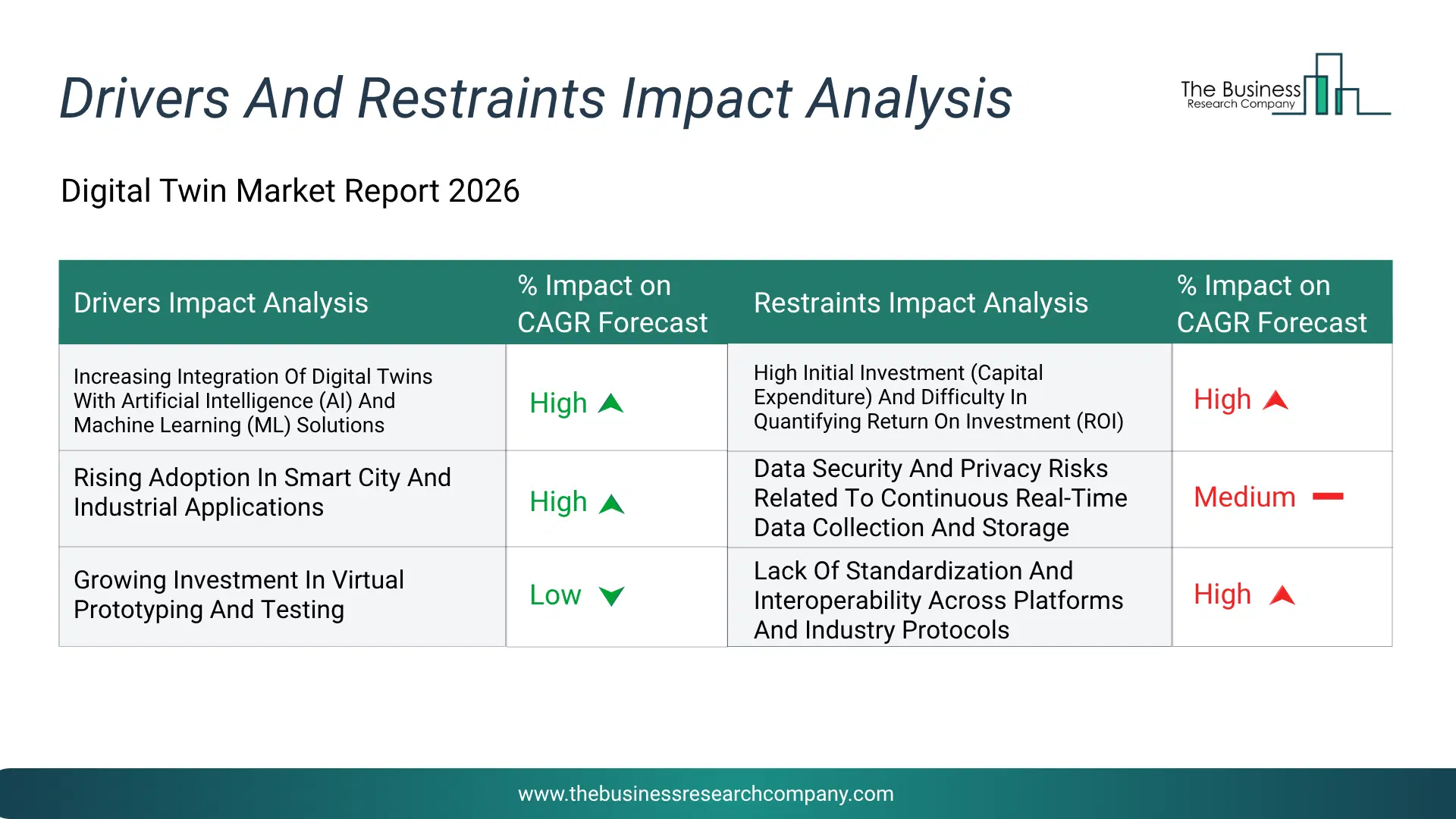
Infographic Chart Showing Key Market Drivers Analysis And Restraints For Digital Twin Market
The chart presents an impact analysis of key drivers and restraints, quantifying their relative influence on the market's growth rate and helping assess the balance between growth enablers and limiting factors. This chart offers a high-level perspective; the full report contains more detailed insights.
How Will The Drivers Impact Growth In The Global Digital Twin Market?
• Increasing Integration Of Digital Twins With Artificial Intelligence (AI) And Machine Learning (ML) Solutions (High) – During the forecast period, the increasing integration of digital twins with artificial intelligence (ai) and machine learning (ml) solutions is expected to become a major growth driver for the digital twin market by 2030. The integration of ai and ml significantly strengthens the analytical capabilities of digital twin platforms. These technologies enable predictive insights, anomaly detection, and automated decision -making, making digital twins more intelligent and adaptive. This enhances operational efficiency and minimizes downtime across industries such as manufacturing, healthcare, and energy. As organizations increasingly pursue intelligent and data -driven operational systems, the demand for ai -enabled digital twin solutions continues to expand. This technological convergence further accelerates market growth by broadening the scope of applications and enhancing the overall value proposition. • Rising Adoption In Smart City And Industrial Applications (High) – During the forecast period, the rising adoption in smart city and industrial applications is expected to emerge as a major factor driving the expansion of the digital twin market by 2030. The increasing implementation of digital twins in smart city and industrial environments is acting as a key catalyst for market growth. Governments and enterprises are leveraging digital twin technology to monitor infrastructure, manage utilities, optimize traffic management systems, and improve industrial production processes. These applications enhance resource efficiency, safety, and sustainability while lowering operational costs. As global urbanization and industrial automation continue to expand, the demand for real-time virtual models is increasing steadily. This widespread adoption across large-scale infrastructure and industrial projects continues to stimulate strong demand for digital twin technologies. • Growing Investment In Virtual Prototyping And Testing (Low) – During the forecast period, the growing investment in virtual prototyping and testing is expected to act as a key growth catalyst for the digital twin market by 2030. Increasing investment in digital simulation and virtual prototyping is significantly supporting the expansion of the digital twin market by reducing dependence on costly physical prototypes. Organizations are utilizing digital twins to simulate product designs, analyze performance, and detect potential issues before manufacturing begins. This approach shortens development cycles, reduces research and development costs, and accelerates time-to-market for new products. Industries such as automotive, aerospace, and electronics increasingly rely on digital simulations to drive product innovation. As companies prioritize cost efficiency and faster innovation processes, the adoption of digital twin technologies continues to grow.How Will The Restraints Impact Growth In The Global Digital Twin Market?
• High Initial Investment (Capital Expenditure) And Difficulty In Quantifying Return On Investment (ROI) (High) – During the forecast period, the high initial investment requirements act as a major restraint for the digital twin market, as organizations must allocate substantial capital for software platforms, sensors, cloud infrastructure, and system integration. The complexity of large-scale digital twin implementations further increases deployment and maintenance costs. Many enterprises, especially small and medium-sized businesses, hesitate due to uncertainty in measuring tangible returns. Difficulty in clearly quantifying roi slows decision-making and budget approvals. As a result, high upfront costs limit widespread adoption and delay market expansion. • Data Security And Privacy Risks Related To Continuous Real-Time Data Collection And Storage (Medium) – During the forecast period, the data security and privacy risks significantly restrain the digital twin market because these systems rely on continuous real-time data exchange across connected networks. Sensitive operational, industrial, and infrastructure data can become vulnerable to cyberattacks or unauthorized access. Concerns over intellectual property theft and regulatory non-compliance discourage organizations from fully deploying digital twin solutions. Industries handling critical infrastructure or confidential information remain particularly cautious. These cybersecurity challenges reduce trust and slow the pace of market adoption. • Lack Of Standardization And Interoperability Across Platforms And Industry Protocols (High) – During the forecast period, the lack of standardization and interoperability restricts the growth of the digital twin market by creating compatibility issues between diverse systems and platforms. Organizations often use heterogeneous devices, legacy software, and varied communication protocols that do not seamlessly integrate. The absence of unified industry standards increases integration time, operational complexity, and costs. This fragmentation limits scalability and cross-industry collaboration. Consequently, interoperability challenges hinder smooth implementation and act as a barrier to broader market penetration.Key Players In The Global Digital Twin Market
Major companies operating in the digital twin market are SAP SE; IBM Corporation; ANSYS Inc; Microsoft Corporation; General Electric; Siemens AG; Bentley Systems; Dassault Systèmes; ABB Ltd.; Oracle Corporation; PTC; TIBCO Software Inc; SAS Institute Inc; Bosch; Aveva Group; Amazon Web Services; FARO; Hexagon AB; Rockwell Automation; Schneider Electric; Altair Engineering; Cisco Systems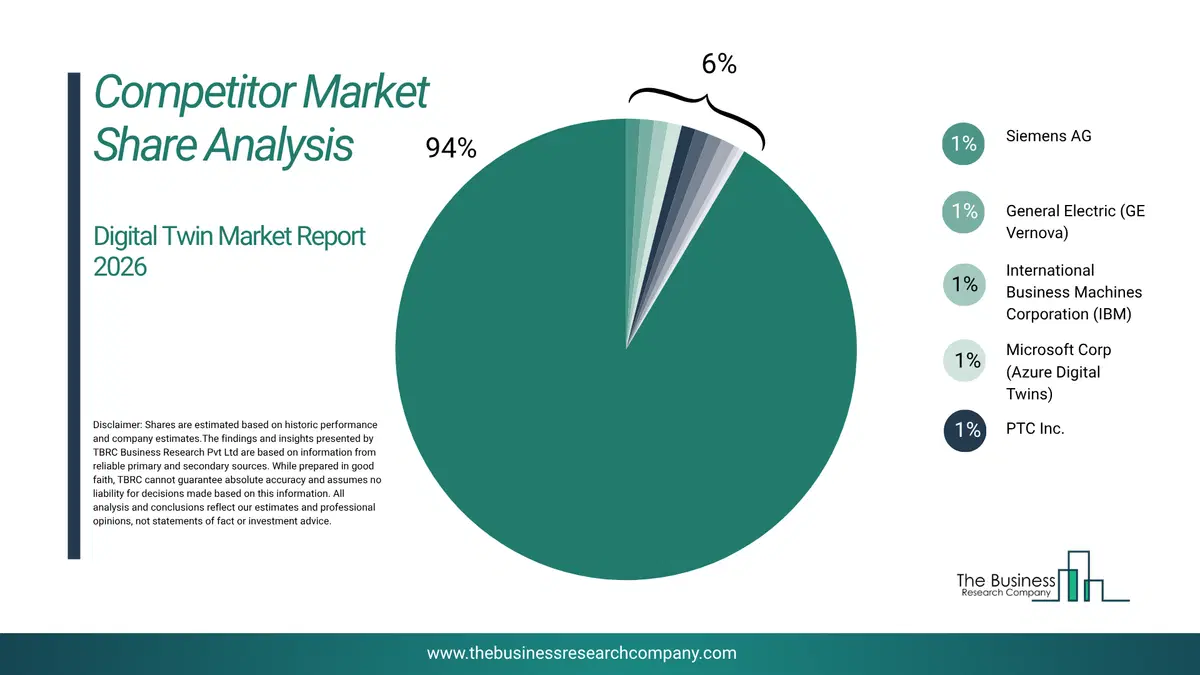
This chart is for illustrative purposes; the full report includes a detailed competitor analysis and comprehensive overview of the top 10 companies in the market.
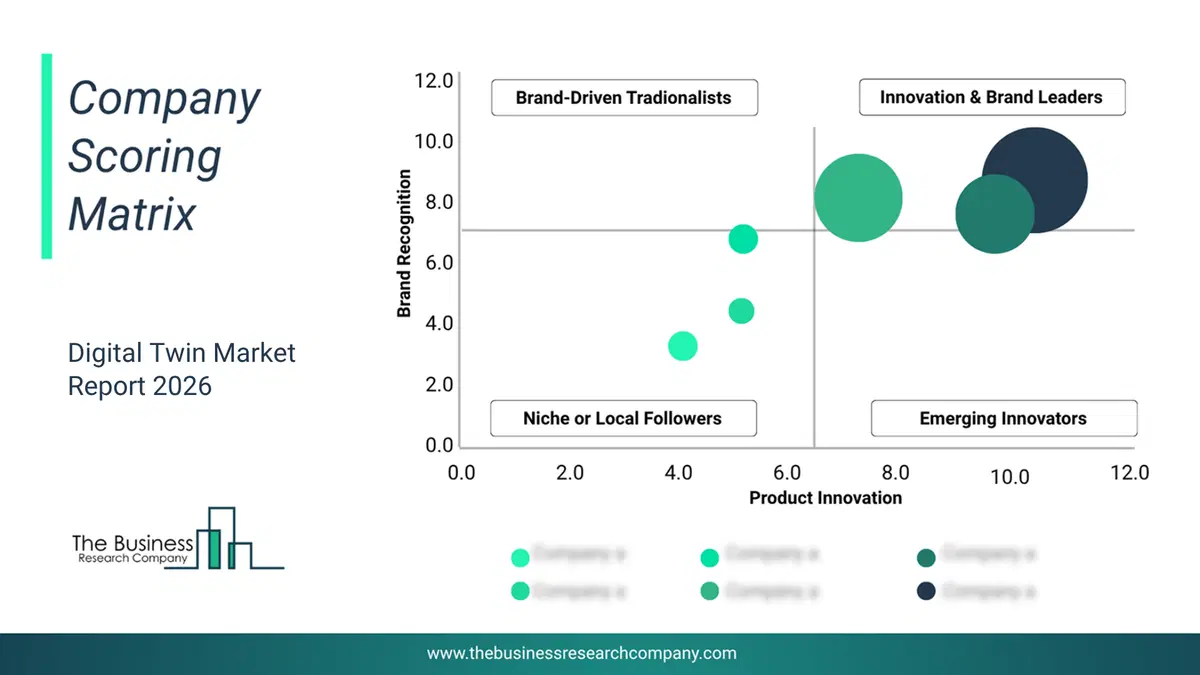
This chart maps companies by product innovation and brand strength, with bubble size indicating relative revenue, helping identify market leaders, challengers, and niche players. This is an illustrative chart; the full report provides a complete and accurate competitive analysis.
Global Digital Twin Market Trends and Insights
Major companies operating in the digital twin market are focusing on developing innovative technologies such as holistic simulation to enhance operational efficiency, optimize system performance, and enable more accurate predictive insights across complex processes. Holistic simulation refers to an integrated simulation approach that models an entire system to provide a realistic understanding of performance and support accurate outcome prediction and optimized decision making. For instance, in February 2025, Peaxy, Inc., a US-based software company, launched what it describes as the industry’s first Hydrogen Digital Twin, developed over seven years and now deployed for a large Fortune 200 client. This end-to-end solution models the full hydrogen value chain, from renewable power input through electrolyzers, compression, and storage, to optimize plant design, simulate operations, and generate key metrics like the levelized cost of hydrogen. It offers users an interactive 3D visualization of plant layouts, enables scenario analysis to refine equipment sizing and spatial configurations, and accelerates engineering and commissioning phases via physics-based simulation. By unifying system integration, cost modeling, and operational forecasting, the platform positions Peaxy at the forefront of digital tools for hydrogen project execution.What Are Latest Mergers And Acquisitions In The Digital Twin Market?
In September 2024, Bentley Systems, a US-based company specializing in software solutions, acquired Cesium for an undisclosed amount. His acquisition focuses on integrating Cesium's 3D geospatial visualization capabilities with Bentley's comprehensive portfolio, enabling more advanced modeling and analysis of infrastructure projects. Cesium is a US-based company that specializes in geospatial technology and digital twins.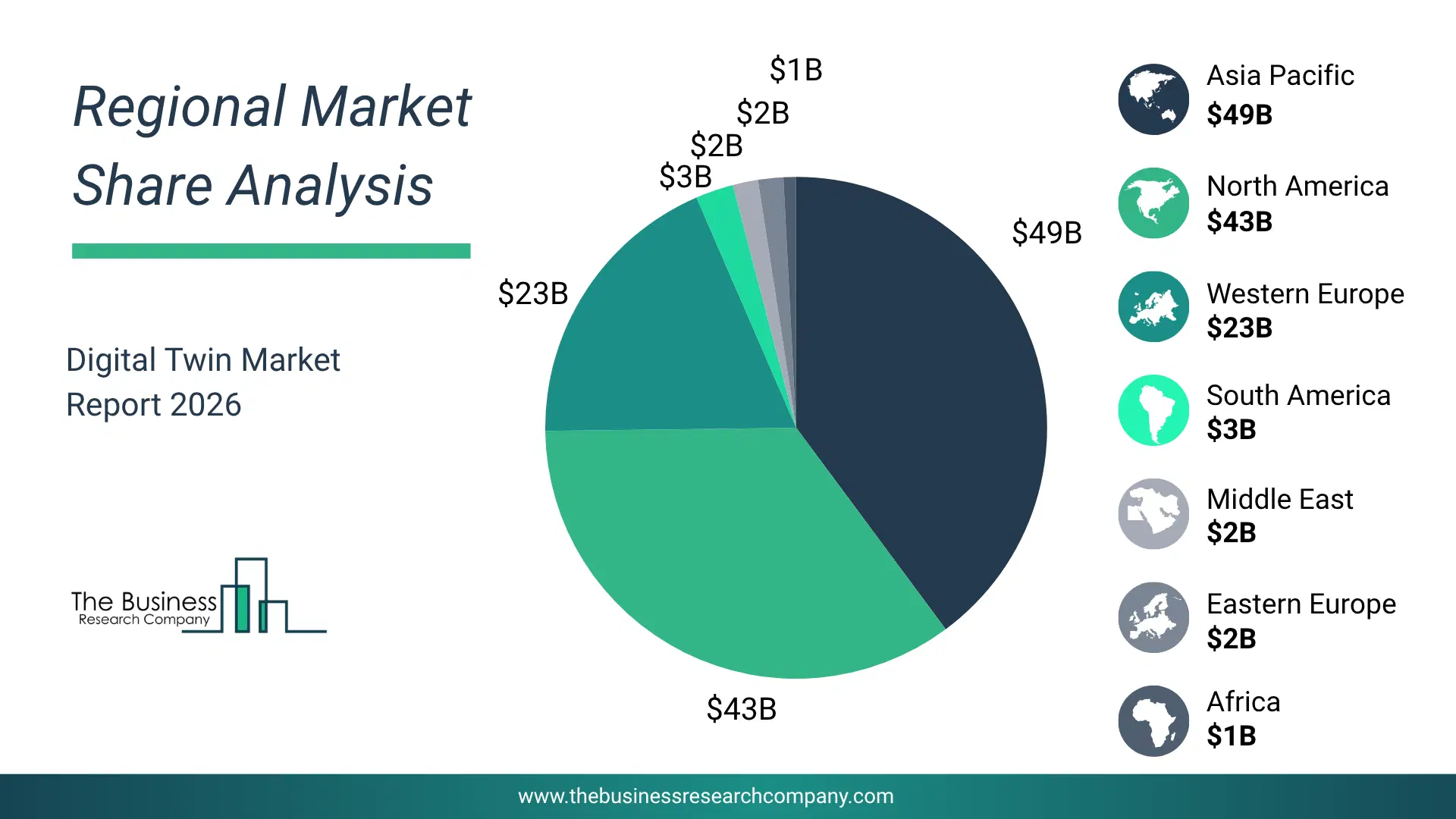
Regional Insights
North America was the largest region in the digital twin market in 2025. Asia-Pacific is expected to be the fastest-growing region in the forecast period. The regions covered in this market report are Asia-Pacific, South East Asia, Western Europe, Eastern Europe, North America, South America, Middle East, Africa. The countries covered in this market report are Australia, Brazil, China, France, Germany, India, Indonesia, Japan, Taiwan, Russia, South Korea, UK, USA, Canada, Italy, SpainWhat Defines the Digital Twin Market?
The digital twin market includes revenues earned by entities by providing software tools that automate the processes for better tracking entities' real-time data to monitor an asset's performance, detect issues, and enhance maintenance and lifecycle decisions. The market value includes the value of related goods sold by the service provider or included within the service offering. Only goods and services traded between entities or sold to end consumers are included.How is Market Value Defined and Measured?
The market value is defined as the revenues that enterprises gain from the sale of goods and/or services within the specified market and geography through sales, grants, or donations in terms of the currency (in USD unless otherwise specified). The revenues for a specified geography are consumption values that are revenues generated by organizations in the specified geography within the market, irrespective of where they are produced. It does not include revenues from resales along the supply chain, either further along the supply chain or as part of other products.
This chart presents market attractiveness based on a quantitative evaluation of growth, competition, strategic alignment, and risk, offering a clear view of opportunity areas for decision-making. This chart is for illustrative purposes; the full report contains the complete analysis.

This chart highlights the Total Addressable Market (TAM) by estimating the maximum revenue opportunity using an assumption-driven approach, supporting strategic planning and opportunity sizing across markets. The chart is illustrative; the full report provides a more comprehensive analysis.
What Key Data and Analysis Are Included in the Digital Twin Market Report 2026?
The digital twin market research report is one of a series of new reports from The Business Research Company that provides market statistics, including industry global market size, regional shares, competitors with the market share, detailed market segments, market trends and opportunities, and any further data you may need to thrive in the digital twin industry. The market research report delivers a complete perspective of everything you need, with an in-depth analysis of the current and future state of the industry.Digital Twin Market Report Forecast Analysis
| Report Attribute | Details |
|---|---|
| Market Size Value In 2026 | $39.75 billion |
| Revenue Forecast In 2030 | $122.24 billion |
| Growth Rate | CAGR of 32.4% from 2026 to 2030 |
| Base Year For Estimation | 2025 |
| Actual Estimates/Historical Data | 2020-2025 |
| Forecast Period | 2026 - 2030 |
| Market Representation | Revenue in USD Billion and CAGR from 2026 to 2030 |
| Segments Covered | Type, Technology, Application |
| Regional Scope | Asia-Pacific, Western Europe, Eastern Europe, North America, South America, Middle East, Africa |
| Country Scope | The countries covered in the report are Australia, Brazil, China, France, Germany, India, ... |
| Key Companies Profiled | SAP SE; IBM Corporation; ANSYS Inc; Microsoft Corporation; General Electric; Siemens AG; Bentley Systems; Dassault Systèmes; ABB Ltd.; Oracle Corporation; PTC; TIBCO Software Inc; SAS Institute Inc; Bosch; Aveva Group; Amazon Web Services; FARO; Hexagon AB; Rockwell Automation; Schneider Electric; Altair Engineering; Cisco Systems |
| Customization Scope | Request for Customization |
| Pricing And Purchase Options | Explore Purchase Options |