
Dimethyl Carbonate Market Report 2026
Global Outlook – By Grade (Industry Grade (>99.0 weight %), Pharmaceutical Grade (>99.5 weight %), Battery Grade (>99.9 weight %) ), By Application (Polycarbonate Synthesis, Battery Electrolyte, Solvents, Reagents, Other Applications (Fuel Additives, Electrolyte for Supercapacitors, Electrolyte For Dye-synthesized Solar Cells) ), By End-Use Industry (Plastics, Paints And Coating, Pharmaceutical, Battery, Agrochemicals, Other End-Use Industries (Adhesives And Sealants, Ink, Food And Beverages, And Energy) ) – Market Size, Trends, Strategies, and Forecast to 2030
Dimethyl Carbonate Market Overview
• Dimethyl Carbonate market size has reached to $1.18 billion in 2025 • Expected to grow to $1.6 billion in 2030 at a compound annual growth rate (CAGR) of 6.2% • Growth Driver: Surging Demand For Lithium-Ion Batteries Fuels Dimethyl Carbonate Market Growth • Market Trend: Facility Expansion Trends in the Dimethyl Carbonate Market • Asia-Pacific was the largest region and fastest growing region.What Is Covered Under Dimethyl Carbonate Market?
Dimethyl carbonate refers to a form of carbonic acid in which both hydrogen atoms are replaced with methyl groups. This substance stands as an appealing, environmentally friendly substitute for methyl halides (dimethyl sulfate) and phosgene for methylation and carboxylation processes. The main grades of dimethyl carbonate are industry grade (>99.0 weight %), pharmaceutical grade (>99.5 weight %), and battery grade (>99.9 weight %). The industry-grade (>99.0 weight %) segment is used in the manufacturing of polycarbonates and the synthesis of solvents and reagents. The industry-grade dimethyl carbonate is referred to as the compound that is meant for industrial purposes for manufacturing coatings, adhesives, and cleaning agents. The dimethyl carbonate finds its application in polycarbonate synthesis, battery electrolyte, solvents, reagents, and other applications (fuel additives, electrolyte for super capacitors, electrolyte for dye-synthesized solar cells) that are used by plastics, paints and coating, pharmaceutical, battery, agrochemicals, and other end-use industries (adhesives and sealants, ink, food and beverages, and energy).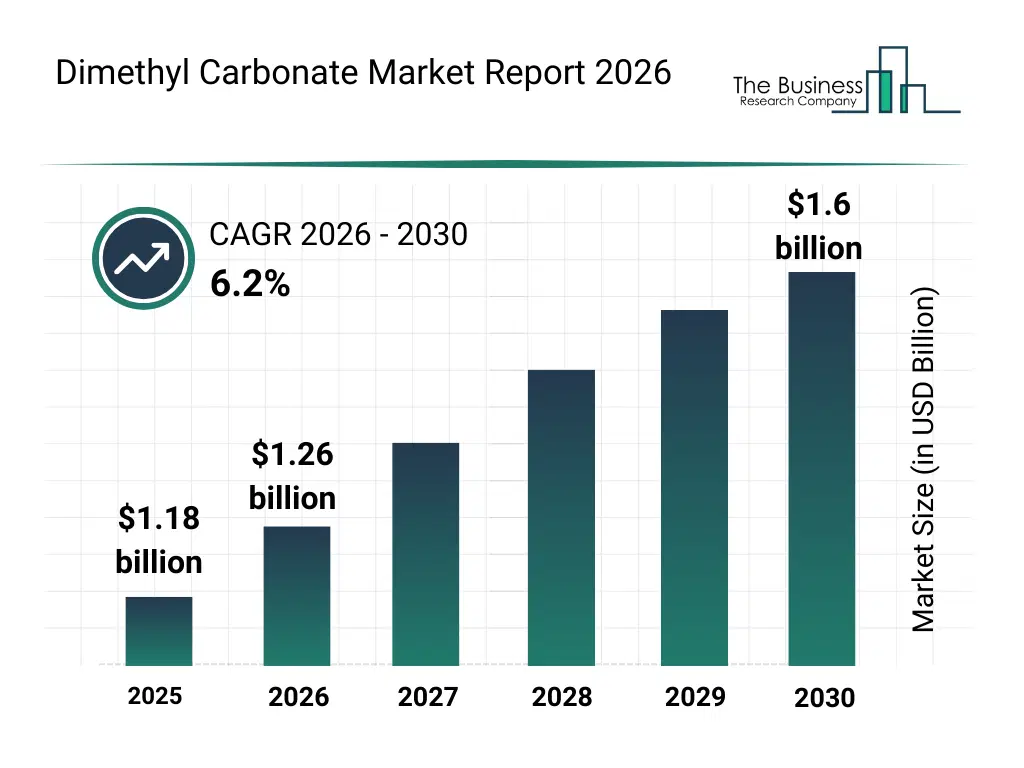
What Is The Dimethyl Carbonate Market Size and Share 2026?
The dimethyl carbonate market size has grown strongly in recent years. It will grow from $1.18 billion in 2025 to $1.26 billion in 2026 at a compound annual growth rate (CAGR) of 6.6%. The growth in the historic period can be attributed to shift away from toxic methylating agents, growth of polycarbonate plastics demand, increasing use of environmentally friendly solvents, expansion of specialty chemical manufacturing, availability of large-scale carbonate synthesis technologies.What Is The Dimethyl Carbonate Market Growth Forecast?
The dimethyl carbonate market size is expected to see strong growth in the next few years. It will grow to $1.6 billion in 2030 at a compound annual growth rate (CAGR) of 6.2%. The growth in the forecast period can be attributed to increasing demand from lithium-ion battery manufacturing, rising investments in green chemistry processes, expansion of energy storage applications, growing pharmaceutical solvent requirements, increasing adoption in sustainable chemical synthesis. Major trends in the forecast period include increasing use of green methylation agents, rising demand for battery-grade dimethyl carbonate, growing adoption in polycarbonate production, expansion of phosgene-free chemical processes, enhanced focus on high-purity solvent applications.
Global Dimethyl Carbonate Market Segmentation
1) By Grade: Industry Grade (>99.0 weight %), Pharmaceutical Grade (>99.5 weight %), Battery Grade (>99.9 weight %) 2) By Application: Polycarbonate Synthesis, Battery Electrolyte, Solvents, Reagents, Other Applications (Fuel Additives, Electrolyte for Supercapacitors, Electrolyte For Dye-synthesized Solar Cells) 3) By End-Use Industry: Plastics, Paints And Coating, Pharmaceutical, Battery, Agrochemicals, Other End-Use Industries (Adhesives And Sealants, Ink, Food And Beverages, And Energy) Subsegments: 1) By Industry Grade (>99.0 Weight %): General Industrial Applications, Solvent Applications, Chemical Intermediate Uses 2) By Pharmaceutical Grade (>99.5 Weight %): API (Active Pharmaceutical Ingredient) Production, Solvent For Drug Formulations, Research And Development 3) By Battery Grade (>99.9 Weight %): Lithium-Ion Battery Manufacturing, Electrolyte Solutions, Energy Storage ApplicationsWhat Are The Drivers Of The Dimethyl Carbonate Market?
The increasing demand for lithium-ion batteries is expected to propel the growth of the dimethyl carbonate market. The lithium-ion (Li-ion) battery is a modern technology that relies on lithium ions in its electrochemistry. Dimethyl carbonate is used as an electrolyte in lithium batteries to increase the octane number instead of MTBE (methyl tert-butyl ether). For instance, in 2025, according to the International Energy Agency, a France-based intergovernmental organization, in 2024, both EV batteries and storage applications reached the historical milestone of 1 TWh. Further, demand for EV batteries grew to over 950 GWh, 25% more than in 2023. Therefore, increased demand for lithium-ion batteries is driving the growth of dimethyl carbonate. The rising demand in the electronics and automotive industries is driving the dimethyl carbonate market. The growing economy and rising standard of living have changed the purchasing power of consumers and increased their preference for advanced electronics and automobiles. Dimethyl carbonate serves as the electrolyte in lithium-ion batteries (LIB) used in cell phones and notebook PCs. Dimethyl carbonate is also used in plug-in hybrid electric cars (PHEVs) and hybrid electric vehicles (HEVs). For instance, in March 2024, according to the International Energy Agency, a France-based intergovernmental organization, around 14 million electric cars were registered globally in 2023, marking a 35% increase over the 10.5 million registered in 2022. Electric vehicles (EVs) made up 18% of total car sales in 2023, up from 14% in 2022. This growth demonstrates strong momentum in the EV market, with weekly registrations in 2023 exceeding 250,000. Battery electric vehicles accounted for 70% of the total electric car stock in 2023. Therefore, the rising demand in the electronics and automotive industries will increase demand for dimethyl carbonate.Key Players In The Global Dimethyl Carbonate Market
Major companies operating in the dimethyl carbonate market are Shandong Haike Chemical Industry Group Co. Ltd., Shandong Wells Chemicals Co. Ltd., Qingdao Aspirit Chemical Co. Ltd., Shandong Feiyang Chemical Co. Ltd., Kindun Chemical Co.Limited, Hefei TNJ Chemical Industry Co.Ltd., Dongying City Longxing Chemical Co. Ltd., Hebei New Chaoyang Chemical Stock Co.Ltd., Shandong Depu Chemical Industry Science & Technology Co. Ltd., Dongying Hi-tech Spring Chemical Industry Co. Ltd, Tongling Jintai Chemical Industrial, UBE Industries, Tangshan Chaoyang Chemical Co. Ltd., Mitsubishi Chemical Corporation, Tokyo Chemical Industry Co. Ltd., Linyi Evergreen Chemical Co. Ltd., Akzo Nobel N.V., Taizhou Lingyu Chemical Co. Ltd., Dongying Jintan Chemical Co. Ltd., Luxi Chemical Group Co.Ltd., Dongying Xinyuan Chemical Co. Ltd., Dongying City Shuangma Chemical Co. Ltd.
This chart is for illustrative purposes; the full report includes a detailed competitor analysis and comprehensive overview of the top 10 companies in the market.
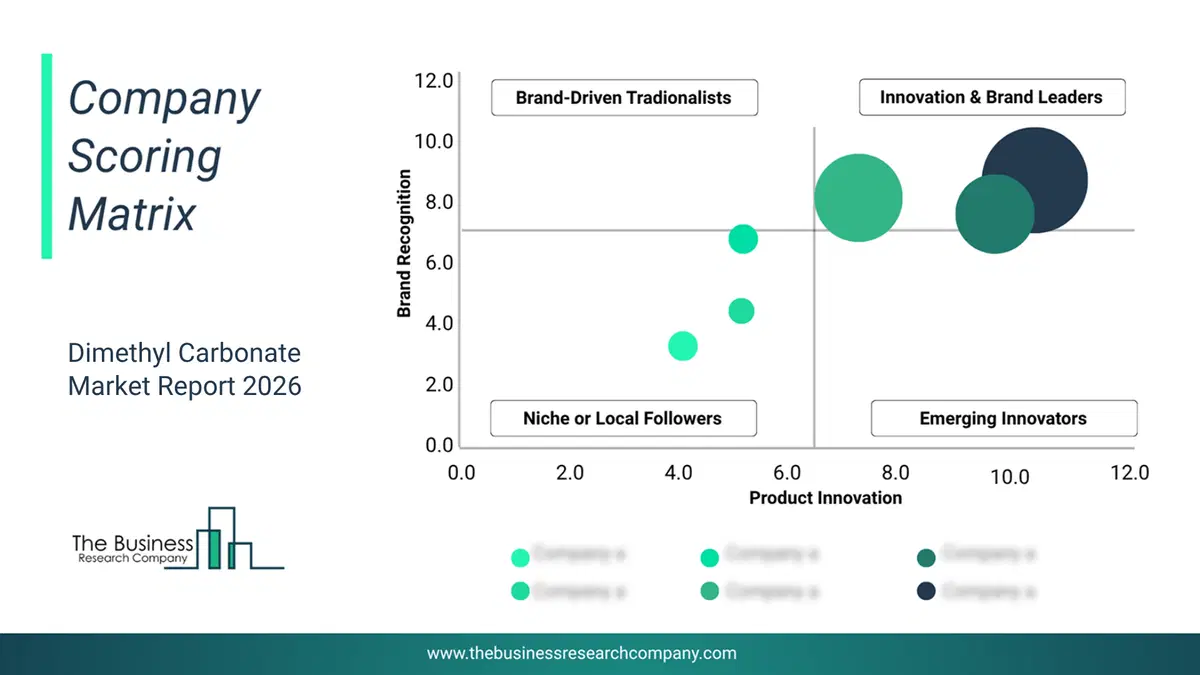
This chart maps companies by product innovation and brand strength, with bubble size indicating relative revenue, helping identify market leaders, challengers, and niche players. This is an illustrative chart; the full report provides a complete and accurate competitive analysis.
Global Dimethyl Carbonate Market Trends and Insights
Major companies operating in the dimethyl carbonate market are focusing on developing innovative solutions, such as large-scale facility expansions, to meet the rising demand for high-volume production, stable supply, and downstream integration opportunities in chemical value chains. Facility expansion enables increased capacity and greater market reach compared with existing limited-scale plants, supporting long-term growth, improved cost efficiency, and stronger regional distribution capabilities. For instance, in March 2024, UBE Corp., a Japan-based company that manufactures and sells chemicals, opened a dimethyl carbonate (DMC) and ethyl methyl carbonate (EMC) plant in the U.S. The plant has an annual production capacity of 100,000 metric tons of DMC and 40,000 metric tons of EMC, which is derived from DMC. Through the construction of this plant, UBE aims to ensure a stable supply in the U.S. Additionally, UBE has plans for future downstream expansion into environmentally friendly products within the C1 chemical chain, including polycarbonate diol (PCD) and waterborne polyurethane dispersion (PUD).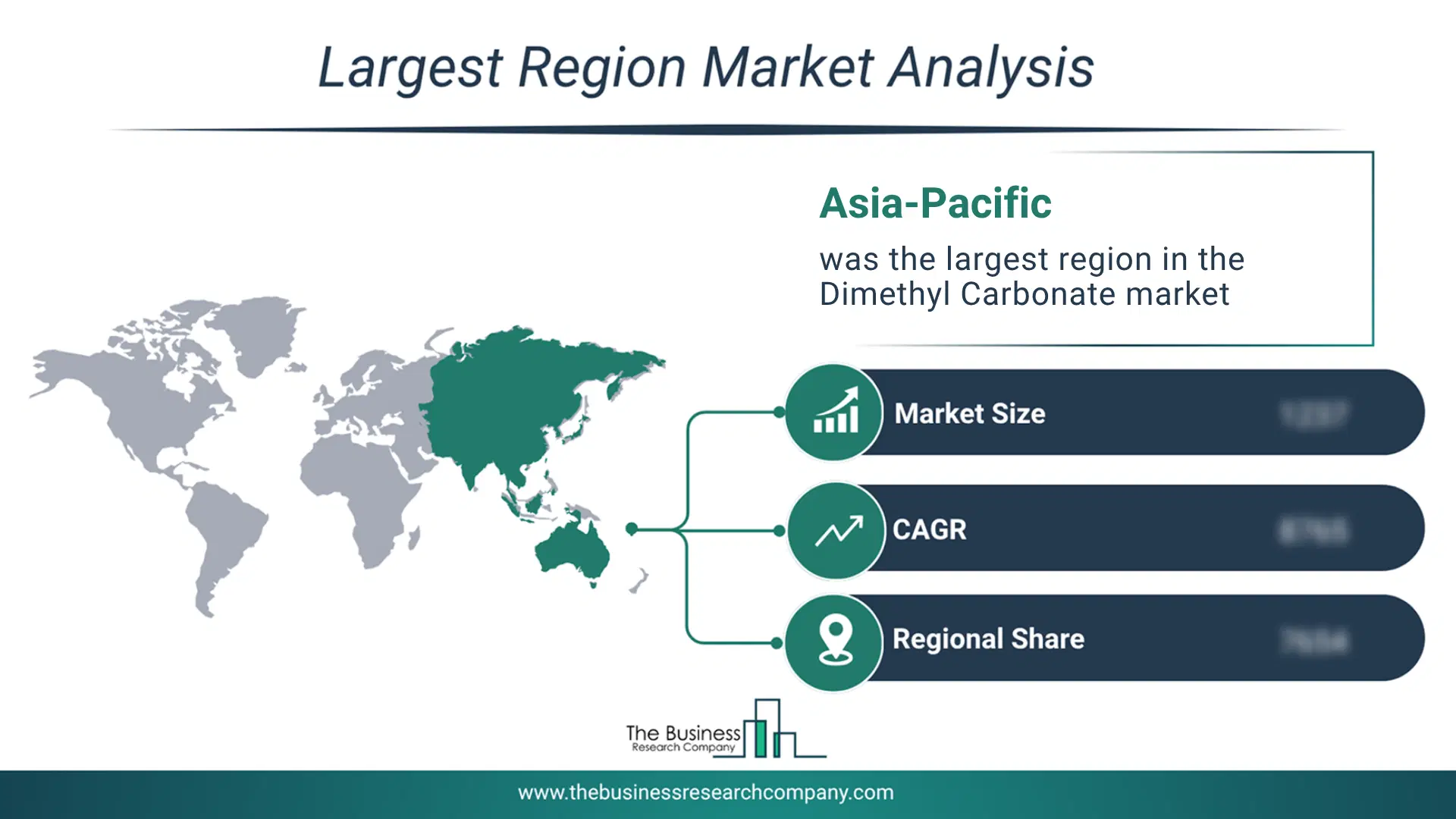
Regional Insights
Asia-Pacific was the largest region in the dimethyl carbonate market in 2025. The regions covered in this market report are Asia-Pacific, South East Asia, Western Europe, Eastern Europe, North America, South America, Middle East, Africa The countries covered in this market report are Australia, Brazil, China, France, Germany, India, Indonesia, Japan, Taiwan, Russia, South Korea, UK, USA, Canada, Italy, SpainWhat Defines the Dimethyl Carbonate Market?
The dimethyl carbonate market consists of sales of dimethyl carbonate used to synthesize polyurethane, polycarbonate, agricultural chemicals, and medicines. Values in this market are ‘factory gate’ values, that is, the value of goods sold by the manufacturers or creators of the goods, whether to other entities (including downstream manufacturers, wholesalers, distributors, and retailers) or directly to end customers. The value of goods in this market includes related services sold by the creators of the goods.How is Market Value Defined and Measured?
The market value is defined as the revenues that enterprises gain from the sale of goods and/or services within the specified market and geography through sales, grants, or donations in terms of the currency (in USD unless otherwise specified). The revenues for a specified geography are consumption values that are revenues generated by organizations in the specified geography within the market, irrespective of where they are produced. It does not include revenues from resales along the supply chain, either further along the supply chain or as part of other products.
This chart presents market attractiveness based on a quantitative evaluation of growth, competition, strategic alignment, and risk, offering a clear view of opportunity areas for decision-making. This chart is for illustrative purposes; the full report contains the complete analysis.

This chart highlights the Total Addressable Market (TAM) by estimating the maximum revenue opportunity using an assumption-driven approach, supporting strategic planning and opportunity sizing across markets. The chart is illustrative; the full report provides a more comprehensive analysis.
What Key Data and Analysis Are Included in the Dimethyl Carbonate Market Report 2026?
The dimethyl carbonate market research report is one of a series of new reports from The Business Research Company that provides market statistics, including industry global market size, regional shares, competitors with the market share, detailed market segments, market trends and opportunities, and any further data you may need to thrive in the dimethyl carbonate industry. The market research report delivers a complete perspective of everything you need, with an in-depth analysis of the current and future state of the industry.Dimethyl Carbonate Market Report Forecast Analysis
| Report Attribute | Details |
|---|---|
| Market Size Value In 2026 | $1.26 billion |
| Revenue Forecast In 2030 | $1.6 billion |
| Growth Rate | CAGR of 6.6% from 2026 to 2030 |
| Base Year For Estimation | 2025 |
| Actual Estimates/Historical Data | 2020-2025 |
| Forecast Period | 2026 - 2030 |
| Market Representation | Revenue in USD Billion and CAGR from 2026 to 2030 |
| Segments Covered | Grade, Application, End-Use Industry |
| Regional Scope | Asia-Pacific, Western Europe, Eastern Europe, North America, South America, Middle East, Africa |
| Country Scope | The countries covered in this market report are Australia, Brazil, China, France, Germany, India, Indonesia, Japan, Taiwan, Russia, South Korea, UK, USA, Canada, Italy, Spain |
| Key Companies Profiled | Shandong Haike Chemical Industry Group Co. Ltd., Shandong Wells Chemicals Co. Ltd., Qingdao Aspirit Chemical Co. Ltd., Shandong Feiyang Chemical Co. Ltd., Kindun Chemical Co.Limited, Hefei TNJ Chemical Industry Co.Ltd., Dongying City Longxing Chemical Co. Ltd., Hebei New Chaoyang Chemical Stock Co.Ltd., Shandong Depu Chemical Industry Science & Technology Co. Ltd., Dongying Hi-tech Spring Chemical Industry Co. Ltd, Tongling Jintai Chemical Industrial, UBE Industries, Tangshan Chaoyang Chemical Co. Ltd., Mitsubishi Chemical Corporation, Tokyo Chemical Industry Co. Ltd., Linyi Evergreen Chemical Co. Ltd., Akzo Nobel N.V., Taizhou Lingyu Chemical Co. Ltd., Dongying Jintan Chemical Co. Ltd., Luxi Chemical Group Co.Ltd., Dongying Xinyuan Chemical Co. Ltd., Dongying City Shuangma Chemical Co. Ltd. |
| Customization Scope | Request for Customization |
| Pricing And Purchase Options | Explore Purchase Options |