
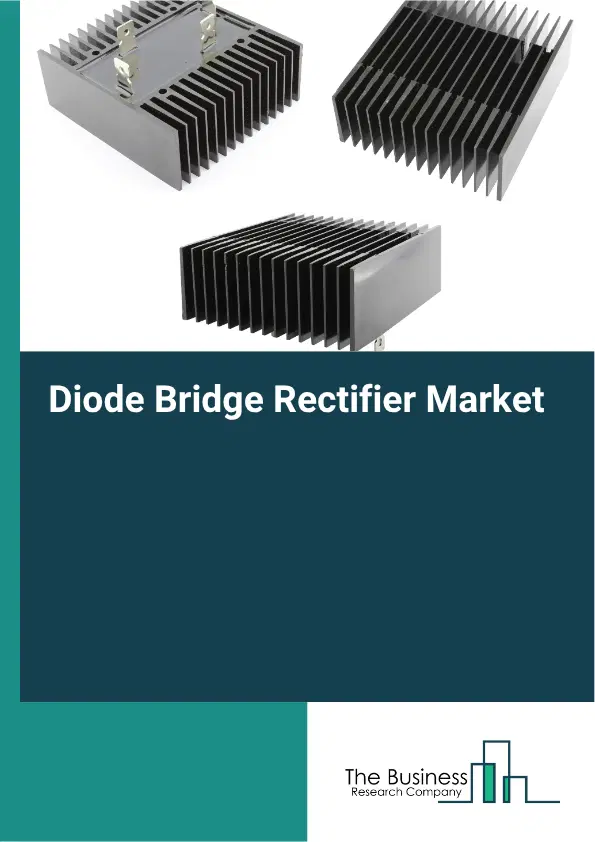
Diode Bridge Rectifier Market Report 2026
Global Outlook – By Type (4 Pins, 5 Pins, 6 Pins, Other Types), By Package Type (Through Hole Package, Surface Mount Device Package, Module Package, Panel Mount Package), By Current Rating (Low Current (Below 1 Ampere), Medium Current (1–10 Amperes), High Current (10–50 Amperes), Very High Current (Above 50 Amperes)), By Voltage Rating (Low Voltage (Up To 200 Volts), Medium Voltage (201–600 Volts), High Voltage (Above 600 Volts)), By End Use Industry (Consumer Electronics, Automotive, Industrial Equipment, Telecommunications, Power Generation And Distribution, Renewable Energy, Medical Devices, Aerospace And Defense, Railways, Home Appliances) – Market Size, Trends, Strategies, and Forecast to 2030
Diode Bridge Rectifier Market Overview
• Diode Bridge Rectifier market size has reached to $1.59 billion in 2025 • Expected to grow to $2.33 billion in 2030 at a compound annual growth rate (CAGR) of 7.8% • Growth Driver: Growing Electric Vehicle (EV) Adoption Driving The Market Growth Due To Increasing Demand For Advanced Power Semiconductor Solutions • Market Trend: Advancements In SiC-Based High-Current Single-Phase Bridge Rectifiers Enhance System Reliability And Efficiency • North America was the largest region in 2025 and Asia-Pacific is the fastest growing region.What Is Covered Under Diode Bridge Rectifier Market?
Diode bridge rectifiers refer to electronic devices that convert alternating current (AC) into direct current (DC) using an arrangement of four or more diodes configured in a bridge circuit. They are designed to provide efficient and reliable AC-to-DC power conversion while minimizing power loss and ensuring stable output voltage. These components are widely used in power supply systems and electronic circuits requiring rectified DC power. The main types of diode bridge rectifiers include 4 pins, 5 pins, 6 pins, and other types. 4 pin diode bridge rectifiers refer to rectifier devices with four terminals that convert alternating current into direct current for use in electronic and electrical circuits. These rectifiers are available in through hole package, surface mount device package, module package, and panel mount package formats, with low current below 1 ampere, medium current from 1 to 10 amperes, high current from 10 to 50 amperes, and very high current above 50 amperes ratings. They are available with low voltage up to 200 volts, medium voltage from 201 to 600 volts, and high voltage above 600 volts ratings and are used end use industries across consumer electronics, automotive, industrial equipment, telecommunications, power generation and distribution, renewable energy, medical devices, aerospace and defense, railways, and home appliances.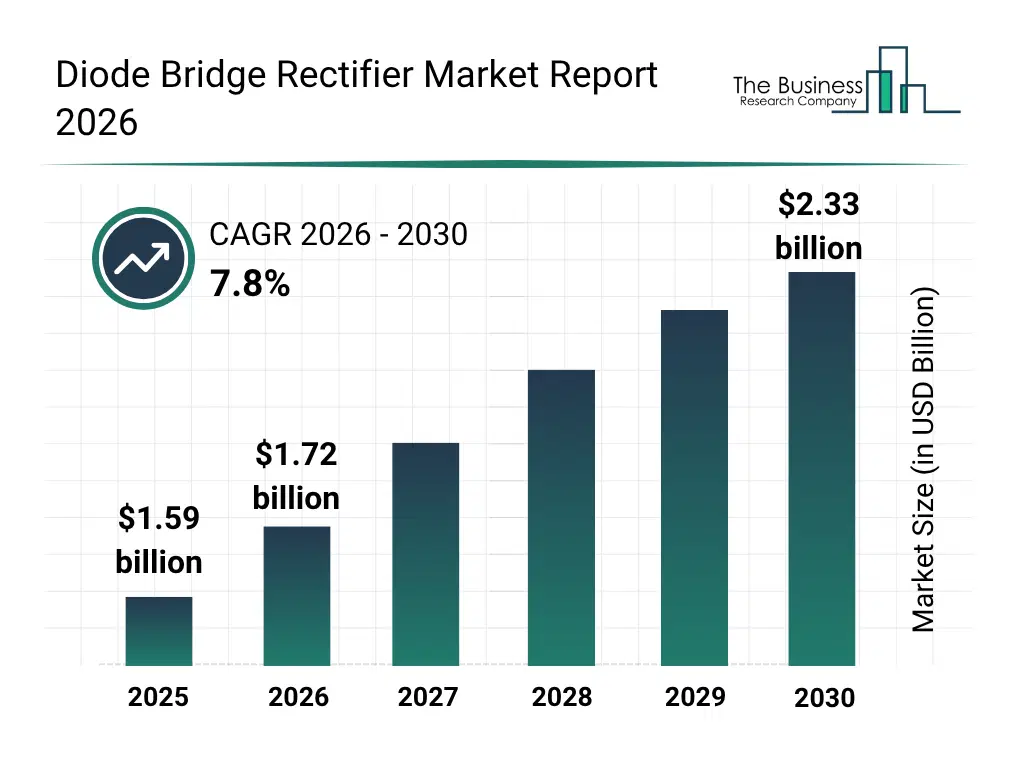
What Is The Diode Bridge Rectifier Market Size and Share 2026?
The diode bridge rectifier market size has grown strongly in recent years. It will grow from $1.59 billion in 2025 to $1.72 billion in 2026 at a compound annual growth rate (CAGR) of 8.3%. The growth in the historic period can be attributed to growth in electronic equipment production, expansion of power supply systems, increasing demand for AC-to-DC conversion, growth in industrial automation equipment, rising adoption of consumer electronic devices.What Is The Diode Bridge Rectifier Market Growth Forecast?
The diode bridge rectifier market size is expected to see strong growth in the next few years. It will grow to $2.33 billion in 2030 at a compound annual growth rate (CAGR) of 7.8%. The growth in the forecast period can be attributed to increasing demand for electric vehicles, expansion of renewable energy installations, growing deployment of smart industrial equipment, rising demand for energy-efficient power electronics, increasing electrification across end-use industries. Major trends in the forecast period include increasing demand for higher power density rectifiers, growing adoption of compact bridge rectifier packages, rising demand for high-temperature rectifier components, increasing preference for high-efficiency rectification solutions, growing demand for reliable and long-life rectifier components.
Global Diode Bridge Rectifier Market Segmentation
1) By Type: 4 Pins, 5 Pins, 6 Pins, Other Types 2) By Package Type: Through Hole Package, Surface Mount Device Package, Module Package, Panel Mount Package 3) By Current Rating: Low Current (Below 1 Ampere), Medium Current (1–10 Amperes), High Current (10–50 Amperes), Very High Current (Above 50 Amperes) 4) By Voltage Rating: Low Voltage (Up To 200 Volts), Medium Voltage (201–600 Volts), High Voltage (Above 600 Volts) 5) By End Use Industry: Consumer Electronics, Automotive, Industrial Equipment, Telecommunications, Power Generation And Distribution, Renewable Energy, Medical Devices, Aerospace And Defense, Railways, Home Appliances Subsegments: 1) By 4 Pins: Single Phase Bridge Rectifiers, Through Hole Bridge Rectifiers, Surface Mount Bridge Rectifiers, Glass Passivated Bridge Rectifiers, Standard Recovery Bridge Rectifiers 2) By 5 Pins: Single Phase Bridge Rectifiers With Mounting Tab, Through Hole Bridge Rectifiers, Surface Mount Bridge Rectifiers, High Current Bridge Rectifiers, Glass Passivated Bridge Rectifiers 3) By 6 Pins: Three Phase Bridge Rectifiers, High Power Bridge Rectifiers, Through Hole Bridge Rectifiers, Surface Mount Bridge Rectifiers, Industrial Grade Bridge Rectifiers 4) By Other Types: Eight Pin Bridge Rectifiers, Multi Pin Bridge Rectifiers, Custom Package Bridge Rectifiers, High Voltage Bridge Rectifiers, Automotive Grade Bridge RectifiersWhat Are The Drivers Of The Diode Bridge Rectifier Market?
The growing adoption of electric vehicles (EVs) is expected to propel the growth of the diode bridge rectifier market going forward. Electric vehicles (EVs) are automobiles powered wholly or partially by electric motors using rechargeable battery systems instead of conventional internal combustion engines. The demand for electric vehicles is due to growing environmental concerns, as they produce lower emissions compared to conventional vehicles and support the transition toward cleaner and more sustainable transportation. Rising adoption of electric vehicles (EVs) drives demand for diode bridge rectifiers by increasing the need for efficient AC-to-DC conversion solutions that enable reliable battery charging, stable DC bus voltage regulation, and enhanced overall power system efficiency in EV powertrains and onboard chargers. For instance, in January 2024, according to the US Department of Energy, a US-based government department, more than 1.4 million electric vehicles were sold in the United States in 2023, marking a 50% year-over-year increase. Therefore, the growing adoption of electric vehicles (EVs) is driving the growth of the diode bridge rectifier industry. The expansion of industrial automation is expected to propel the growth of the diode bridge rectifier market going forward. Industrial automation refers to the use of control systems, such as computers, robotics, and information technologies, to handle industrial processes and machinery with minimal human intervention. The demand for industrial automation is due to higher production accuracy, as automated manufacturing systems require reliable AC-to-DC power conversion for control units. Rising adoption of industrial automation drives demand for diode bridge rectifiers by increasing the need for reliable AC-to-DC power conversion for PLCs, motor drives, robotic systems, and other automated equipment requiring stable and uninterrupted DC power. For instance, in September 2024, according to the World Robotics 2024 report released by the International Federation of Robotics, a Germany-based non-profit organization, operational stock of industrial robots reached 4,281,585 units in factories worldwide, representing a 10% year-on-year increase. Therefore, the expansion of industrial automation is driving the growth of the diode bridge rectifier industry.Key Players In The Global Diode Bridge Rectifier Market
Major companies operating in the diode bridge rectifier market are Infineon Technologies AG, Mitsubishi Electric Corporation, STMicroelectronics N.V., Toshiba Electronic Devices & Storage Corporation, ON Semiconductor Corporation, Vishay Intertechnology Inc., Microchip Technology Incorporated, Littelfuse Inc., ROHM Co. Ltd., Diodes Incorporated, Taiwan Semiconductor Co. Ltd., Shindengen Electric Manufacturing Co. Ltd., WeEn Semiconductors Co. Ltd., PANJIT International Inc., Yangzhou Yangjie Electronic Technology Co. Ltd., Sansha Electric Manufacturing Co. Ltd., Micro Commercial Components Corp., SMC Diode Solutions, Rectron Semiconductor, Comchip Technology Co. Ltd., DACO Semiconductor Co. Ltd., Ark Semiconductor Inc., DC Components Co. Ltd.
This chart is for illustrative purposes; the full report includes a detailed competitor analysis and comprehensive overview of the top 10 companies in the market.
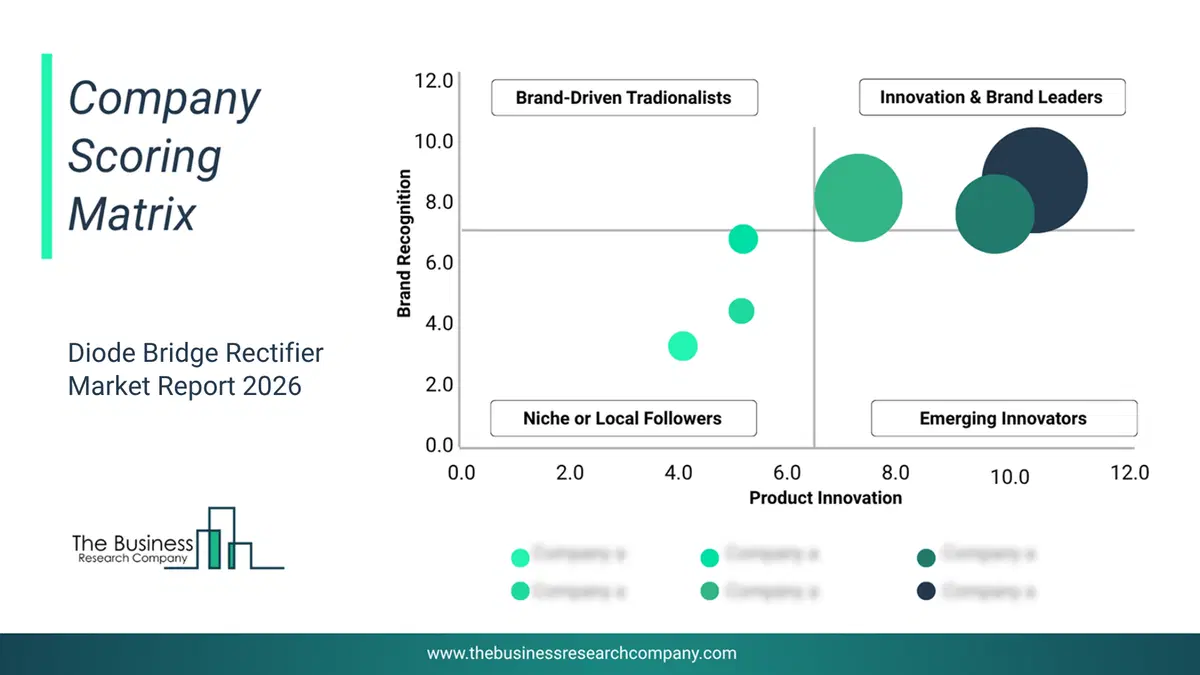
This chart maps companies by product innovation and brand strength, with bubble size indicating relative revenue, helping identify market leaders, challengers, and niche players. This is an illustrative chart; the full report provides a complete and accurate competitive analysis.
Global Diode Bridge Rectifier Market Trends and Insights
Major companies operating in the diode bridge rectifier market are focusing on developing advanced power rectification devices such as, high-current single-phase bridge rectifiers to enhance power conversion efficiency, high-frequency switching performance, thermal reliability, and energy efficiency in industrial, renewable energy, and power supply applications. High-current single-phase bridge rectifiers are diode bridge rectifier devices that convert single-phase alternating current (AC) into direct current (DC), enabling efficient power conversion with lower conduction losses, faster switching, and higher temperature operation than conventional silicon bridge rectifiers. For instance, in January 2025, Vishay Intertechnology Inc., a US-based semiconductor and electronic components manufacturer, launched 16 new 650 V and 1200 V SiC Schottky diodes, including 50 A and 90 A single-phase bridge devices, for high-frequency power applications. Built on the company's latest thin-wafer technology, the devices feature a low forward voltage drop of up to 1.36 V, low capacitive charge of 56 nC, virtually zero reverse recovery tail, and support operating temperatures of up to 175°C. The new bridge rectifier devices are designed for AC/DC power factor correction (PFC), DC/DC ultra-high-frequency output rectification, photovoltaic systems, EV charging stations, industrial UPS, and telecom power supplies, offering higher efficiency, simplified assembly, and drop-in compatibility with existing solutions. These innovations highlight the growing adoption of SiC-based rectification technologies for next-generation high-power electronic systems.
Regional Insights
North America was the largest region in the diode bridge rectifier market in 2025. Asia-Pacific is expected to be the fastest-growing region in the forecast period. The regions covered in this market report are Asia-Pacific, South East Asia, Western Europe, Eastern Europe, North America, South America, Middle East, Africa. The countries covered in this market report are Australia, Brazil, China, France, Germany, India, Indonesia, Japan, Taiwan, Russia, South Korea, UK, USA, Canada, Italy, Spain.What Defines the Diode Bridge Rectifier Market?
The diode bridge rectifier market consists of sales of high-current bridge rectifiers, high-voltage bridge rectifiers, and silicon bridge rectifiers. Values in this market are ‘factory gate’ values, that is, the value of goods sold by the manufacturers or creators of the goods, whether to other entities (including downstream manufacturers, wholesalers, distributors, and retailers) or directly to end customers. The value of goods in this market includes related services sold by the creators of the goods.How is Market Value Defined and Measured?
The market value is defined as the revenues that enterprises gain from the sale of goods and/or services within the specified market and geography through sales, grants, or donations in terms of the currency (in USD unless otherwise specified). The revenues for a specified geography are consumption values that are revenues generated by organizations in the specified geography within the market, irrespective of where they are produced. It does not include revenues from resales along the supply chain, either further along the supply chain or as part of other products.
This chart presents market attractiveness based on a quantitative evaluation of growth, competition, strategic alignment, and risk, offering a clear view of opportunity areas for decision-making. This chart is for illustrative purposes; the full report contains the complete analysis.

This chart highlights the Total Addressable Market (TAM) by estimating the maximum revenue opportunity using an assumption-driven approach, supporting strategic planning and opportunity sizing across markets. The chart is illustrative; the full report provides a more comprehensive analysis.
What Key Data and Analysis Are Included in the Diode Bridge Rectifier Market Report 2026?
The diode bridge rectifier market research report is one of a series of new reports from The Business Research Company that provides market statistics, including industry global market size, regional shares, competitors with the market share, detailed market segments, market trends and opportunities, and any further data you may need to thrive in the diode bridge rectifier industry. The market research report delivers a complete perspective of everything you need, with an in-depth analysis of the current and future state of the industry.Diode Bridge Rectifier Market Report Forecast Analysis
| Report Attribute | Details |
|---|---|
| Market Size Value In 2026 | $1.72 billion |
| Revenue Forecast In 2030 | $2.33 billion |
| Growth Rate | CAGR of 7.8% from 2026 to 2030 |
| Base Year For Estimation | 2025 |
| Actual Estimates/Historical Data | 2020-2025 |
| Forecast Period | 2026 - 2030 |
| Market Representation | Revenue in USD Billion and CAGR from 2026 to 2030 |
| Segments Covered | Type, Package Type, Current Rating, Voltage Rating, End Use Industry |
| Regional Scope | Asia-Pacific, Western Europe, Eastern Europe, North America, South America, Middle East, Africa |
| Country Scope | The countries covered in the report are Australia, Brazil, China, France, Germany, India, Indonesia, Japan, Taiwan, Russia, South Korea, UK, USA, Canada, Italy, Spain. |
| Key Companies Profiled | Infineon Technologies AG, Mitsubishi Electric Corporation, STMicroelectronics N.V., Toshiba Electronic Devices & Storage Corporation, ON Semiconductor Corporation, Vishay Intertechnology Inc., Microchip Technology Incorporated, Littelfuse Inc., ROHM Co. Ltd., Diodes Incorporated, Taiwan Semiconductor Co. Ltd., Shindengen Electric Manufacturing Co. Ltd., WeEn Semiconductors Co. Ltd., PANJIT International Inc., Yangzhou Yangjie Electronic Technology Co. Ltd., Sansha Electric Manufacturing Co. Ltd., Micro Commercial Components Corp., SMC Diode Solutions, Rectron Semiconductor, Comchip Technology Co. Ltd., DACO Semiconductor Co. Ltd., Ark Semiconductor Inc., DC Components Co. Ltd. |
| Customization Scope | Request for Customization |
| Pricing And Purchase Options | Explore Purchase Options |