
Diquat Dibromide Market Report 2026
Global Outlook – By Product Grade (Technical Grade Diquat Dibromide, Formulated Grade Diquat Dibromide), By Formulation Type (Liquid Concentrates, Soluble Liquid Formulations, Crystalline Or Solid Form), By Distribution Channel (Direct Sales, Agrochemical Distributors, Government And Institutional Supply, Retail And Cooperative Channels), By Application (Aquatic Weed Control, Algae Control, Pre-Harvest Crop Desiccation, Non-Crop Weed Control), By End-User (Agriculture, Water Treatment And Aquatic Management, Municipal And Public Utilities, Industrial And Commercial Users, Other End Users) – Market Size, Trends, Strategies, and Forecast to 2030
Diquat Dibromide Market Overview
• Diquat Dibromide market size has reached to $8.2 billion in 2025 • Expected to grow to $10.93 billion in 2030 at a compound annual growth rate (CAGR) of 6.1% • Growth Driver: Growing Demand For Industrial Crops Boosts The Diquat Dibromide Market For Enhanced Productivity • North America was the largest region in 2025 and Asia-Pacific is the fastest growing region.What Is Covered Under Diquat Dibromide Market?
Diquat dibromide refers to a non-selective contact herbicide, algicide, desiccant, and defoliant with a slight smell used as a pesticide to manage aquatic plants and to desalinate water. Diquat dibromide limits photosynthesis by disrupting the thylakoid membranes of green cells and also inhibiting the function of the photosynthetic enzyme. The main diquat dibromide types are synthetic, and bio-based. Synthetic refers to a chemical molecule synthesized artificially. The various corn types are corn, wheat, cotton, and soybean, that comes into various forms that includes crystalline, and liquid. The end-users are water treatment, agriculture, and others.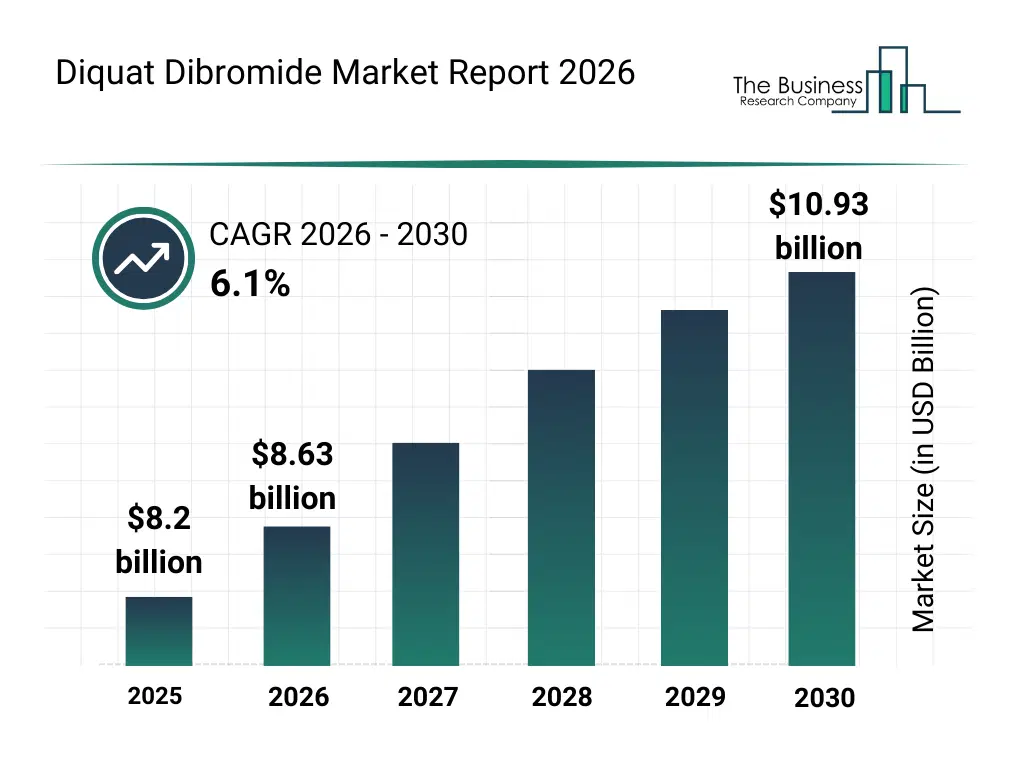
What Is The Diquat Dibromide Market Size and Share 2026?
The diquat dibromide market size has grown strongly in recent years. It will grow from $8.2 billion in 2025 to $8.63 billion in 2026 at a compound annual growth rate (CAGR) of 5.2%. The growth in the historic period can be attributed to need for non selective herbicides, expansion of irrigation systems, demand for aquatic weed management, agricultural productivity needs, availability of chemical formulations.What Is The Diquat Dibromide Market Growth Forecast?
The diquat dibromide market size is expected to see strong growth in the next few years. It will grow to $10.93 billion in 2030 at a compound annual growth rate (CAGR) of 6.1%. The growth in the forecast period can be attributed to growth of water infrastructure projects, stricter weed control regulations, innovation in safer formulations, demand for efficient crop management, expansion of bio based alternatives. Major trends in the forecast period include increasing use in aquatic weed control, rising demand for fast acting herbicides, expansion of water treatment applications, growing regulatory oversight on chemical herbicides, higher adoption in crop desiccation practices.
Global Diquat Dibromide Market Segmentation
1) By Product Grade: Technical Grade Diquat Dibromide, Formulated Grade Diquat Dibromide 2) By Formulation Type: Liquid Concentrates, Soluble Liquid Formulations, Crystalline Or Solid Form 3) By Distribution Channel: Direct Sales, Agrochemical Distributors, Government And Institutional Supply, Retail And Cooperative Channels 4) By Application: Aquatic Weed Control, Algae Control, Pre-Harvest Crop Desiccation, Non-Crop Weed Control 5) By End-User: Agriculture, Water Treatment And Aquatic Management, Municipal And Public Utilities, Industrial And Commercial Users, Other End Users Subsegments: 1) By Technical Grade Diquat Dibromide: ≥95% Purity Technical Grade, 90–95% Purity Technical Grade, Industrial Or Intermediate Technical Grade 2) By Formulated Grade Diquat Dibromide: Soluble Liquid (SL) Formulations, Water-Soluble Concentrate Formulations, Ready-to-Use (RTU) Formulations, Customized Concentration FormulationsWhat Are The Drivers Of The Diquat Dibromide Market?
Increased demand for industrial crops such as sugar cane is expected to propel the growth of the diquat dibromide market going forward. Sugar cane refers to a tall grass called Saccharum officinarum that is native to tropical and warm climates, has a strong, jointed stalk, and is the main source of sugar. Diquat is a non-selective herbicide that kills or harm a wide range of plants when it meets them. It is absorbed by plant leaves and causes direct cell tissue destruction and increase the productive of the crops. For instance, in December 2024, according to the Food and Agriculture Organization of the United Nations (FAO), a US-based intergovernmental organization, world production of sugar crops increased by 122 million tonnes between 2022 and 2023. Sugarcane was by far the main sugar crop, with more than 2 billion tonnes in 2023 compared to 281 million tonnes for sugar beet. Therefore, increased demand for industrial crops is driving the growth of the diquat dibromide industry going forward. The increasing demand for agricultural production is expected to propel the growth of the diquat dibromide market going forward. Agricultural production encompasses the cultivation of crops and the rearing of animals to yield food, fiber, and various other products. It involves various activities such as soil cultivation, planting, harvesting, livestock breeding, and managing farm resources. Agricultural production uses diquat dibromide as an herbicide to control and manage weed growth in various crops. For instance, in June 2024, according to the Department for Environment Food & Rural Affairs a UK-based government Department, in 2023, the largest value increase in a crop item was in potatoes, which saw an increase of £237 million ($296.25 million), or 30.8%, from 2022, bringing the total to £1,005 million ($1.26 billion) in 2023. Therefore, the increasing demand for agricultural production is driving the growth of the diquat dibromide industry going forward. Rising soil contamination is expected to propel the growth of the diquat dibromide market going forward. Soil contamination refers to the presence of pollutants in the soil at levels that impair one or more soil functions, reducing its productivity and ecological balance. The rise in soil contamination is driven by the increasing number of polluted and degraded lands, which require active vegetation and weed management to restore usability. Diquat dibromide helps manage soil contamination by efficiently controlling unwanted vegetation and aquatic weeds on polluted or degraded lands, facilitating land rehabilitation and reducing the spread of invasive plants that can worsen soil degradation. For instance, in July 2023, according to the World Health Organization (WHO), a Switzerland-based organization, there are around 2.8 million land sites potentially affected by pollution across the European Environment Agency (EEA) region that require environmental action. Therefore, rising soil contamination is driving the growth of the diquat dibromide industry.Key Players In The Global Diquat Dibromide Market
Major companies operating in the diquat dibromide market are Corteva Agriscience Inc., Coromandel International Limited, EverGrow Group, American Vanguard Corporation, Bayer CropScience SE, Israel Chemicals Limited, ADAMA Agricultural Solutions Ltd., FMC Corporation, Syngenta International AG, Nufarm Limited, UPL Limited, Sumitomo Chemical Company, Ltd., Albaugh LLC, DuPont de Nemours, Inc., The Gowan Company, LLC, Hubei Xianlong Chemical Industry Co., Ltd., Jiangsu Luye Agrochemicals Co., Ltd., Nantong Jiangshan Agrochemical & Chemicals Co., Ltd., Nissan Chemical Corporation, Shandong Luba Chemical Co., Ltd., Sharda Cropchem Limited, Willowood USA
This chart is for illustrative purposes; the full report includes a detailed competitor analysis and comprehensive overview of the top 10 companies in the market.
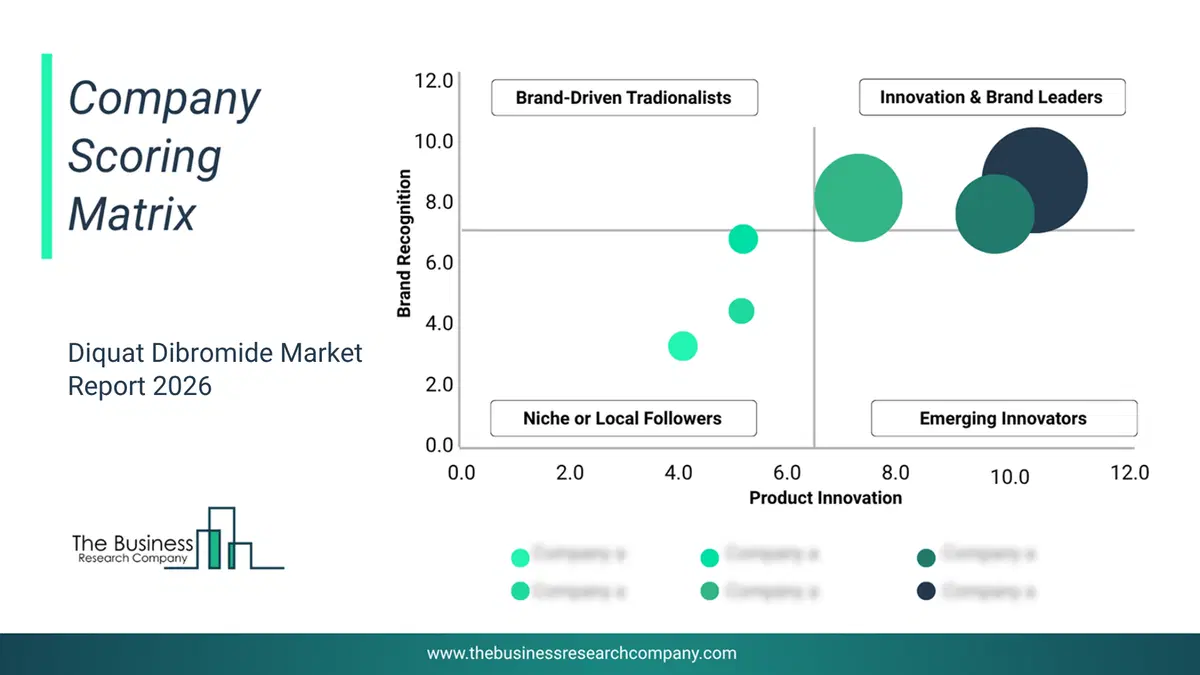
This chart maps companies by product innovation and brand strength, with bubble size indicating relative revenue, helping identify market leaders, challengers, and niche players. This is an illustrative chart; the full report provides a complete and accurate competitive analysis.
Regional Insights
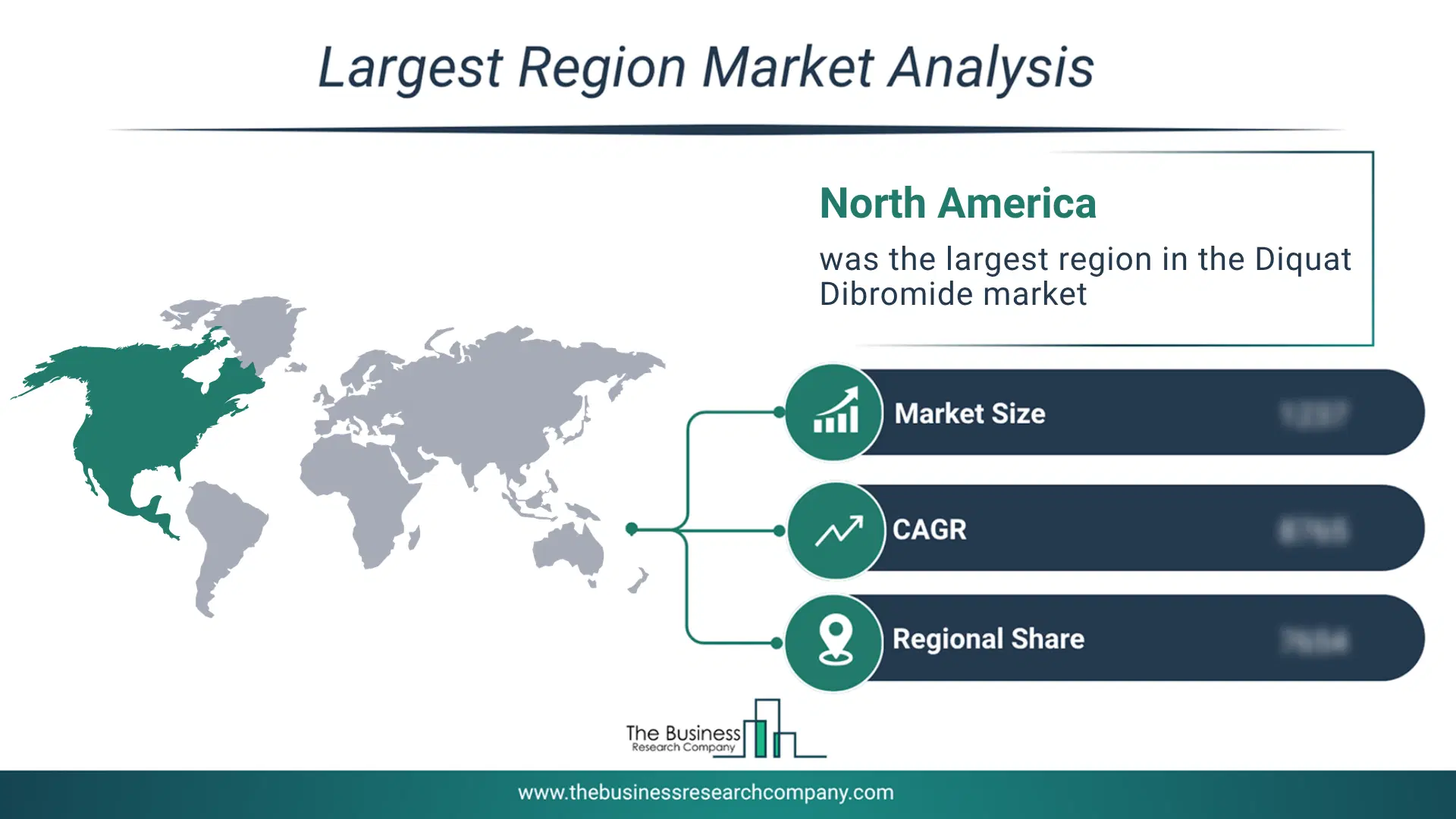
North America was the largest region in the diquat dibromide market in 2025.Asia-Pacific is expected to be the fastest-growing region in the global diquat dibromide market report during the forecast period. The regions covered in this market report are Asia-Pacific, South East Asia, Western Europe, Eastern Europe, North America, South America, Middle East, Africa The countries covered in this market report are Australia, Brazil, China, France, Germany, India, Indonesia, Japan, Taiwan, Russia, South Korea, UK, USA, Canada, Italy, SpainWhat Defines the Diquat Dibromide Market?
The diquat dibromide market consists of sales of diquat dibromide and diquat dichloride. Values in this market are ‘factory gate’ values, that is, the value of goods sold by the manufacturers or creators of the goods, whether to other entities (including downstream manufacturers, wholesalers, distributors, and retailers) or directly to end customers. The value of goods in this market includes related services sold by the creators of the goods.How is Market Value Defined and Measured?
The market value is defined as the revenues that enterprises gain from the sale of goods and/or services within the specified market and geography through sales, grants, or donations in terms of the currency (in USD unless otherwise specified). The revenues for a specified geography are consumption values that are revenues generated by organizations in the specified geography within the market, irrespective of where they are produced. It does not include revenues from resales along the supply chain, either further along the supply chain or as part of other products.
This chart presents market attractiveness based on a quantitative evaluation of growth, competition, strategic alignment, and risk, offering a clear view of opportunity areas for decision-making. This chart is for illustrative purposes; the full report contains the complete analysis.

This chart highlights the Total Addressable Market (TAM) by estimating the maximum revenue opportunity using an assumption-driven approach, supporting strategic planning and opportunity sizing across markets. The chart is illustrative; the full report provides a more comprehensive analysis.
What Key Data and Analysis Are Included in the Diquat Dibromide Market Report 2026?
The diquat dibromide market research report is one of a series of new reports from The Business Research Company that provides market statistics, including industry global market size, regional shares, competitors with the market share, detailed market segments, market trends and opportunities, and any further data you may need to thrive in the diquat dibromide industry. The market research report delivers a complete perspective of everything you need, with an in-depth analysis of the current and future state of the industry.Diqat Dibromide Market Report Forecast Analysis
| Report Attribute | Details |
|---|---|
| Market Size Value In 2026 | $8.63 billion |
| Revenue Forecast In 2030 | $10.93 billion |
| Growth Rate | CAGR of 5.2% from 2026 to 2030 |
| Base Year For Estimation | 2025 |
| Actual Estimates/Historical Data | 2020-2025 |
| Forecast Period | 2026 - 2030 |
| Market Representation | Revenue in USD Billion and CAGR from 2026 to 2030 |
| Segments Covered | Product Grade, Formulation Type, Distribution Channel, Application, End-User |
| Regional Scope | Asia-Pacific, Western Europe, Eastern Europe, North America, South America, Middle East, Africa |
| Country Scope | The countries covered in this market report are Australia, Brazil, China, France, Germany, India, Indonesia, Japan, Taiwan, Russia, South Korea, UK, USA, Canada, Italy, Spain |
| Key Companies Profiled | Corteva Agriscience Inc., Coromandel International Limited, EverGrow Group, American Vanguard Corporation, Bayer CropScience SE, Israel Chemicals Limited, ADAMA Agricultural Solutions Ltd., FMC Corporation, Syngenta International AG, Nufarm Limited, UPL Limited, Sumitomo Chemical Company, Ltd., Albaugh LLC, DuPont de Nemours, Inc., The Gowan Company, LLC, Hubei Xianlong Chemical Industry Co., Ltd., Jiangsu Luye Agrochemicals Co., Ltd., Nantong Jiangshan Agrochemical & Chemicals Co., Ltd., Nissan Chemical Corporation, Shandong Luba Chemical Co., Ltd., Sharda Cropchem Limited, Willowood USA |
| Customization Scope | Request for Customization |
| Pricing And Purchase Options | Explore Purchase Options |