

Contact Us
  Search
The Business Research Company Logo
Direct Air Capture Market 2025
Published :September 2025
Pages :327
Format :PDF
Delivery Time :2-3 Business Days
Why 2-3 days? We update the report with the latest data and news before delivery. Let us know if you need us to expedite.
Report Price :$4,490.00

Direct Air Capture Market 2025

By Product (Absorption-Based, Adsorption-Based, Membrane-Based, Cryogenic-Based) , By Scale (Pilot-Scale, Demonstration-Scale, Commercial-Scale) , By Source (Electricity, Heat) , By Application (Carbon Capture And Storage (CCS), Carbon Capture, Utilization And Storage (CCUS)) 5) By End-Use (Oil And Gas, Food And Beverage, Automotive, Chemicals, Healthcare, Other End-Uses), And By Region, Opportunities And Strategies – Global Forecast To 2035
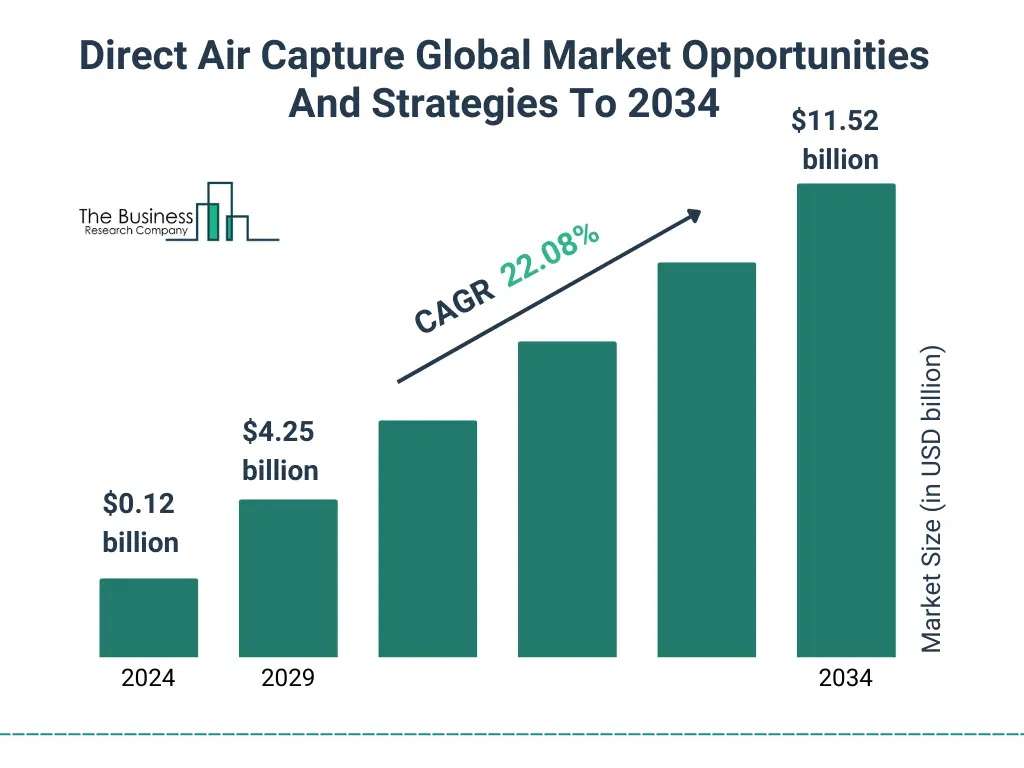
Direct Air Capture Global Market Opportunities And Strategies To 2034 Market Size and growth rate 2025 to 2029: Graph

Direct Air Capture Market Definition

Direct air capture (DAC) is a climate technology that involves the chemical or electrochemical process of extracting carbon dioxide (CO₂) directly from the ambient air using engineered systems. These systems typically use solid or liquid sorbents or electrochemical cells to capture CO₂, which is then either stored underground (carbon sequestration) or reused in products like fuels or building materials. The primary purpose of DAC is to reduce atmospheric CO₂ levels and help mitigate climate change. It is particularly valuable for achieving net-zero or negative emissions targets, especially in sectors where emissions are hard to eliminate entirely. The DAC market consists of sales, by entities (organizations, sole traders and partnerships), of DAC systems that draw in air and pass it through materials or solvents that bind CO₂, which is then released and captured when the material is regenerated.
Research Expert

Book your 30 minutes free consultation with our research experts

Direct Air Capture Market Size

The global direct air capture market reached a value of nearly $121.88 million in 2024, having grown at a compound annual growth rate (CAGR) of 123.77% since 2019. The market is expected to grow from $121.88 million in 2024 to $4,249.49 million in 2029 at a rate of 103.46%. The market is then expected to grow at a CAGR of 22.08% from 2029 and reach $11,522.93 million in 2034. Growth in the historic period resulted from rising carbon credit prices, rising awareness of climate change, increasing government funding and increased policy support. Factors that negatively affected growth in the historic period were lack of CO₂ transport and storage infrastructure and intensive energy demand. Going forward, rising environmental concerns, increasing awareness to reduce greenhouse gas emissions, growing investment by venture capital and energy companies and growth in demand for hydrogen and synthetic fuels support will drive growth. Factor that could hinder the growth of the direct air capture market in the future include immature technology, high costs and impact of trade war and tariff.

Direct Air Capture Market Drivers

The key drivers of the direct air capture market include: Increasing Awareness To Reduce Greenhouse Gas Emissions The increasing awareness to reduce greenhouse gas emissions is expected to propel the growth of the DAC market, during the forecast period. Growing climate awareness is pushing governments, companies and individuals to take urgent action on greenhouse gas reductions, driving demand for solutions like DAC. Governments are responding with stricter emissions regulations, tax incentives and inclusion of DAC in national climate strategies, creating a favorable regulatory landscape. At the same time, businesses are setting ambitious net-zero or carbon-negative targets, often requiring high-quality carbon removals to offset hard-to-abate emissions. DAC is increasingly seen as a credible, scalable option to meet these commitments. This convergence of policy, corporate responsibility and public pressure is accelerating investment and commercial adoption of DAC technologies.

Direct Air Capture Market Restraints

The key restraints on the direct air capture market include: Immature Technology The immature technology is expected to restrict the growth of the DAC market, during the forecast period. Many DAC technologies, especially emerging solid absorbents and electrochemical systems, remain at low technology readiness levels, lacking real-world validation and raising concerns over long-term reliability and scalability. The absence of industry-wide standards streamlined permitting and proven deployment models makes each DAC project complex and costly to execute. These inefficiencies discourage investor confidence and delay commercial adoption. Moreover, the high energy intensity, requiring both heat and electricity, undermines environmental and economic viability, particularly where low-carbon energy is limited. Infrastructure to support integration with energy grids and CO₂ storage is also underdeveloped. Without improvements in efficiency and scalability, DAC risks remain a niche solution rather than a mainstream climate tool.

Need data on a specific region in this market?

Opportunities And Recommendations In The Direct Air Capture Market

Opportunities – The top opportunities in the direct air capture market segmented by product will arise in the adsorption-based segment, which will gain $2,406.91 million of global annual sales by 2029. The top opportunities in the direct air capture market segmented by scale will arise in the commercial-scale segment, which will gain $3,531.43 million of global annual sales by 2029. The top opportunities in the direct air capture market segmented by source will arise in the electricity segment, which will gain $2,877.42 million of global annual sales by 2029. The top opportunities in the direct air capture market segmented by application will arise in the carbon capture, and storage (CCS) segment, which will gain $3,410.30 million of global annual sales by 2029. The top opportunities in the direct air capture market segmented by end-use will arise in the oil and gas segment, which will gain $1,658.75 million of global annual sales by 2029. The direct air capture market size will gain the most in the USA at $3,150.36 million. Recommendations- To take advantage of the opportunities, The Business Research Company recommends the companies to focus on strategic investment and scalable deployment, focus on integration with industrial processes, focus on advancing modular technology for scale and efficiency, focus on advancing scalable, energy-efficient technologies, focus on absorption-based segment to maximize growth potential, focus on commercial-scale projects to capture largest market growth, expand in emerging markets, continue to focus on developed markets, focus on value-based pricing to align with buyer expectations and market readiness, continue to use b2b promotions, focus on strategic partnerships to accelerate commercialization and market expansion, focus on industry-specific communication channels to strengthen market position, focus on carbon capture and storage to maximize long-term market growth, focus on automotive applications to capture highest-growth demand.
Chat with us