
Direct Air Carbon Capture Technology Market Report 2026
Global Outlook – By Technology Type (Solid-Direct Air Carbon Capture (DAC), Liquid-Direct Air Carbon Capture (DAC), Electrochemical-Direct Air Carbon Capture (DAC)), By Operating Temperature (Low-Temperature Direct Air Carbon Capture (DAC), High-Temperature Direct Air Carbon Capture (DAC)), By Number Of Collectors (Less Than 10 Collectors, More Than 10 Collectors), By Application (Carbon Capture And Storage (CCS), Carbon Capture, Utilization, And Storage (CCUS)), By End-Use Industry (Energy Industry, Industrial Sector, Transportation, Other End-Use Industries) – Market Size, Trends, Strategies, and Forecast to 2030
Direct Air Carbon Capture Technology Market Overview
• Direct Air Carbon Capture Technology market size has reached to $3.32 billion in 2025 • Expected to grow to $7.45 billion in 2030 at a compound annual growth rate (CAGR) of 17.5% • Growth Driver: Rising Awareness Of Climate Change Mitigation Fuelling The Growth Of The Market Due To Increasing Focus On Emission Reduction And Sustainable Innovations • Market Trend: Next-Generation Carbon Capture Solutions Driving Efficiency And Scalability In The Market • North America was the largest region in 2025.Market Gains By 2030 – Top Opportunities By Segment
Market Gain identifies the most promising market opportunities by highlighting the segments or products expected to generate the highest incremental revenue growth over the next five years.
What Is Covered Under Direct Air Carbon Capture Technology Market?
Direct air carbon capture (DACC) technology refers to a process that captures carbon dioxide (CO₂) directly from the atmosphere using chemical or physical processes. The captured CO₂ can then be stored underground (carbon sequestration) or utilized in industrial applications, such as synthetic fuels or carbonated beverages. DACC is considered a key technology for reducing greenhouse gas concentrations and mitigating climate change, complementing emissions reduction efforts. The main technologies of direct air carbon capture technology are solid-direct air carbon capture (DAC), liquid-direct air carbon capture (DAC), and electrochemical-direct air carbon capture (DAC). Low-temperature direct air carbon capture (DAC) operates at relatively lower temperatures, typically below 100°C. It uses liquid sorbents or solid materials to capture carbon dioxide (CO₂) from the air, which is then released through chemical reactions at mild heat. The operating temperatures involved are low-temperature direct air carbon capture (dac) and high-temperature direct air carbon capture (dac), with less than 10 collectors and more than 10 collectors. The various applications involved are carbon capture and storage (ccs), carbon capture, utilization, and storage (CCUS) used by the energy industry, industrial sector, transportation, and other end-use industries.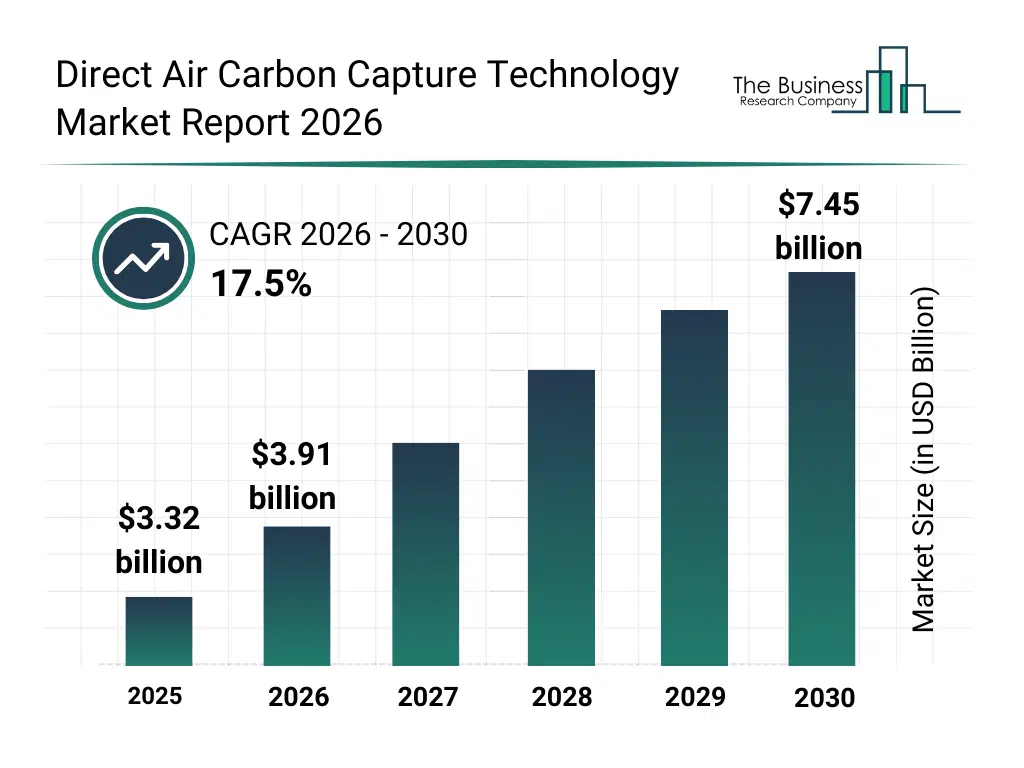
What Is The Direct Air Carbon Capture Technology Market Size and Share 2026?
The direct air carbon capture technology market size has grown rapidly in recent years. It will grow from $3.32 billion in 2025 to $3.91 billion in 2026 at a compound annual growth rate (CAGR) of 17.9%. The growth in the historic period can be attributed to growing climate change awareness, early carbon capture research, government funded pilot projects, industrial emission control initiatives, international climate agreements.What Is The Direct Air Carbon Capture Technology Market Growth Forecast?
The direct air carbon capture technology market size is expected to see rapid growth in the next few years. It will grow to $7.45 billion in 2030 at a compound annual growth rate (CAGR) of 17.5%. The growth in the forecast period can be attributed to net zero emission targets, expansion of carbon markets, rising investment in climate technologies, industrial decarbonization demand, policy incentives for carbon removal. Major trends in the forecast period include large scale carbon removal deployment, industrial carbon utilization expansion, modular DAC system design, energy efficient capture processes, carbon negative technology adoption.
Global Direct Air Carbon Capture Technology Market Segmentation
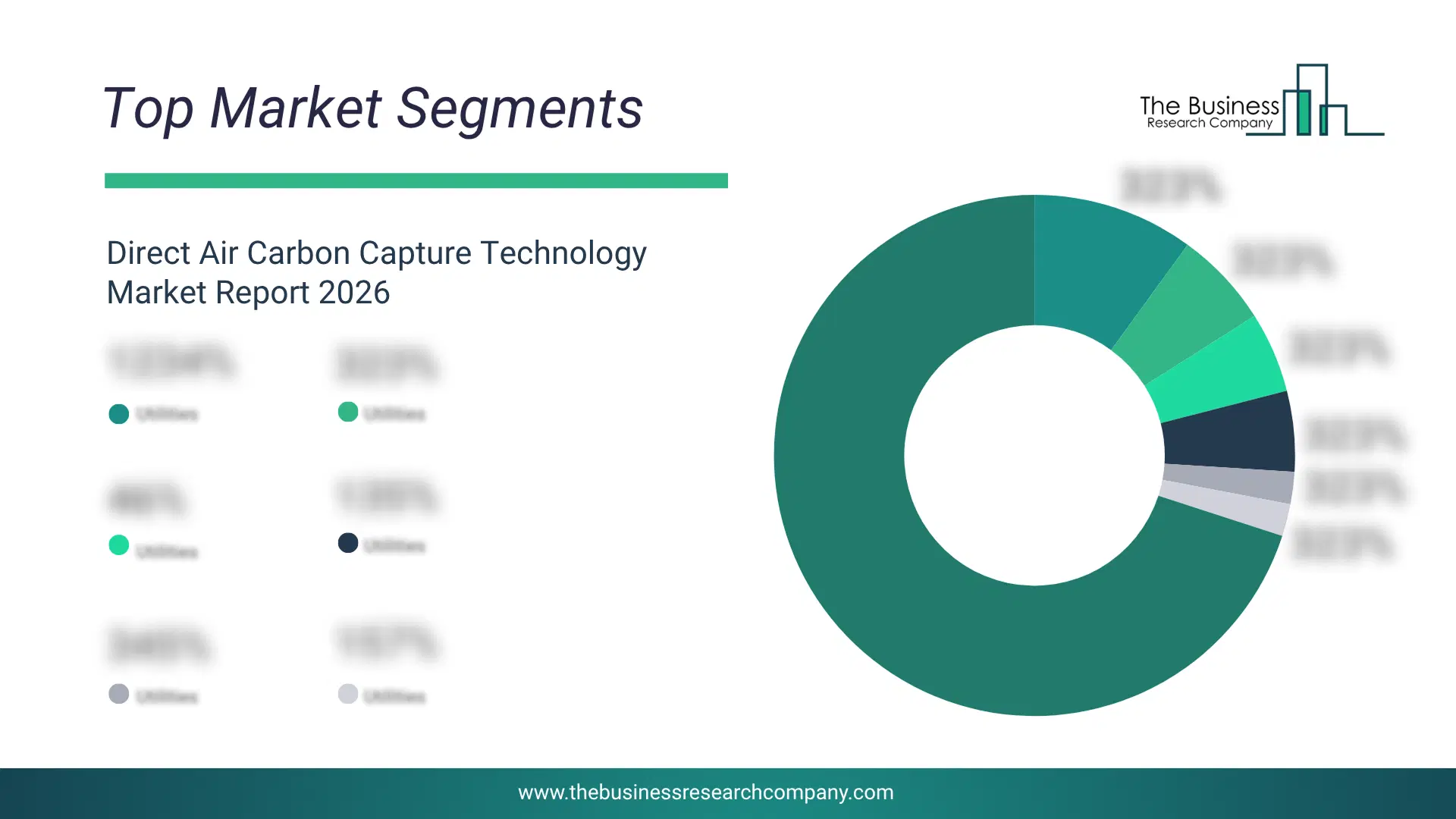
1) By Technology Type: Solid-Direct Air Carbon Capture (DAC), Liquid-Direct Air Carbon Capture (DAC), Electrochemical-Direct Air Carbon Capture (DAC) 2) By Operating Temperature: Low-Temperature Direct Air Carbon Capture (DAC), High-Temperature Direct Air Carbon Capture (DAC) 3) By Number Of Collectors: Less Than 10 Collectors, More Than 10 Collectors 4) By Application: Carbon Capture And Storage (CCS), Carbon Capture, Utilization, And Storage (CCUS) 5) By End-Use Industry: Energy Industry, Industrial Sector, Transportation, Other End-Use Industries Subsegments: 1) By Solid-Direct Air Carbon Capture (DAC): Adsorption-Based DAC, Absorption-Based DAC, Membrane-Based DAC 2) By Liquid-Direct Air Carbon Capture (DAC): Solvent-Based DAC, Aqueous Alkaline Solution DAC, Bioengineered Liquid DAC 3) By Electrochemical-Direct Air Carbon Capture (DAC): Electro-Swing Adsorption DAC, Redox-Active Material-Based DAC, Ionic Liquid Electrochemical DAC The top segments in the direct air carbon capture technology market will be: • Less Than 10 Collectors will reach $2717.98 Million by 2025. • Carbon Capture And Storage (CCS) will reach $2578.98 Million by 2025. • Low-Temperature Direct Air Carbon Capture (DAC) will reach $2036.06 Million by 2025. • Solid-Direct Air Carbon Capture (DAC) will reach $2013.16 Million by 2025. • Energy Industry (including Clear Energy Industry) will reach $1636.27 Million by 2025.What Is The Driver Of The Direct Air Carbon Capture Technology Market?
The rising awareness of climate change mitigation is expected to drive the growth of the direct air carbon capture technology market going forward. Climate change mitigation refers to efforts and actions taken to reduce or prevent the emission of greenhouse gases (GHGs) into the atmosphere. The rising awareness of climate change mitigation is due to the increasing frequency and severity of extreme weather events worldwide. Hurricanes, wildfires, heatwaves, and floods have become more intense and frequent, causing devastating impacts on communities, economies, and ecosystems. These events serve as tangible evidence of climate change, prompting governments, organizations, and individuals to take action. Direct Air Carbon Capture (DACC) technology helps raise awareness of climate change mitigation by demonstrating a tangible and innovative solution to reducing atmospheric carbon dioxide (CO₂) levels. For instance, in October 2023, according to a report published by the World Health Organization (WHO), a Switzerland-based intergovernmental organization, about 3.6 billion individuals reside in regions highly vulnerable to the impacts of climate change by 2023. It is projected that from 2030 to 2050, climate change will lead to an estimated annual increase of approximately 250,000 deaths due to factors such as undernutrition, malaria, diarrhea, and heat stress. Therefore, the rising awareness of climate change mitigation is driving the growth of the direct air carbon capture technology industry.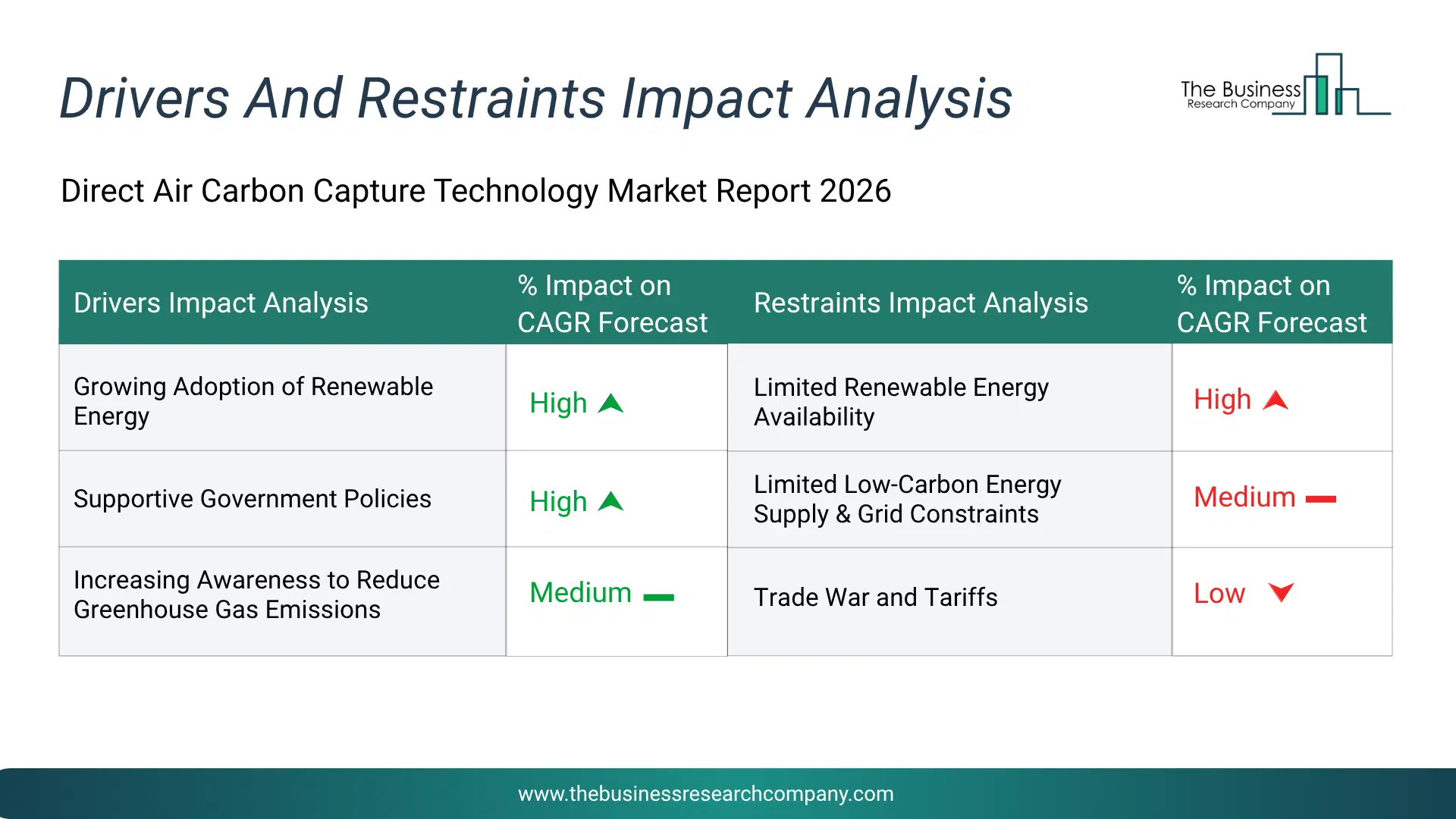
Infographic Chart Showing Key Market Drivers Analysis And Restraints For Direct Air Carbon Capture Technology Market
The chart presents an impact analysis of key drivers and restraints, quantifying their relative influence on the market's growth rate and helping assess the balance between growth enablers and limiting factors. This chart offers a high-level perspective; the full report contains more detailed insights.
How Will The Drivers Impact Growth In The Global Direct Air Carbon Capture Technology Market?
• Growing Adoption of Renewable Energy (High) – The growing adoption of renewable energy will become a key driver of growth in the direct air carbon capture technology market by 2030. As governments and industries worldwide prioritize carbon neutrality and decarbonization, there is heightened demand for innovative solutions that can effectively remove CO₂ from the atmosphere. DAC technology, which complements renewable energy by enabling large-scale carbon mitigation, is gaining traction as a strategic tool in achieving sustainability goals. The alignment of renewable energy deployment with carbon capture initiatives is expected to create new investment opportunities, foster technological advancements and accelerate the commercial adoption of DAC solutions across multiple sectors. As a result, the growing adoption of renewable energy is anticipated to contributing to a 2.5% annual growth in the market. • Supportive Government Policies (High) – The supportive government policies will emerge as a major factor driving the expansion of the direct air carbon capture technology market by 2030. Regulatory frameworks, financial incentives and grants aimed at promoting carbon reduction initiatives are encouraging investments in DAC solutions. By fostering innovation and reducing the financial burden associated with large-scale carbon capture projects, these policies are facilitating faster adoption of DAC technologies across industries. Additionally, government support for research, development and deployment of sustainable technologies is strengthening market confidence and attracting strategic partnerships. Collectively, such measures are likely to accelerate technological advancements and expand the commercial footprint of DAC solutions globally. Consequently, the supportive government policies capabilities is projected to contributing to a 2.3% annual growth in the market. • Increasing Awareness to Reduce Greenhouse Gas Emissions (Medium) – The increasing awareness to reduce greenhouse gas emissions will serve as a key growth catalyst for the direct air carbon capture technology market by 2030. As businesses, governments and consumers increasingly prioritize environmental sustainability, there is growing demand for effective solutions that can actively remove CO₂ from the atmosphere. DAC technology offers a scalable approach to complement existing decarbonization efforts, making it a critical tool in achieving climate targets. This heightened focus on emission reduction is likely to encourage greater investments, foster technological innovation and accelerate the commercial adoption of DAC solutions across various industrial and energy sectors, supporting long-term market expansion. Therefore, the increasing awareness to reduce greenhouse gas emissions will drive the growth of the direct air carbon capture technology market. Therefore, this increasing awareness to reduce greenhouse gas emissions operations is projected to supporting to a 1.8% annual growth in the market. • Accelerating Climate Change Impacts (Low) – The accelerating climate change impacts will become a significant driver contributing to the growth of the direct air carbon capture technology market by 2030. Rising global temperatures, extreme weather events and increasing greenhouse gas concentrations are creating urgent demand for effective solutions to mitigate environmental risks. DAC technology, which actively removes CO₂ from the atmosphere, is emerging as a critical tool in achieving carbon neutrality and supporting climate goals. The growing recognition of the need for immediate and large-scale carbon reduction is likely to encourage investments, foster innovation and accelerate adoption of DAC solutions across industries, governments and energy sectors, thereby boosting overall market expansion. Therefore, accelerating climate change impacts will drive the growth of the direct air carbon capture technology market. Consequently, the accelerating climate change impacts strategies is projected to contributing to a 0.5% annual growth in the market.How Will The Restraints Impact Growth In The Global Direct Air Carbon Capture Technology Market?
• Limited Renewable Energy Availability (High) – Limited Renewable Energy Availability will restrict the growth of the Direct Air Carbon Capture Technology market during the forecast period. Direct air capture requires significant energy input, and the availability of renewable energy for DAC operations affects project viability. Limited access to low-cost renewable energy can affect DAC project economics and deployment. Energy constraints can limit the scalability of DAC technology and market growth. • Limited Low-Carbon Energy Supply & Grid Constraints (Medium) – Limited Low-Carbon Energy Supply & Grid Constraints will restrict the growth of the Direct Air Carbon Capture Technology market during the forecast period. DAC technology deployment requires access to low-carbon energy sources and grid connections for operation. Limited energy infrastructure in some regions can constrain DAC project development. Grid constraints and energy supply limitations affect the feasibility and scalability of DAC projects. • Trade War and Tariffs (Low) – Trade War and Tariffs will restrict the growth of the Direct Air Carbon Capture Technology market during the forecast period. Trade tensions and economic uncertainty can affect investment in carbon capture and climate technology. Reduced government support and private investment during trade disputes may limit DAC deployment. Trade barriers may also impact the availability and cost of DAC technology components.Key Players In The Global Direct Air Carbon Capture Technology Market
Major companies operating in the direct air carbon capture technology market are Exxon Mobil Corporation, Occidental Petroleum Corporation, GE Vernova, Sunfire GmbH, Climeworks AG, Carbon Clean Solutions Pvt Ltd, Heirloom Carbon Technologies, Carbon Engineering ULC, CarbonCure Technologies Inc, Skytree, CarbonCapture Inc, CarbonFree Chemicals Holdings LLC, Synhelion SA, 1PointFive LLC, Zero Carbon Systems, Soletair Power, LanzaJet, Noya PBC, Sustaera Inc, Mission Zero Technologies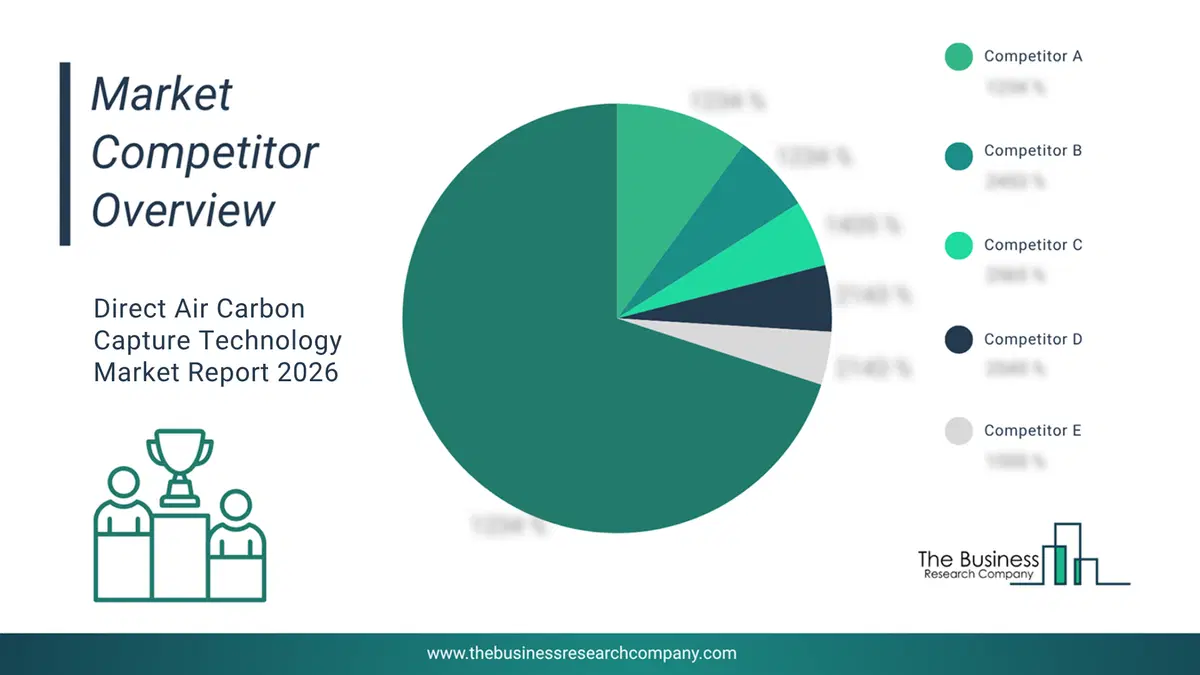
This chart is for illustrative purposes; the full report includes a detailed competitor analysis and comprehensive overview of the top 10 companies in the market.
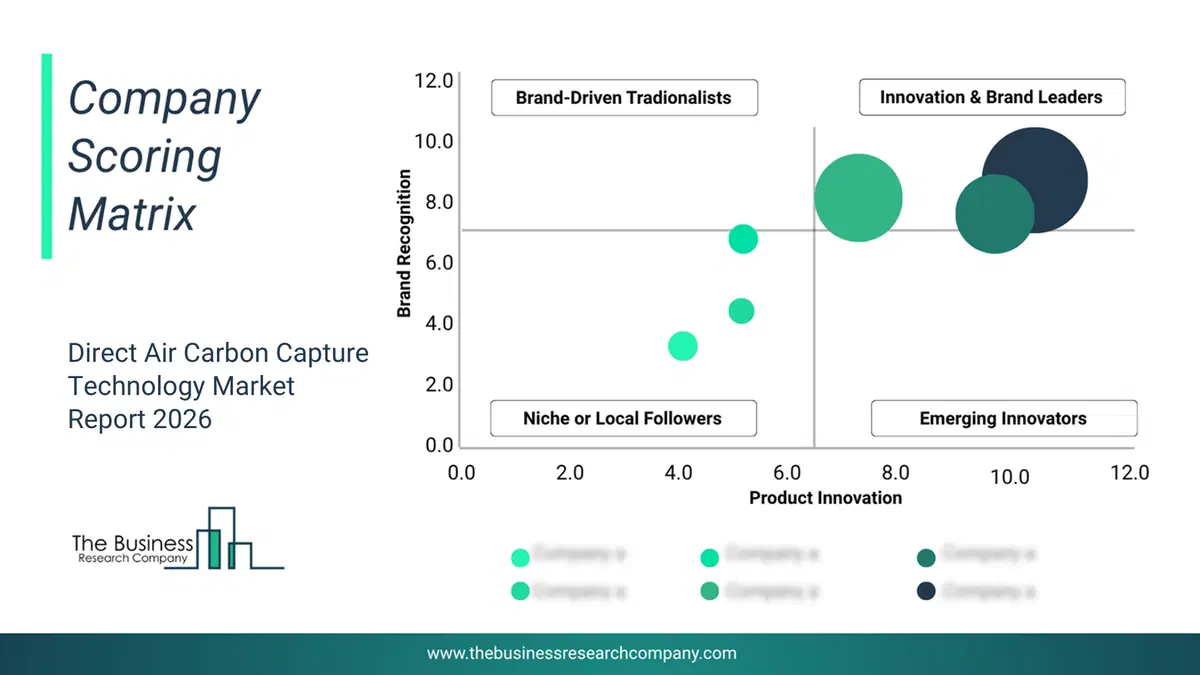
This chart maps companies by product innovation and brand strength, with bubble size indicating relative revenue, helping identify market leaders, challengers, and niche players. This is an illustrative chart; the full report provides a complete and accurate competitive analysis.
Global Direct Air Carbon Capture Technology Market Trends and Insights
Major companies operating in the direct air carbon capture technology market are focusing on technological advancements, such as next-generation carbon capture solutions, to enhance efficiency and scalability. The next-generation carbon capture solution has innovative structured sorbent materials and advanced filtration systems, optimizing CO₂ removal while reducing energy consumption. For instance, in June 2024, Climeworks AG, a Switzerland-based direct air capture technology company, launched Generation 3 direct air capture (DAC) technology, an innovative solution to transform carbon removal by enhancing efficiency and scalability. This advanced system doubles CO₂ capture capacity per module, cuts energy consumption by 50%, and extends material lifespan, significantly lowering costs. It features newly developed structured sorbent materials that replace traditional packed filter beds, increasing surface contact with CO₂. These enhancements accelerate the capture and release process at least two times, enabling the system to capture more than twice the CO₂ compared to previous generations.What Are Latest Mergers And Acquisitions In The Direct Air Carbon Capture Technology Market?
In December 2024, Skytree B.V., a Netherlands-based direct air capture (DAC) company, acquired ReCarbn B.V. for an undisclosed amount. The acquisition aims to integrate ReCarbn’s innovative filtration and sorbent circulation technologies into Skytree’s DAC portfolio, enhancing efficiency, scalability, and cost-effectiveness in carbon capture solutions. ReCarbn B.V. is a Netherlands-based direct air capture (DAC) startup focused on innovative filtration and sorbent circulation technologies.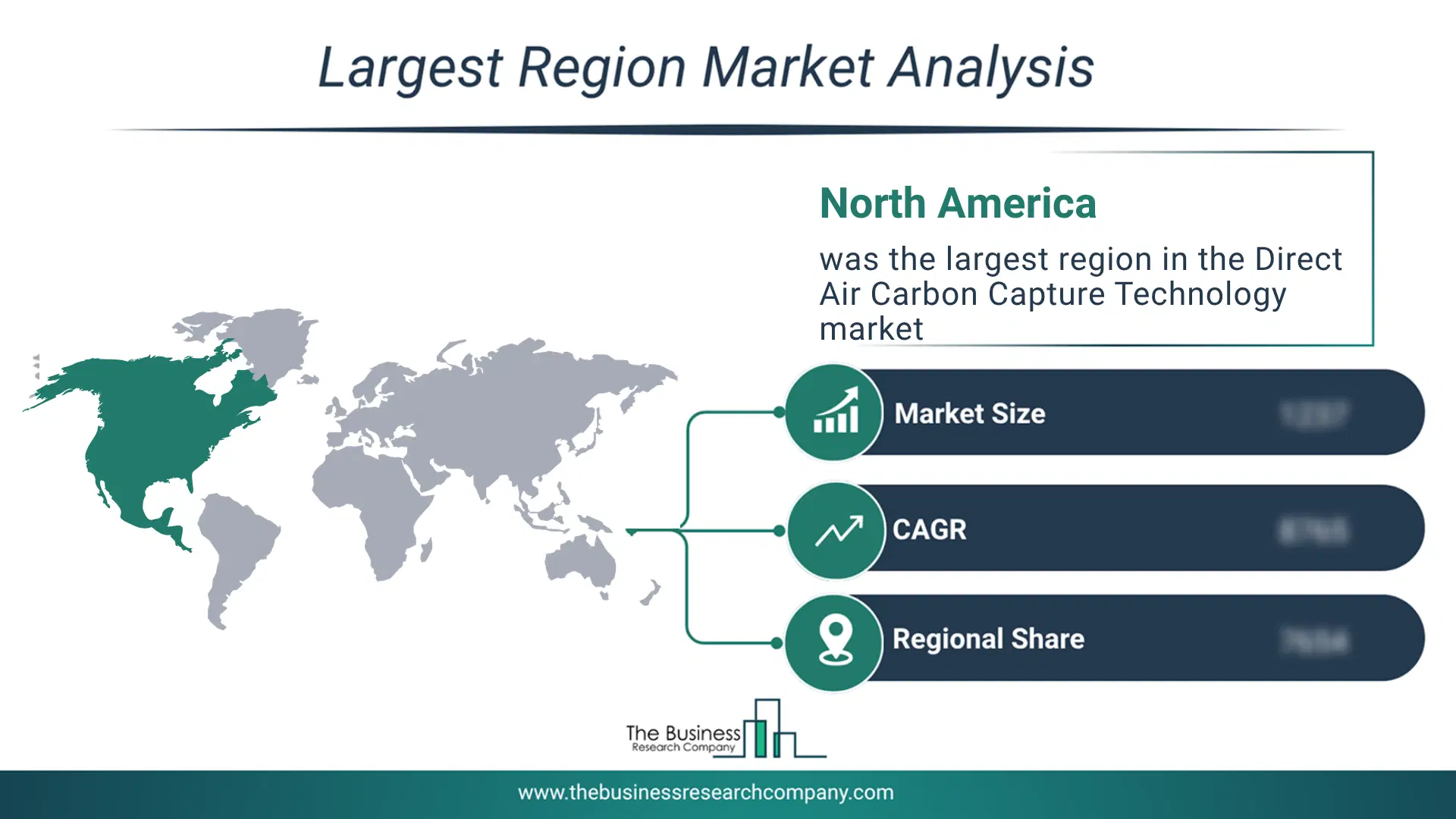
Regional Insights
North America was the largest region in the direct air carbon capture technology market in 2025. The regions covered in this market report are Asia-Pacific, South East Asia, Western Europe, Eastern Europe, North America, South America, Middle East, Africa. The countries covered in this market report are Australia, Brazil, China, France, Germany, India, Indonesia, Japan, Taiwan, Russia, South Korea, UK, USA, Canada, Italy, Spain.What Defines the Direct Air Carbon Capture Technology Market?
The direct air carbon capture technology market consists of revenues earned by entities by providing services such as permanent carbon sequestration services, enhanced oil recovery (EOR) services, and carbon removal as a service (CRaaS). The market value includes the value of related goods sold by the service provider or included within the service offering. The direct air carbon capture technology market also includes sales of synthetic fuels (E-Fuels), waste heat-powered DAC systems, and building-integrated DAC systems. Values in this market are ‘factory gate’ values, that is the value of goods sold by the manufacturers or creators of the goods, whether to other entities (including downstream manufacturers, wholesalers, distributors and retailers) or directly to end customers. The value of goods in this market includes related services sold by the creators of the goods.How is Market Value Defined and Measured?
The market value is defined as the revenues that enterprises gain from the sale of goods and/or services within the specified market and geography through sales, grants, or donations in terms of the currency (in USD unless otherwise specified). The revenues for a specified geography are consumption values that are revenues generated by organizations in the specified geography within the market, irrespective of where they are produced. It does not include revenues from resales along the supply chain, either further along the supply chain or as part of other products.
This chart presents market attractiveness based on a quantitative evaluation of growth, competition, strategic alignment, and risk, offering a clear view of opportunity areas for decision-making. This chart is for illustrative purposes; the full report contains the complete analysis.

This chart highlights the Total Addressable Market (TAM) by estimating the maximum revenue opportunity using an assumption-driven approach, supporting strategic planning and opportunity sizing across markets. The chart is illustrative; the full report provides a more comprehensive analysis.
What Key Data and Analysis Are Included in the Direct Air Carbon Capture Technology Market Report 2026?
The direct air carbon capture technology market research report is one of a series of new reports from The Business Research Company that provides market statistics, including industry global market size, regional shares, competitors with the market share, detailed market segments, market trends and opportunities, and any further data you may need to thrive in the direct air carbon capture technology industry. The market research report delivers a complete perspective of everything you need, with an in-depth analysis of the current and future state of the industry.Direct Air Carbon Capture Technology Market Report Forecast Analysis
| Report Attribute | Details |
|---|---|
| Market Size Value In 2026 | $3.91 billion |
| Revenue Forecast In 2030 | $7.45 billion |
| Growth Rate | CAGR of 17.9% from 2026 to 2030 |
| Base Year For Estimation | 2025 |
| Actual Estimates/Historical Data | 2020-2025 |
| Forecast Period | 2026 - 2030 |
| Market Representation | Revenue in USD Billion and CAGR from 2026 to 2030 |
| Segments Covered | Technology Type, Operating Temperature, Number Of Collectors, Application, End-Use Industry |
| Regional Scope | Asia-Pacific, Western Europe, Eastern Europe, North America, South America, Middle East, Africa |
| Country Scope | The countries covered in the report are Australia, Brazil, China, France, Germany, India, Indonesia, Japan, Taiwan, Russia, South Korea, UK, USA, Canada, Italy, Spain. |
| Key Companies Profiled | Exxon Mobil Corporation, Occidental Petroleum Corporation, GE Vernova, Sunfire GmbH, Climeworks AG, Carbon Clean Solutions Pvt Ltd, Heirloom Carbon Technologies, Carbon Engineering ULC, CarbonCure Technologies Inc, Skytree, CarbonCapture Inc, CarbonFree Chemicals Holdings LLC, Synhelion SA, 1PointFive LLC, Zero Carbon Systems, Soletair Power, LanzaJet, Noya PBC, Sustaera Inc, Mission Zero Technologies |
| Customization Scope | Request for Customization |
| Pricing And Purchase Options | Explore Purchase Options |