
Contact Us
  Search
The Business Research Company Logo
Direct Satellite-To-Phone Cellular Global Market Opportunities And Strategies To 2035
Published :May 2026
Pages :311
Format :PDF
Delivery Time :2-3 Business Days
ⓘ
Why 2-3 days? We update the report with the latest data and news before delivery. Let us know if you need us to expedite.
Report Price :$4,490.00

Direct Satellite-To-Phone Cellular Global Market Opportunities And Strategies To 2035

By Type (Consumer Services, Mobile Satellite Services), By Connectivity Type (Two-Way Communication, One-Way Communication), By End-User Industry (Individual, Media And Entertainment, Government, Defense, Aerospace, Retail And Enterprise, Other End User Industries), And By Region, Opportunities And Strategies – Global Forecast To 2035

Direct Satellite-To-Phone Cellular Market Definition

Direct satellite-to-phone cellular refers to a wireless communication technology that enables standard mobile phones to connect directly to satellites in orbit without requiring terrestrial cell towers or specialized satellite phones. It leverages low Earth orbit (LEO) satellite constellations and modified cellular protocols to provide voice, messaging, and limited data services directly to conventional smartphones. The primary purpose of direct satellite-to-phone cellular is to extend mobile network coverage to remote, rural, and underserved areas where traditional infrastructure is unavailable. The direct satellite-to-phone cellular market consists of sales, by entities (organizations, sole traders, or partnerships) that encompasses technologies and services that allow users to send and receive voice, text and data communications through satellite networks using unmodified or minimally modified smartphones. It is primarily used by consumers, enterprises, governments and defense organizations in areas where terrestrial network coverage is limited, unreliable, or unavailable, such as remote, rural, maritime and disaster-affected regions. The service is used both for routine connectivity in underserved areas and for emergency communication when traditional networks fail.
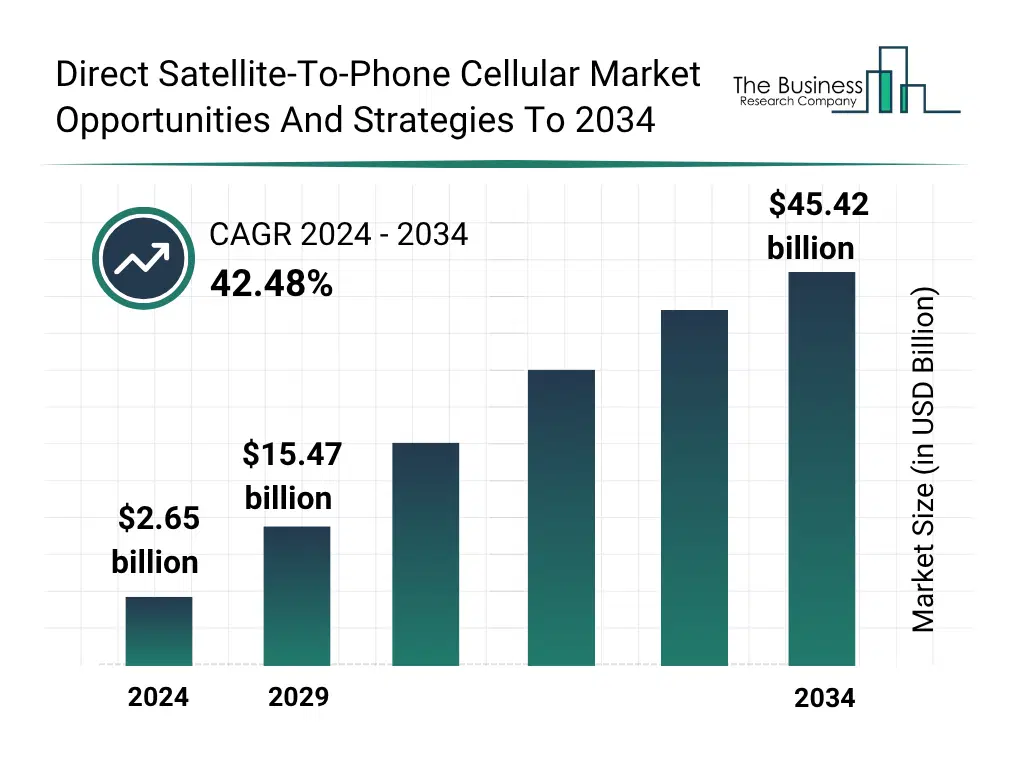
Direct Satellite-To-Phone Cellular Global Market Opportunities And Strategies To 2035 Market Size and growth rate 2025 to 2030: Graph

Direct Satellite-To-Phone Cellular Market Size

The global direct satellite-to-phone cellular market reached a value of nearly $2,652.86 million in 2024. The market is expected to grow from $2,652.86 million in 2024 to $15,466.75 million in 2029 at a rate of 42.48%. The market is then expected to grow at a CAGR of 24.04% from 2029 and reach $45,422.56 million in 2034. Growth in the historic period resulted from growing demand from the remote workforce, government-backed rural connectivity and universal service programs, rising frequency of natural disasters and growth in smartphone penetration. Factors that negatively affected growth in the historic period were high infrastructure costs and interference with terrestrial networks. Going forward, integration of satellite with 5G non-terrestrial networks (NTN), rising need for satellite connectivity in border and surveillance regions, growing requirement for emergency SOS and safety communication and growth in government initiatives for digital inclusion will drive growth. Factors that could hinder the growth of the direct satellite-to-phone cellular market in the future include regulatory hurdles, limited data bandwidth and impact of trade war and tariff.
Research Expert

Book your 30 minutes free consultation with our research experts

Direct Satellite-To-Phone Cellular Market Segmentation

The direct satellite-to-phone cellular market is segmented by type, by connectivity type and by end-user industry.

By Type –
The direct satellite-to-phone cellular market is segmented by type into:
    • a) Consumer Services
    • b) Mobile Satellite Services
The consumer services market was the largest segment of the direct satellite-to-phone cellular market segmented by type, accounting for 65.06% or $1,726.08 million of the total in 2024. Going forward, the consumer services segment is expected to be the fastest-growing segment in the direct satellite-to-phone cellular market segmented by type, at a CAGR of 45.91% during 2024-2029.

By Connectivity Type –
The direct satellite-to-phone cellular market is segmented by connectivity type into:
    • a) Two-Way Communication
    • b) One-Way Communication
The two-way communication market was the largest segment of the direct satellite-to-phone cellular market segmented by connectivity type, accounting for 97.00% or $2,573.27 million of the total in 2024. Going forward, the two-way communication segment is expected to be the fastest-growing segment in the direct satellite-to-phone cellular market segmented by connectivity type, at a CAGR of 42.58% during 2024-2029.

By End-User Industry –
The direct satellite-to-phone cellular market is segmented by end-user industry into:
    • a) Individual
    • b) Media And Entertainment
    • c) Government
    • d) Defense
    • e) Aerospace
    • f) Retail And Enterprise
    • g) Other End User Industries
The individual market was the largest segment of the direct satellite-to-phone cellular market segmented by end-user industry, accounting for 45.92% or $1,218.09 million of the total in 2024. Going forward, the defense segment is expected to be the fastest growing segment in the direct satellite-to-phone cellular market segmented by end-user industry, at a CAGR of 45.24% during 2024-2029.

By Geography - The direct satellite-to-phone cellular market is segmented by geography into:
      o Asia Pacific
      • China
      • India
      • Japan
      • Australia
      • Indonesia
      • South Korea
      o North America
      • USA
      • Canada
      o South America
      • Brazil
      o Western Europe
      • France
      • Germany
      • UK
      • Italy
      • Spain
      o Eastern Europe
      • Russia
      o Middle East
      o Africa
North America was the largest region in the direct satellite-to-phone cellular market, accounting for 51.00% or $1,352.96 million of the total in 2024. It was followed by North America and Asia Pacific. Going forward, the fastest-growing regions in the direct satellite-to-phone cellular market will be North America and Asia Pacific where growth will be at CAGRs of 37.66% and 34.37% respectively.

Direct Satellite-To-Phone Cellular Market Drivers

The key drivers of the direct satellite-to-phone cellular market include: Integration Of Satellite With 5G Non-Terrestrial Networks (NTN) Integration of satellite with 5G non-terrestrial networks (NTN) is expected to be a key driver of the growth of the direct satellite-to-phone cellular market in the forecast period. The integration of satellites with 5G Non-Terrestrial Networks enables seamless connectivity between terrestrial mobile systems and orbiting infrastructure. This convergence allows direct communication between standard mobile devices and satellites using compatible spectrum and protocols. It improves network continuity in areas where ground-based towers are unavailable or overloaded. Advances in 5G standards supporting NTN make it technically feasible to extend coverage globally without major changes to user devices. This interoperability reduces dependency on traditional infrastructure while enhancing scalability. As a result, service providers can deliver more consistent connectivity across remote and underserved regions.

Direct Satellite-To-Phone Cellular Market Restraints

The key restraints on the direct satellite-to-phone cellular market include: Regulatory Hurdles In the forecast period, stringent environmental regulations and material restrictions are Regulatory hurdles restricting the growth of the direct satellite-to-phone cellular market during the forecast period. Strict licensing requirements, spectrum allocation rules and cross-border coordination slow down deployment because operators must obtain approvals from multiple national authorities before offering service. Different countries enforce varying technical standards and compliance frameworks, which creates delays in harmonizing operations globally. Uncertainty in policy decisions can also discourage long-term investment, as companies face the risk of changing rules or restricted spectrum access. In addition, concerns around interference with existing terrestrial networks often lead regulators to impose additional testing and constraints. These approvals and compliance processes increase timelines and administrative complexity, slowing overall rollout and scalability.

Direct Satellite-To-Phone Cellular Market Competitive Landscape

Major Competitors are:

  • SpaceX (Starlink)
  • AST SpaceMobile Inc.
  • Lynk Global Inc.
  • China Telecom Corporation Limited
  • T-Mobile Inc.
  • Other Competitors Include:

  • AT&T Inc.
  • Apple Inc.
  • Vodafone Group Plc.
  • Huawei Technologies Co., Ltd.
  • Globalstar Inc.
  • Vodafone Idea Limited
  • T-Mobile
  • Telstra
  • China Satellite Communications Co. Ltd.
  • KDDI Corporation
  • Rakuten Mobile, Inc.
  • KT Sat
  • Viasat
  • BSNL
  • Jio Airtel
  • Eutelsat OneWeb
  • SK Telecom
  • China Mobile
  • China Unicom
  • Okinawa Cellular Telephone Company
  • LG Uplus
  • Iridium Communications Inc.,
  • Eutelsat Communications
  • SES S.A. Vodafone Group Plc.
  • Deutsche Telekom
  • MasOrange
  • Kyivstar (VEON)
  • EchoStar Mobile
  • Verizon Communications Inc.
  • T-Mobile US, Inc.
  • Qualcomm Incorporated
  • Telstra Corporation Limited
  • Rogers Communications Inc.
  • Viasat Inc.
  • Hughes Network Systems LLC
  • Globalstar, Inc.
  • Connecta Satellite Solutions LLC.
  • Eutelsat
  • Syniverse
  • Bell Canada
  • Telus Corporation
  • Viasat Eutelsat OneWeb
  • Al Yah Satellite Communications Company (Yahsat)
  • e&
  • stc Group
  • Omnispace LLC
  • OQ Technology
  • Space Exploration Technologies Corp.
  • Vodacom Group Limited
  • MTN Group Limited
  • Orange S.A
  • Need data on a specific region in this market?

    Opportunities And Recommendations In The Direct Satellite-To-Phone Cellular Market

    Opportunities – The top opportunities in the direct satellite-to-phone cellular market segmented by type will arise in the consumer services segment, which will gain $9,688.56 million of global annual sales by 2029. The top opportunities in the direct satellite-to-phone cellular market segmented by connectivity type will arise in the two-way communication segment, which will gain $12,589.61 million of global annual sales by 2029. The top opportunities in the direct satellite-to-phone cellular market segmented by end-user industry will arise in the individual segment, which will gain $5,845.83 million of global annual sales by 2029. The direct satellite-to-phone cellular market size will gain the most in the USA at $4,727.68 million. Recommendations- To take advantage of the opportunities, The Business Research Company recommends the direct satellite-to-phone cellular companies to focus on expanding LEO satellite coverage for consumer accessibility; focus on hybrid satellite-terrestrial networks to expand mobile coverage; focus on space-based cellular networks for remote connectivity; focus on advanced beamforming and spectrum-sharing satellites; focus on expanding direct-to-device satellite services; focus on expanding consumer direct-to-device services; focus on expanding two-way satellite communication services; expand in emerging markets; continue to focus on developed markets; focus on expanding distribution networks for satellite-to-phone services, focus on optimizing pricing strategies for satellite-to-phone services, focus on raising market awareness through targeted campaigns, focus on leveraging partnerships and industry events for visibility and focus on expanding defense communications in satellite-to-phone services.
    Chat with us