
Direct-To-Consumer Earned Wage Access (EWA) Market Report 2026
Global Outlook – By Component Type (Solutions, Services), By Pricing Model (Subscription Fees, Transaction Fees, Voluntary Tips, Hybrid Pricing Models), By Delivery Model (Standalone Earned Wage Access Applications, Bank And Financial Technology Integrated Earned Wage Access, Gig Economy And Platform Worker Earned Wage Access), By Target User Profile (Gig Workers, Freelancers, Hourly Workers, Employees Without Employer Sponsored Wage Access, Users Requiring Small Dollar Frequent Access), By Vertical (Retail, Healthcare, Manufacturing, Information Technology And Telecom, Travel And Transportation, Hospitality, Other Verticals) – Market Size, Trends, Strategies, and Forecast to 2030
Direct-To-Consumer Earned Wage Access (EWA) Market Overview
• Direct-To-Consumer Earned Wage Access (EWA) market size has reached to $5.34 billion in 2025 • Expected to grow to $23.61 billion in 2030 at a compound annual growth rate (CAGR) of 34.6% • Growth Driver: Growing Digital Banking Adoption Fueling The Growth Of The Market Due To Increasing Demand For Seamless, Real-Time Wage Access • Market Trend: Artificial Intelligence (AI)-Driven Instant Pay Solutions Transforming Employee Financial Well-Being • North America was the largest region in 2025 and Asia-Pacific is the fastest growing region.What Is Covered Under Direct-To-Consumer Earned Wage Access (EWA) Market?
Direct-to-consumer earned wage access (EWA) is a financial service that allows individuals to access a portion of their earned wages before the scheduled payday. It provides immediate liquidity, helping users manage unexpected expenses and improve financial flexibility. The system typically operates through mobile apps or digital platforms that securely transfer funds directly to the user. The main components of the direct-to-consumer earned wage access (EWA) include solutions and services. Solutions refer to platforms and applications that provide workers with on-demand access to earned wages, enabling financial flexibility and real-time payment options outside traditional payroll cycles. There are pricing models such as subscription fees, transaction fees, voluntary tips, and hybrid pricing models. Multiple delivery models include standalone earned wage access applications, bank and financial technology integrated earned wage access, and gig economy and platform worker earned wage access. Different target user profiles include gig workers, freelancers, hourly workers, employees without employer sponsored wage access, users requiring small dollar frequent access, and others. Various organization sizes include small and medium enterprises and large enterprises, and they are used across verticals such as retail, healthcare, manufacturing, information technology and telecom, travel and transportation, hospitality, and others.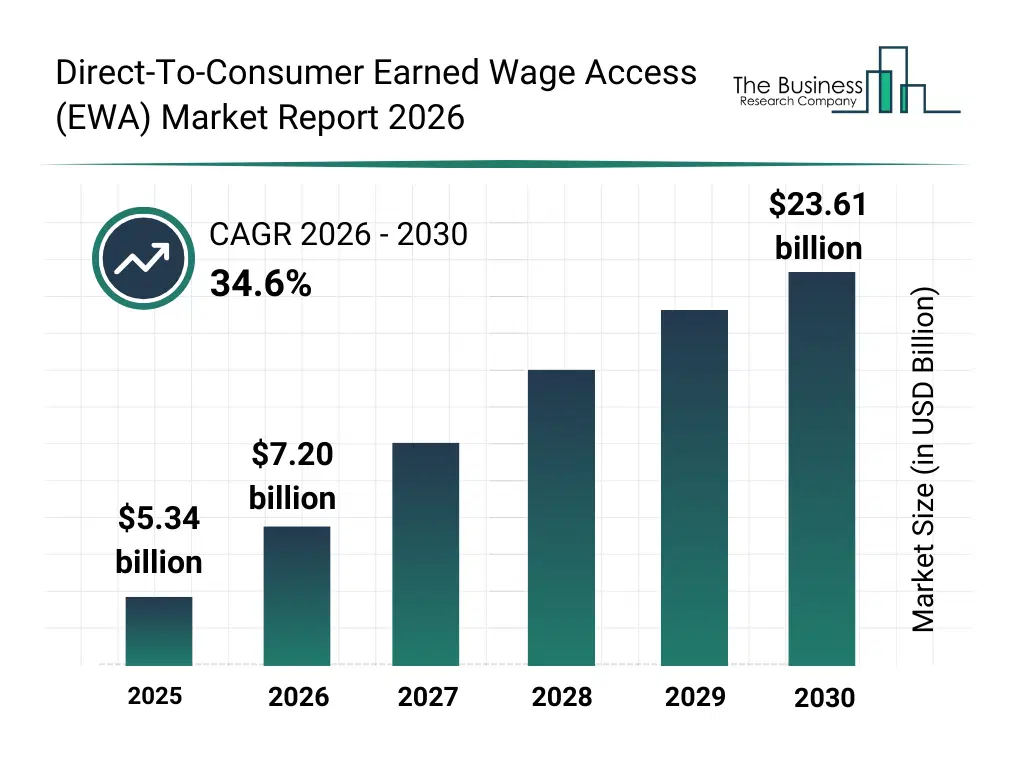
What Is The Direct-To-Consumer Earned Wage Access (EWA) Market Size and Share 2026?
The direct-to-consumer earned wage access (EWA) market size has grown exponentially in recent years. It will grow from $5.34 billion in 2025 to $7.20 billion in 2026 at a compound annual growth rate (CAGR) of 34.8%. The growth in the historic period can be attributed togrowing demand for financial flexibility, increasing adoption of digital payment solutions, rising awareness of wage access benefits, expansion of fintech platforms, and growing consumer preference for instant payout options.What Is The Direct-To-Consumer Earned Wage Access (EWA) Market Growth Forecast?
The direct-to-consumer earned wage access (EWA) market size is expected to see exponential growth in the next few years. It will grow to $23.61 billion in 2030 at a compound annual growth rate (CAGR) of 34.6%. The growth in the forecast period can be attributed to increasing integration with embedded finance and neobanks, rising adoption among gig and hourly workers, growing focus on financial wellness solutions, expansion of partnerships with fintech and payroll providers, and rise in demand for no-fee and seamless wage access. Major trends in the forecast period include technology-driven platform innovations, advancements in real-time payment processing, developments in secure and automated payroll integrations, rising research and development in financial data analytics, and innovation in user experience and mobile app functionalities.
Global Direct-To-Consumer Earned Wage Access (EWA) Market Segmentation
1) By Component Type: Solutions, Services 2) By Pricing Model: Subscription Fees, Transaction Fees, Voluntary Tips, Hybrid Pricing Models 3) By Delivery Model: Standalone Earned Wage Access Applications, Bank And Financial Technology Integrated Earned Wage Access, Gig Economy And Platform Worker Earned Wage Access 4) By Target User Profile: Gig Workers, Freelancers, Hourly Workers, Employees Without Employer Sponsored Wage Access, Users Requiring Small Dollar Frequent Access 5) By Vertical: Retail, Healthcare, Manufacturing, Information Technology And Telecom, Travel And Transportation, Hospitality, Other Verticals Subsegments: 1) By Solutions: Mobile Application Solutions, Web Platform Solutions, Payroll Integration Solutions 2) By Services: Financial Education Services, Customer Support Services, Compliance And Risk Management ServicesWhat Is The Driver Of The Direct-To-Consumer Earned Wage Access (EWA) Market?
The growing digital banking adoption is expected to propel the growth of the direct-to-consumer earned wage access (EWA) market going forward. Digital banking adoption refers to the increasing use of online and mobile banking platforms that enable individuals to access financial services, manage accounts, and execute transactions remotely without visiting physical branches. The rise in digital banking adoption is due to growing smartphone penetration and consumer preference for convenient, fast, and secure financial solutions. Direct-to-consumer earned wage access (EWA) solutions support digital banking adoption by providing employees with instant access to earned wages, seamless integration with digital bank accounts, and improved financial flexibility, reducing reliance on traditional payroll cycles. For instance, in January 2024, according to the European Central Bank, a Germany-based monetary authority, e-money payment transactions in the euro area rose by 6.9% to 4.4 billion in the first half of 2023 compared with the first half of 2022, with the value increasing by 7.0% to about $220 billion (€0.2 trillion), and 9% of these transactions were made using cards storing electronic money while 91% were made through electronic money accounts, reflecting an 11% to 89% value split. Therefore, the growing digital banking adoption is driving the growth of the direct-to-consumer earned wage access (EWA) industry.Key Players In The Global Direct-To-Consumer Earned Wage Access (EWA) Market
Major companies operating in the direct-to-consumer earned wage access (ewa) market are Chime Financial Inc., MoneyLion Inc., Dave Inc., DailyPay Inc., EarnIn, Possible Finance Inc., PayActiv Inc., Branch Messenger Inc., Cleo AI Ltd., CASHe, Payflow Digital S.L., FloatMe Corp., Vola Finance Inc., Refyne Tech Pvt. Ltd., Hastee Technologies Ltd., Klover Holdings Inc., KarmaLife AI Technologies Pvt. Ltd., MyPayNow Pty Ltd., Empower Finance Inc., SoLo Funds Inc.
This chart is for illustrative purposes; the full report includes a detailed competitor analysis and comprehensive overview of the top 10 companies in the market.
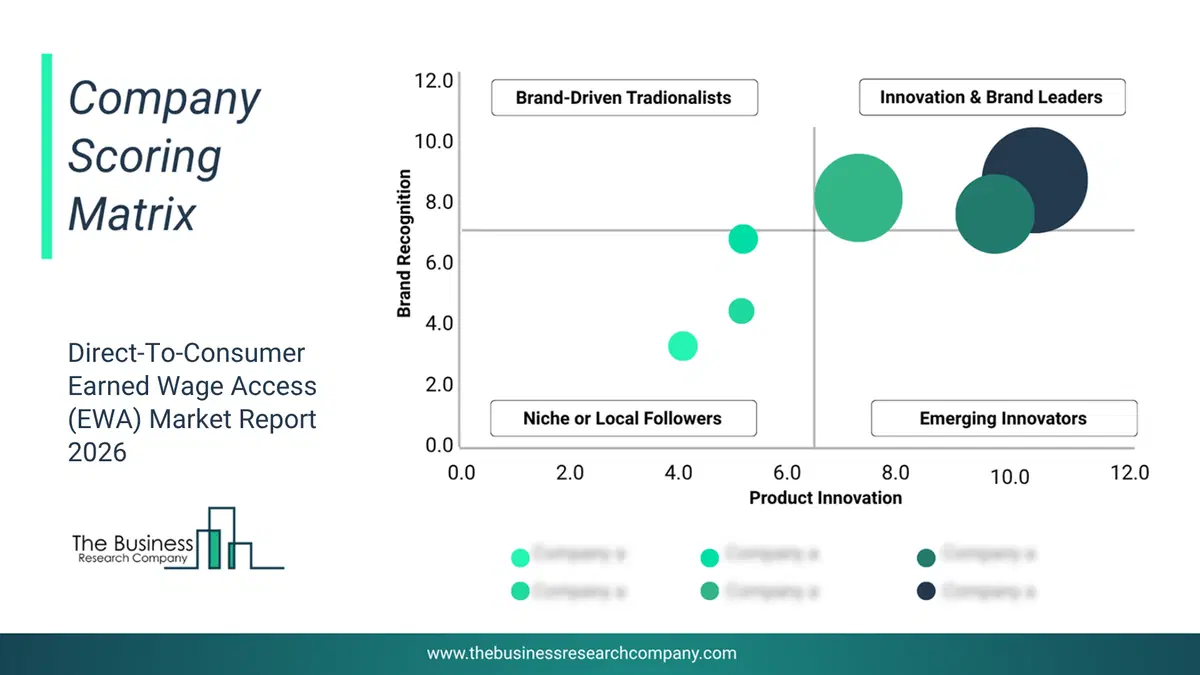
This chart maps companies by product innovation and brand strength, with bubble size indicating relative revenue, helping identify market leaders, challengers, and niche players. This is an illustrative chart; the full report provides a complete and accurate competitive analysis.
Global Direct-To-Consumer Earned Wage Access (EWA) Market Trends and Insights
Major companies operating in the direct-to-consumer earned wage access (EWA) market are focusing on advanced technology, such as leveraging artificial Intelligence (AI)-driven platforms, to facilitate instant, fee-free wage disbursements. Artificial Intelligence (AI)-driven platforms refer to integrated software or hardware environments that use machine learning models to automatically analyze data make predictions and drive decisions or workflows. For instance, in October 2025, WorkWhile, a US-based flexible labor platform, launched the Real-Time Pay feature to all workers on its platform. The feature is designed to allow workers to access their earned wages the day after completing a shift at no cost, effectively bypassing standard bi-weekly pay cycles to help users avoid high-interest debt and payday loans. The solution also provides a worker-centric financial tool that aligns with the company's "Living Paycheck-to-Paycheck Is Dead" campaign, aiming to improve retention and job satisfaction by prioritizing immediate financial stability for the hourly workforce.What Are Latest Mergers And Acquisitions In The Direct-To-Consumer Earned Wage Access (EWA) Market?
In June 2025, Zellis Group, a UK-based provider of human resources, workforce management, payroll, and benefits solutions, acquired Hastee Technologies HR Ltd. for an undisclosed amount. With this acquisition, Zellis aimed to integrate earned wage access (EWA) and broader financial wellbeing capabilities of Hastee, directly into its artificial intelligence (AI)-enabled human resources and payroll platforms so that employers can improve employee financial health, reduce money-related stress, and enhance talent retention. Hastee Technologies HR Ltd. is a UK-based employee benefit platform that allows workers to get real-time wage acccess, also known as the earned wage access (EWA).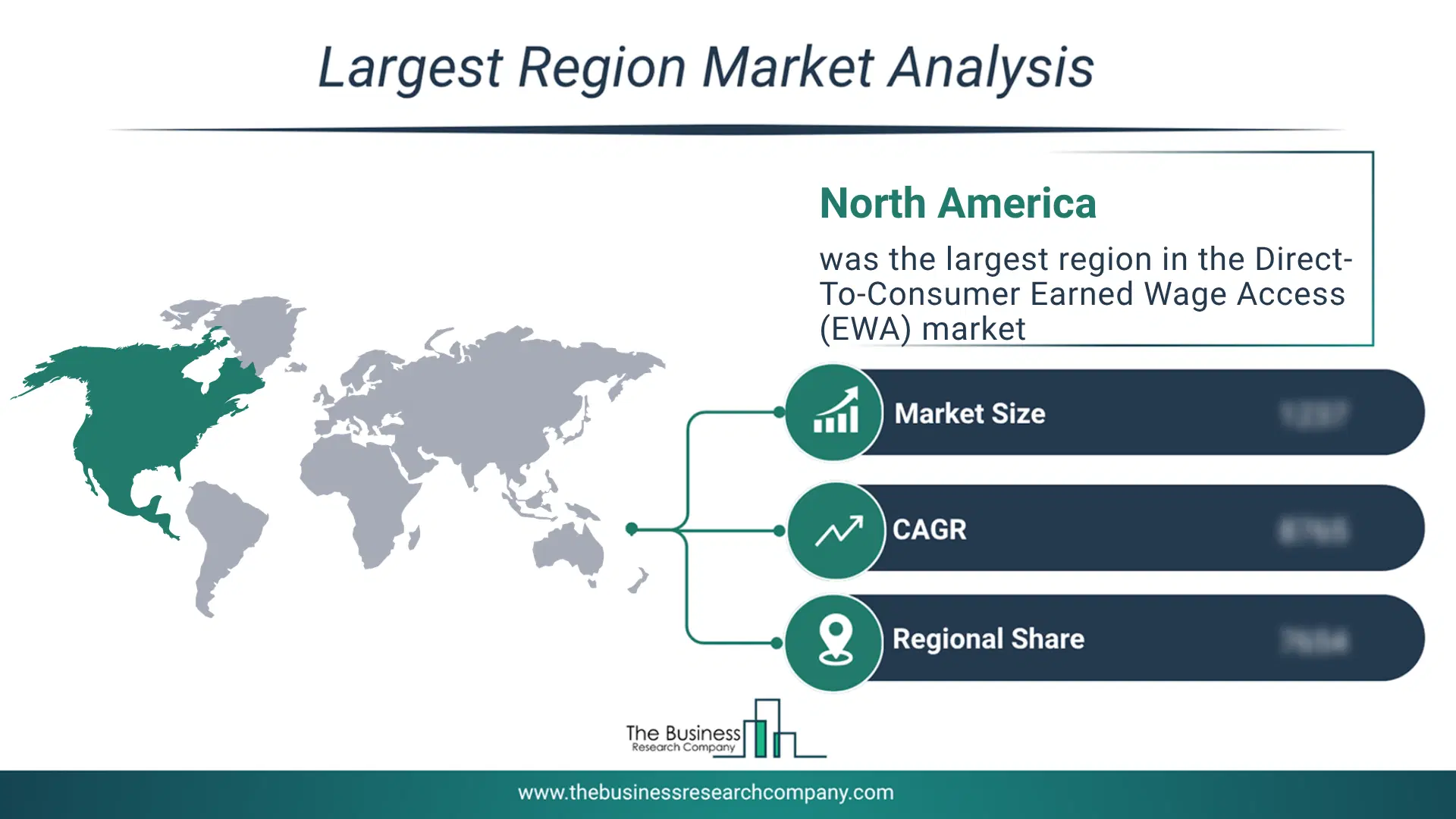
Regional Insights
North America was the largest region in the direct-to-consumer earned wage access (EWA) market in 2025. Asia-Pacific is expected to be the fastest-growing region in the forecast period. The regions covered in this market report are Asia-Pacific, South East Asia, Western Europe, Eastern Europe, North America, South America, Middle East, Africa. The countries covered in this market report are Australia, Brazil, China, France, Germany, India, Indonesia, Japan, Taiwan, Russia, South Korea, UK, USA, Canada, Italy, Spain.What Defines the Direct-To-Consumer Earned Wage Access (EWA) Market?
The direct-to-consumer earned wage access (EWA) market consists of revenues earned by entities by providing services such as on-demand wage withdrawal platforms, instant wage access applications, subscription-based wage access tools, automated wage-tracking systems, and consumer financial wellness integrations. The market value includes the value of related goods sold by the service provider or included within the service offering. The direct-to-consumer earned wage access market also includes sales of digital wage-access software, payment processing infrastructure, data integration tools, and financial management tool. Values in this market are ‘factory gate’ values, that is, the value of goods and services sold by the providers or creators, whether to other entities (including downstream financial partners, distributors, and technology integrators) or directly to end customers. The value of goods and services in this market includes related services sold by the creators.How is Market Value Defined and Measured?
The market value is defined as the revenues that enterprises gain from the sale of goods and/or services within the specified market and geography through sales, grants, or donations in terms of the currency (in USD unless otherwise specified). The revenues for a specified geography are consumption values that are revenues generated by organizations in the specified geography within the market, irrespective of where they are produced. It does not include revenues from resales along the supply chain, either further along the supply chain or as part of other products.
This chart presents market attractiveness based on a quantitative evaluation of growth, competition, strategic alignment, and risk, offering a clear view of opportunity areas for decision-making. This chart is for illustrative purposes; the full report contains the complete analysis.

This chart highlights the Total Addressable Market (TAM) by estimating the maximum revenue opportunity using an assumption-driven approach, supporting strategic planning and opportunity sizing across markets. The chart is illustrative; the full report provides a more comprehensive analysis.
What Key Data and Analysis Are Included in the Direct-To-Consumer Earned Wage Access (EWA) Market Report 2026?
The direct-to-consumer earned wage access (ewa) market research report is one of a series of new reports from The Business Research Company that provides market statistics, including industry global market size, regional shares, competitors with the market share, detailed market segments, market trends and opportunities, and any further data you may need to thrive in the direct-to-consumer earned wage access (ewa) industry. The market research report delivers a complete perspective of everything you need, with an in-depth analysis of the current and future state of the industry.Direct-To-Consumer Earned Wage Access (EWA) Market Report Forecast Analysis
| Report Attribute | Details |
|---|---|
| Market Size Value In 2026 | $7.20 billion |
| Revenue Forecast In 2030 | $23.61 billion |
| Growth Rate | CAGR of 34.8% from 2026 to 2030 |
| Base Year For Estimation | 2025 |
| Actual Estimates/Historical Data | 2020-2025 |
| Forecast Period | 2026 - 2030 |
| Market Representation | Revenue in USD Billion and CAGR from 2026 to 2030 |
| Segments Covered | Component Type, Pricing Model, Delivery Model, Target User Profile, Vertical |
| Regional Scope | Asia-Pacific, Western Europe, Eastern Europe, North America, South America, Middle East, Africa |
| Country Scope | The countries covered in the report are Australia, Brazil, China, France, Germany, India, Indonesia, Japan, Taiwan, Russia, South Korea, UK, USA, Canada, Italy, Spain. |
| Key Companies Profiled | Chime Financial Inc., MoneyLion Inc., Dave Inc., DailyPay Inc., EarnIn, Possible Finance Inc., PayActiv Inc., Branch Messenger Inc., Cleo AI Ltd., CASHe, Payflow Digital S.L., FloatMe Corp., Vola Finance Inc., Refyne Tech Pvt. Ltd., Hastee Technologies Ltd., Klover Holdings Inc., KarmaLife AI Technologies Pvt. Ltd., MyPayNow Pty Ltd., Empower Finance Inc., SoLo Funds Inc. |
| Customization Scope | Request for Customization |
| Pricing And Purchase Options | Explore Purchase Options |