
Disaster Preparedness Systems Market Report 2026
Global Outlook – By Type (Emergency Or Mass Notification System, Surveillance System, Safety Management System, Earthquake Or Seismic Warning System, Disaster Recovery And Backup Systems, Other Types), By Solutions (Geospatial Solutions, Disaster Recovery Solutions, Situational Awareness Solutions), By Services (Training And Education Services, Consulting Services, Design And Integration Services, Support And Maintenance Services), By Communication Technology (First Responder Tools, Satellite Phones, Emergency Response Radars, Vehicle-Ready Gateways, Other Communication Technologies), By End-use (Banking, Financial Services And Insurance (BFSI), Healthcare, Other End-uses) – Market Size, Trends, Strategies, and Forecast to 2030
Disaster Preparedness Systems Market Overview
• Disaster Preparedness Systems market size has reached to $217.35 billion in 2025 • Expected to grow to $319.16 billion in 2030 at a compound annual growth rate (CAGR) of 8% • Growth Driver: Rising Frequency Of Natural Disasters Fuels Growth In The Disaster Preparedness System Market • Market Trend: Disaster Preparedness Market Growth Through Advanced Technologies and Innovative Solutions • North America was the largest region in 2025 and Asia-Pacific is the fastest growing region.What Is Covered Under Disaster Preparedness Systems Market?
Disaster preparedness systems are a combination of plans, procedures, and resources that individuals, communities, and organizations put in place to anticipate, respond to, and recover from disasters. It is designed to minimize the impact of disasters on people, property, and the environment. The main types of disaster preparedness systems are emergency or mass notification system, surveillance system, safety management system, earthquake or seismic warning system, disaster recovery and backup systems, and others. Emergency or mass notification systems are designed to quickly and effectively communicate critical information to a large group of people during emergencies or other significant events. The solutions include geospatial solutions, disaster recovery solutions, and situational awareness solutions and services such as training and education services, consulting services, design and integration services, and support and maintenance services. The communication technologies such as first responder tools, satellite phones, emergency response radars, vehicle-ready gateways, others are used by banking, financial services and insurance (BFSI), energy and utilities, aerospace and defense, manufacturing, information technology (IT) and telecom, public sector, transportation and logistics, healthcare, and others.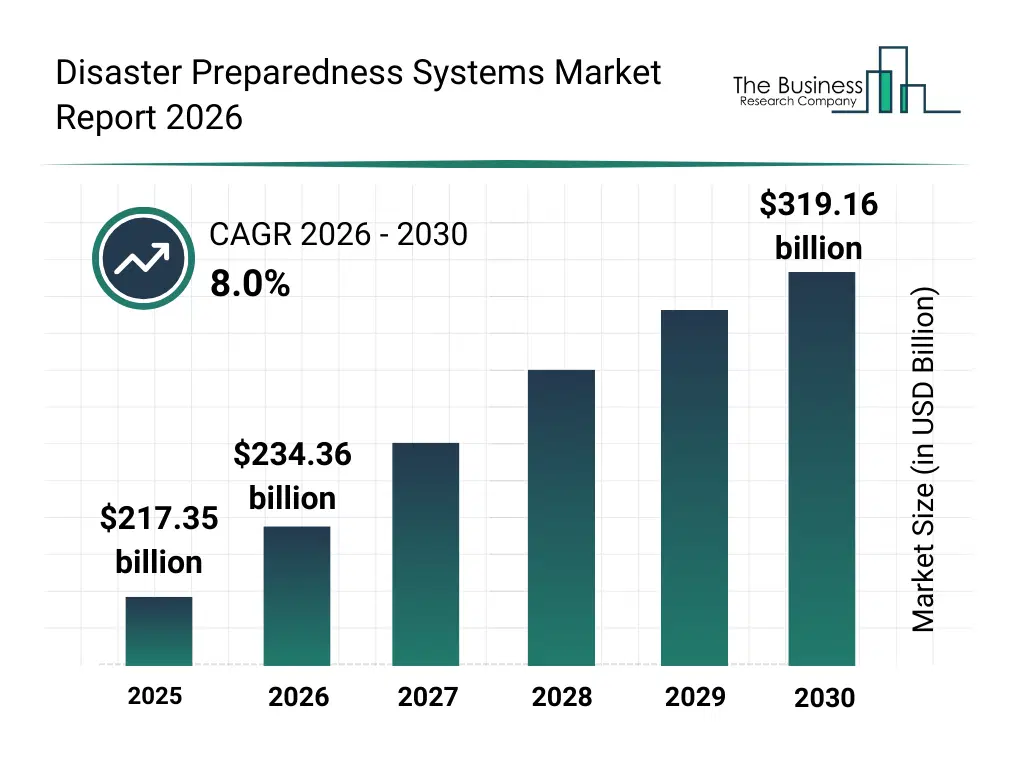
What Is The Disaster Preparedness Systems Market Size and Share 2026?
The disaster preparedness systems market size has grown strongly in recent years. It will grow from $217.35 billion in 2025 to $234.36 billion in 2026 at a compound annual growth rate (CAGR) of 7.8%. The growth in the historic period can be attributed to rising frequency of natural disasters, increasing awareness of disaster risks, early establishment of preparedness programs, growing public safety concerns, increasing government disaster initiatives.What Is The Disaster Preparedness Systems Market Growth Forecast?
The disaster preparedness systems market size is expected to see strong growth in the next few years. It will grow to $319.16 billion in 2030 at a compound annual growth rate (CAGR) of 8.0%. The growth in the forecast period can be attributed to rising investment in preparedness infrastructure, growing emphasis on disaster resilience, increasing focus on minimizing losses, expanding institutional preparedness planning, rising strategic risk management adoption. Major trends in the forecast period include increasing emphasis on community disaster readiness, rising demand for effective emergency response planning, growing focus on public safety and risk mitigation, expansion of disaster education and preparedness training, strengthening institutional and organizational preparedness systems.
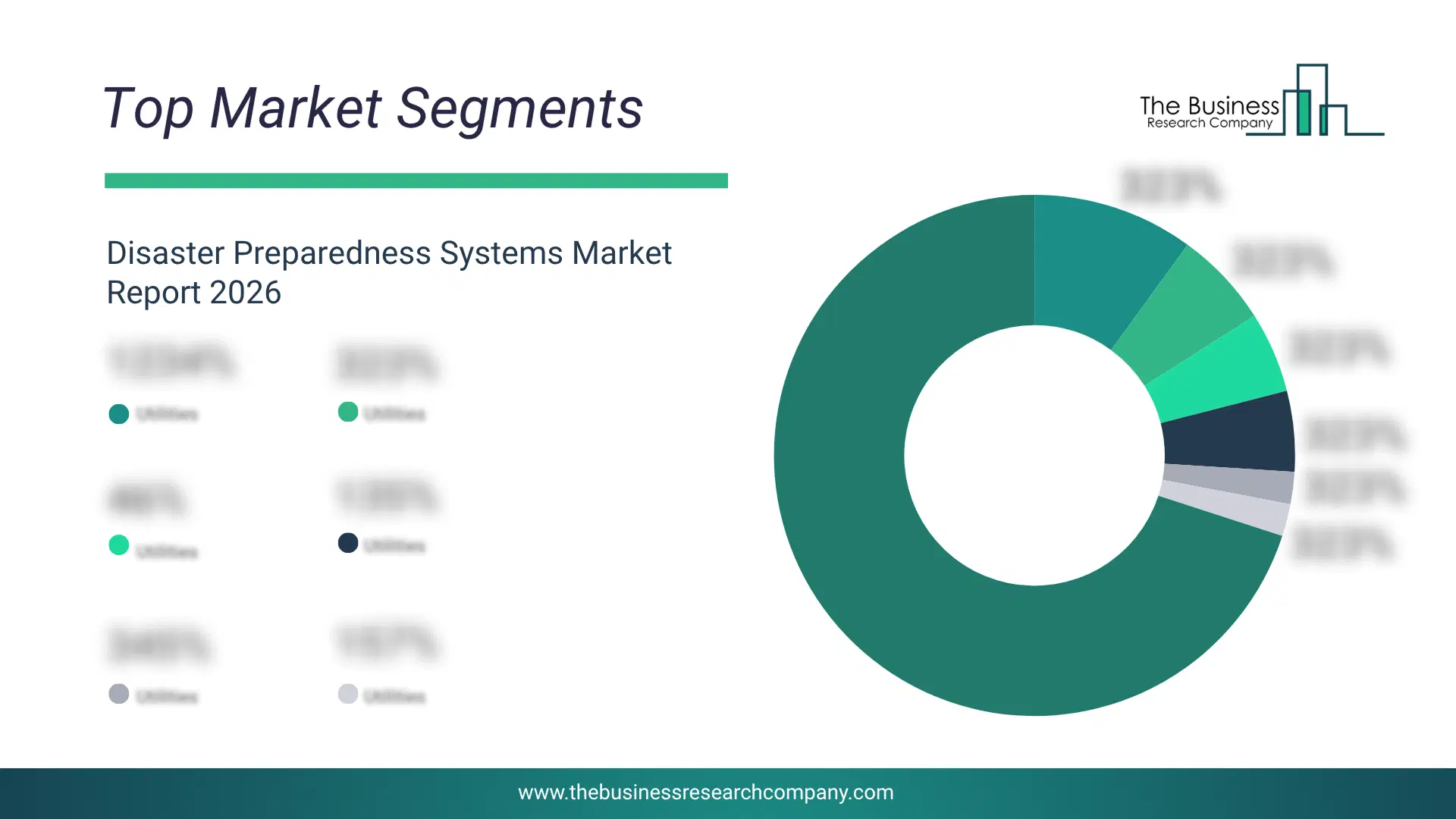
Global Disaster Preparedness Systems Market Segmentation
1) By Type: Emergency Or Mass Notification System, Surveillance System, Safety Management System, Earthquake Or Seismic Warning System, Disaster Recovery And Backup Systems, Other Types 2) By Solutions: Geospatial Solutions, Disaster Recovery Solutions, Situational Awareness Solutions 3) By Services: Training And Education Services, Consulting Services, Design And Integration Services, Support And Maintenance Services 4) By Communication Technology: First Responder Tools, Satellite Phones, Emergency Response Radars, Vehicle-Ready Gateways, Other Communication Technologies 5) By End-use: Banking, Financial Services And Insurance (BFSI), Energy And Utilities, Aerospace And Defense, Manufacturing, Information Technology (IT) And Telecom, Public Sector, Transportation And Logistics, Healthcare, Other End-uses Subsegments: 1) By Emergency Or Mass Notification System: Alert And Warning Systems, Public Address Systems, Mobile Alert Systems 2) By Surveillance System: Video Surveillance Systems, Remote Monitoring Systems, Access Control Systems 3) By Safety Management System: Incident Management Systems, Risk Assessment Tools, Safety Audit And Compliance Tools 4) By Earthquake or Seismic Warning System: Ground Motion Sensors, Early Warning Systems, Data Analysis And Visualization Tools 5) By Disaster Recovery and Backup Systems: Data Backup Solutions, Business Continuity Planning Tools, Cloud Disaster Recovery Solutions 6) By Other Types: Training And Simulation Tools, Emergency Response Planning Software, Resource Management SystemsWhat Is The Driver Of The Disaster Preparedness Systems Market?
The rise in the frequency of natural disasters is expected to propel the growth of the disaster preparedness system market going forward. A natural disaster is a highly harmful impact on a society or community following a natural hazard like earthquakes, hurricanes, floods, or other natural events. The disaster preparedness system helps to reduce the frequency of natural disasters by providing various solutions and tools to communities, organizations, and individuals to prepare for, respond to, and recover from disasters more effectively. For instance, in January 2024, according to the National Centers for Environmental Information (NCEI), a US-based government agency, in 2022, the U.S. faced 18 distinct weather and climate disasters, each causing at least $1 billion in damages. In 2023, this number increased to 28 such disasters. Therefore, the rise in the frequency of natural disasters is driving the growth of the disaster preparedness system industry.Key Players In The Global Disaster Preparedness Systems Market
Major companies operating in the disaster preparedness systems market report are Siemens AG, The Lockheed Martin Corporation, Airbus SE, International Business Machines Corporation, Honeywell International Inc., Johnson Controls International plc, NEC Corporation, Asahi Kasei Corporation, Eaton Corporation, Motorola Solutions Inc., Kumho Petrochemical Co. Ltd., Kuraray Co.Ltd., JSR Corporation, Avient Corporation, Denka Company Limited, Lee Chang Yung Chemical Industry Corp., Blackboard Inc., Everbridge Inc., OnSolve LLC, Singlewire Software LLC, Juvare, Alertus Technologies LLC, CrisisGo Inc.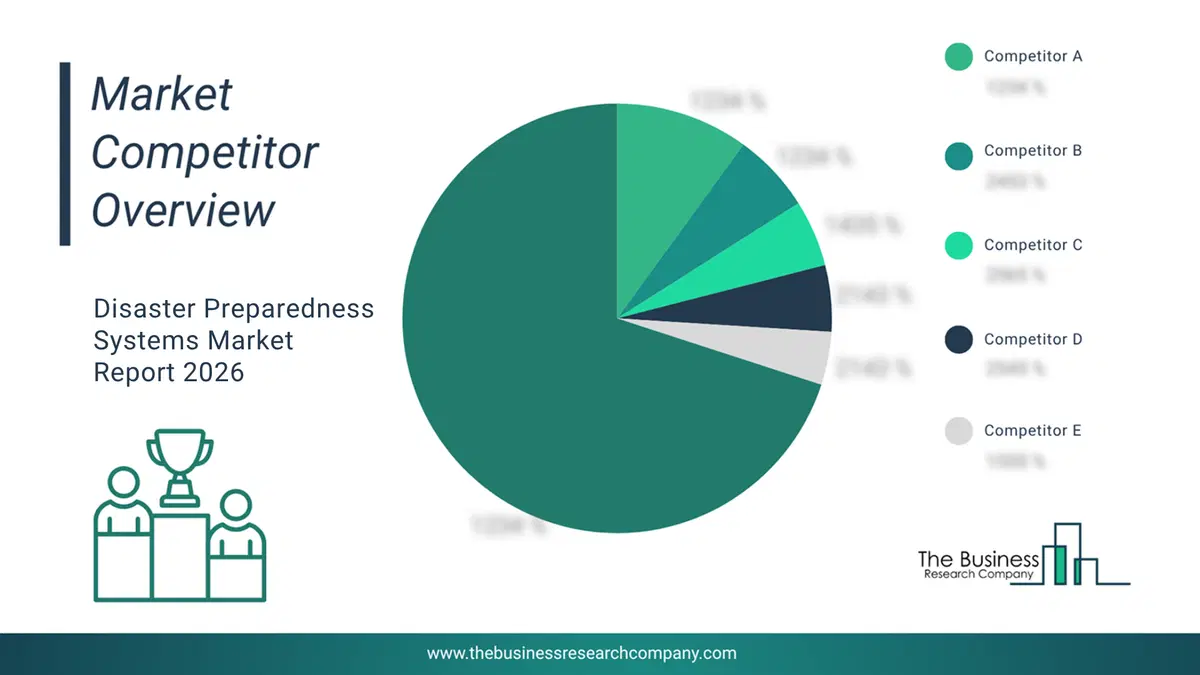
This chart is for illustrative purposes; the full report includes a detailed competitor analysis and comprehensive overview of the top 10 companies in the market.
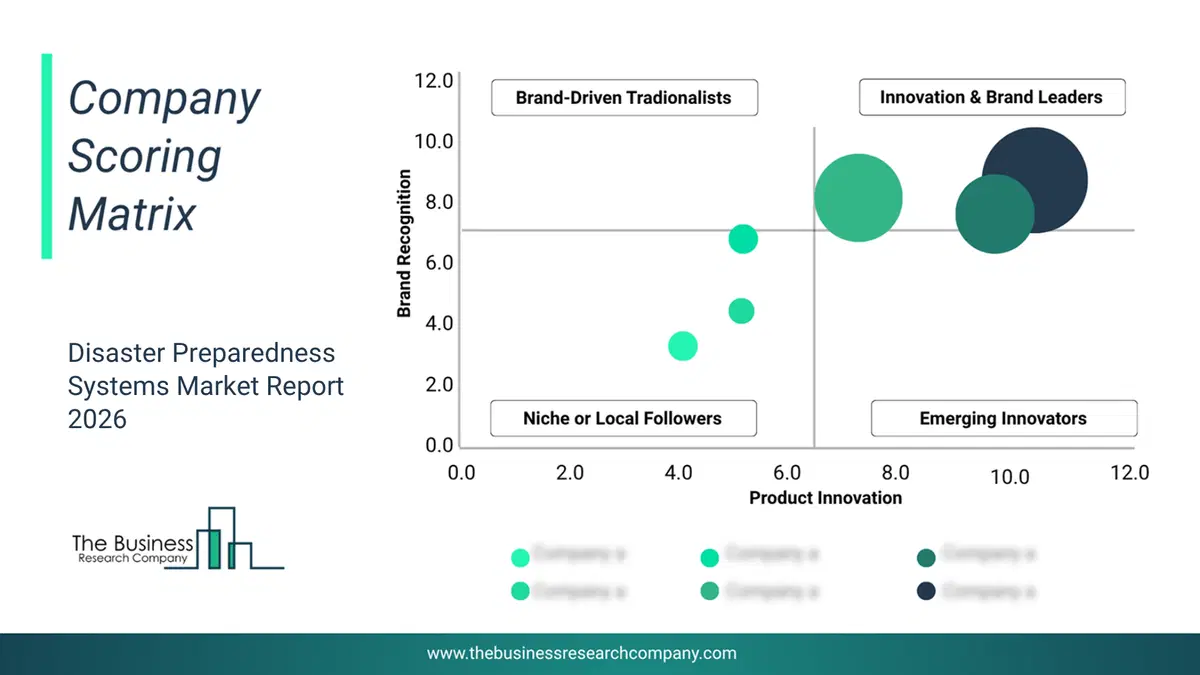
This chart maps companies by product innovation and brand strength, with bubble size indicating relative revenue, helping identify market leaders, challengers, and niche players. This is an illustrative chart; the full report provides a complete and accurate competitive analysis.
Global Disaster Preparedness Systems Market Trends and Insights
Major companies operating in the disaster preparedness system market are focusing on innovative products, such as disaster recovery portfolio solutions, to sustain their position in the market. A disaster recovery portfolio solution is a comprehensive set of policies, tools, and processes used to recover or continue operations of critical IT infrastructure, software, and systems after a natural or human-made disaster. For instance, in March 2023, Huawei Technologies Co. Ltd., a China-based technology corporation, launched Storage and Optical Connection Coordination (SOCC), a unified disaster recovery portfolio solution. It is designed to solve service losses and ensure the swift recovery of operations. SOCC is the industry's first solution that combines storage and optical networks to provide a unified disaster recovery portfolio solution. Its main goal is to reduce data loss and avoid business interruptions in the event of calamities like earthquakes or fires.What Are Latest Mergers And Acquisitions In The Disaster Preparedness Systems Market?
In July 2024, Thoma Bravo LP, a US-based equity firm, acquired Everbridge, Inc., for $1.8 billion. Through this acquisition, Thoma Bravo aims to enhance Everbridge’s emergency-alert, public-warning, and disaster-response technology solutions used by governments and enterprises worldwide, making the transaction directly relevant to the disaster preparedness systems market. Everbridge Inc. is a US-based company that provides comprehensive Disaster Preparedness and Critical Event Management (CEM) systems.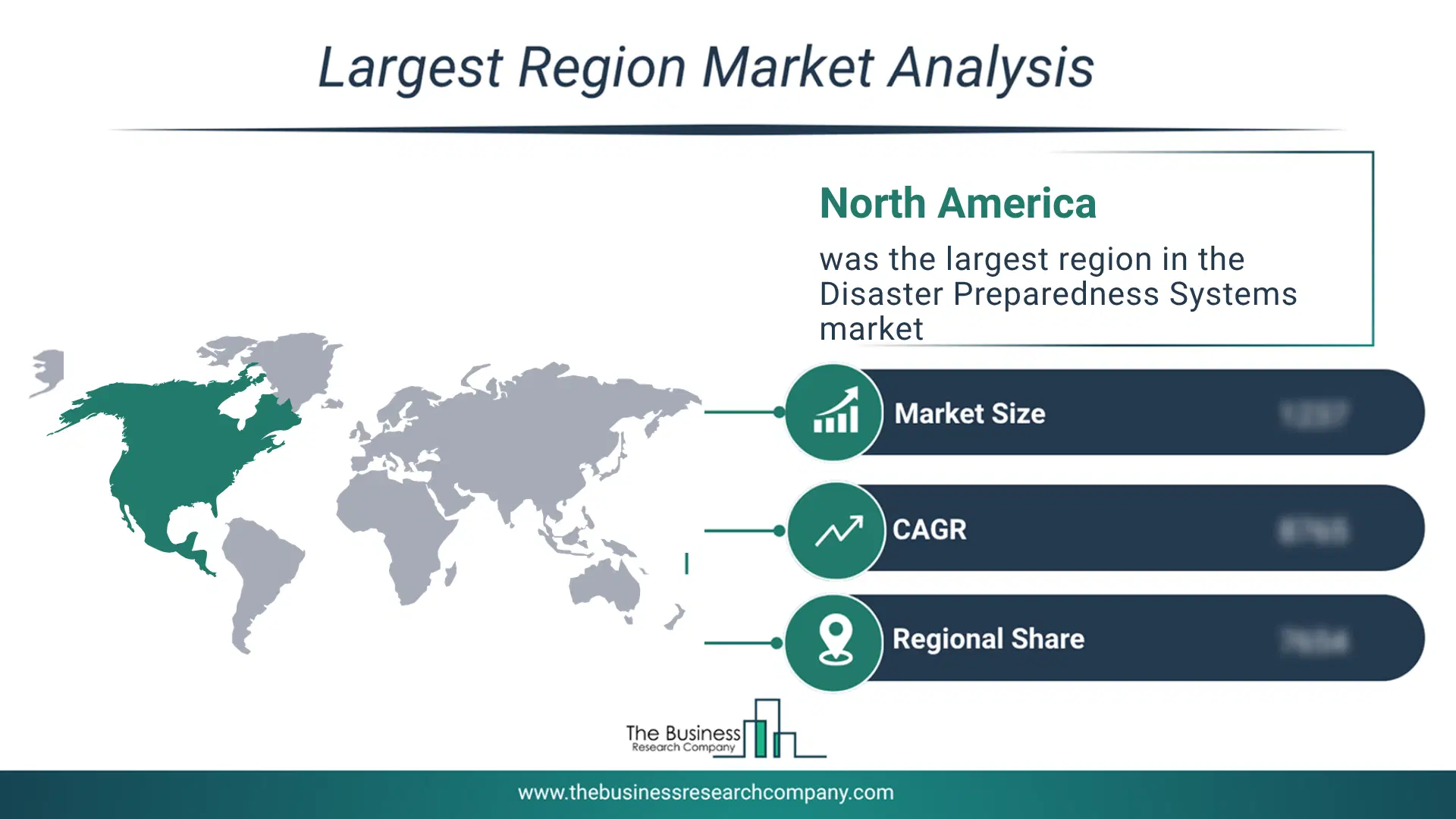
Regional Outlook
North America was the largest region in the disaster preparedness systems market in 2025. Asia-Pacific is expected to be the fastest-growing region in the forecast period. The regions covered in this market report are Asia-Pacific, South East Asia, Western Europe, Eastern Europe, North America, South America, Middle East, Africa. The countries covered in this market report are Australia, Brazil, China, France, Germany, India, Indonesia, Japan, Taiwan, Russia, South Korea, UK, USA, Canada, Italy, SpainWhat Defines the Disaster Preparedness Systems Market?
The disaster preparedness systems market includes revenues earned by entities by providing services such as risk assessment and planning, early warning systems, emergency communication systems, infrastructure resilience, emergency shelter solutions, post-disaster recovery services. The market value includes the value of related goods sold by the service provider or included within the service offering. The disaster preparedness systems market consists of sales of communication equipment, power generation equipment, water purification equipment and navigation equipment. Values in this market are ‘factory gate’ values, that is the value of goods sold by the manufacturers or creators of the goods, whether to other entities (including downstream manufacturers, wholesalers, distributors, and retailers) or directly to end customers. The value of goods in this market includes related services sold by the creators of the goods.How is Market Value Defined and Measured?
The market value is defined as the revenues that enterprises gain from the sale of goods and/or services within the specified market and geography through sales, grants, or donations in terms of the currency (in USD unless otherwise specified). The revenues for a specified geography are consumption values that are revenues generated by organizations in the specified geography within the market, irrespective of where they are produced. It does not include revenues from resales along the supply chain, either further along the supply chain or as part of other products.
This chart presents market attractiveness based on a quantitative evaluation of growth, competition, strategic alignment, and risk, offering a clear view of opportunity areas for decision-making. This chart is for illustrative purposes; the full report contains the complete analysis.

This chart highlights the Total Addressable Market (TAM) by estimating the maximum revenue opportunity using an assumption-driven approach, supporting strategic planning and opportunity sizing across markets. The chart is illustrative; the full report provides a more comprehensive analysis.
What Key Data and Analysis Are Included in the Disaster Preparedness Systems Market Report 2026?
The disaster preparedness systems market research report is one of a series of new reports from The Business Research Company that provides market statistics, including industry global market size, regional shares, competitors with the market share, detailed market segments, market trends and opportunities, and any further data you may need to thrive in the disaster preparedness systems industry. The market research report delivers a complete perspective of everything you need, with an in-depth analysis of the current and future state of the industry.Disaster Preparedness Systems Market Report Forecast Analysis
| Report Attribute | Details |
|---|---|
| Market Size Value In 2026 | $234.36 billion |
| Revenue Forecast In 2030 | $319.16 billion |
| Growth Rate | CAGR of 7.8% from 2026 to 2030 |
| Base Year For Estimation | 2025 |
| Actual Estimates/Historical Data | 2020-2025 |
| Forecast Period | 2026 - 2030 - 2030 |
| Market Representation | Revenue in USD Billion and CAGR from 2026 to 2030 |
| Segments Covered | Type, Solutions, Services, Communication Technology, End-use |
| Regional Scope | Asia-Pacific, Western Europe, Eastern Europe, North America, South America, Middle East, Africa |
| Country Scope | The countries covered in the report are Australia, Brazil, China, France, Germany, India, Indonesia, Japan, Taiwan, Russia, South Korea, UK, USA, Canada, Italy, Spain. |
| Key Companies Profiled | Siemens AG, The Lockheed Martin Corporation, Airbus SE, International Business Machines Corporation, Honeywell International Inc., Johnson Controls International plc, NEC Corporation, Asahi Kasei Corporation, Eaton Corporation, Motorola Solutions Inc., Kumho Petrochemical Co. Ltd., Kuraray Co.Ltd., JSR Corporation, Avient Corporation, Denka Company Limited, Lee Chang Yung Chemical Industry Corp., Blackboard Inc., Everbridge Inc., OnSolve LLC, Singlewire Software LLC, Juvare, Alertus Technologies LLC, CrisisGo Inc. |
| Customization Scope | Request for Customization |
| Pricing And Purchase Options | Explore Purchase Options |