

Disaster Recovery Software Market Report 2026
Global Outlook – By Deployment Type (On-Premise, Cloud), By Organization Size (Large Enterprises, Small And Medium-Sized Enterprises), By Application (Application Backup, Email Backup, Media Storage Backup), By Vertical (Telecommunication And Information Technology (IT)-Enabled Services, Banking, Financial Services, And Insurance, Media And Entertainment, Other Verticals) – Market Size, Trends, Strategies, and Forecast to 2030
Disaster Recovery Software Market Overview
• Disaster Recovery Software market size has reached to $12.83 billion in 2025 • Expected to grow to $26.2 billion in 2030 at a compound annual growth rate (CAGR) of 14.8% • Growth Driver: Increasing Concern For Data Security Fuels Growth In The Disaster Recovery Software • Market Trend: New Disaster Recovery Feature Strengthens Database Resilience • North America was the largest region in 2025 and Asia-Pacific is the fastest growing region.What Is Covered Under Disaster Recovery Software Market?
Disaster recovery software refers to a specialized type of software designed to help organizations recover data, applications, and systems in the event of a disaster or disruptive event. This software is used to minimize downtime and data loss by facilitating the rapid recovery of critical IT infrastructure components. The main types of deployment of disaster recovery software are on-premise and cloud. On-premise deployment refers to installing and running software on servers and hardware located within the organization's premises or data center. It is used in various organizational sizes, including large enterprises and small and medium-sized enterprises, for various applications, including application backup, email backup, and media storage backup. It is used by various verticals such as telecommunication and information technology (IT)-enabled services, banking, financial services, and insurance (BFSI), media and entertainment, and others.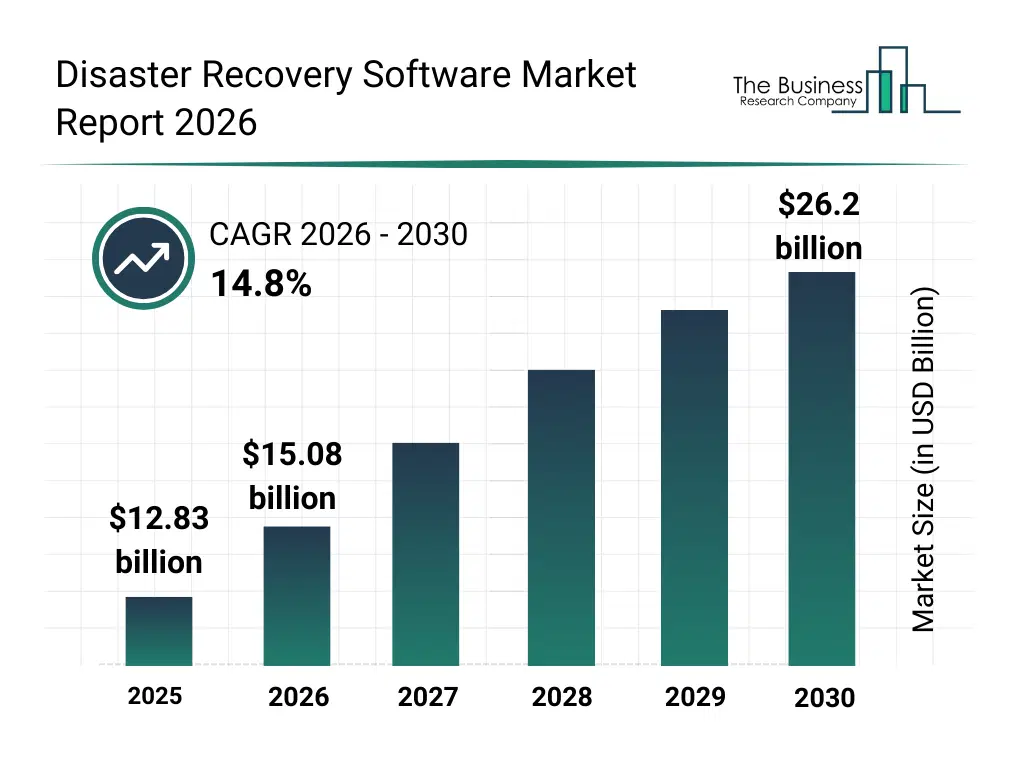
What Is The Disaster Recovery Software Market Size and Share 2026?
The disaster recovery software market size has grown rapidly in recent years. It will grow from $12.83 billion in 2025 to $15.08 billion in 2026 at a compound annual growth rate (CAGR) of 17.5%. The growth in the historic period can be attributed to increasing data volumes, rising frequency of cyberattacks, dependence on legacy on-premise systems, regulatory compliance requirements, growth of enterprise IT infrastructure.What Is The Disaster Recovery Software Market Growth Forecast?
The disaster recovery software market size is expected to see rapid growth in the next few years. It will grow to $26.2 billion in 2030 at a compound annual growth rate (CAGR) of 14.8%. The growth in the forecast period can be attributed to expansion of cloud adoption, demand for cost-efficient recovery solutions, increasing adoption of AI-driven monitoring, integration with it modernization initiatives, growth of smes requiring disaster recovery. Major trends in the forecast period include adoption of hybrid and multi-cloud disaster recovery solutions, automation of backup and recovery processes, real-time monitoring and predictive analytics for downtime prevention, integration with enterprise it service management tools, scalability and rapid deployment of recovery software.
Global Disaster Recovery Software Market Segmentation
1) By Deployment Type: On-Premise, Cloud 2) By Organization Size: Large Enterprises, Small And Medium-Sized Enterprises 3) By Application: Application Backup, Email Backup, Media Storage Backup 4) By Vertical: Telecommunication And Information Technology (IT)-Enabled Services, Banking, Financial Services, And Insurance, Media And Entertainment, Other Verticals Subsegments: 1) By On-Premise: On-Premise Software, On-Premise Hardware 2) By Cloud: Public Cloud, Private Cloud, Hybrid CloudWhat Is The Driver Of The Disaster Recovery Software Market?
The increase in concern for data security among organizations is expected to propel the disaster recovery software market going forward. Data security refers to the protection of digital data from unauthorized access, disclosure, alteration, or destruction throughout its lifecycle. The surge in data security among organizations can be attributed to the growing volume of sensitive data and the rising awareness of the potential financial and reputational damage caused by data breaches. Disaster recovery software ensures data security by facilitating swift restoration of critical information in cases of emergencies. For instance, in July 2024, according to Check Point Software Technologies Ltd., an Israel-based cybersecurity company, cyberattacks on corporate networks rose by 30% in weekly attacks in the second quarter of 2024 compared to the same period in 2023 and a 25% rise from the first quarter of 2024, highlighting the need for data security among organizations. Therefore, the increase in concern for data security among organizations is driving the growth of the disaster recovery software industry.Key Players In The Global Disaster Recovery Software Market
Major companies operating in the disaster recovery software market are IBM; VMware; Veritas Technologies; Veeam Software; Commvault Systems; Rubrik; Acronis; Actifio; Carbonite; Zerto; Arcserve; Druva; StorageCraft; HYCU; Axcient; iLand; Vembu Technologies; Nakivo; Altaro; Bacula Systems; Storix; Asigra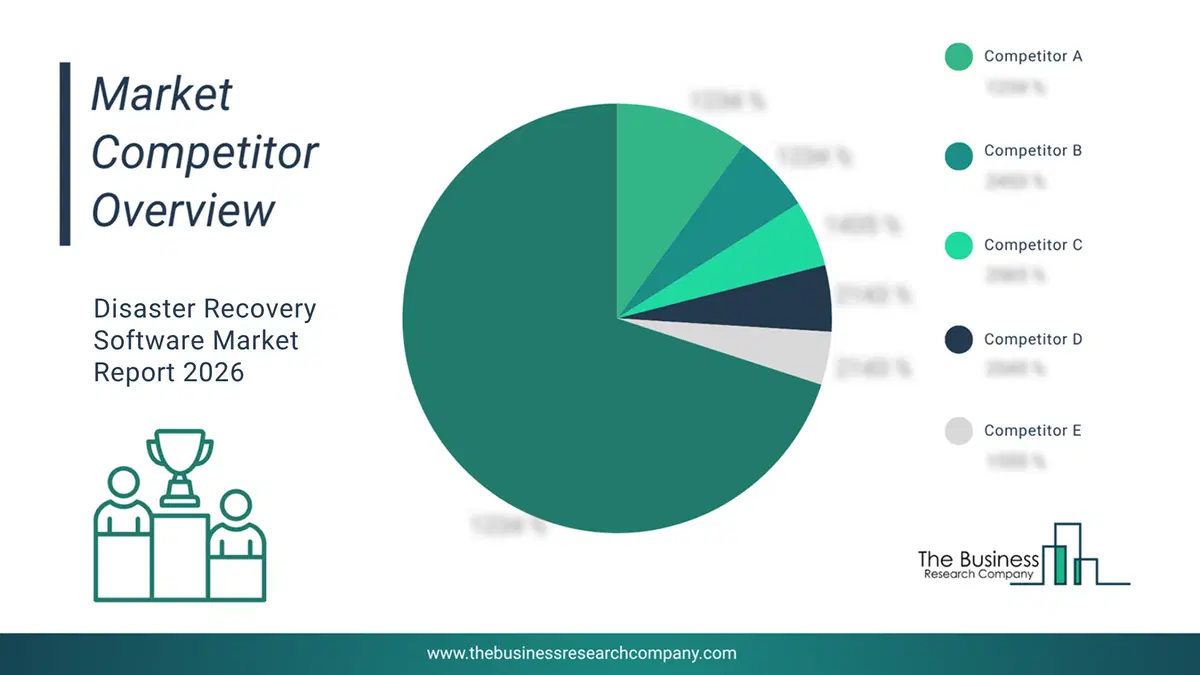
This chart is for illustrative purposes; the full report includes a detailed competitor analysis and comprehensive overview of the top 10 companies in the market.
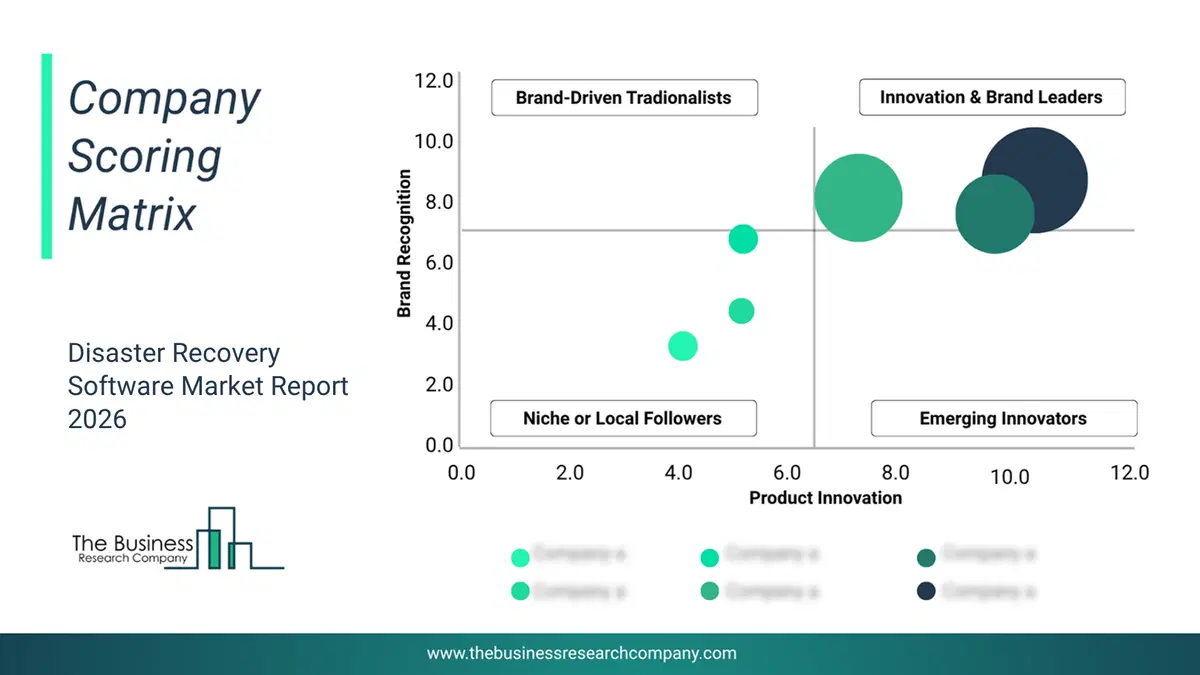
This chart maps companies by product innovation and brand strength, with bubble size indicating relative revenue, helping identify market leaders, challengers, and niche players. This is an illustrative chart; the full report provides a complete and accurate competitive analysis.
Global Disaster Recovery Software Market Trends and Insights
Major companies operating in the disaster recovery software market are focusing on developing technologically advanced solutions, such as delayed replication technology, to enhance data protection and operational resilience. Delayed replication technology refers to a data management approach in which copies of data are intentionally replicated to secondary or backup systems after a predefined delay rather than in real-time. For instance, in November 2025, AWS, a US-based cloud services provider, launched delayed read replicas for Amazon RDS for PostgreSQL, featuring delayed replication technology. This feature enables the creation of standby replicas that retain historical data from minutes or hours in the past. It allows promotion of the replica to a primary instance for rapid recovery, reduces complexity compared to traditional point-in-time restore methods, and supports auditing and forensic analysis. Users can configure the recovery delay using the recovery-min-apply-delay parameter, ensuring a robust, efficient, and near real-time disaster recovery strategy for enterprise databases.What Are Latest Mergers And Acquisitions In The Disaster Recovery Software Market?
In April 2024, Commvault Systems Inc., a US-based provider of cyber resilience and data protection solutions for the hybrid cloud, acquired Appranix Inc. for an undisclosed amount. With this acquisition, Commvault aims to accelerate its ability to automate cloud application recovery and enhance end-to-end cyber resilience for enterprises recovering from outages or attacks. Appranix Inc. is a US-based provider of automated cloud native configuration and dependency recovery services for enterprise applications.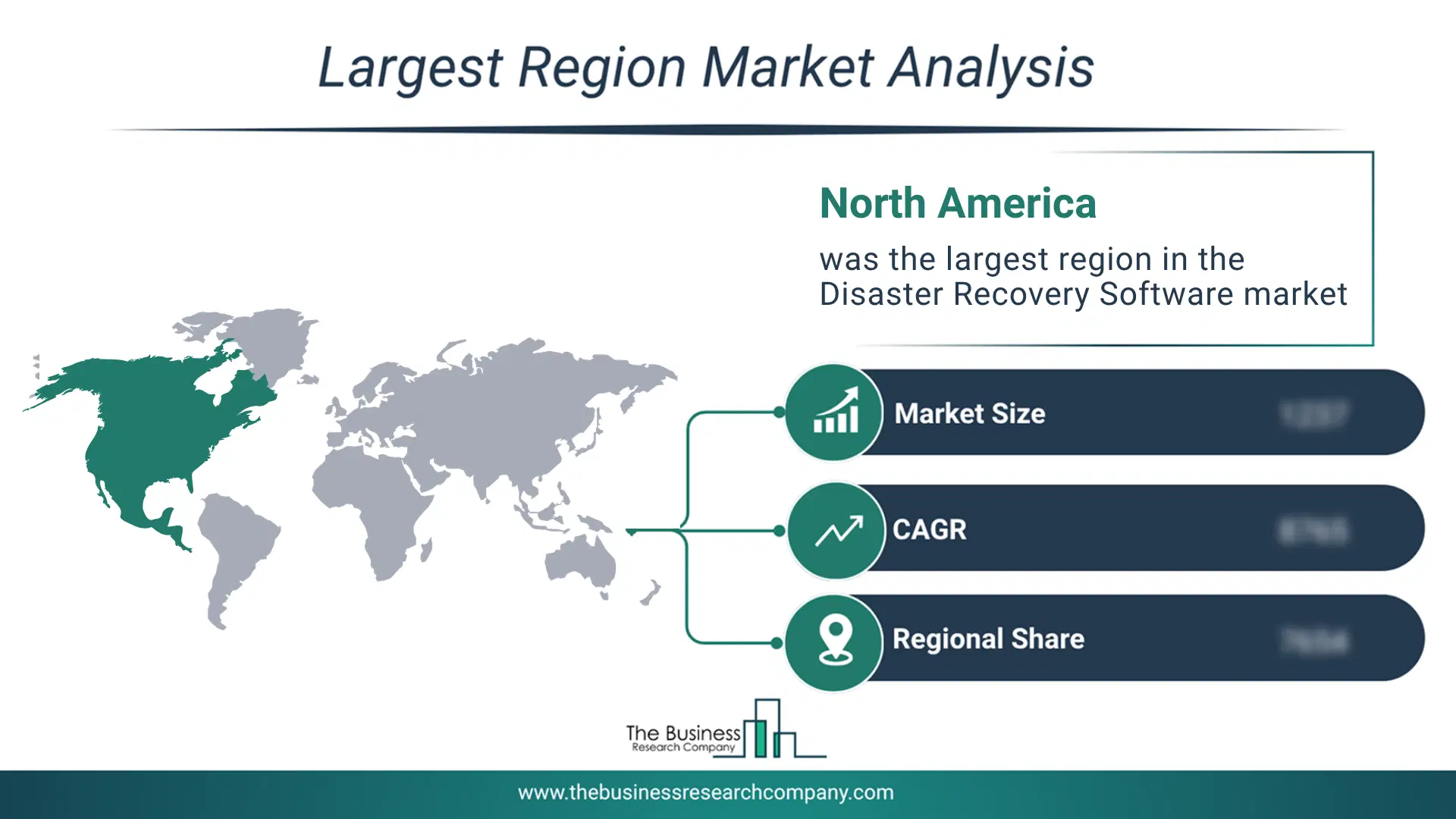
Regional Insights
North America was the largest region in the disaster recovery software market in 2025. Asia-Pacific is expected to be the fastest-growing region in the forecast period. The regions covered in this market report are Asia-Pacific, South East Asia, Western Europe, Eastern Europe, North America, South America, Middle East, Africa. The countries covered in this market report are Australia, Brazil, China, France, Germany, India, Indonesia, Japan, Taiwan, Russia, South Korea, UK, USA, Canada, Italy, SpainWhat Defines the Disaster Recovery Software Market?
The disaster recovery software market includes revenues earned by entities by providing services such as backup and recovery, real-time replication, data protection, and business continuity planning that are used in safeguarding operations. The market value includes the value of related goods sold by the service provider or included within the service offering. Only goods and services traded between entities or sold to end consumers are included.How is Market Value Defined and Measured?
The market value is defined as the revenues that enterprises gain from the sale of goods and/or services within the specified market and geography through sales, grants, or donations in terms of the currency (in USD unless otherwise specified). The revenues for a specified geography are consumption values that are revenues generated by organizations in the specified geography within the market, irrespective of where they are produced. It does not include revenues from resales along the supply chain, either further along the supply chain or as part of other products.
This chart presents market attractiveness based on a quantitative evaluation of growth, competition, strategic alignment, and risk, offering a clear view of opportunity areas for decision-making. This chart is for illustrative purposes; the full report contains the complete analysis.

This chart highlights the Total Addressable Market (TAM) by estimating the maximum revenue opportunity using an assumption-driven approach, supporting strategic planning and opportunity sizing across markets. The chart is illustrative; the full report provides a more comprehensive analysis.
What Key Data and Analysis Are Included in the Disaster Recovery Software Market Report 2026?
The disaster recovery software market research report is one of a series of new reports from The Business Research Company that provides market statistics, including industry global market size, regional shares, competitors with the market share, detailed market segments, market trends and opportunities, and any further data you may need to thrive in the disaster recovery software industry. The market research report delivers a complete perspective of everything you need, with an in-depth analysis of the current and future state of the industry.Disaster Recovery Software Market Report Forecast Analysis
| Report Attribute | Details |
|---|---|
| Market Size Value In 2026 | $15.08 billion |
| Revenue Forecast In 2030 | $26.2 billion |
| Growth Rate | CAGR of 14.8% from 2026 to 2030 |
| Base Year For Estimation | 2025 |
| Actual Estimates/Historical Data | 2020-2025 |
| Forecast Period | 2026 - 2030 |
| Market Representation | Revenue in USD Billion and CAGR from 2026 to 2030 |
| Segments Covered | Deployment Type, Organization Size, Application, Vertical |
| Regional Scope | Asia-Pacific, Western Europe, Eastern Europe, North America, South America, Middle East, Africa |
| Country Scope | The Countries Covered In This Market Report Are Australia, Brazil, China, France, Germany, India, Indonesia, Japan, Taiwan, Russia, South Korea, Uk, Usa, Canada, Italy, Spain. |
| Key Companies Profiled | IBM, VMware, Veritas Technologies, Veeam Software, Commvault Systems, Rubrik, Acronis, Actifio, Carbonite, Zerto, Arcserve, Druva, StorageCraft, HYCU, Axcient, iLand, Vembu Technologies, Nakivo, Altaro, Bacula Systems, Storix, Asigra |
| Customization Scope | Request for Customization |
| Pricing And Purchase Options | Explore Purchase Options |