

Disease Registry Software Market Report 2026
Global Outlook – By Type (Standalone, Integrated ), By Database (Public, Commercial), By Deployment Mode (On-Premises, Cloud-Based ), By End-User (Hospitals, Government Organizations, Research Centers, Pharmaceutical Companies, Other End-Users) - Market Size, Trends, Strategies, and Forecast to 2030
Disease Registry Software Market Overview
• Disease Registry Software market size has reached to $1.55 billion in 2025 • Expected to grow to $2.64 billion in 2030 at a compound annual growth rate (CAGR) of 11.1% • Growth Driver: Increasing Adoption Of Personalized Medicine Fueling The Growth Of The Market Due To Advancements In Genomics And Tailored Treatment Strategies • Market Trend: Patient-Centric Platform Enables Direct Enrollment And Longitudinal Tracking • North America was the largest region in 2025.What Is Covered Under Disease Registry Software Market?
Disease registry software is a specialized digital platform that collects, organizes, and manages patient data related to specific diseases or conditions. It helps healthcare providers, researchers, and policymakers track disease patterns, monitor treatment outcomes, ensure regulatory compliance, and support clinical decision-making to improve patient care and population health. The main types of disease registry software are standalone and integrated. Standalone function independently to collect, manage, and analyze disease-related patient data without depending on hospital or clinic systems. The databases can be public or commercial, with deployment modes including on-premises and cloud-based, and cater to end users such as hospitals, government organizations, research centers, pharmaceutical companies, and others.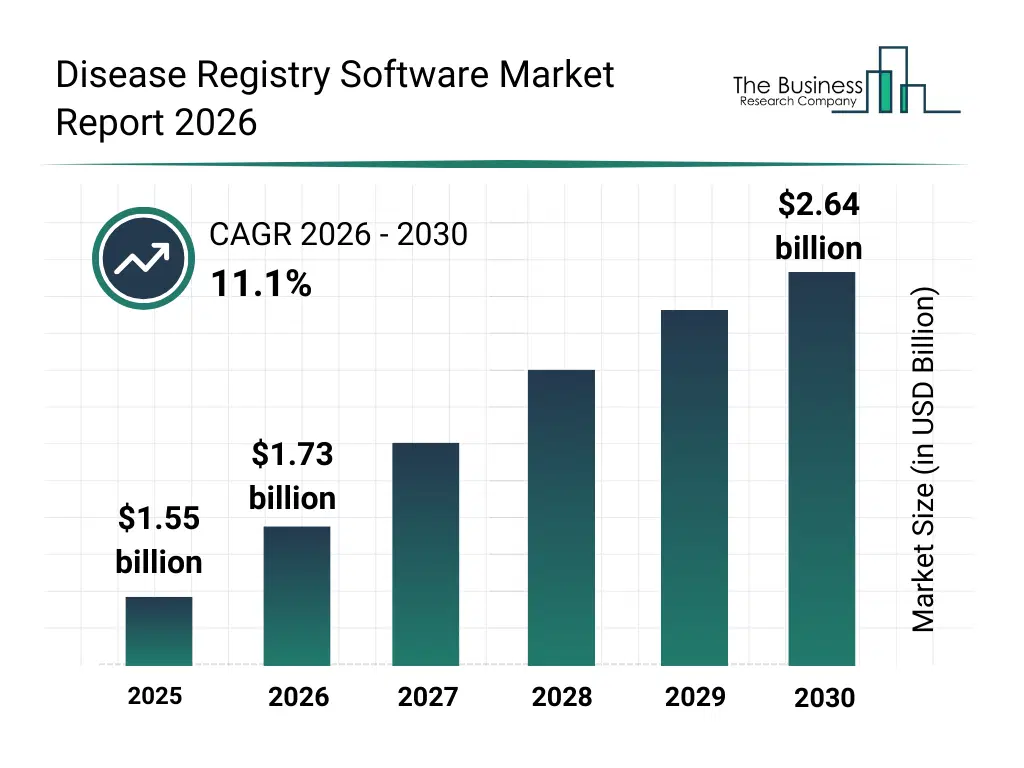
What Is The Disease Registry Software Market Size and Share 2026?
The disease registry software market size has grown rapidly in recent years. It will grow from $1.55 billion in 2025 to $1.73 billion in 2026 at a compound annual growth rate (CAGR) of 11.4%. The growth in the historic period can be attributed to increasing digitization of patient records, expansion of disease-specific research programs, growing regulatory reporting requirements, adoption of electronic health records, rising use of data-driven clinical decision tools.What Is The Disease Registry Software Market Growth Forecast?
The disease registry software market size is expected to see rapid growth in the next few years. It will grow to $2.64 billion in 2030 at a compound annual growth rate (CAGR) of 11.1%. The growth in the forecast period can be attributed to increasing demand for population health analytics, rising integration with AI-driven clinical insights, expansion of cloud-based registry deployments, growing focus on outcomes-based healthcare, increasing use of real-world data in clinical research. Major trends in the forecast period include increasing adoption of integrated disease registry platforms, rising use of cloud-based patient data management, growing focus on regulatory-compliant data reporting, expansion of ehr-integrated registry solutions, enhanced emphasis on real-world evidence collection.
Global Disease Registry Software Market Segmentation
1) By Type: Standalone, Integrated 2) By Database: Public, Commercial 3) By Deployment Mode: On-Premises, Cloud-Based 4) By End-User: Hospitals, Government Organizations, Research Centers, Pharmaceutical Companies, Other End-Users Subsegments: 1) By Standalone: Patient Registry Software, Population Health Registry Software, Research Registry Software, Custom Or Single-Disease Registry Software 2) By Integrated: Electronic Health Record (EHR)-Integrated Registry Software, Practice Management System-Integrated Registry Software, Clinical Decision Support (CDS)-Integrated Registry Software, Health Information Exchange (HIE)-Integrated Registry SoftwareWhat Is The Driver Of The Disease Registry Software Market?
The increasing adoption of personalized medicine is expected to propel the growth of the disease registry software market going forward. Personalized medicine refers to a medical approach that tailors treatment and prevention strategies to an individual’s unique genetic makeup, lifestyle, and environment. The increasing adoption of personalized medicine is primarily due to advancements in genomics, which enable precise identification of genetic variations and tailored treatments for individuals. Disease registry software supports personalized medicine by systematically collecting and managing patient health data, enabling tailored treatment plans and improved clinical decision-making. It streamlines data access and analysis, enhancing patient outcomes and advancing precision healthcare. For instance, in February 2024, according to the Personalized Medicine Coalition (PMC), a US-based nonprofit organization, the U.S. Food and Drug Administration (FDA) approved 26 new personalized medicines in 2023, a significant increase from the 12 approved in 2022. Therefore, the increasing adoption of personalized medicine is driving the growth of the disease registry software industry.Key Players In The Global Disease Registry Software Market
Major companies operating in the disease registry software market are Optum Inc., IQVIA Holdings Inc., Syneos Health Inc., Epic Systems Corporation, Premier Inc., MRO Corp., ImageTrend Inc., Anju Software Inc., BayaTree Inc., Medrio Inc., ArborMetrix Inc., Cedaron Medical Inc., Evado Pty. Ltd., OpenClinica LLC, Dacima Software Inc., Global Vision Technologies Inc., Ordinal Data Inc., Healthmonix LLC, Axis Clinical Software Inc., Vanderbilt University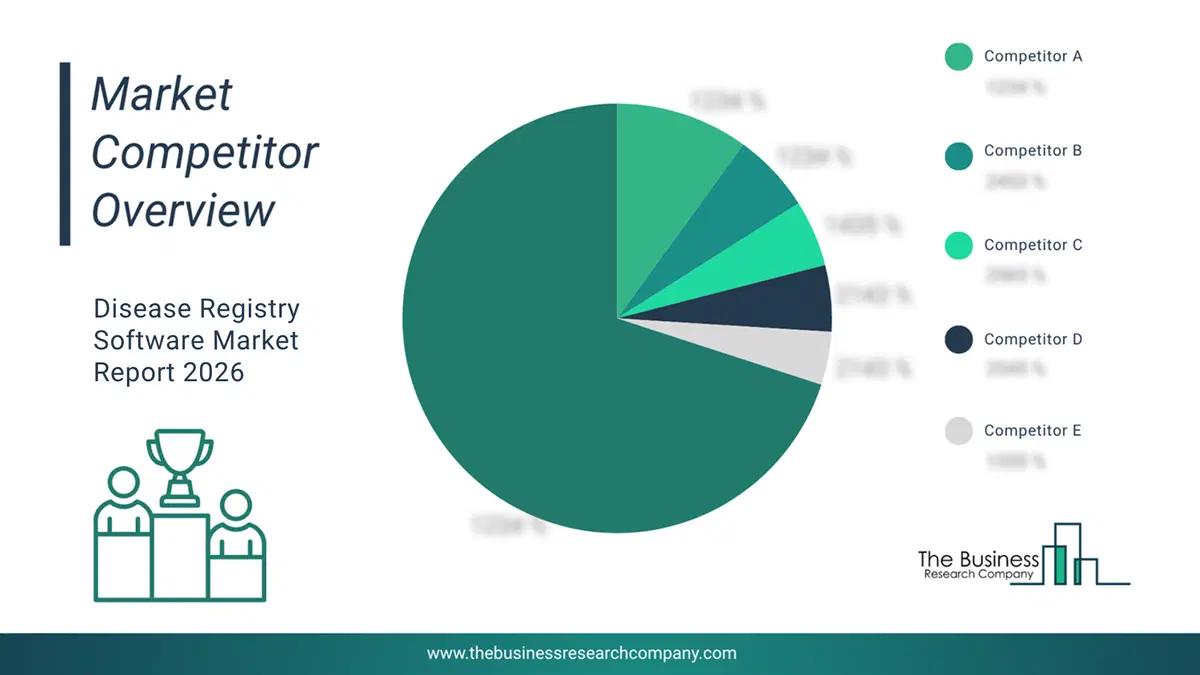
This chart is for illustrative purposes; the full report includes a detailed competitor analysis and comprehensive overview of the top 10 companies in the market.
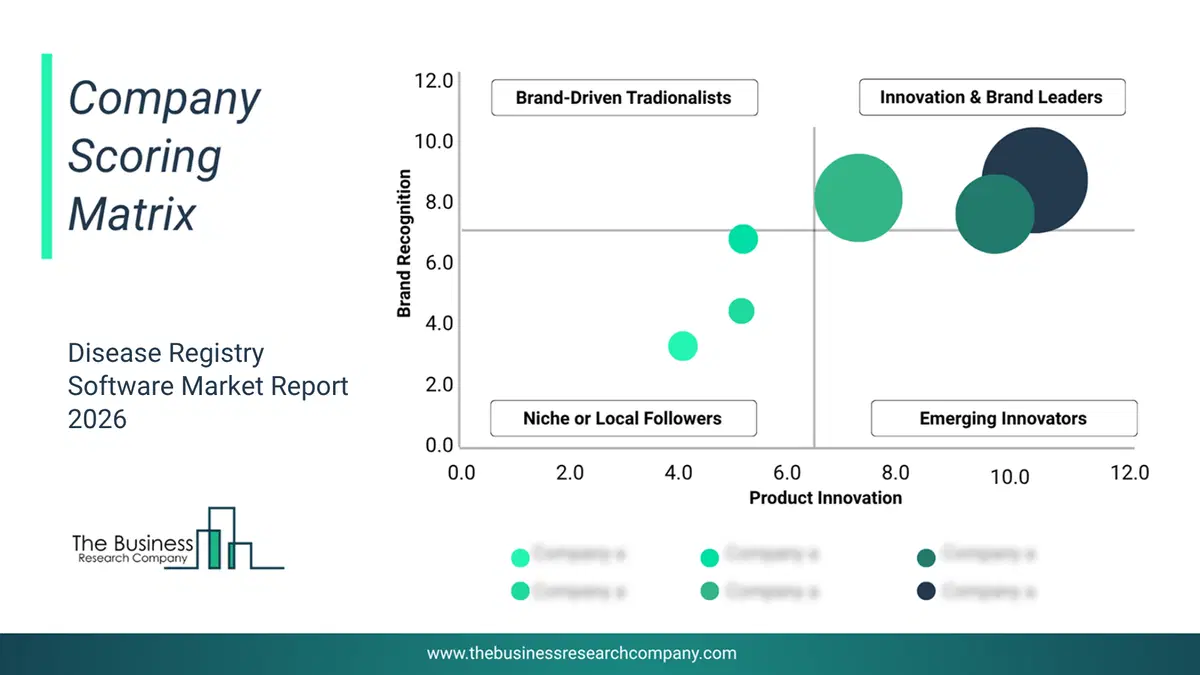
This chart maps companies by product innovation and brand strength, with bubble size indicating relative revenue, helping identify market leaders, challengers, and niche players. This is an illustrative chart; the full report provides a complete and accurate competitive analysis.
Global Disease Registry Software Market Trends and Insights
Major companies operating in the disease registry software market are focusing on developing patient-centric registries, such as digital registers to track outcomes and support personalized care. Digital registers refer to electronic systems or software platforms that systematically collect, store, and manage patient health information, replacing traditional paper-based registries. For instance, in August 2025, the American College of Cardiology (ACC), a US-based nonprofit medical association, launched the CONNECT-HCM Registry. It is a nationwide digital registry designed to improve understanding and management of hypertrophic cardiomyopathy (HCM), the most common genetic cardiovascular disease. The registry enables direct patient enrollment beyond single centers, addressing long-standing diagnostic and care gaps. This platform links registry data with electronic health records via Arboretum’s Hugo Connect platform and helps researchers track symptoms, imaging, treatments, and outcomes over time.What Are Latest Mergers And Acquisitions In The Disease Registry Software Market?
In November 2023, Health Catalyst Inc., a US-based healthcare analytics company, acquired Electronic Registry Systems Inc. (ERS) for an undisclosed amount. With this acquisition, Health Catalyst aims to strengthen its oncology registry capabilities, integrating ERS’s cancer data management expertise into its tech-enabled managed services to enhance data abstraction, reporting, and analytics for healthcare organizations. Electronic Registry Systems Inc. is a US-based company that specializes in providing cancer registry software and services.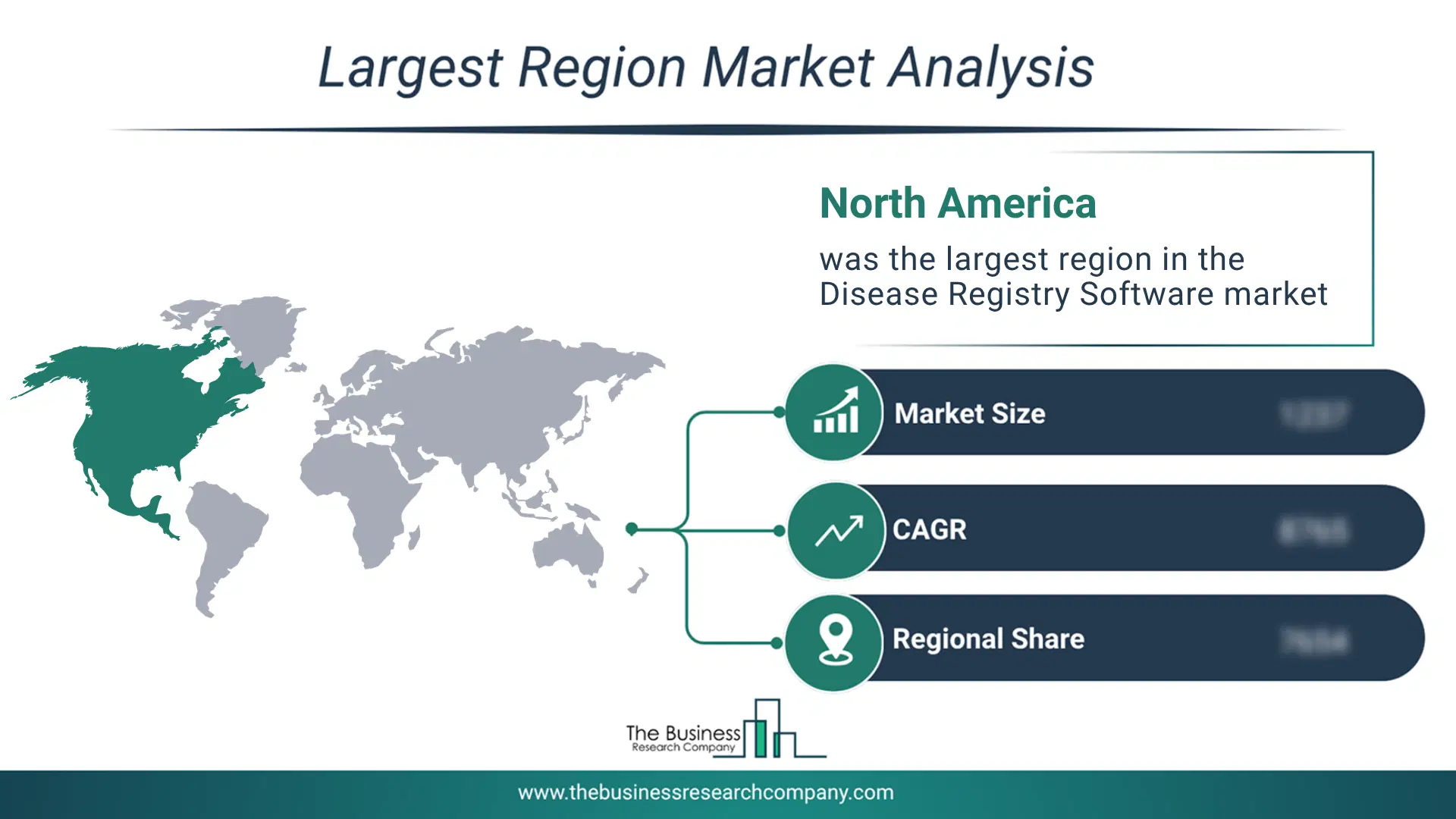
Regional Outlook
North America was the largest region in the disease registry software market in 2025. The regions covered in this market report are Asia-Pacific, South East Asia, Western Europe, Eastern Europe, North America, South America, Middle East, Africa. The countries covered in this market report are Australia, Brazil, China, France, Germany, India, Indonesia, Japan, Taiwan, Russia, South Korea, UK, USA, Canada, Italy, Spain.What Defines the Disease Registry Software Market?
The disease registry software market includes revenues earned by entities through patient data management, real-time data collection, integration with electronic health records, analytics and reporting, clinical research support, chronic disease management, and public health surveillance. The market value includes the value of related goods sold by the service provider or included within the service offering. Only goods and services traded between entities or sold to end consumers are included.How is Market Value Defined and Measured?
The market value is defined as the revenues that enterprises gain from the sale of goods and/or services within the specified market and geography through sales, grants, or donations in terms of the currency (in USD unless otherwise specified). The revenues for a specified geography are consumption values that are revenues generated by organizations in the specified geography within the market, irrespective of where they are produced. It does not include revenues from resales along the supply chain, either further along the supply chain or as part of other products.
This chart presents market attractiveness based on a quantitative evaluation of growth, competition, strategic alignment, and risk, offering a clear view of opportunity areas for decision-making. This chart is for illustrative purposes; the full report contains the complete analysis.

This chart highlights the Total Addressable Market (TAM) by estimating the maximum revenue opportunity using an assumption-driven approach, supporting strategic planning and opportunity sizing across markets. The chart is illustrative; the full report provides a more comprehensive analysis.
What Key Data and Analysis Are Included in the Disease Registry Software Market Report 2026?
The disease registry software market research report is one of a series of new reports from The Business Research Company that provides market statistics, including industry global market size, regional shares, competitors with the market share, detailed market segments, market trends and opportunities, and any further data you may need to thrive in the disease registry software industry. The market research report delivers a complete perspective of everything you need, with an in-depth analysis of the current and future state of the industry.Disease Registry Software Market Report Forecast Analysis
| Report Attribute | Details |
|---|---|
| Market Size Value In 2026 | $1.73 billion |
| Revenue Forecast In 2030 | $2.64 billion |
| Growth Rate | CAGR of 11.1% from 2026 to 2030 |
| Base Year For Estimation | 2025 |
| Actual Estimates/Historical Data | 2020-2025 |
| Forecast Period | 2026 - 2030 |
| Market Representation | Revenue in USD Billion and CAGR from 2026 to 2030 |
| Segments Covered | Type, Database, Deployment Mode, End-User |
| Regional Scope | Asia-Pacific, Western Europe, Eastern Europe, North America, South America, Middle East, Africa |
| Country Scope | The countries covered in the report are Australia, Brazil, China, France, Germany, India, Indonesia, Japan, Taiwan, Russia, South Korea, UK, USA, Canada, Italy, Spain |
| Key Companies Profiled | Optum Inc., IQVIA Holdings Inc., Syneos Health Inc., Epic Systems Corporation, Premier Inc., MRO Corp., ImageTrend Inc., Anju Software Inc., BayaTree Inc., Medrio Inc., ArborMetrix Inc., Cedaron Medical Inc., Evado Pty. Ltd., OpenClinica LLC, Dacima Software Inc., Global Vision Technologies Inc., Ordinal Data Inc., Healthmonix LLC, Axis Clinical Software Inc., Vanderbilt University |
| Customization Scope | Request for Customization |
| Pricing And Purchase Options | Explore Purchase Options |