
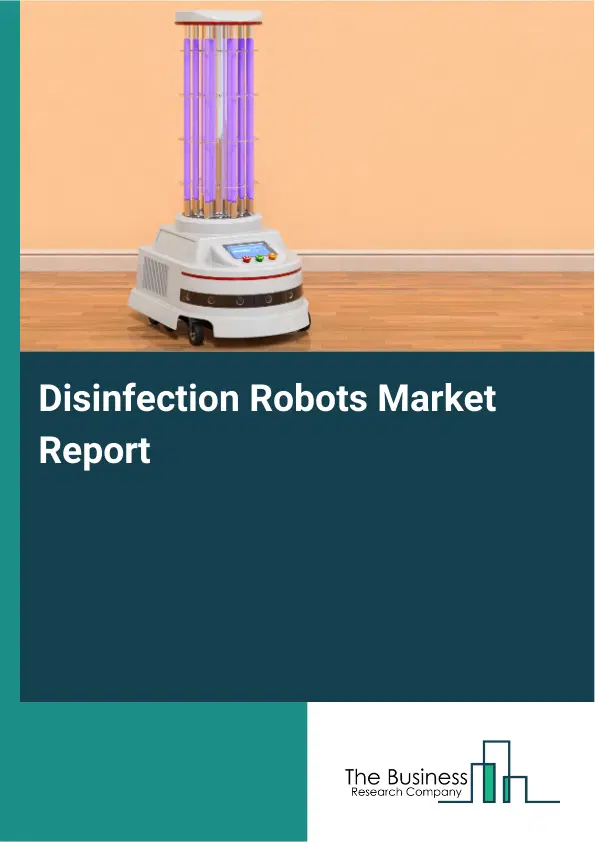
Disinfection Robots Market Report 2026
Global Outlook – By Type (Ultraviolet Light Disinfection Robots, Disinfectant Spraying Robots, Combined System Disinfection Robots), By Technology (Semi-Autonomous Disinfection Robots, Fully Autonomous Disinfection Robots), By End-User (Healthcare Facilities, Biopharmaceutical Industry, Airport And Transports, Hospitality, Other End Users ) – Market Size, Trends, Strategies, and Forecast to 2030
Disinfection Robots Market Overview
• Disinfection Robots market size has reached to $1.91 billion in 2025 • Expected to grow to $4.51 billion in 2030 at a compound annual growth rate (CAGR) of 18.3% • Growth Driver: Mitigating Hospital-Acquired Infections Through Disinfection Robots • Market Trend: Pudu Robotics Launches AI-Powered PUDU MT1 Sweeper To Transform Large-Scale Cleaning In Disinfection Robot Market • Asia-Pacific was the largest region in 2025 and North America is the fastest growing region.What Is Covered Under Disinfection Robots Market?
Disinfection robots are autonomous or semi-autonomous robotic systems designed to effectively and efficiently sanitize or disinfect various environments, such as hospitals, offices, schools, public spaces, and transportation vehicles. These robots use different methods, such as ultraviolet (UV) light, hydrogen peroxide vapor, or other chemical agents, to eliminate harmful pathogens from surfaces, reducing the risk of infections and the spread of diseases. The main types of disinfection robots are ultraviolet light disinfection robots, disinfectant spraying robots, and combined system disinfection robots. Ultraviolet light disinfection robots are robotic systems equipped with UV light sources to disinfect surfaces by emitting ultraviolet radiation. Technologies such as semi-autonomous disinfection robots and fully autonomous disinfection robots by end-users such as healthcare facilities, biopharmaceutical industry, airports and transports, hospitality, and others.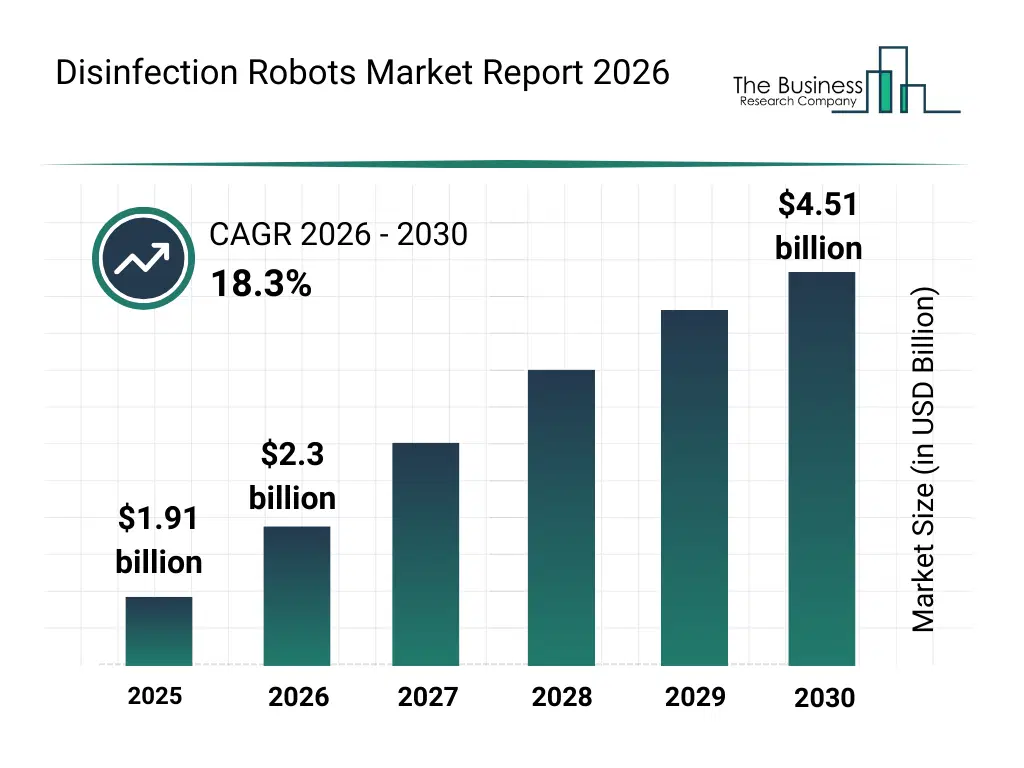
What Is The Disinfection Robots Market Size and Share 2026?
The disinfection robots market size has grown exponentially in recent years. It will grow from $1.91 billion in 2025 to $2.3 billion in 2026 at a compound annual growth rate (CAGR) of 20.5%. The growth in the historic period can be attributed to increased emphasis on hospital sanitation, growth in robotic automation adoption, rising awareness of infection prevention, availability of autonomous navigation technologies, expansion of healthcare infrastructure.What Is The Disinfection Robots Market Growth Forecast?
The disinfection robots market size is expected to see rapid growth in the next few years. It will grow to $4.51 billion in 2030 at a compound annual growth rate (CAGR) of 18.3%. The growth in the forecast period can be attributed to increasing investments in smart healthcare systems, rising adoption of robotics in public spaces, expansion of automated sanitation solutions, growing focus on operational efficiency, increasing demand for contactless disinfection technologies. Major trends in the forecast period include rising deployment of autonomous disinfection robots, growing adoption in healthcare facilities, expansion of uv-based disinfection technologies, increasing use in public infrastructure, enhanced focus on infection control automation.Tariff Impact On Disinfection Robots Market
Tariffs are affecting the disinfection robots market by increasing costs for imported sensors, control units, batteries, mobility components, and UV light systems used in robotic platforms. Healthcare facilities, airports, and hospitality sectors in North America and Europe are most impacted due to reliance on imported robotic components, while Asia-Pacific manufacturers face export-related cost pressures. These tariffs have increased procurement costs and slowed deployment in some regions. However, they are also encouraging local robot manufacturing, regional component sourcing, and innovation in cost-efficient autonomous disinfection solutions.
Global Disinfection Robots Market Segmentation
1) By Type: Ultraviolet Light Disinfection Robots, Disinfectant Spraying Robots, Combined System Disinfection Robots 2) By Technology: Semi-Autonomous Disinfection Robots, Fully Autonomous Disinfection Robots 3) By End-User: Healthcare Facilities, Biopharmaceutical Industry, Airport And Transports, Hospitality, Other End Users Subsegments: 1) By Ultraviolet Light Disinfection Robots: Mobile UV Disinfection Robots, Fixed UV Disinfection Robots 2) By Disinfectant Spraying Robots: Autonomous Spraying Robots, Manual-Controlled Spraying Robots 3) By Combined System Disinfection Robots: UV + Disinfectant Spraying Robots, UV + Fogging System RobotsWhat Is The Driver Of The Disinfection Robots Market?
The increasing spread of hospital-acquired infections (HAIs) is expected to propel the growth of the disinfection robot market going forward. Hospital-acquired infections refer to infections that patients acquire while receiving treatment in a healthcare facility, such as a hospital or clinic. The increasing number of hospital-acquired infections (HAIs) are occurring due to antibiotic resistance, inadequate infection control practices, overcrowding in healthcare facilities, and the presence of virulent pathogens in hospital environments. Disinfection robots aid in mitigating the risk of hospital-acquired infections (HAIs) by providing efficient and thorough sanitization of healthcare environments, enhancing patient safety, and reducing the incidence of healthcare-associated infections. For instance, in January 2024, according to the NHSN’s HAI Progress Report published by the Centers for Disease Control and Prevention (CDC), a US-based public health agency, there was a 4% rise in the surgical site infection ratio (SIR) across all NHSN operative procedure categories compared to the previous year. Therefore, the increasing spread of hospital-acquired infections (HAIs) drives the disinfection robot industry.Key Players In The Global Disinfection Robots Market
Major companies operating in the disinfection robots market are Xenex Disinfection Services LLC, UltraViolet Devices, Inc., Tru-D SmartUVC LLC, Blue Ocean Robotics ApS, Surfacide LLC, Bioquell Inc., Ecolab Inc., Skytron LLC, Finsen Technologies Limited, Dimer UVC Innovations, Akara Robotics Ltd, SESTO Robotics, Sanondaf Ltd, Decon-X International LLC, Solustar Pte. Ltd., OTSAW Digital Pte. Ltd., Ateago Technology Co. Ltd., Ecovacs Robotics Co. Ltd., Mediland Enterprise Corporation, TMI Robotics Technology Co. Ltd., Nevoa Inc.
This chart is for illustrative purposes; the full report includes a detailed competitor analysis and comprehensive overview of the top 10 companies in the market.
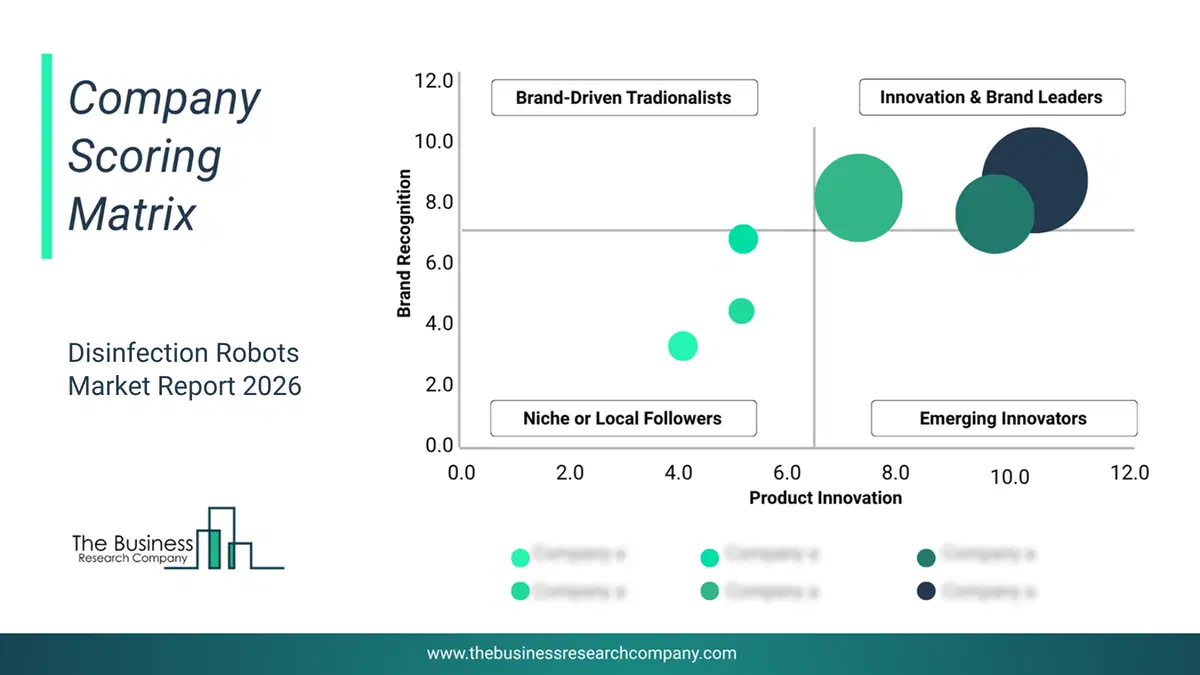
This chart maps companies by product innovation and brand strength, with bubble size indicating relative revenue, helping identify market leaders, challengers, and niche players. This is an illustrative chart; the full report provides a complete and accurate competitive analysis.
Global Disinfection Robots Market Trends and Insights
Major companies operating in the disinfection robot market focus on developing advanced robotic technologies such as the PUDU MT1, an AI-powered robotic sweeper designed for large-scale cleaning and sanitization in environments. An AI-powered robotic sweeper is an autonomous cleaning device that utilizes artificial intelligence technologies to perform cleaning tasks, primarily in large commercial and industrial spaces. These sweepers are equipped with sensors, cameras, and sophisticated software that allow them to navigate complex environments, detect obstacles, and optimize cleaning paths. For instance, in September 2024, Pudu Robotics, a China-based technology company specializing in robotics solutions, launched the PUDU MT1, an AI-powered robotic sweeper designed for large-scale cleaning in environments such as warehouses and home improvement stores. This innovative robot can efficiently clean areas exceeding 100,000 square meters, utilizing advanced AI for trash recognition and smart spot cleaning to optimize energy use and effectiveness. The key features include dynamic environment adaptability through Lidar SLAM technology, a large-capacity trash bin, proactive dust control mechanisms, and IoT integration for real-time monitoring and management. The PUDU MT1 aims to revolutionize cleaning practices by enhancing efficiency and reducing labor costs while maintaining high cleanliness standards in expansive settings.What Are Latest Mergers And Acquisitions In The Disinfection Robots Market?
In July 2023, Iris Ohyama, Inc., a Japan-based manufacturer that offers a range of products, including household goods, electronics, and office supplies acquired Smile Robotics, Inc. for an undisclosed amount. With this acquisition, Iris Ohyama, Inc. aims to expand its capabilities in robotics by incorporating Smile Robotics, Inc.'s expertise in service and disinfection robots, enhancing its portfolio to address the increasing demand for automated cleaning solutions in commercial and public spaces, and positioning itself more competitively in the hygiene and automation markets. Smile Robotics Inc., is a Japan-based company that specializes in service robots offering cleaning services.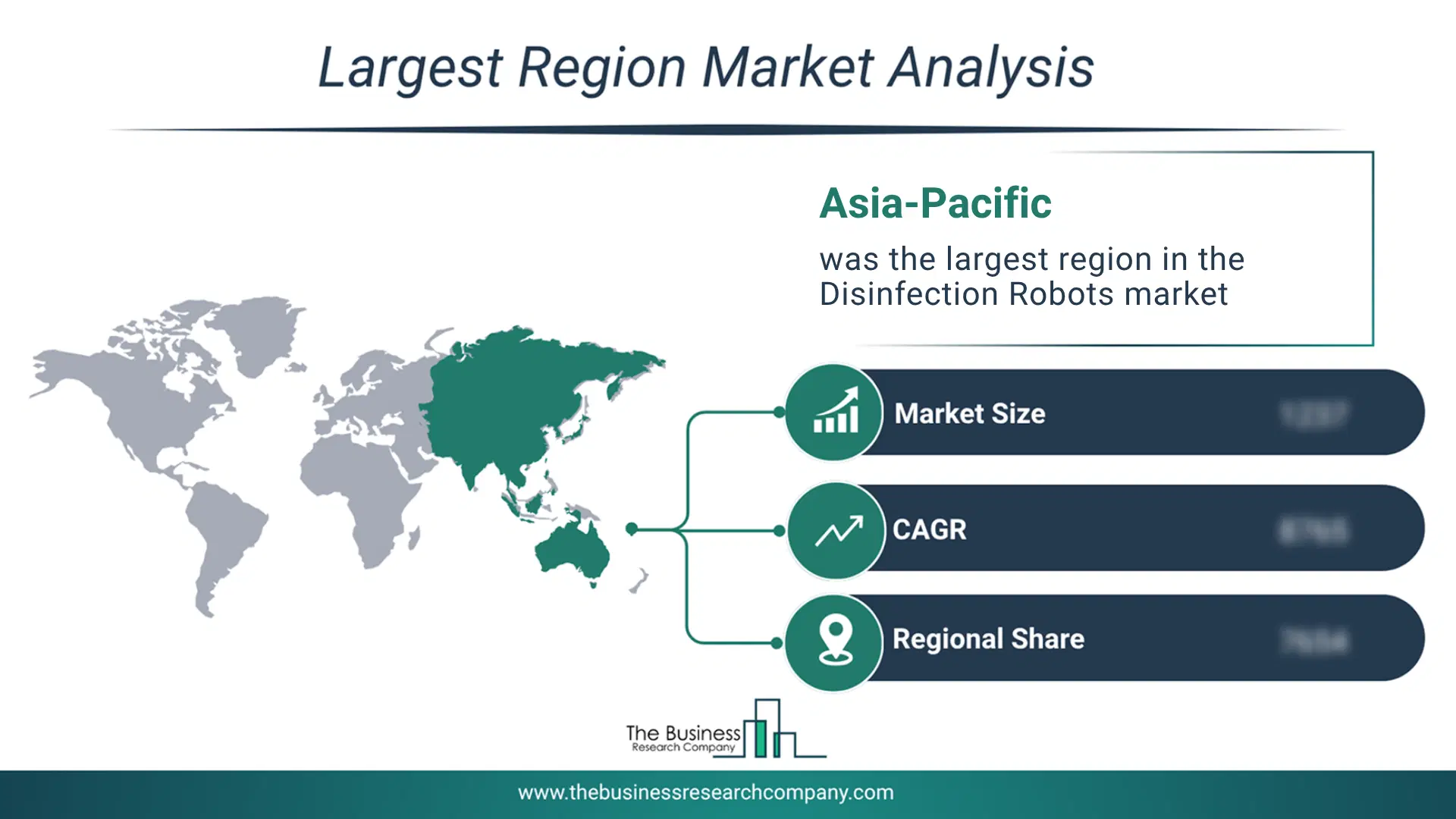
Regional Outlook
Asia-Pacific was the largest region in the disinfection robots market in 2025. North America is expected to be the fastest-growing region in the forecast period. The regions covered in this market report are Asia-Pacific, South East Asia, Western Europe, Eastern Europe, North America, South America, Middle East, Africa The countries covered in this market report are Australia, Brazil, China, France, Germany, India, Indonesia, Japan, Taiwan, Russia, South Korea, UK, USA, Canada, Italy, Spain.What Defines the Disinfection Robots Market?
The disinfection robot market consists of revenues earned by entities providing services such as installation and maintenance, rental and leasing, training programs, technical support, and customization and integration to facilitate the effective deployment and operation of robotic systems for sanitizing and disinfecting various environments. The market value includes the value of related goods sold by the service provider or included within the service offering. The disinfection robot market also includes sales of robotic systems, disinfectant solutions, UV lamps, sensors, and hardware and equipment aimed at automating and optimizing the disinfection process in various environments. Values in this market are ‘factory gate’ values, that is, the value of goods sold by the manufacturers or creators of the goods, whether to other entities (including downstream manufacturers, wholesalers, distributors, and retailers) or directly to end customers. The value of goods in this market includes related services sold by the creators of the goods.How is Market Value Defined and Measured?
The market value is defined as the revenues that enterprises gain from the sale of goods and/or services within the specified market and geography through sales, grants, or donations in terms of the currency (in USD unless otherwise specified). The revenues for a specified geography are consumption values that are revenues generated by organizations in the specified geography within the market, irrespective of where they are produced. It does not include revenues from resales along the supply chain, either further along the supply chain or as part of other products.
This chart presents market attractiveness based on a quantitative evaluation of growth, competition, strategic alignment, and risk, offering a clear view of opportunity areas for decision-making. This chart is for illustrative purposes; the full report contains the complete analysis.

This chart highlights the Total Addressable Market (TAM) by estimating the maximum revenue opportunity using an assumption-driven approach, supporting strategic planning and opportunity sizing across markets. The chart is illustrative; the full report provides a more comprehensive analysis.
What Key Data and Analysis Are Included in the Disinfection Robots Market Report 2026?
The disinfection robots market research report is one of a series of new reports from The Business Research Company that provides market statistics, including industry global market size, regional shares, competitors with the market share, detailed market segments, market trends and opportunities, and any further data you may need to thrive in the disinfection robots industry. The market research report delivers a complete perspective of everything you need, with an in-depth analysis of the current and future state of the industry.Disinfection Robots Market Report Forecast Analysis
| Report Attribute | Details |
|---|---|
| Market Size Value In 2026 | $2.3 billion |
| Revenue Forecast In 2030 | $4.51 billion |
| Growth Rate | CAGR of 18.3% from 2026 to 2030 |
| Base Year For Estimation | 2025 |
| Actual Estimates/Historical Data | 2020-2025 |
| Forecast Period | 2026 - 2030 |
| Market Representation | Revenue in USD Billion and CAGR from 2026 to 2030 |
| Segments Covered | Type, Technology, End-User |
| Regional Scope | Asia-Pacific, Western Europe, Eastern Europe, North America, South America, Middle East, Africa |
| Key Companies Profiled | Xenex Disinfection Services LLC, UltraViolet Devices, Inc., Tru-D SmartUVC LLC, Blue Ocean Robotics ApS, Surfacide LLC, Bioquell Inc., Ecolab Inc., Skytron LLC, Finsen Technologies Limited, Dimer UVC Innovations, Akara Robotics Ltd, SESTO Robotics, Sanondaf Ltd, Decon-X International LLC, Solustar Pte. Ltd., OTSAW Digital Pte. Ltd., Ateago Technology Co. Ltd., Ecovacs Robotics Co. Ltd., Mediland Enterprise Corporation, TMI Robotics Technology Co. Ltd., Nevoa Inc. |
| Customization Scope | Request for Customization |
| Pricing And Purchase Options | Explore Purchase Options |