
Displays Market Report 2026
Global Outlook – By Display Type (Liquid Crystal Display, Light Emitting Diode, Organic Light Emitting Diode, Micro Light Emitting Diode, Electronic Paper, Other Display Types), By Resolution (High Definition (HD), Full High Definition (FHD), 4K, 8K, Other Resolutions), By Panel Size (Small And Medium, Large), By Application (Consumer Electronics, Automotive, Healthcare, Retail, Industrial, Other Applications), By End User (Residential, Commercial, Other End Users) – Market Size, Trends, Strategies, and Forecast to 2030
Displays Market Overview
• Displays market size has reached to $1.1 billion in 2025 • Expected to grow to $1.28 billion in 2030 at a compound annual growth rate (CAGR) of 17% • Growth Driver: Surge In Smart TV Adoption Fueling The Growth Of The Market Due To Rising Demand For On-Demand Entertainment And Streaming Services • Market Trend: Technological Advancements In OLED Displays Enhancing Visual Clarity And Immersive Viewing Experience • Asia-Pacific was the largest region and fastest growing region.What Is Covered Under Displays Market?
Displays are advanced visual output technologies that present information, images, and video content through electronic screens across a wide range of devices and applications. Leveraging technologies such as liquid crystal display (LCD), organic light-emitting diode (OLED), micro light-emitting diode (MicroLED), and electronic paper (e-paper), modern displays deliver high-resolution, energy-efficient, and increasingly interactive viewing experiences. By enabling real-time visualization and seamless user interaction, displays play a critical role in enhancing communication, supporting data-driven decision-making, and improving user engagement across consumer, commercial, and industrial sectors. The main display types of the displays are liquid crystal display, light emitting diode, organic light emitting diode, micro light emitting diode, electronic paper, and other display types. Liquid crystal display (LCD) refers to display technology that uses liquid crystals modulated by backlight illumination to produce images, widely used in monitors, TVs, and mobile devices. These displays are categorized by resolution, including high definition (HD), full high definition (FHD), 4K, 8K, and other resolutions, and are also categorized by panel size, such as small and medium and large. The displays are used across various applications, including consumer electronics, automotive, healthcare, retail, industrial, and other applications, and serve multiple end users, such as residential, commercial, and other end users.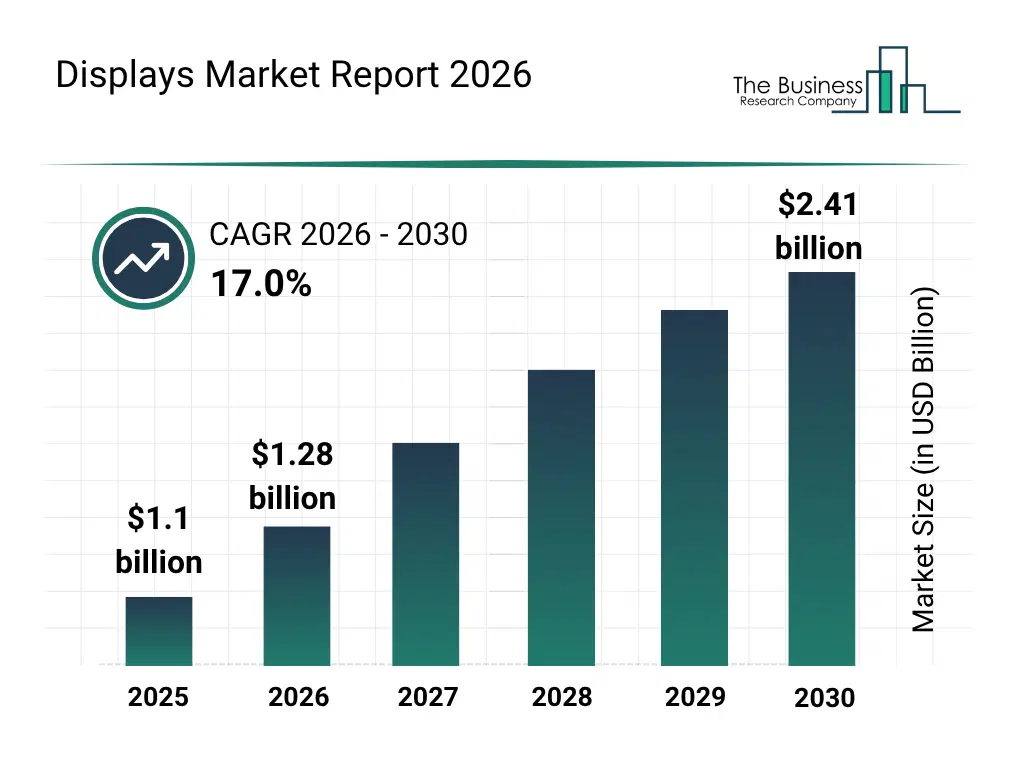
What Is The Displays Market Size and Share 2026?
The displays market size has grown rapidly in recent years. It will grow from $1.1 billion in 2025 to $1.28 billion in 2026 at a compound annual growth rate (CAGR) of 16.8%. The growth in the historic period can be attributed to rise of lcd mass production manufacturing scale, increasing consumer electronics penetration globally, declining display production costs over time, growth of smartphone and television markets, improvements in backlight and panel technologies.What Is The Displays Market Growth Forecast?
The displays market size is expected to see rapid growth in the next few years. It will grow to $2.41 billion by 2030 at a compound annual growth rate (CAGR) of 17.0%. The growth in the forecast period can be attributed to expansion of ar vr immersive display applications, rising demand for ultra high resolution content consumption, growth in automotive digital cockpit displays, increasing adoption of smart retail and signage solutions, development of microled and next gen display materials. Major trends in the forecast period include microled and oled display adoption acceleration, flexible and foldable display innovation, high resolution 8k and beyond display expansion, energy efficient e paper and low power displays, smart interactive and touch enabled displays.
Global Displays Market Segmentation
1) By Display Type: Liquid Crystal Display, Light Emitting Diode, Organic Light Emitting Diode, Micro Light Emitting Diode, Electronic Paper, Other Display Types 2) By Resolution: High Definition (HD), Full High Definition (FHD), 4K, 8K, Other Resolutions 3) By Panel Size: Small And Medium, Large 4) By Application: Consumer Electronics, Automotive, Healthcare, Retail, Industrial, Other Applications 5) By End User: Residential, Commercial, Other End Users Subsegments: 1) By Liquid Crystal Display: Twisted Nematic Display, In Plane Switching Display, Vertical Alignment Display, Super Twisted Nematic Display, Advanced Fringe Field Switching Display 2) By Light Emitting Diode: Edge Lit Light Emitting Diode Display, Full Array Light Emitting Diode Display, Mini Light Emitting Diode Backlit Display, Direct Lit Light Emitting Diode Display, Quantum Dot Light Emitting Diode Display 3) By Organic Light Emitting Diode: Active Matrix Organic Light Emitting Diode Display, Passive Matrix Organic Light Emitting Diode Display, Transparent Organic Light Emitting Diode Display, Flexible Organic Light Emitting Diode Display, Foldable Organic Light Emitting Diode Display 4) By Micro Light Emitting Diode: Passive Matrix Micro Light Emitting Diode Display, Active Matrix Micro Light Emitting Diode Display, Transparent Micro Light Emitting Diode Display, Flexible Micro Light Emitting Diode Display, Ultra Fine Pitch Micro Light Emitting Diode Display 5) By Electronic Paper: Electrophoretic Electronic Paper Display, Electrowetting Electronic Paper Display, Cholesteric Electronic Paper Display, Interferometric Modulator Electronic Paper Display, Flexible Electronic Paper Display 6) By Other Display Type: Quantum Dot Display, Laser Display, Field Emission Display, Digital Light Processing Display, Plasma DisplayWhat Is The Driver Of The Displays Market?
The rising demand for smart TVs is expected to propel the growth of the displays market going forward. Smart TVs are television devices integrated with internet connectivity and streaming capabilities, enabling users to access online video content and digital services directly. The increasing adoption of smart TVs is driven by the growing preference for on-demand entertainment, the expansion of streaming platforms, and improved internet accessibility. Displays play a critical role in smart TVs by delivering high-resolution visuals, enhanced color accuracy, and improved viewing experiences, thereby supporting consumer demand for better content consumption. For instance, in December 2024, according to the Australian Communications and Media Authority, an Australia-based regulatory body, smart TV ownership continued to rise, with 58% of users watching online video content at home in 2024, up from 52% in 2023. Smart TVs also accounted for the majority of television imports, with industry projections indicating continued growth through 2027. Therefore, the rising demand for smart TVs is driving the growth of the displays industry.Key Players In The Global Displays Market
Major companies operating in the displays market are Samsung Electronics; Sony Corporation; Panasonic Holdings Corporation; DENSO Corporation; Continental AG; Mitsubishi Electric Corporation (Japan); Fujitsu Limited; BOE Technology Group; LG Display; Kyocera Corporation; Corning Incorporated; AU Optronics; Innolux Corporation; Visteon Corporation; Nippon Seiki; Advantech Co. Ltd; Japan Display Inc. (JDI); Barco NV; Leyard Optoelectronic; Hisense Group; Universal Display Corporation; Hannstar Display Corporation; TCL China Star Optoelectronics Technology (CSOT)
This chart is for illustrative purposes; the full report includes a detailed competitor analysis and comprehensive overview of the top 10 companies in the market.
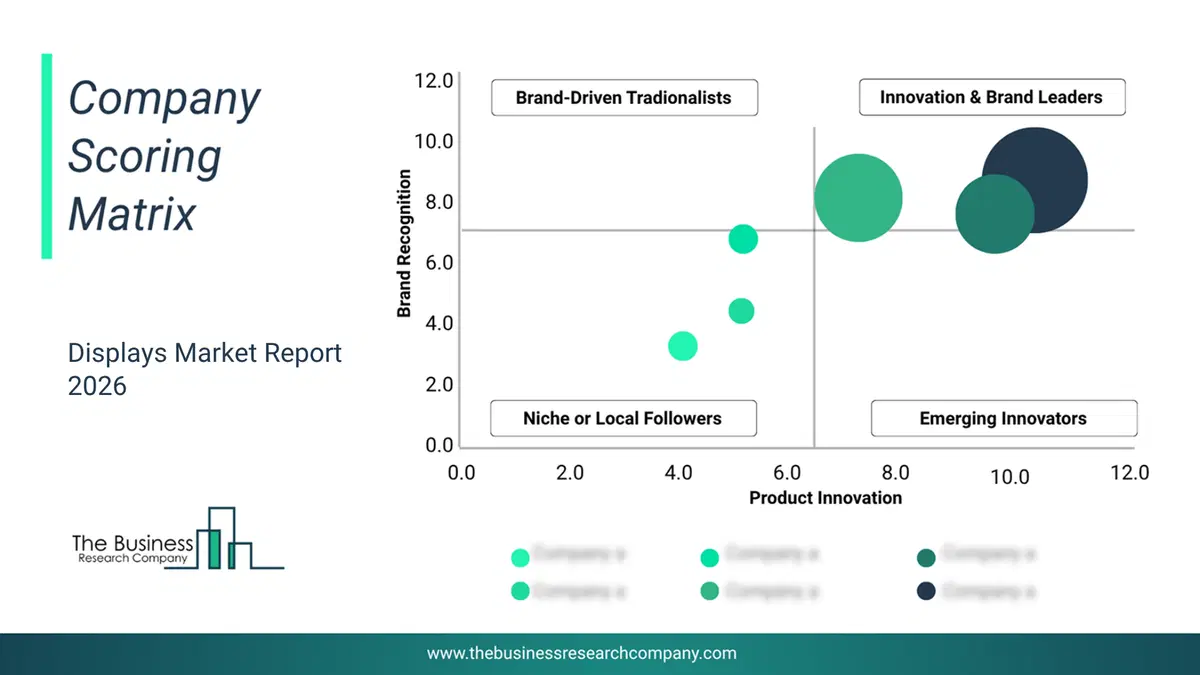
This chart maps companies by product innovation and brand strength, with bubble size indicating relative revenue, helping identify market leaders, challengers, and niche players. This is an illustrative chart; the full report provides a complete and accurate competitive analysis.
Global Displays Market Trends and Insights
Major companies operating in the displays market are focusing on technological advancements in OLED displays, such as OLED glare-free technology, to enhance visual clarity, reduce reflections, and improve the overall user viewing experience. OLED glare-free technology is an advanced display innovation that minimizes screen reflections while maintaining high color accuracy and brightness, enabling clearer and more immersive visuals even in brightly lit environments. For instance, in January 2024, Samsung Electronics, a South Korea-based electronics company, launched its 2024 OLED display lineup, reinforcing its commitment to next-generation display innovation. The launch highlights the company’s focus on integrating advanced visual technologies to address evolving consumer demand for premium viewing experiences. The lineup features OLED glare-free technology that reduces reflections while preserving color accuracy, offers enhanced brightness with deeper blacks for improved contrast, and supports high refresh rates of up to 144 hertz for smoother motion and enhanced gaming and viewing performance.What Are Latest Mergers And Acquisitions In The Displays Market?
In September 2024, AUO Display Plus Corp., a Taiwan-based provider of industrial and commercial display solutions, acquired Avocor Limited for an undisclosed amount. Through this acquisition, AUO Display Plus aims to strengthen its position in the global display solutions market by expanding its interactive display offerings, enhancing its product portfolio, and accelerating its penetration into education and enterprise verticals. Avocor Limited is a US-based provider of collaboration display solutions, specializing in interactive touchscreens and commercial-grade displays designed for corporate, education, and healthcare environments.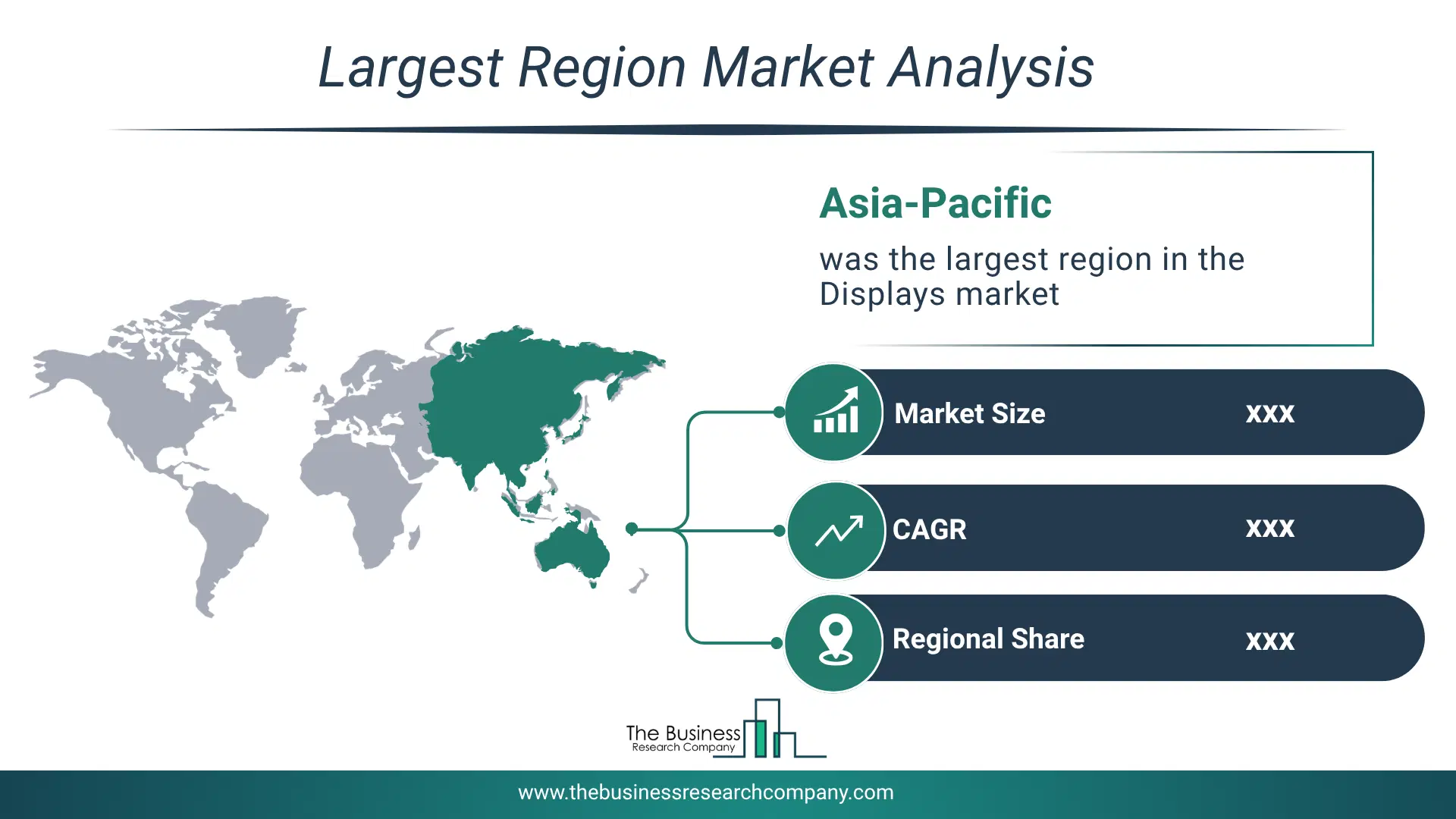
Regional Insights
Asia-Pacific was the largest region in the displays market in 2025, and it is expected to be the fastest-growing region in the forecast period. The regions covered in this market report are Asia-Pacific, South East Asia, Western Europe, Eastern Europe, North America, South America, Middle East, Africa. The countries covered in this market report are Australia, Brazil, China, France, Germany, India, Indonesia, Japan, Taiwan, Russia, South Korea, UK, USA, Canada, Italy, Spain.What Defines the Displays Market?
The displays market consists of sales of display panels, touchscreens, backlight units, driver integrated circuits, display glass substrates, flexible display components, projection displays, digital signage systems, and embedded display modules. Values in this market are ‘factory gate’ values, that is the value of goods sold by the manufacturers or creators of the goods, whether to other entities (including downstream manufacturers, wholesalers, distributors and retailers) or directly to end customers. The value of goods in this market includes related services sold by the creators of the goods.How is Market Value Defined and Measured?
The market value is defined as the revenues that enterprises gain from the sale of goods and/or services within the specified market and geography through sales, grants, or donations in terms of the currency (in USD unless otherwise specified). The revenues for a specified geography are consumption values that are revenues generated by organizations in the specified geography within the market, irrespective of where they are produced. It does not include revenues from resales along the supply chain, either further along the supply chain or as part of other products.
This chart presents market attractiveness based on a quantitative evaluation of growth, competition, strategic alignment, and risk, offering a clear view of opportunity areas for decision-making. This chart is for illustrative purposes; the full report contains the complete analysis.

This chart highlights the Total Addressable Market (TAM) by estimating the maximum revenue opportunity using an assumption-driven approach, supporting strategic planning and opportunity sizing across markets. The chart is illustrative; the full report provides a more comprehensive analysis.
What Key Data and Analysis Are Included in the Displays Market Report 2026?
The displays market research report is one of a series of new reports from The Business Research Company that provides market statistics, including industry global market size, regional shares, competitors with the market share, detailed market segments, market trends and opportunities, and any further data you may need to thrive in the displays industry. The market research report delivers a complete perspective of everything you need, with an in-depth analysis of the current and future state of the industry.Displays Market Report Forecast Analysis
| Report Attribute | Details |
|---|---|
| Market Size Value In 2026 | $1.28 billion |
| Revenue Forecast In 2030 | $2.41 billion |
| Growth Rate | CAGR of 17.00% from 2026 to 2030 |
| Base Year For Estimation | 2025 |
| Actual Estimates/Historical Data | 2020-2025 |
| Forecast Period | 2026 - 2030 |
| Market Representation | Revenue in USD Billion and CAGR from 2026 to 2030 |
| Segments Covered | Display Type, Resolution, Panel Size, Application, End User |
| Regional Scope | Asia-Pacific, Western Europe, Eastern Europe, North America, South America, Middle East, Africa |
| Country Scope | The countries covered in the report are Australia, Brazil, China, France, Germany, India, Indonesia, Japan, Taiwan, Russia, South Korea, UK, USA, Canada, Italy, Spain. |
| Key Companies Profiled | Samsung Electronics; Sony Corporation; Panasonic Holdings Corporation; DENSO Corporation; Continental AG; Mitsubishi Electric Corporation (Japan); Fujitsu Limited; BOE Technology Group; LG Display; Kyocera Corporation; Corning Incorporated; AU Optronics; Innolux Corporation; Visteon Corporation; Nippon Seiki; Advantech Co. Ltd; Japan Display Inc. (JDI); Barco NV; Leyard Optoelectronic; Hisense Group; Universal Display Corporation; Hannstar Display Corporation; TCL China Star Optoelectronics Technology (CSOT) |
| Customization Scope | Request for Customization |
| Pricing And Purchase Options | Explore Purchase Options |