

Contact Us
  Search
The Business Research Company Logo
Disposable Incontinence Products Global Market Opportunities And Strategies To 2035
Published :June 2026
Pages :244
Format :PDF
Delivery Time :2-3 Business Days
Why 2-3 days? We update the report with the latest data and news before delivery. Let us know if you need us to expedite.
Report Price :$4,490.00

Disposable Incontinence Products Global Market Opportunities And Strategies To 2035

By Product Type (Adult Diapers (Briefs), Disposable Protective Underwear (Pull-Ups), Incontinence Pads And Liners, Underpads, Other Types), By Absorbency Level (Light Absorbency, Moderate Absorbency, Heavy Absorbency), By Incontinence Type (Stress Urinary Incontinence, Urge Urinary Incontinence, Overflow Incontinence, Functional Incontinence, Fecal Incontinence, Dual Incontinence), By Material Type (Super Absorbent Polymers (SAP), Nonwoven Fabrics, Fluff Pulp, Plastic Back Sheets, Bio-Based And Sustainable Materials, Other Materials), By End-User (Homecare And Individual Consumers, Hospitals, Nursing Homes, Long-Term Care Facilities, Other Healthcare Facilities), And By Region, Opportunities And Strategies – Global Forecast To 2035

Disposable Incontinence Products Market Definition

Disposable incontinence products are single-use absorbent hygiene items designed to manage urinary or fecal incontinence. These products include adult diapers (briefs), protective underwear, absorbent pads and liners, underpads (bed pads), and disposable wipes. The primary purpose of disposable incontinence products is to provide effective moisture control, maintain hygiene, and protect skin health for individuals experiencing bladder or bowel control issues. The disposable incontinence products market consists of sales by entities (organizations, sole traders, or partnerships) of single-use items that helps to enhance dignity, comfort, and independence while reducing the risk of skin irritation, infections, and caregiver burden in homecare, hospital, and long-term care settings.
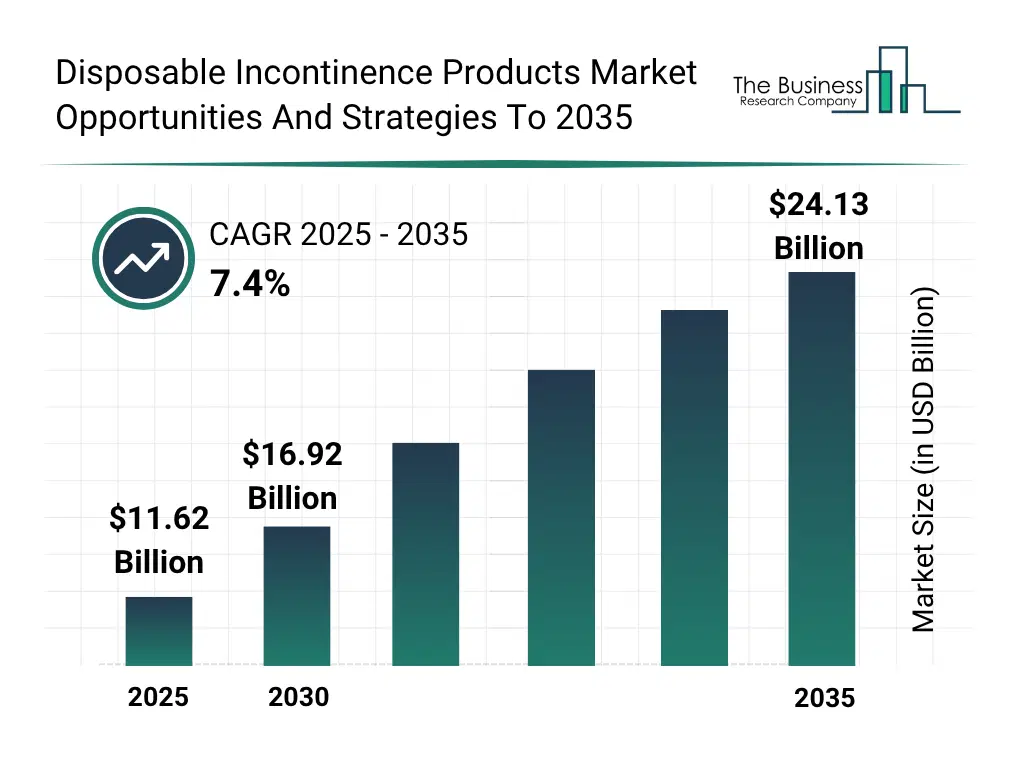
Disposable Incontinence Products Global Market Opportunities And Strategies To 2035 Market Size and growth rate 2026 to 2030: Graph

Disposable Incontinence Products Market Size

The global disposable incontinence products market reached a value of nearly $11,619.3 million in 2025, having grown at a compound annual growth rate (CAGR) of 8.0% since 2020. The market is expected to grow from $11,619.3 million in 2025 to $16,921.4 million in 2030 at a rate of 7.8%. The market is then expected to grow at a CAGR of 7.4% from 2030 and reach $24,130.6 million in 2035. Growth in the historic period resulted from increasing neurological disease prevalence, rising healthcare expenditure, growing number of urological disorders and growing prevalence of chronic diseases (diabetes). Factors that negatively affected growth in the historic period were environmental impact and waste-disposal concerns and social stigma and cultural barriers. Going forward, increasing awareness of incontinence products, rise in geriatric population, postpartum and delivery-related injury and rising demand for home healthcare will drive the growth. Factors that could hinder the growth of the disposable incontinence products market in the future include high price sensitivity, reimbursement and limited insurance coverage and impact of trade war and tariffs.
Research Expert

Book your 30 minutes free consultation with our research experts

Disposable Incontinence Products Market Segmentation

The disposable incontinence products market is segmented by product, by absorbency level, by incontinence type, by material type and by end-user.

By Product –
The disposable incontinence products market is segmented by product into:
    • a) Adult Diapers (Briefs)
    • b) Disposable Protective Underwear (Pull-Ups)
    • c) Incontinence Pads and Liners
    • d) Underpads
    • e) Other Types
The adult diapers (briefs) market was the largest segment of the disposable incontinence products market segmented by product type, accounting for 40.3% or $4,683.5 million of the total in 2025. Going forward, the disposable protective underwear (pull-ups) segment is expected to be the fastest-growing segment in the disposable incontinence products market segmented by product type, at a CAGR of 8.8% during 2025-2030.

By Absorbency Level –
The disposable incontinence products market is segmented by absorbency level into:
    • a) Light Absorbency
    • b) Moderate Absorbency
    • c) Heavy Absorbency
The heavy absorbency was the largest segment of the disposable incontinence products market segmented by absorbency level, accounting for 41.7% or $4,840.4 million of the total in 2025. Going forward, the heavy absorbency segment is expected to be the fastest-growing segment in the disposable incontinence products market segmented by absorbency level, at a CAGR of 8.3% during 2025-2030.

By Incontinence Type –
The disposable incontinence products market is segmented by incontinence type into:
    • a) Stress Urinary Incontinence
    • b) Urge Urinary Incontinence
    • c) Overflow Incontinence
    • d) Functional Incontinence
    • e) Fecal Incontinence
    • f) Dual Incontinence
The stress urinary incontinence market was the largest segment of the disposable incontinence products market segmented by incontinence type, accounting for 36.1% or $4,197.2 million of the total in 2025. Going forward, the dual incontinence segment is expected to be the fastest-growing segment in the disposable incontinence products market segmented by incontinence type, at a CAGR of 9.0% during 2025-2030.

By Material Type –
The disposable incontinence products market is segmented by material type into:
  1. a) Super Absorbent Polymers (SAP)
  2. b) Nonwoven Fabrics
  3. c) Fluff Pulp
  4. d) Plastic Back Sheets
  5. e) Bio-based and Sustainable Materials
  6. f) Other Materials
The super absorbent polymers (SAP) market was the largest segment of the disposable incontinence products market segmented by material type, accounting for 34.7% or $4,036.6 million of the total in 2025. Going forward, the bio-based and sustainable materials segment is expected to be the fastest-growing segment in the disposable incontinence products market segmented by material type, at a CAGR of 9.8% during 2025-2030.

By End-User –
The disposable incontinence products market is segmented by end-user into:
  1. a) Homecare and Individual Consumers
  2. b) Hospitals
  3. c) Nursing Homes
  4. d) Long-Term Care Facilities
  5. e) Other Healthcare Facilities
The homecare and individual consumers market was the largest segment of the disposable incontinence products market segmented by end-user, accounting for 46.1% or $5,357.7 million of the total in 2025. Going forward, the long-term care facilities segment is expected to be the fastest-growing segment in the disposable incontinence products market segmented by end-user, at a CAGR of 8.5% during 2025-2030.

By Geography - The disposable incontinence products market is segmented by geography into:
      o Asia Pacific
      • China
      • India
      • Japan
      • Australia
      • Indonesia
      • South Korea
      o North America
      • USA
      • Canada
      o South America
      • Brazil
      o Western Europe
      • France
      • Germany
      • UK
      • Italy
      • Spain
      o Eastern Europe
      • Russia
      o Middle East
      o Africa
North America was the largest region in the disposable incontinence products market, accounting for 35.1% or $4,077.2 million of the total in 2025. It was followed by Asia Pacific, Western Europe and then the other regions. Going forward, the fastest-growing regions in the disposable incontinence products market will be Asia Pacific and South America where growth will be at CAGRs of 9.7% and 8.0% respectively. These will be followed by Eastern Europe and Africa where the markets are expected to grow at CAGRs of 7.8% and 7.4% respectively.

Disposable Incontinence Products Market Competitive Landscape

Major Competitors are:

  • Essity AB (TENA)
  • Kimberly Clark Corporation
  • Procter & Gamble (P&G) Company
  • Unicharm Corporation
  • Ontex Group
  • Other Competitors Include:

  • Medline Industries LLP
  • Attindas Hygiene Partners
  • Abena Group
  • Paul Hartmann AG
  • Daio Paper Corporation
  • Ausepic Group
  • Nobel Hygiene Pvt. Ltd.
  • Tulips Hygiene
  • Shanghai JPS Medical Co. Ltd
  • Hangzhou Reliable Care Products
  • Wuhu U-Play Corporation
  • Kao Corporation
  • Nippon Paper Industries
  • Livedo Corporation
  • First Quality
  • Deva Industries Pte Ltd
  • Aire
  • SCA Hygiene Products
  • Domtar Corporation
  • Coloplast Corp
  • TZMO Group
  • Salts Healthcare
  • TZMO SA
  • Essity Poland Z.o.o
  • UroConti
  • Principle Business Enterprises Inc. (PBE)
  • Hiro Technologies
  • Cardinal Health
  • TENA
  • Medline Canada
  • Ontex Group
  • Vinda International
  • TENA (Essity)
  • HARTMANN Group (Paul Hartmann AG)
  • Disposable Incontinence Products Market Drivers

    The key drivers of the disposable incontinence products market include: Rise In Geriatric Population During the forecast period, the rise in geriatric population will propel the growth of the disposable incontinence products market. Longer life expectancy has increased the number of elderly individuals living with age-related conditions that impact continence. Mobility limitations, cognitive decline, and chronic illnesses often require reliable hygiene support. Older adults value products that maintain dignity, comfort, and independence. Disposable solutions reduce the physical effort required for cleaning and reuse, benefiting both users and caregivers. Their role in preventing skin irritation and infections supports daily use. Demand is further reinforced in assisted living and long-term care settings. This demographic shift creates sustained, recurring consumption. The rise in geriatric population growth contribution during the forecast period in 2025 is 1.5%.

    Disposable Incontinence Products Market Restraints

    The key restraints on the disposable incontinence products market include: High Price Sensitivity High price sensitivity is restricting the growth of the disposable incontinence products market during the forecast period. High costs relative to income levels make regular use difficult for many consumers, especially in low- and middle-income regions. These products are often required daily, creating a recurring expense that strains household budgets. Limited insurance coverage or reimbursement further shifts the cost burden to patients and caregivers. As a result, some users reduce usage frequency or switch to lower-quality alternatives. Institutions such as nursing homes also face budget constraints when purchasing in bulk. This price sensitivity ultimately slows wider adoption despite clear medical need. Growth affected by the high price sensitivity during the forecast period in 2025 is -1.0%.

    Need data on a specific region in this market?

    Opportunities And Recommendations In The Disposable Incontinence Products Market

    Opportunities – The top opportunities in the disposable incontinence products market segmented by product type will arise in the adult diapers (briefs) segment, which will gain $2,018.6 million of global annual sales by 2030. The top opportunities in the disposable incontinence products market segmented by absorbency level will arise in the heavy absorbency segment, which will gain $2,371.4 million of global annual sales by 2030. The top opportunities in the disposable incontinence products market segmented by incontinence type will arise in the stress urinary incontinence segment, which will gain $1,870.8 million of global annual sales by 2030. The top opportunities in the disposable incontinence products market segmented by material type will arise in the super absorbent polymers (SAP) segment, which will gain $2,045.3 million of global annual sales by 2030. The top opportunities in the disposable incontinence products market segmented by end-user will arise in the homecare and individual consumers segment, which will gain $2,502.6 million of global annual sales by 2030. The disposable incontinence products market size will gain the most in the USA at $1,345.0 million. Recommendations- To take advantage of the opportunities, The Business Research Company recommends the disposable incontinence products companies to focus on discreet product innovation and healthcare channel expansion, focus on capacity expansion and regional manufacturing to capture emerging market demand, focus on ultra-thin discreet products for younger light incontinence users, focus on gender-specific lightweight designs to expand consumer base, focus on disposable protective underwear segment to capture high growth demand, focus on heavy absorbency segment to capture high value growth, focus on dual incontinence segment to capture high growth and premium demand, focus on bio-based and sustainable materials to capture high growth demand, focus on strategic partnerships to accelerate market entry and distribution reach, focus on tiered and value-based pricing to balance affordability and margins, focus on awareness-led promotion to reduce stigma and drive adoption, focus on targeted engagement and channel-specific promotion to strengthen demand, focus on long-term care facilities segment to capture high growth demand.
    Chat with us