

Dissolving Pulp Market 2025
By Source (Wood Pulp, Cotton Linters, Bamboo Pulp, Other Sources), By Application (Textiles, Food And Beverages, Pharmaceuticals, Personal Care, Industrial Applications, Other Applications), By Grade (Specialty Grade, Technical Grade), By Production Process (Prehydrolysis Kraft Process, Acid Sulfite Process, Other Production Processes), And By Region, Opportunities And Strategies – Global Forecast To 2035
Dissolving Pulp Market Definition
Dissolving pulp refers to a highly purified, high‑cellulose pulp that is used primarily as a raw material in specialty cellulose derivatives. It is produced through rigorous purification to remove hemicellulose, lignin and other impurities, resulting in pulp with outstanding solubility and reactivity. It is principally used by manufacturers of viscose (rayon), cellulose acetate, cellulose ethers and other regenerated cellulose products. The dissolving pulp market consists of sales, by entities (organizations, sole traders and partnerships), of dissolving pulp that are utilized wherever derivative cellulose products are required, as textile industries use it in spinning fibers like rayon; food and beverage formulators incorporate cellulose derivatives as stabilizers, thickeners, or dietary fiber; pharmaceutical companies rely on it for tablets, coatings, or as a binder; personal care producers use cellulose derivatives in lotions, creams, or cosmetic formulations; and various industrial applications rely on derivatives for films, membranes, or specialty materials. Its usage is often tied to demand cycles in textiles (fast fashion, sustainable viscose), pharmaceutical formulation trends and evolving personal‑care product innovations.
Dissolving Pulp Market Size
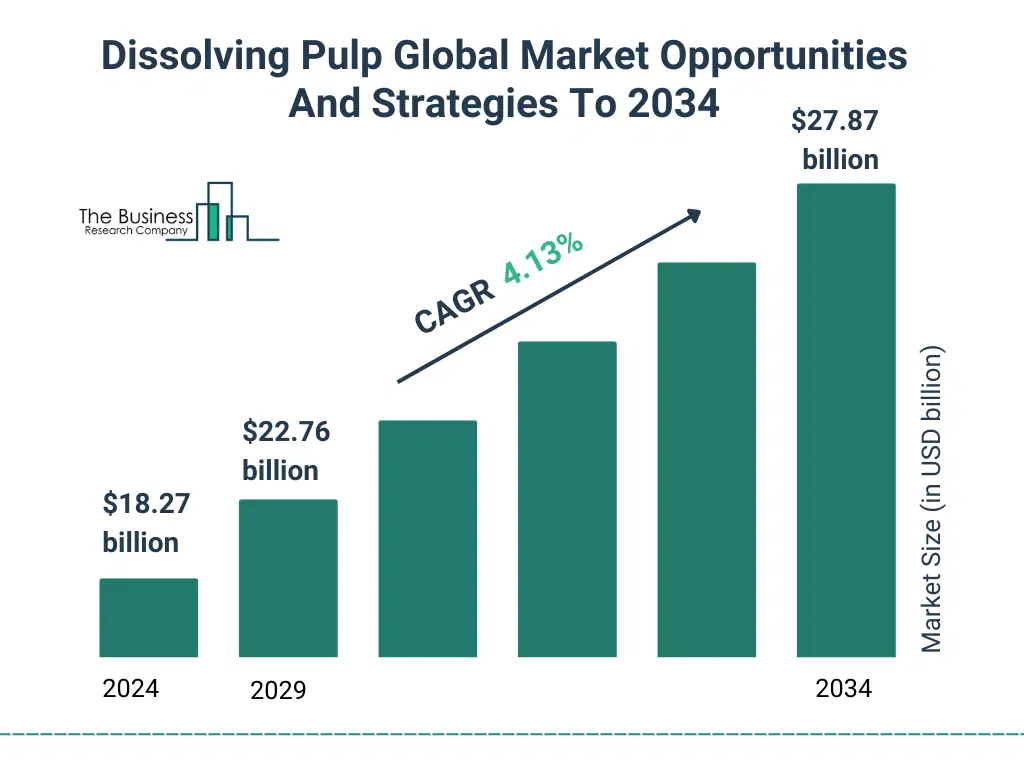
The global dissolving pulp market reached a value of nearly $18,265.48 million in 2024, having grown at a compound annual growth rate (CAGR) of 6.81% since 2019. The market is expected to grow from $18,265.48 million in 2024 to $22,759.79 million in 2029 at a rate of 4.50%. The market is then expected to grow at a CAGR of 4.13% from 2029 and reach $27,866.62 million in 2034. Growth in the historic period resulted from rising demand from the textile industry, stringent environmental regulations, increasing demand from the pharmaceutical and personal care sectors and growth in nonwoven and hygiene products. Factors that negatively affected growth in the historic period were the volatile raw material prices and high chemical consumption in DP production. Going forward, the consumer shift toward sustainable/biobased fibers, growth in apparel and fast-fashion volumes, growing corporate ESG and carbon footprint reduction goals and growing demand for bio-based polymers and films support will drive growth. Factors that could hinder the growth of the dissolving pulp market in the future include were competition from alternative fibers, dependence on wood-based feedstock and impact of trade war and tariff.Dissolving Pulp Market Drivers
The key drivers of the dissolving pulp market include: Consumer Shift Toward Sustainable/Biobased Fibers During the forecast period, the growing consumer demand for sustainable and bio-based fibers will significantly increase in demand for dissolving pulp. Dissolving pulp is the primary raw material used in the production of regenerated cellulose fibers such as viscose, lyocell and modal. As consumers increasingly prefer sustainable clothing over synthetic fibers like polyester, demand for bio-based fibers grows, creating a positive push for dissolving pulp. As consumers become more conscious of the environmental impact of their purchases, the demand for apparel made from sustainable and bio-based fibers is expected to rise, driving the industry towards more sustainable practices and dissolving pulp. The growing consumer demand for sustainable and bio-based fibers contribution during the forecast period in 2024 is 1.25%.Dissolving Pulp Market Restraints
The key restraints on the dissolving pulp market include: Competition From Alternative Fibers Competition from alternative fibers is restricting the growth of the dissolving pulp market during the forecast period. Cotton, being a natural and widely preferred fiber, is increasingly favored by consumers and manufacturers for its comfort, breathability and eco-friendly appeal. As the demand for cotton-based textiles grows, some manufacturers are shifting away from dissolving pulp-based fibers in favor of cotton or blended fabrics. This shift in preference is influencing purchasing and sourcing decisions across the textile industry, potentially reducing the demand for conventional dissolving pulp. Consequently, the rising popularity of cotton and other alternative fibers is slowing the expansion of the dissolving pulp market, particularly in regions where consumers prioritize natural and sustainable materials. Growth affected by competition from alternative fibers during the forecast period in 2024 is -2.87%.Dissolving Pulp Market Trends
Major trends shaping the dissolving pulp market include: Development Of Agricultural-Waste-Based Dissolving Pulp To Diversify Raw Material Sources Major companies in the dissolving pulp market are focusing on the development of agricultural-waste-based dissolving pulp designed to reduce reliance on traditional wood feedstock and address sustainability challenges in fiber production. These innovations emphasize raw material diversification, lower environmental impact and circular use of agricultural by-products, while also ensuring high fiber quality for textile and specialty applications. For instance, in March 2025, researchers at Chalmers University of Technology, in collaboration with Stora Enso, a Finnish and Swedish forest industry company, successfully demonstrated the production of dissolving pulp from oat husks and wheat straw at pilot scale, using soda pulping combined with pre-hydrolysis and bleaching. The process achieved high-purity cellulose yields while significantly lowering chemical usage and greenhouse gas emissions compared to conventional wood-based methods. By leveraging non-wood feedstock and advanced processing techniques, the initiative aims to deliver dissolving pulps that combines sustainability, performance and scalability to meet the evolving needs of global textile and specialty fiber markets. Development Of Energy-Efficient Greenfield Mill With Renewable Energy Integration Major companies in the dissolving pulp market are investing in greenfield mills that pair high-efficiency production with renewable energy generation to enhance sustainability and self-sufficiency. These developments focus on vertical integration, cost competitiveness and energy resilience. For instance, in May 2023, LD Celulose, a joint venture between Lenzing, an Austrian fiber producer and Dexco, a Brazil based joint venture that operates a large-scale dissolving wood pulp mill, commissioned a new 500 000 tons per annum (tpa) dissolving pulp mill in Minas Gerais, Brazil, incorporating 144 MW of clean energy capacity and supplying over 50 % of its electricity output to the public grid. By blending pulp production with renewable energy integration, the project aims to strengthen supply security and advance sustainable fiber production on a large scale.Opportunities And Recommendations In The Dissolving Pulp Market
Opportunities – The top opportunities in the dissolving pulp market segmented by source will arise in the wood pulp segment, which will gain $3,400.26 million of global annual sales by 2029. The top opportunities in the dissolving pulp market segmented by application will arise in the textiles segment, which will gain $3,232.72 million of global annual sales by 2029. The top opportunities in the dissolving pulp market segmented by grade will arise in the specialty grade segment, which will gain $3,590.94 million of global annual sales by 2029. The top opportunities in the dissolving pulp market segmented by production process will arise in the prehydrolysis kraft process segment, which will gain $3,297.13 million of global annual sales by 2029. The dissolving pulp market size will gain the most in China at $1,859.60 million. Recommendations- To take advantage of the opportunities, The Business Research Company recommends the dissolving pulp companies to focus on expanding agricultural-waste-based dissolving pulp production, focus on integrating renewable energy with greenfield dissolving pulp mills, focus on upgrading bleaching infrastructure to improve efficiency and sustainability, focus on expanding operations in the bamboo pulp segment, focus on expanding operations in the specialty grade segment, focus on strengthening presence in the prehydrolysis kraft process segment, expand in emerging markets, continue to focus on developed markets, focus on strengthening global distribution and supply networks, focus on developing flexible and value-based pricing strategies, strengthen market visibility through targeted industry engagement, optimize digital promotion and relationship marketing and focus on expanding presence in the textiles segment.Dissolving Pulp Market Segmentation
The dissolving pulp market is segmented by source, by application, by grade and by production process.By Source –
The dissolving pulp market is segmented by Source into:
- a) Wood Pulp
- b) Cotton Linters
- a) Bamboo Pulp
- b) Other Sources
By Application –
The dissolving pulp market is segmented by application into:
- a) Textiles
- b) Food And Beverages
- c) Pharmaceuticals
- d) Personal Care
- e) Industrial Applications
- f) Other Applications
By Grade –
The dissolving pulp market is segmented by Grade into:
- a) Specialty Grade
- b) Technical Grade
By Production Process –
The dissolving pulp market is segmented by production process into:
- a) Prehydrolysis Kraft Process
- b) Acid Sulfite Process
- c) Other Production Processes
By Geography - The dissolving pulp market is segmented by geography into:
- • China
- • India
- • Japan
- • Australia
- • Indonesia
- • South Korea
- • USA
- • Canada
- • Brazil
- • France
- • Germany
- • UK
- • Italy
- • Spain
- • Russia
-
o Asia Pacific
o Africa