
Distributed Databases Market Report 2026
Global Outlook – By Database Type (Relational, New Structured Query Language (NewSQL), Non Structured Query Language (NoSQL)), By Architecture Type (Master-Slave, Master-Master, Multi-Master), By Deployment Mode (On-Premises, Cloud), By Organization Size (Small And Medium Enterprises (SMEs), Large Enterprises), By Application (Banking, Financial Services, And Insurance (BFSI), Healthcare, Retail, Information Technology (IT) And Telecommunications, Government, Other Applications) – Market Size, Trends, Strategies, and Forecast to 2030
Distributed Databases Market Overview
• Distributed Databases market size has reached to $8.91 billion in 2025 • Expected to grow to $15.68 billion in 2030 at a compound annual growth rate (CAGR) of 12% • Growth Driver: Rising Data Volumes Driving Growth Of The Market Due To Digitalization And IoT Adoption • Market Trend: Advancements In Low-Latency Edge Databases For Real-Time, Edge-Optimized Data Processing • North America was the largest region in 2025 and Asia-Pacific is the fastest growing region.What Is Covered Under Distributed Databases Market?
Distributed databases refer to a database system where data is stored across multiple physical locations, such as different servers or geographic regions, while appearing as a single database to users. This setup improves scalability, fault tolerance, and data availability, allowing organizations to handle large volumes of data efficiently. The main database types of distributed databases include relational, new structured query language (NewSQL), and non-structured query language (NoSQL). Relational Databases refer to structured systems that organize data into tables with predefined schemas and support SQL queries for transaction-heavy and consistency-critical applications. The architecture types involved are master-slave, master-master, and multi-master and are deployed through on-premises and cloud modes, catering to organization sizes that include small and medium enterprises (SMEs) and large enterprises. The various applications include banking, financial services, and insurance (BFSI), healthcare, retail, information technology (IT) and telecommunications, government, and others.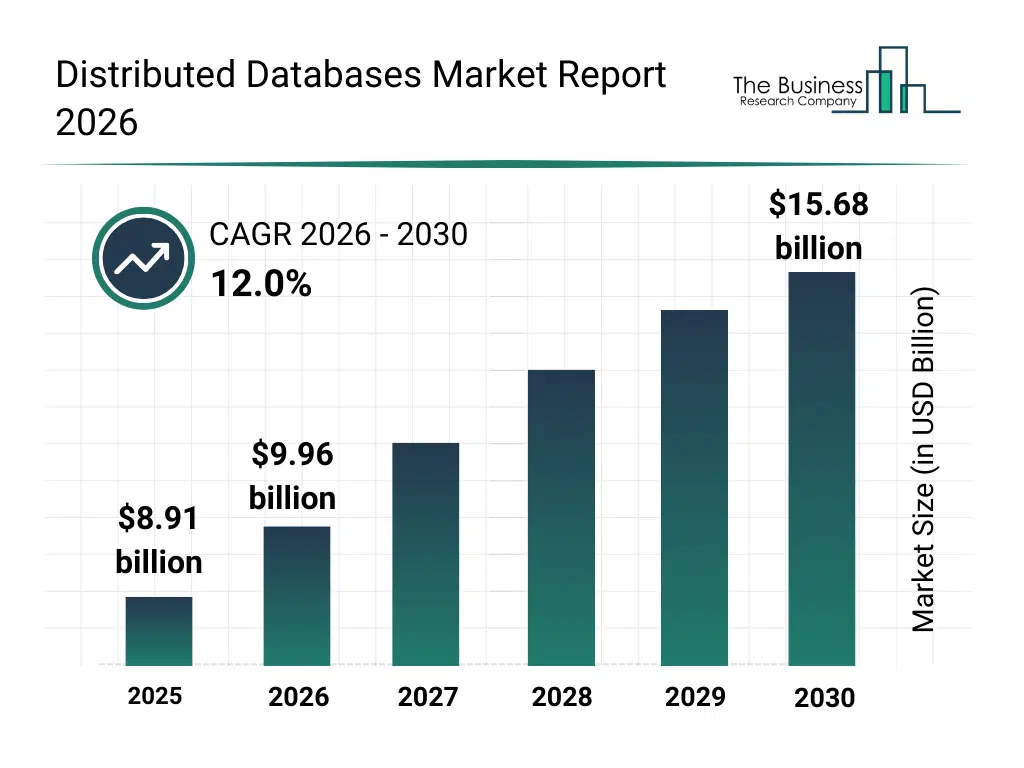
What Is The Distributed Databases Market Size and Share 2026?
The distributed databases market size has grown rapidly in recent years. It will grow from $8.91 billion in 2025 to $9.96 billion in 2026 at a compound annual growth rate (CAGR) of 11.8%. The growth in the historic period can be attributed to rising adoption of relational databases, increasing need for data availability and fault tolerance, growth of enterprise it infrastructure, expansion of global data centers, rising demand for transactional and analytical processing.What Is The Distributed Databases Market Growth Forecast?
The distributed databases market size is expected to see rapid growth in the next few years. It will grow to $15.68 billion in 2030 at a compound annual growth rate (CAGR) of 12.0%. The growth in the forecast period can be attributed to growth of cloud computing and hybrid deployments, increasing adoption of nosql and newsql databases, rising demand for high-performance distributed databases, expansion of banking, fintech, and healthcare applications, growing need for real-time data analytics and ai-driven insights. Major trends in the forecast period include increasing adoption of cloud-native distributed databases, rising demand for multi-model distributed database solutions, expansion of high-performance newsql databases, growing focus on real-time transaction and query processing, increasing deployment of distributed analytical databases.
Global Distributed Databases Market Segmentation
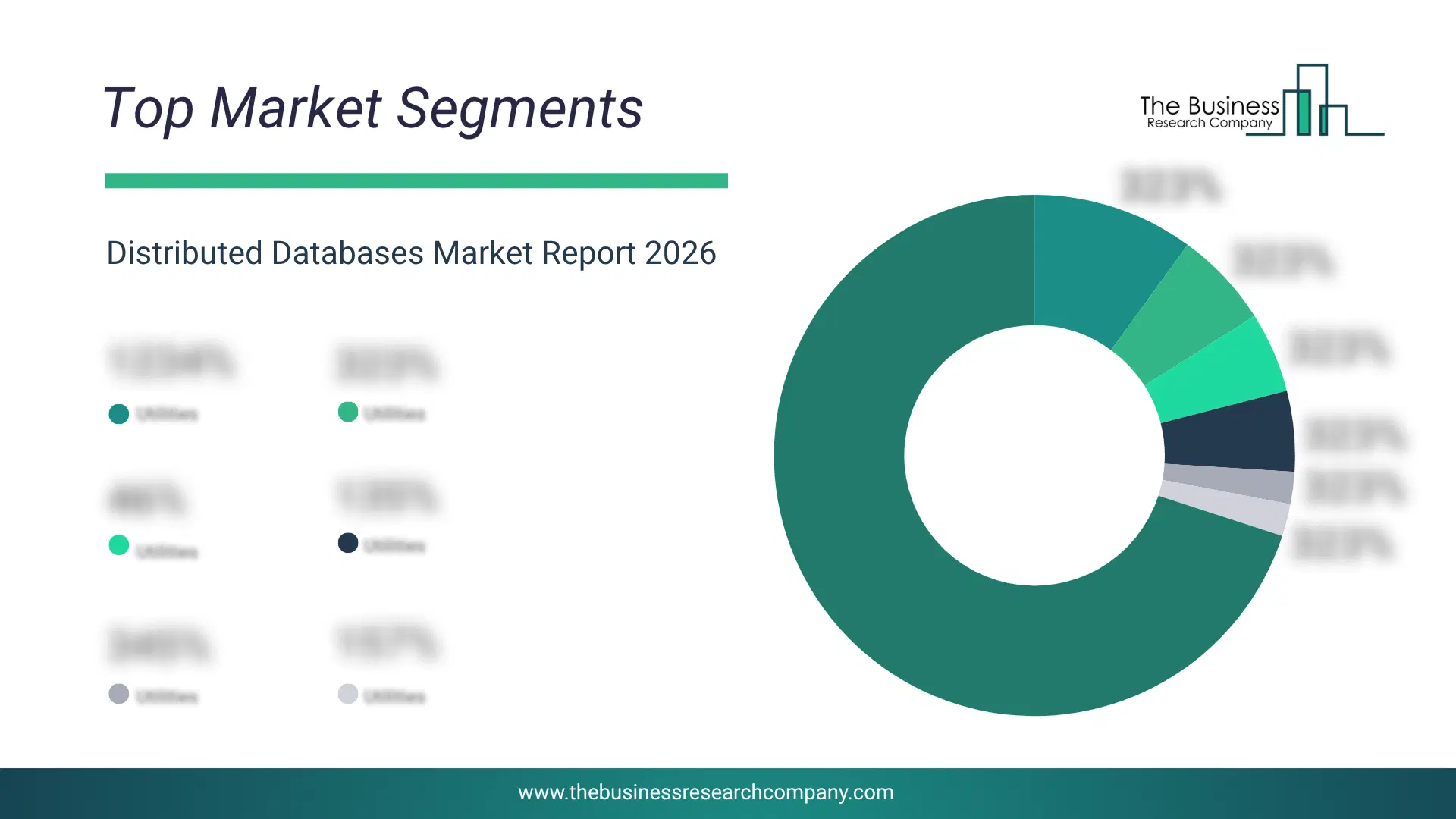
1) By Database Type: Relational, New Structured Query Language (NewSQL), Non Structured Query Language (NoSQL) 2) By Architecture Type: Master-Slave, Master-Master, Multi-Master 3) By Deployment Mode: On-Premises, Cloud 4) By Organization Size: Small And Medium Enterprises (SMEs), Large Enterprises 5) By Application: Banking, Financial Services, And Insurance (BFSI), Healthcare, Retail, Information Technology (IT) And Telecommunications, Government, Other Applications Subsegments: 1) By Relational: Transactional Databases, Analytical Databases, Hybrid Databases 2) By New Structured Query Language: Distributed New Structured Query Databases, Cloud Native New Structured Query Databases, High Performance New Structured Query Databases 3) By Non Structured Query Language: Document Databases, Key Value Databases, Columnar Databases, Graph DatabasesWhat Is The Driver Of The Distributed Databases Market?
The increasing data volumes are expected to propel the growth of the distributed databases market going forward. Data volumes refer to the total amount of data generated, collected, or stored by a system or organization. Data volumes are increasing because digitalization and IoT adoption are generating massive amounts of real-time data, as connected devices, sensors, and online interactions continuously produce information that organizations collect and store for analysis. Distributed databases help manage increasing data volumes by storing and processing data across multiple servers, enabling scalable, efficient, and real-time access to large datasets. For instance, in December 2024, according to G2.ai, a US-based software review marketplace, by 2025, daily data creation is projected to reach 463 zettabytes, representing an estimated market value of $229.4 billion. Therefore, the increasing data volumes are driving the growth of the distributed databases industry.Key Players In The Global Distributed Databases Market
Major companies operating in the distributed databases market are Amazon Web Services Inc., Google LLC, Microsoft Corporation, Alibaba Cloud Computing Co. Ltd., Tencent Holdings Limited, International Business Machines Corporation, Oracle Corporation, SAP SE, Hewlett Packard Enterprise Company, Huawei Technologies Co. Ltd., Teradata Corporation, MongoDB Inc., Cloudera Inc., Redis Labs Inc., Couchbase Inc., DataStax Inc., Cockroach Labs Inc., Neo4j Inc., MarkLogic Corporation, PingCAP Inc., MariaDB Corporation, Yugabyte Inc., and ArangoDB GmbH.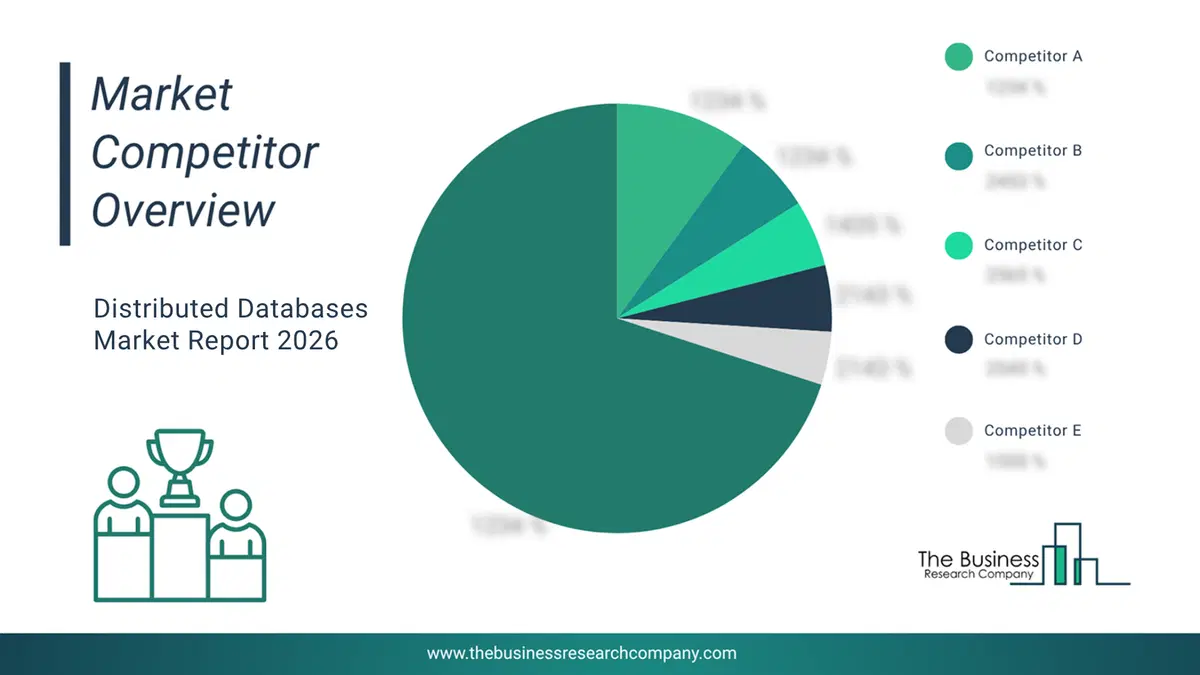
This chart is for illustrative purposes; the full report includes a detailed competitor analysis and comprehensive overview of the top 10 companies in the market.
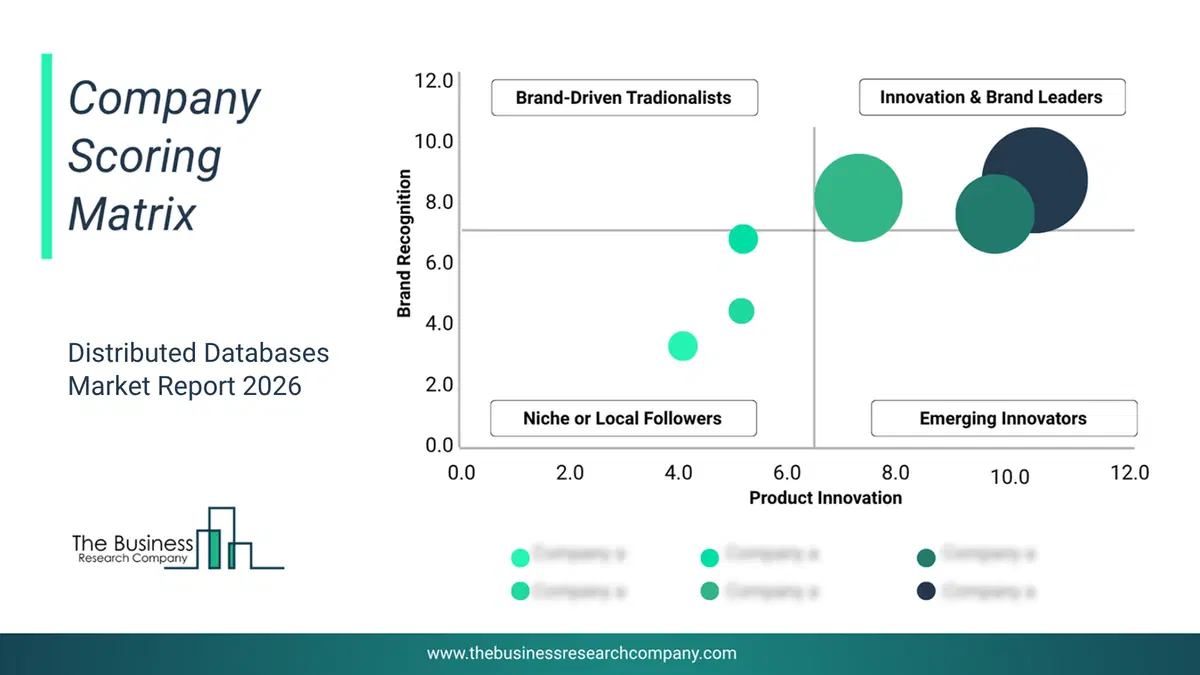
This chart maps companies by product innovation and brand strength, with bubble size indicating relative revenue, helping identify market leaders, challengers, and niche players. This is an illustrative chart; the full report provides a complete and accurate competitive analysis.
Global Distributed Databases Market Trends and Insights
Major companies operating in the distributed databases market are focusing on developing innovative technologies, such as low-latency edge databases, to enable faster data processing, real-time analytics, and improved performance for applications deployed at the network edge. Low-latency edge database refers to a distributed database system designed to process and store data close to the source (at the network edge) with minimal delay, enabling real-time analytics, faster response times, and efficient handling of high-volume, time-sensitive data. For instance, in March 2023, pgEdge Inc., a US-based technology company, launched pgEdge distributed postgreSQL, claimed as the first fully distributed edge database built on standard PostgreSQL. It is a fully distributed, multi-master database built on standard PostgreSQL, designed for low-latency, high-availability apps at the network edge or across clouds. Its key advantages include 2-3x faster page loads by placing nodes near users, true active-active replication with built-in conflict resolution, zero-downtime maintenance, and data residency compliance via geo-sharding. Benefits encompass scalable deployments without proprietary lock-in, support for edge AI workloads, and seamless Postgres compatibility for global SaaS or enterprise use.What Are Latest Mergers And Acquisitions In The Distributed Databases Market?
In February 2025, International Business Machines Corporation, a US-based consultant and technology company, acquired DataStax Inc. for an undisclosed amount. With this acquisition, IBM aims to deepen watsonx capabilities by integrating DataStax's vector databases and tools to unlock unstructured data value for scalable enterprise generative AI and RAG applications. DataStax Inc. is a US-based technology company that offers distributed databases.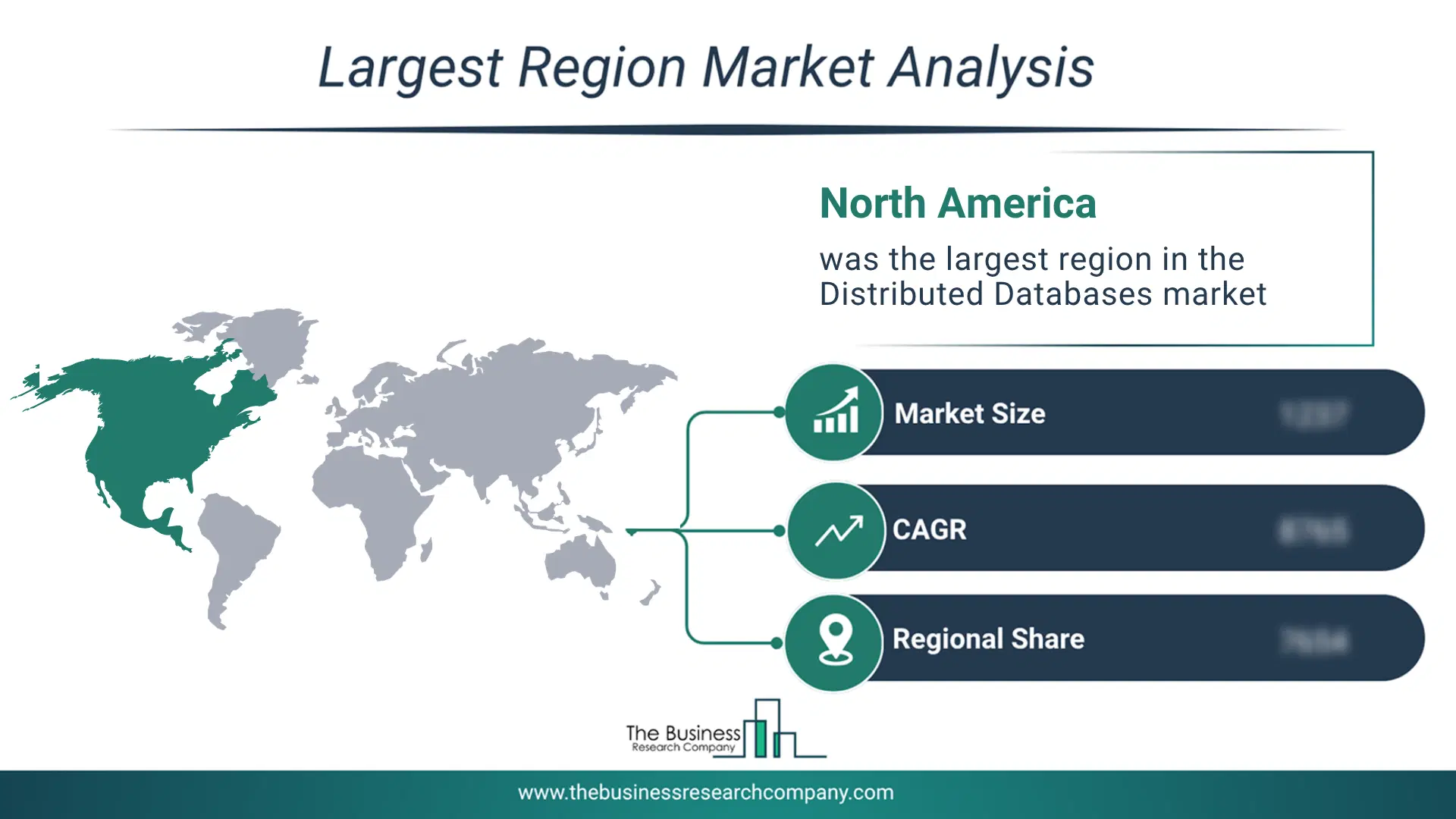
Regional Insights
North America was the largest region in the distributed databases market in 2025. Asia-Pacific is expected to be the fastest-growing region in the forecast period. The regions covered in this market report are Asia-Pacific, South East Asia, Western Europe, Eastern Europe, North America, South America, Middle East, Africa. The countries covered in this market report are Australia, Brazil, China, France, Germany, India, Indonesia, Japan, Taiwan, Russia, South Korea, UK, USA, Canada, Italy, Spain.What Defines the Distributed Databases Market?
The distributed databases market consists of revenues earned by entities by providing services such as data storage and management, query processing, and transaction management. The market value includes the value of related goods sold by the service provider or included within the service offering. The distributed databases market also includes sales of distributed analytical databases, cloud-native distributed databases, and multi-model distributed databases. Values in this market are ‘factory gate’ values that is, the value of goods sold by the manufacturers or creators of the goods, whether to other entities (including downstream manufacturers, wholesalers, distributors, and retailers) or directly to end customers. The value of goods in this market includes related services sold by the creators of the goods.How is Market Value Defined and Measured?
The market value is defined as the revenues that enterprises gain from the sale of goods and/or services within the specified market and geography through sales, grants, or donations in terms of the currency (in USD unless otherwise specified). The revenues for a specified geography are consumption values that are revenues generated by organizations in the specified geography within the market, irrespective of where they are produced. It does not include revenues from resales along the supply chain, either further along the supply chain or as part of other products.
This chart presents market attractiveness based on a quantitative evaluation of growth, competition, strategic alignment, and risk, offering a clear view of opportunity areas for decision-making. This chart is for illustrative purposes; the full report contains the complete analysis.

This chart highlights the Total Addressable Market (TAM) by estimating the maximum revenue opportunity using an assumption-driven approach, supporting strategic planning and opportunity sizing across markets. The chart is illustrative; the full report provides a more comprehensive analysis.
What Key Data and Analysis Are Included in the Distributed Databases Market Report 2026?
The distributed databases market research report is one of a series of new reports from The Business Research Company that provides distributed databases market statistics, including distributed databases industry global market size, regional shares, competitors with a distributed databases market share, detailed distributed databases market segments, market trends and opportunities, and any further data you may need to thrive in the distributed databases industry. This distributed databases market research report delivers a complete perspective of everything you need, with an in-depth analysis of the current and future scenario of the industry.Distributed Databases Market Report Forecast Analysis
| Report Attribute | Details |
|---|---|
| Market Size Value In 2026 | $9.96 billion |
| Revenue Forecast In 2030 | $15.68 billion |
| Growth Rate | CAGR of 12% from 2026 to 2030 |
| Base Year For Estimation | 2025 |
| Actual Estimates/Historical Data | 2020-2025 |
| Forecast Period | 2026 - 2030 |
| Market Representation | Revenue in USD Billion and CAGR from 2026 to 2030 |
| Segments Covered | Database Type, Architecture Type, Deployment Mode, Organization Size, Application |
| Regional Scope | Asia-Pacific, Western Europe, Eastern Europe, North America, South America, Middle East, Africa |
| Country Scope | The Countries Covered In This Market Report Are Australia, Brazil, China, France, Germany, India, Indonesia, Japan, Taiwan, Russia, South Korea, Uk, Usa, Canada, Italy, Spain. |
| Key Companies Profiled | Amazon Web Services Inc., Google LLC, Microsoft Corporation, Alibaba Cloud Computing Co. Ltd., Tencent Holdings Limited, International Business Machines Corporation, Oracle Corporation, SAP SE, Hewlett Packard Enterprise Company, Huawei Technologies Co. Ltd., Teradata Corporation, MongoDB Inc., Cloudera Inc., Redis Labs Inc., Couchbase Inc., DataStax Inc., Cockroach Labs Inc., Neo4j Inc., MarkLogic Corporation, PingCAP Inc., MariaDB Corporation, Yugabyte Inc., and ArangoDB GmbH. |
| Customization Scope | Request for Customization |
| Pricing And Purchase Options | Explore Purchase Options |