
Distributed Digital Fault Recorders Market Report 2026
Global Outlook – By Component (Hardware, Software, Services), By Product Type (Standalone Digital Fault Recorders, Networked Distributed Digital Fault Recorders, Substation-Based Digital Fault Recorders, Feeder-Level Digital Fault Recorders, Wide Area Digital Fault Recorders), By Deployment Mode (Utility-Owned Infrastructure, Third-Party Managed Systems, Hybrid Models), By Application (Fault Isolation And Diagnosis, Grid Reliability And Stability Enhancement, System Optimization And Performance Monitoring, Preventive Maintenance And Asset Management), By End User (Electric Utilities, Power Generation Plants, Industrial And Manufacturing, Infrastructure) – Market Size, Trends, Strategies, and Forecast to 2030
Distributed Digital Fault Recorders Market Overview
• Distributed Digital Fault Recorders market size has reached to $1.12 billion in 2025 • Expected to grow to $1.67 billion in 2030 at a compound annual growth rate (CAGR) of 8.5% • Growth Driver: Rising Adoption Of Renewable Energy Driving Market Growth Due To The Need For Enhanced Grid Monitoring, Fault Detection, And Reliable Integration Of Variable Power Generation • North America was the largest region in 2025 and Asia-Pacific is the fastest growing region.What Is Covered Under Distributed Digital Fault Recorders Market?
Distributed digital fault recorders refer to electronic devices used in power systems to monitor and record electrical disturbances or faults across a distributed network. They capture high-resolution data on voltage, current, and frequency variations during faults, helping utilities identify the cause, location, and impact of disruptions. These recorders enhance system reliability, support preventive maintenance, and improve overall grid stability. The main components of distributed digital fault recorders are hardware, software, and services. Hardware refers to the physical devices used to capture, record, and analyze electrical faults in power systems, ensuring accurate monitoring and protection. These solutions are available in various product types, including standalone digital fault recorders, networked distributed digital fault recorders, substation-based digital fault recorders, feeder-level digital fault recorders, and wide area digital fault recorders, and can be deployed through different modes, such as utility-owned infrastructure, third-party managed systems, and hybrid models. They are used across multiple applications, including fault isolation and diagnosis, grid reliability and stability enhancement, system optimization and performance monitoring, and preventive maintenance and asset management, serving end-users such as electric utilities, power generation plants, industrial and manufacturing, and infrastructure.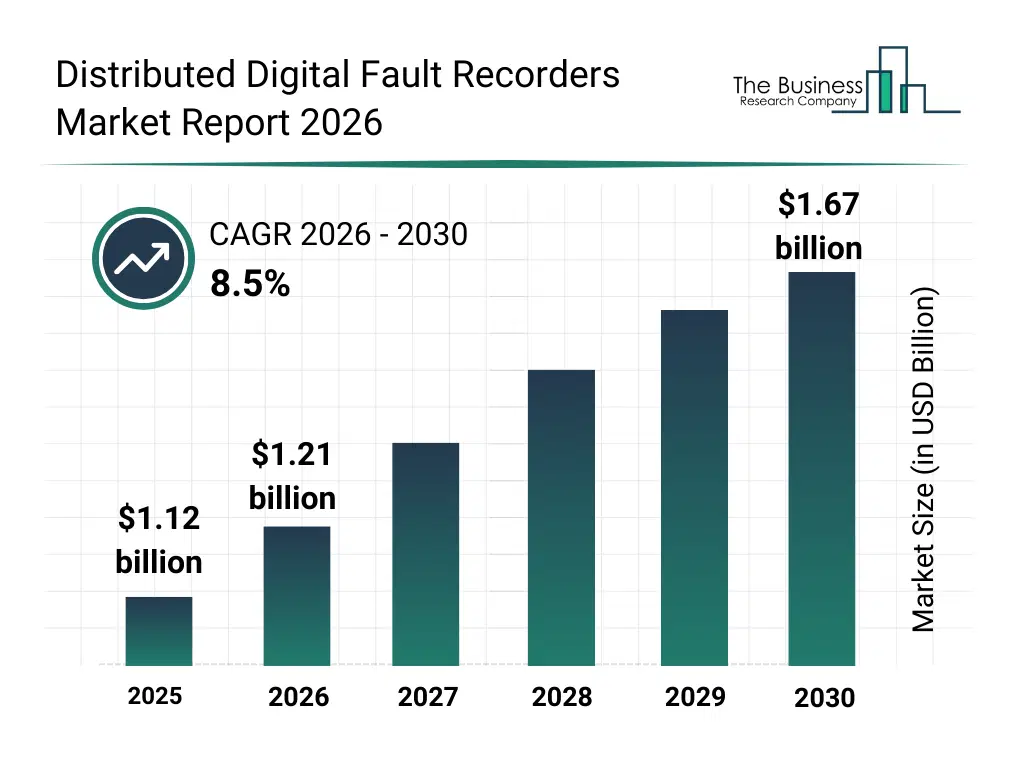
What Is The Distributed Digital Fault Recorders Market Size and Share 2026?
The distributed digital fault recorders market size has grown strongly in recent years. It will grow from $1.12 billion in 2025 to $1.21 billion in 2026 at a compound annual growth rate (CAGR) of 8.2%. The growth in the historic period can be attributed to expansion of power transmission infrastructure, increasing grid disturbance incidents, adoption of Digital Substation technologies, rising need for grid reliability monitoring, availability of high-speed communication networks.What Is The Distributed Digital Fault Recorders Market Growth Forecast?
The distributed digital fault recorders market size is expected to see strong growth in the next few years. It will grow to $1.67 billion in 2030 at a compound annual growth rate (CAGR) of 8.5%. The growth in the forecast period can be attributed to increasing investments in smart grid modernization, rising integration of renewable energy sources, growing demand for predictive grid maintenance, expansion of wide-area monitoring systems, increasing focus on grid resilience and stability. Major trends in the forecast period include increasing deployment of networked fault recording systems, rising adoption of high-speed data acquisition modules, growing integration of time-synchronized grid monitoring, expansion of real-time fault analytics capabilities, enhanced focus on wide-area grid visibility.
Global Distributed Digital Fault Recorders Market Segmentation
1) By Component: Hardware; Software; Services 2) By Product Type: Standalone Digital Fault Recorders; Networked Distributed Digital Fault Recorders; Substation-Based Digital Fault Recorders; Feeder-Level Digital Fault Recorders; Wide Area Digital Fault Recorders 3) By Deployment Mode: Utility-Owned Infrastructure; Third-Party Managed Systems; Hybrid Models 4) By Application: Fault Isolation And Diagnosis; Grid Reliability And Stability Enhancement; System Optimization And Performance Monitoring; Preventive Maintenance And Asset Management 5) By End User: Electric Utilities; Power Generation Plants; Industrial And Manufacturing; Infrastructure Subsegments: 1) By Hardware: Digital Fault Recorder Units; Data Acquisition Modules; Current And Voltage Sensors; Communication Interfaces; Time Synchronization Devices; Data Storage Units 2) By Software: Fault Recording And Analysis Software; Event Visualization And Reporting Software; Data Management And Archiving Software; Grid Monitoring And Diagnostics Software; Configuration And Control Software 3) By Services: Installation And Commissioning Services; System Integration Services; Maintenance And Support Services; Calibration And Testing Services; Consulting And Training ServicesWhat Are The Drivers Of The Distributed Digital Fault Recorders Market?
The growing adoption of renewable energy sources is expected to propel the growth of the distributed digital fault recorders market going forward. Renewable energy sources are natural resources that can be replenished naturally and used to generate energy, such as sunlight, wind, water, and biomass. The growing adoption of renewable energy sources is primarily driven by environmental concerns and climate change, as countries and organizations seek to reduce greenhouse gas emissions, minimize pollution, and transition to sustainable, low-carbon energy systems. Distributed digital fault recorders help renewable energy sources by enabling precise monitoring, rapid fault detection, and coordinated grid protection, ensuring stable and reliable integration of variable energy generation. For instance, in December 2024, according to Eurostat, a Luxembourg-based government agency, in 2023, renewable energy represented 24.5% of total energy consumption in the EU, up from 23.0% in 2022. Therefore, the growing adoption of renewable energy sources is driving the growth of the distributed digital fault recorders industry. The increasing investments in smart grid infrastructure are expected to propel the growth of the distributed digital fault recorders market going forward. Smart grid infrastructure refers to the integrated network of advanced digital technologies, communication systems, and automated controls used to monitor, manage, and optimize the generation, transmission, and distribution of electricity in a reliable, efficient, and sustainable manner. Increasing investments in smart grid infrastructure are primarily driven by the growing need to modernize aging power networks to improve reliability, efficiency, and real-time monitoring while supporting rising electricity demand and grid complexity. Investments in smart grid infrastructure help distributed digital fault recorders by enabling advanced digital substations, high-speed communication networks, and real-time data integration, which enhance fault detection accuracy, faster disturbance analysis, and overall grid reliability. For instance, according to International Energy Agency, a France-based autonomous intergovernmental organization, investment in smart grids need to more than double from around $330 billion per year to $750 billion by 2030 to get on track with the Net Zero Emissions by 2050 (NZE) Scenario, especially in emerging market and developing economies (EMDEs). Therefore, the increasing investments in smart grid infrastructure are driving the growth of the distributed digital fault recorders industry. The growing electricity consumption is expected to propel the growth of the distributed digital fault recorders market going forward. Electricity consumption refers to the amount of electrical energy used by a device, system, or facility over a specific period of time. Growing electricity consumption is primarily driven by an increasing population, as more people require energy for residential, commercial, and industrial activities, leading to higher overall demand. Distributed digital fault recorders help optimize electricity consumption by providing real-time monitoring and precise fault analysis, enabling utilities to reduce energy losses, improve grid efficiency, and ensure reliable power delivery. For instance, in April 2025, according to Ember, a US-based energy think tank, electric vehicle (EV) electricity consumption surged by 38% in 2024, rising by 62 TWh from 163 TWh in 2023 to 225 TWh in 2024, and contributed an additional 0.2% to global electricity demand. Therefore, the growing electricity consumption is driving the growth of the distributed digital fault recorders industry.Key Players In The Global Distributed Digital Fault Recorders Market
Major companies operating in the distributed digital fault recorders market are Siemens AG, Hitachi Energy Ltd., Schneider Electric SE, Mitsubishi Electric Corporation, Honeywell International Inc., GE Vernova, ABB Ltd., Emerson Electric Co., AMETEK Inc., Yokogawa Electric Corporation, Schweitzer Engineering Laboratories Inc., Prosoft-Systems Ltd., Qualitrol Company LLC, Elspec Ltd., OMICRON electronics GmbH, Ducati Energia Spa, KoCoS Messtechnik AG, ErlPhase Power Technologies Ltd., Arbiter Systems Inc., Mehta Tech Inc.
This chart is for illustrative purposes; the full report includes a detailed competitor analysis and comprehensive overview of the top 10 companies in the market.
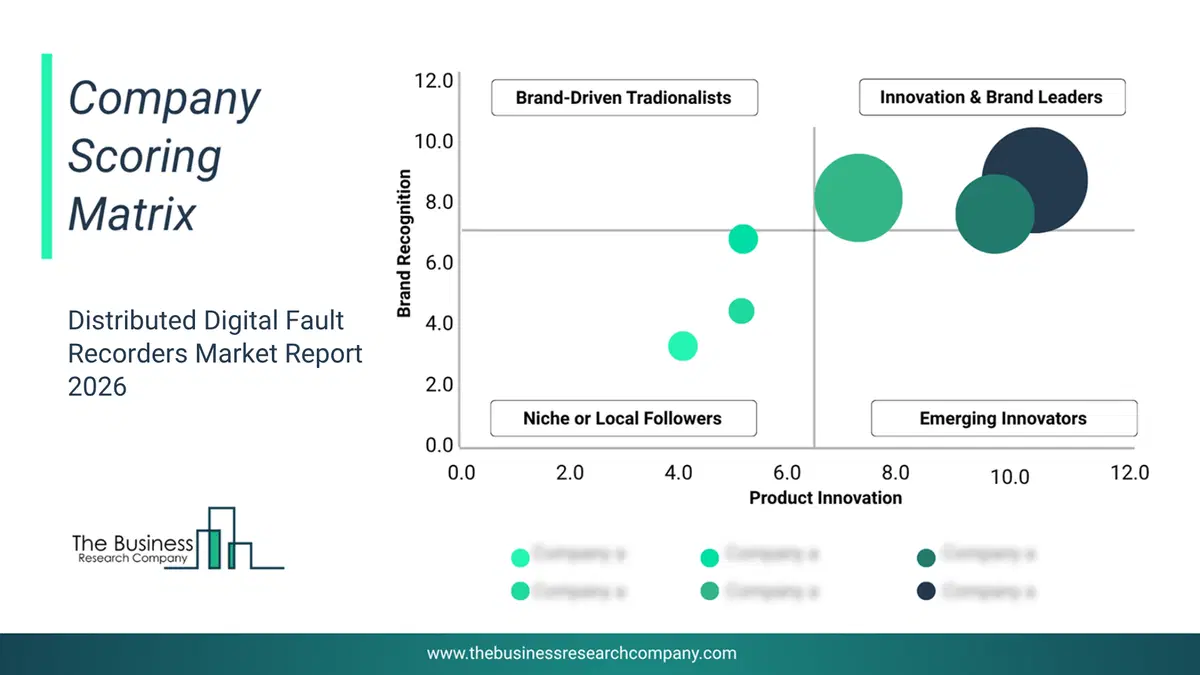
This chart maps companies by product innovation and brand strength, with bubble size indicating relative revenue, helping identify market leaders, challengers, and niche players. This is an illustrative chart; the full report provides a complete and accurate competitive analysis.
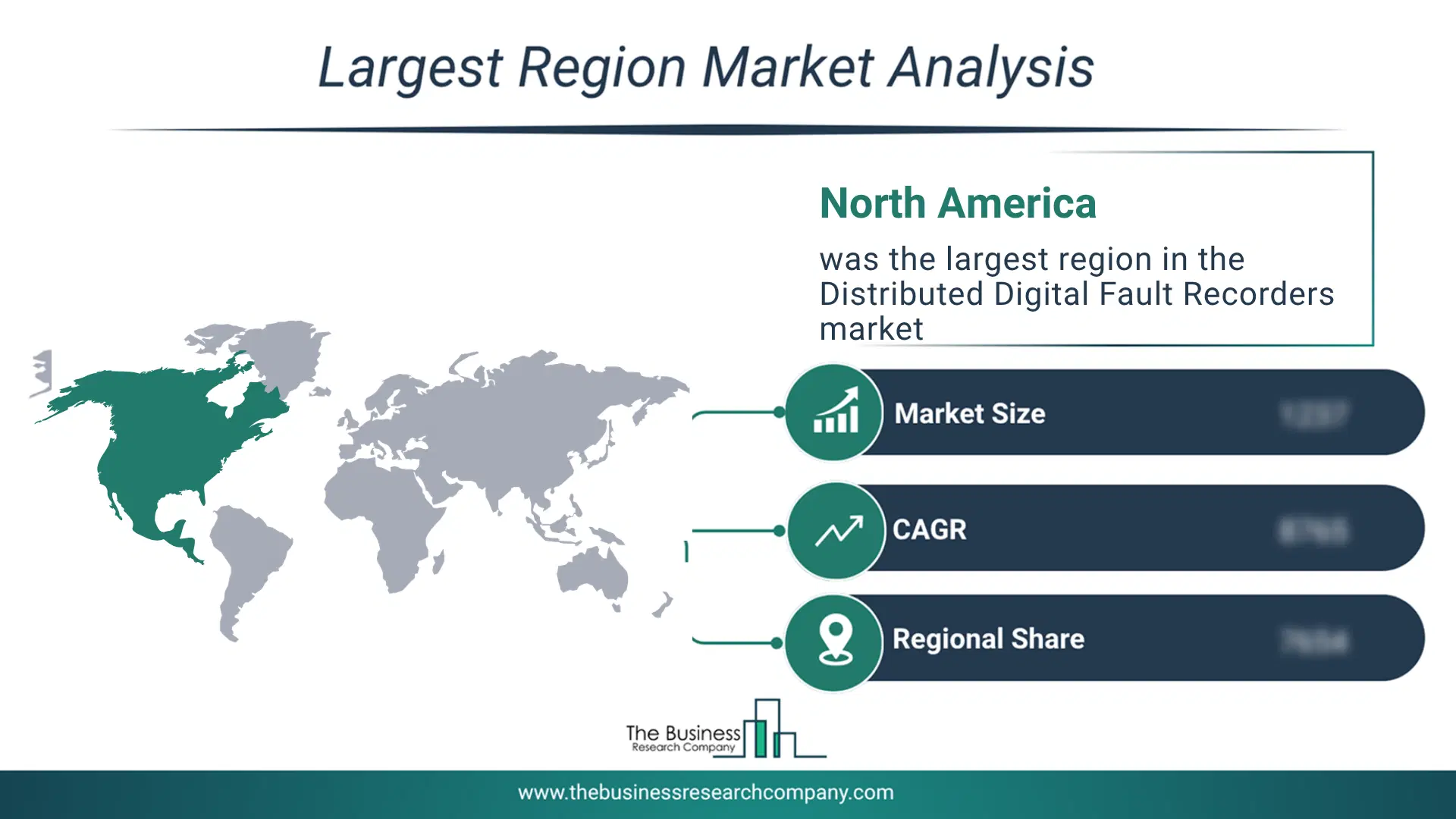
Regional Insights
North America was the largest region in the distributed digital fault recorders market in 2025. Asia-Pacific is expected to be the fastest-growing region in the forecast period. The regions covered in this market report are Asia-Pacific, South East Asia, Western Europe, Eastern Europe, North America, South America, Middle East, Africa. The countries covered in this market report are Australia, Brazil, China, France, Germany, India, Indonesia, Japan, Taiwan, Russia, South Korea, UK, USA, Canada, Italy, Spain.What Defines the Distributed Digital Fault Recorders Market?
The distributed digital fault recorders market consists of revenues earned by entities by providing services such as site assessment and grid connectivity analysis, installation and commissioning of distributed fault recorders, time synchronization and data acquisition setup, real-time fault detection and disturbance analysis, and waveform data management and analytics. The market value includes the value of related goods sold by the service provider or included within the service offering. The distributed digital fault recorders market also includes sales of high-speed data acquisition modules, voltage and current sensors, time synchronization equipment, communication and networking modules, and embedded processing units. Values in this market are ‘factory gate’ values, that is the value of goods sold by the manufacturers or creators of the goods, whether to other entities (including downstream manufacturers, wholesalers, distributors and retailers) or directly to end customers. The value of goods in this market includes related services sold by the creators of the goods.How is Market Value Defined and Measured?
The market value is defined as the revenues that enterprises gain from the sale of goods and/or services within the specified market and geography through sales, grants, or donations in terms of the currency (in USD unless otherwise specified). The revenues for a specified geography are consumption values that are revenues generated by organizations in the specified geography within the market, irrespective of where they are produced. It does not include revenues from resales along the supply chain, either further along the supply chain or as part of other products.
This chart presents market attractiveness based on a quantitative evaluation of growth, competition, strategic alignment, and risk, offering a clear view of opportunity areas for decision-making. This chart is for illustrative purposes; the full report contains the complete analysis.

This chart highlights the Total Addressable Market (TAM) by estimating the maximum revenue opportunity using an assumption-driven approach, supporting strategic planning and opportunity sizing across markets. The chart is illustrative; the full report provides a more comprehensive analysis.
What Key Data and Analysis Are Included in the Distributed Digital Fault Recorders Market Report 2026?
The distributed digital fault recorders market research report is one of a series of new reports from The Business Research Company that provides market statistics, including industry global market size, regional shares, competitors with the market share, detailed market segments, market trends and opportunities, and any further data you may need to thrive in the distributed digital fault recorders industry. The market research report delivers a complete perspective of everything you need, with an in-depth analysis of the current and future state of the industry.Distributed Digital Fault Recorders Market Report Forecast Analysis
| Report Attribute | Details |
|---|---|
| Market Size Value In 2026 | $1.21 billion |
| Revenue Forecast In 2030 | $1.67 billion |
| Growth Rate | CAGR of 8.2% from 2026 to 2030 |
| Base Year For Estimation | 2025 |
| Actual Estimates/Historical Data | 2020-2025 |
| Forecast Period | 2026 - 2030 - 2030 |
| Market Representation | Revenue in USD Billion and CAGR from 2026 to 2030 |
| Segments Covered | Component, Product Type, Deployment Mode, Application, End User |
| Regional Scope | Asia-Pacific, Western Europe, Eastern Europe, North America, South America, Middle East, Africa |
| Country Scope | The countries covered in the report are Australia, Brazil, China, France, Germany, India, Indonesia, Japan, Taiwan, Russia, South Korea, UK, USA, Canada, Italy, Spain. |
| Key Companies Profiled | Siemens AG, Hitachi Energy Ltd., Schneider Electric SE, Mitsubishi Electric Corporation, Honeywell International Inc., GE Vernova, ABB Ltd., Emerson Electric Co., AMETEK Inc., Yokogawa Electric Corporation, Schweitzer Engineering Laboratories Inc., Prosoft-Systems Ltd., Qualitrol Company LLC, Elspec Ltd., OMICRON electronics GmbH, Ducati Energia Spa, KoCoS Messtechnik AG, ErlPhase Power Technologies Ltd., Arbiter Systems Inc., Mehta Tech Inc. |
| Customization Scope | Request for Customization |
| Pricing And Purchase Options | Explore Purchase Options |