
Distributed Temperature Sensing Market Report 2026
Global Outlook – By Operating Principle ( Optical Time Domain Reflectometry, Optical Frequency Domain Reflectometry), By Scattering Method ( Rayleigh Scattering Effect, Raman Scattering Effect, Brillouin Scattering Effect), By Installation Type ( Permanent Installation, Temporary Installation), By Application ( Oil And Gas, Infrastructure Monitoring, Environmental Monitoring, Energy Management, Industrial Processes) – Market Size, Trends, Strategies, and Forecast to 2030
Distributed Temperature Sensing Market Overview
• Distributed Temperature Sensing market size has reached to $1.18 billion in 2025 • Expected to grow to $1.98 billion in 2030 at a compound annual growth rate (CAGR) of 10.9% • Growth Driver: Expansion Of The Oil And Gas Sector Fueling The Growth Of The Market Due To Rising Global Energy Demand And Need For Real-Time Infrastructure Monitoring • Market Trend: Advanced Real-Time Monitoring Enhances Infrastructure Security And Efficiency • North America was the largest region in 2025 and Asia-Pacific is the fastest growing region.What Is Covered Under Distributed Temperature Sensing Market?
Distributed temperature sensing (DTS) refers to a fiber optic-based technology that enables continuous, real-time temperature measurement along the entire length of a cable, providing precise thermal monitoring over large distances. It works by sending laser pulses through the fiber optic cable and analyzing the backscattered light to detect and quantify temperature variations along the entire cable, providing detailed and continuous thermal data for monitoring and safety applications. The main types of sensing technologies in distributed temperature sensing are fiber optic temperature sensing, wireless temperature sensing, thermal imaging sensors, thermocouples, and infrared sensors. Fiber optic temperature sensing is a technology that uses fiber optic cables to measure temperature changes along their length with high sensitivity and spatial resolution. It includes various operating principles such as optical time domain reflectometry, and optical frequency domain reflectometry, with scattering methods, including Rayleigh scattering effect, Raman scattering effect, and Brillouin scattering effect. It includes various installation types, such as permanent installation, and temporary installation, and is applied in oil and gas, infrastructure monitoring, environmental monitoring, energy management, and industrial processes.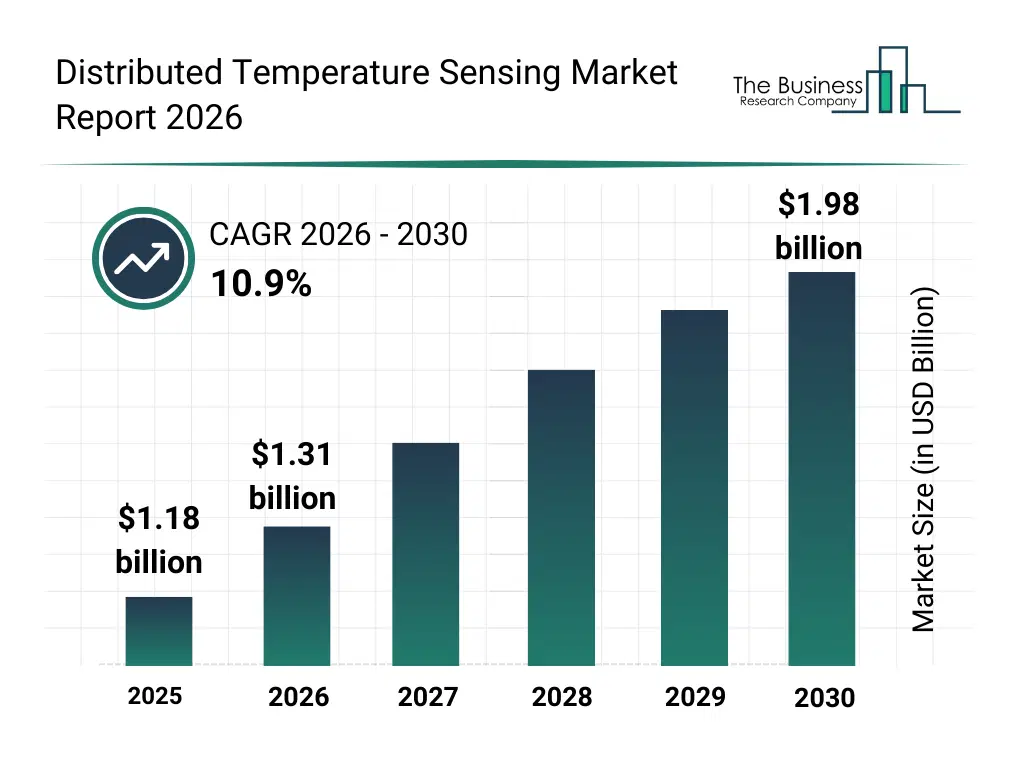
What Is The Distributed Temperature Sensing Market Size 2026 And Growth Rate?
The distributed temperature sensing market size has grown rapidly in recent years. It will grow from $1.18 billion in 2025 to $1.31 billion in 2026 at a compound annual growth rate (CAGR) of 11.0%. The growth in the historic period can be attributed to oil and gas pipeline safety regulations, expansion of fiber optic communication networks, growth in power transmission infrastructure, demand for real-time temperature monitoring, industrial process safety requirements.What Is The Distributed Temperature Sensing Market Growth Forecast?
The distributed temperature sensing market size is expected to see rapid growth in the next few years. It will grow to $1.98 billion in 2030 at a compound annual growth rate (CAGR) of 10.9%. The growth in the forecast period can be attributed to smart city infrastructure investments, integration of AI with fiber optic sensing, renewable energy grid expansion, rising demand for predictive maintenance, adoption of digital twins in industrial assets. Major trends in the forecast period include ai-driven predictive temperature analytics, iot-enabled distributed sensing networks, smart infrastructure thermal monitoring, cloud-based dts data platforms, cybersecurity for fiber optic sensing systems.
Global Distributed Temperature Sensing Market Segmentation
1) By Operating Principle: Optical Time Domain Reflectometry, Optical Frequency Domain Reflectometry 2) By Scattering Method: Rayleigh Scattering Effect, Raman Scattering Effect, Brillouin Scattering Effect 3) By Installation Type: Permanent Installation, Temporary Installation 4) By Application: Oil And Gas, Infrastructure Monitoring, Environmental Monitoring, Energy Management, Industrial Processes Subsegments: 1) By OTDR-Based DTS: Raman-Based OTDR Systems, Brillouin-Based OTDR Systems, Rayleigh-Based OTDR Systems 2) By OFDR-Based DTS: Coherent Rayleigh OFDR, Interferometric OFDR, Swept-Laser OFDRWhat Is The Driver Of The Distributed Temperature Sensing Market?
The expansion of the oil and gas sector is expected to propel the growth of the distributed temperature sensing market going forward. The oil and gas sector refers to the industry engaged in exploring, extracting, refining, transporting, and selling oil and natural gas products. The oil and gas sector is expanding rapidly rising global energy demand, especially from growing populations and industrialisation in emerging economies. Distributed temperature sensing enhances the oil and gas sector by providing real-time monitoring of pipelines and critical infrastructure, making it ideal for detecting leaks and anomalies. It improves operational efficiency by enabling proactive maintenance and minimising downtime, enhancing safety, and reducing operational costs. For instance, in March 2025, according to the International Energy Agency, a France-based intergovernmental organisation, oil demand rose by 0.8% in 2024, compared with a 1.9% increase in 2023. Therefore, the expansion of the oil and gas sector is driving the growth of the distributed temperature sensing industry.Key Players In The Global Distributed Temperature Sensing Market
Major companies operating in the distributed temperature sensing market are Sumitomo Electric Industries Ltd., Schlumberger, Halliburton Company, Prysmian S.p.A., Corning Incorporated, Furukawa Electric Co. Ltd., Weatherford International plc, Yokogawa Electric Corporation, QinetiQ Group plc, Banner Engineering Corp., Viavi Solutions Inc., OZ Optics Limited, Luna Innovations Inc., NKT Photonics A/S, AP Sensing GmbH, JMV Co. Ltd., Bitcomm Technologies, Sensornet Ltd., Aragon Photonics, DarkPulse Inc., FEBUS Optics, GESO GmbH & Co. KG, Optromix Inc.
This chart is for illustrative purposes; the full report includes a detailed competitor analysis and comprehensive overview of the top 10 companies in the market.
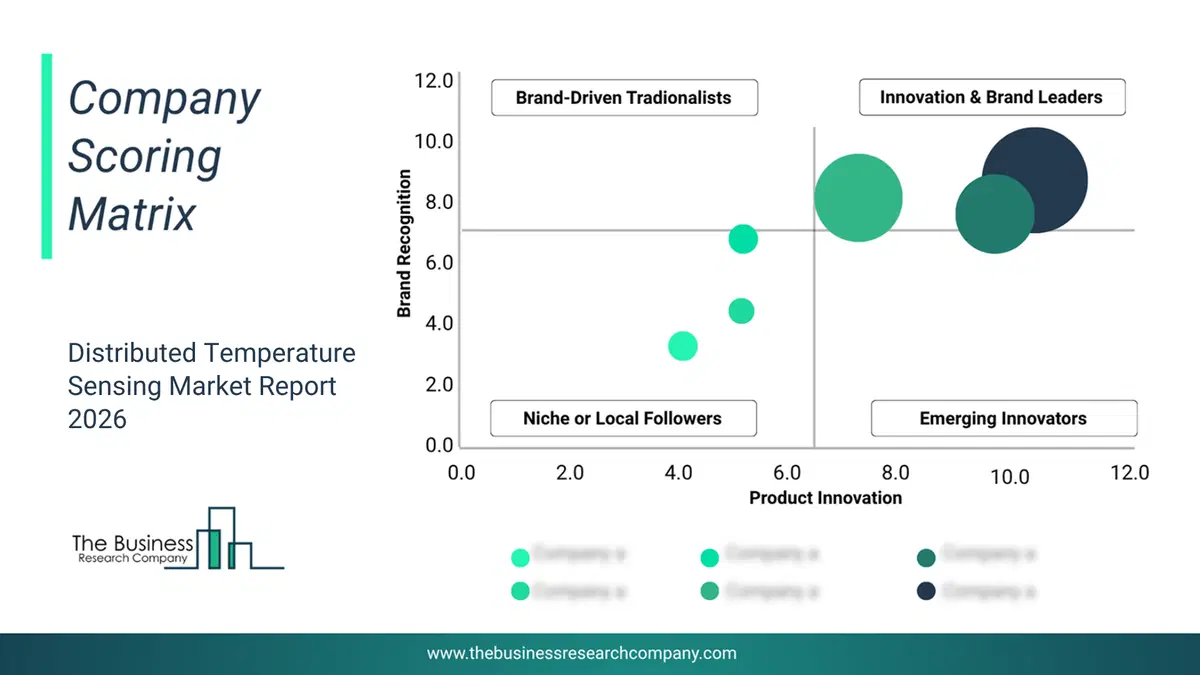
This chart maps companies by product innovation and brand strength, with bubble size indicating relative revenue, helping identify market leaders, challengers, and niche players. This is an illustrative chart; the full report provides a complete and accurate competitive analysis.
Global Distributed Temperature Sensing Market Trends and Insights
Major companies operating in the distributed temperature sensing market are focusing on developing innovative solutions, such as advanced real-time monitoring and analytics systems, to enhance temperature measurement accuracy, enable proactive maintenance, and optimize operational efficiency across industries. An advanced real-time monitoring and analytics system refers to a technology that continuously collects and analyzes temperature data in real time to detect anomalies, optimise processes, and support predictive maintenance. For instance, in July 2024, Viavi Solutions Inc., a US-based network technology company, launched NITRO Fiber Sensing, an advanced real-time monitoring and analytics system for fiber optic cables and fibre-enabled critical infrastructure. This solution combines distributed temperature, strain, and acoustic sensing technologies to continuously monitor physical conditions and detect threats such as intrusions, digging, and vehicle movements along pipelines, power lines, and other critical assets. It provides precise location alerts and actionable intelligence to enhance infrastructure security by using remote fibre test heads, helping minimize damage, reduce outages, optimize maintenance, lower operational costs, and improve overall system resilience.What Are Latest Mergers And Acquisitions In The Distributed Temperature Sensing Market?
In December 2023, Luna Innovations Inc., a US-based fibre-optic solutions provider, acquired Silixa Ltd. for $21.5 million. With this acquisition, Luna aims to elevate its portfolio of fiber optic sensing solutions, strengthen its position as an enabler of energy transition, and extend its reach into new growth sectors such as carbon capture and storage, while enhancing profitable growth across Europe with Silixa’s technology and talent. Silixa Ltd. is a UK-based company specializing in distributed temperature sensing (DTS) solutions for industrial and infrastructure monitoring.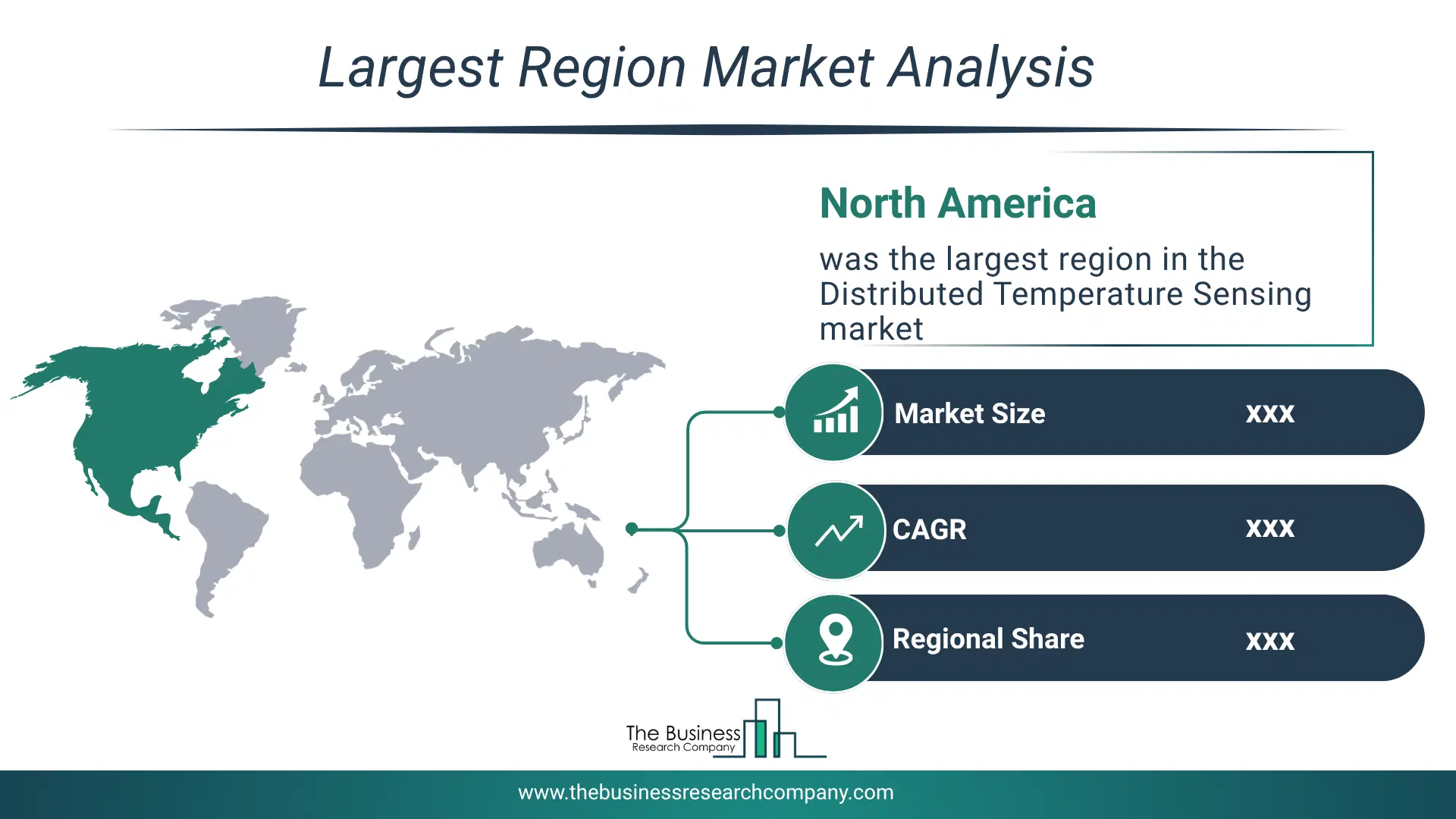
Regional Outlook
North America was the largest region in the distributed temperature sensing market in 2025. Asia-Pacific is expected to be the fastest-growing region in the forecast period. The regions covered in this market report are Asia-Pacific, South East Asia, Western Europe, Eastern Europe, North America, South America, Middle East, Africa. The countries covered in this market report are Australia, Brazil, China, France, Germany, India, Indonesia, Japan, Taiwan, Russia, South Korea, UK, USA, Canada, Italy, Spain.What Defines the Distributed Temperature Sensing Market?
The distributed temperature sensing market consists of revenues earned by entities by providing services, such as real-time temperature monitoring, fire detection, pipeline leak detection, power cable monitoring, and geothermal energy management. The market value includes the value of related goods sold by the service provider or included within the service offering. The distributed temperature sensing market also includes sales of fiber optic cables, distributed temperature sensing (DTS) analyzers, optical interrogation units, temperature sensing modules, and data visualization and analysis software solutions. Values in this market are ‘factory gate’ values; that is, the value of goods sold by the manufacturers or creators of the goods, whether to other entities (including downstream manufacturers, wholesalers, distributors, and retailers) or directly to end customers. The value of goods in this market includes related services sold by the creators of the goods.How is Market Value Defined and Measured?
The market value is defined as the revenues that enterprises gain from the sale of goods and/or services within the specified market and geography through sales, grants, or donations in terms of the currency (in USD unless otherwise specified). The revenues for a specified geography are consumption values that are revenues generated by organizations in the specified geography within the market, irrespective of where they are produced. It does not include revenues from resales along the supply chain, either further along the supply chain or as part of other products.
This chart presents market attractiveness based on a quantitative evaluation of growth, competition, strategic alignment, and risk, offering a clear view of opportunity areas for decision-making. This chart is for illustrative purposes; the full report contains the complete analysis.

This chart highlights the Total Addressable Market (TAM) by estimating the maximum revenue opportunity using an assumption-driven approach, supporting strategic planning and opportunity sizing across markets. The chart is illustrative; the full report provides a more comprehensive analysis.
What Key Data and Analysis Are Included in the Distributed Temperature Sensing Market Report 2026?
The distributed temperature sensing market research report is one of a series of new reports from The Business Research Company that provides market statistics, including industry global market size, regional shares, competitors with the market share, detailed market segments, market trends and opportunities, and any further data you may need to thrive in the distributed temperature sensing industry. The market research report delivers a complete perspective of everything you need, with an in-depth analysis of the current and future state of the industry.Distributed Temperature Sensing Market Report Forecast Analysis
| Report Attribute | Details |
|---|---|
| Market Size Value In 2026 | $1.31 billion |
| Revenue Forecast In 2030 | $1.98 billion |
| Growth Rate | CAGR of 10.9% from 2026 to 2030 |
| Base Year For Estimation | 2025 |
| Actual Estimates/Historical Data | 2020-2025 |
| Forecast Period | 2026 - 2030 |
| Market Representation | Revenue in USD Billion and CAGR from 2026 to 2030 |
| Segments Covered | Operating Principle, Scattering Method, Installation Type, Application |
| Regional Scope | Asia-Pacific, Western Europe, Eastern Europe, North America, South America, Middle East, Africa |
| Country Scope | The countries covered in the report are Australia, Brazil, China, France, Germany, India, Indonesia, Japan, Taiwan, Russia, South Korea, UK, USA, Canada, Italy, Spain. |
| Key Companies Profiled | Sumitomo Electric Industries Ltd., Schlumberger, Halliburton Company, Prysmian S.p.A., Corning Incorporated, Furukawa Electric Co. Ltd., Weatherford International plc, Yokogawa Electric Corporation, QinetiQ Group plc, Banner Engineering Corp., Viavi Solutions Inc., OZ Optics Limited, Luna Innovations Inc., NKT Photonics A/S, AP Sensing GmbH, JMV Co. Ltd., Bitcomm Technologies, Sensornet Ltd., Aragon Photonics, DarkPulse Inc., FEBUS Optics, GESO GmbH & Co. KG, Optromix Inc. |
| Customization Scope | Request for Customization |
| Pricing And Purchase Options | Explore Purchase Options |