
Drone-Assisted Urban Light Detection And Ranging (LiDAR) Mapping Market Report 2026
Global Outlook – By Component (Hardware, Software, Services), By Deployment Mode (On-Premises, Cloud), By End-User (Government, Construction, Utilities, Transportation And Logistics, Other End-Users) – Market Size, Trends, Strategies, and Forecast to 2030
Drone-Assisted Urban Light Detection And Ranging (LiDAR) Mapping Market Overview
• Drone-Assisted Urban Light Detection And Ranging (LiDAR) Mapping market size has reached to $1.61 billion in 2025 • Expected to grow to $3.62 billion in 2030 at a compound annual growth rate (CAGR) of 17.6% • Growth Driver: Increasing Frequency And Severity Of Natural Disasters Driving The Market Growth Due To Rising Need For Accurate Damage Assessment And Urban Planning • Market Trend: Cloud-Powered Drone Surveys Streamline Urban Planning And Monitoring • North America was the largest region in 2025 and Asia-Pacific is the fastest growing region.What Is Covered Under Drone-Assisted Urban Light Detection And Ranging (LiDAR) Mapping Market?
Drone-assisted urban light detection and ranging (LiDAR) mapping is a technique that uses unmanned aerial vehicles equipped with LiDAR sensors to capture high-resolution, three-dimensional data of urban environments. It enables precise measurement of building structures, vegetation, and terrain by emitting laser pulses and recording their reflections. This approach allows for rapid, accurate, and comprehensive mapping of complex city landscapes. The main components in drone-assisted urban light detection and ranging (LiDAR) mapping are hardware, software, and services. The hardware refers to the physical equipment used to capture precise three-dimensional (3D) urban data. It can be categorized by deployment mode, such as on-premises or cloud, and is used by various end-users, including government, construction, utilities, transportation and logistics, and other sectors.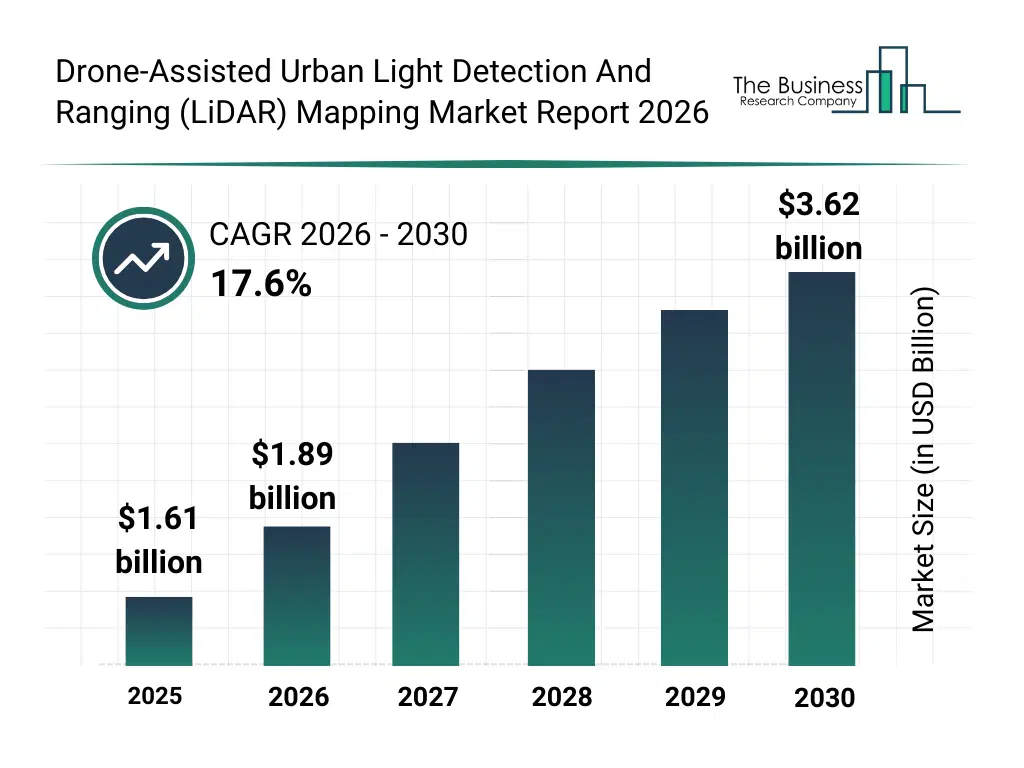
What Is The Drone-Assisted Urban Light Detection And Ranging (LiDAR) Mapping Market Size and Share 2026?
The drone-assisted urban light detection and ranging (lidar) mapping market size has grown rapidly in recent years. It will grow from $1.61 billion in 2025 to $1.89 billion in 2026 at a compound annual growth rate (CAGR) of 17.4%. The growth in the historic period can be attributed to rising adoption of UAV-assisted urban mapping, increasing use of LiDAR for city planning, growth in high-precision 3D mapping projects, expansion of real-time data processing, rising demand for terrain modeling and DEM generation.What Is The Drone-Assisted Urban Light Detection And Ranging (LiDAR) Mapping Market Growth Forecast?
The drone-assisted urban light detection and ranging (lidar) mapping market size is expected to see rapid growth in the next few years. It will grow to $3.62 billion in 2030 at a compound annual growth rate (CAGR) of 17.6%. The growth in the forecast period can be attributed to increasing integration of AI-enabled analytics, expansion of IoT-connected UAV networks, growth in sustainable drone hardware, rising adoption of cloud-based mapping platforms, development of advanced visualization and simulation tools. Major trends in the forecast period include deployment of AI-enhanced lidar mapping systems, integration of IOT-based drone monitoring networks, expansion of 3d urban modeling and simulation platforms, development of real-time data processing and analytics solutions, implementation of sustainable and high-precision uav hardware.
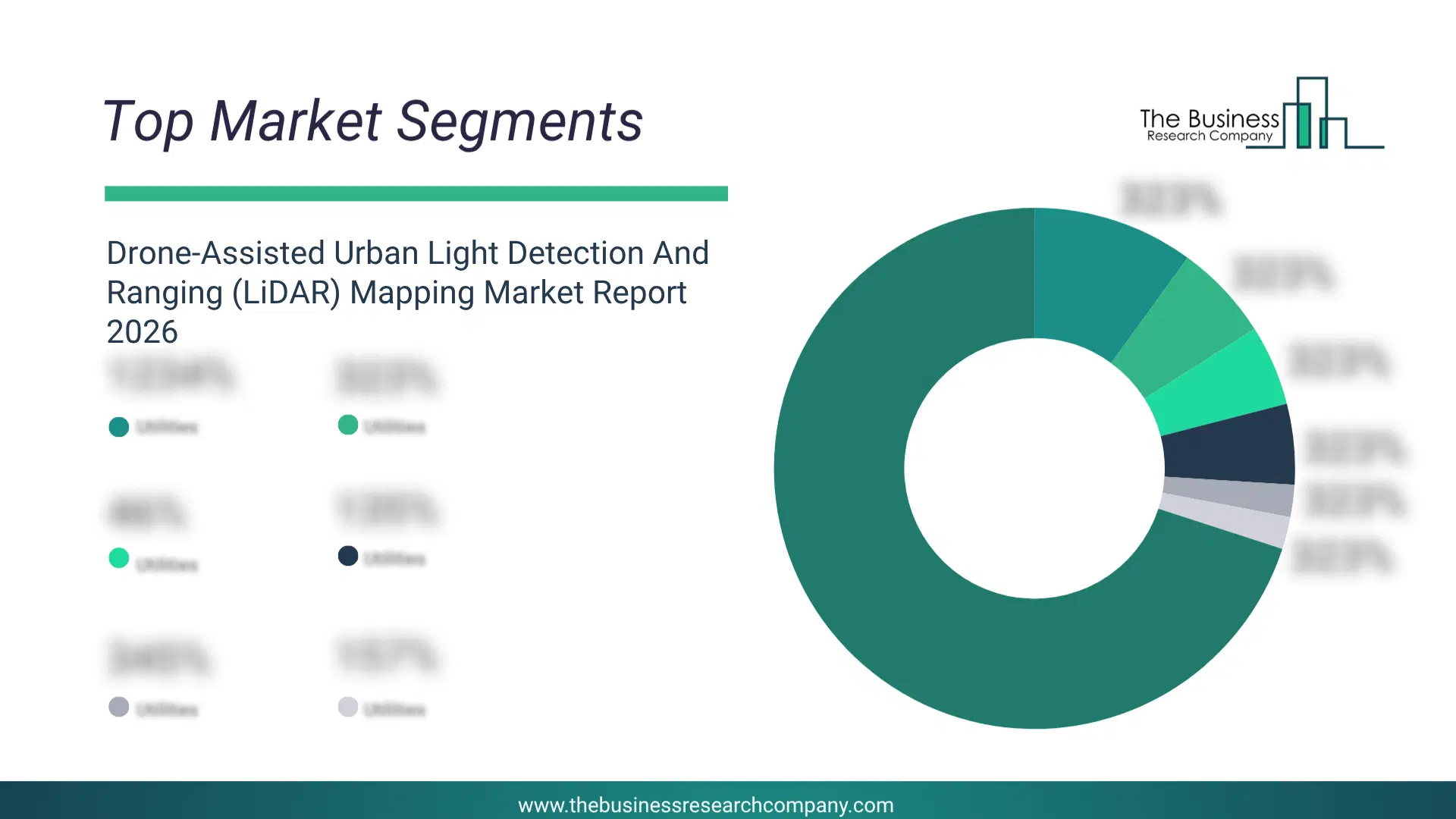
Global Drone-Assisted Urban Light Detection And Ranging (LiDAR) Mapping Market Segmentation
1) By Component: Hardware, Software, Services 2) By Deployment Mode: On-Premises, Cloud 3) By End-User: Government, Construction, Utilities, Transportation And Logistics, Other End-Users Subsegments: 1) By Hardware: Light Detection And Ranging (LiDAR) Sensors, Cameras, Navigation Systems, Power Systems, Communication Systems, Control Systems 2) By Software: Data Processing Software, Mapping Software, Analytics Software, Visualization Software, Simulation Software 3) By Services: Deployment And Integration, Maintenance And Support, Training And Consulting, Managed Services, Data Acquisition ServicesWhat Is The Driver Of The Drone-Assisted Urban Light Detection And Ranging (LiDAR) Mapping Market?
The increasing frequency and severity of natural disasters is expected to propel the growth of the drone-assisted urban light detection and ranging (LiDAR) mapping market going forward. Natural disasters refer to large-scale adverse events such as floods, earthquakes, droughts, and storms that significantly impact urban environments. The rise in natural disasters is mainly due to climate change, which intensifies extreme weather, and human activities such as deforestation, pollution, and urbanization that worsen their impacts. Drone-assisted urban light detection and ranging (LiDAR) mapping enables rapid and highly accurate damage assessment, terrain analysis, and rescue planning in the aftermath of natural disasters, providing actionable data that accelerates emergency response and recovery efforts. For instance, according to the National Centers for Environmental Information (NCEI), a US-based government agency, in 2023, the United States faced 28 distinct weather and climate disasters, each causing damages exceeding $1 billion, that number had climbed to 28 natural disasters. Therefore, the increasing frequency and severity of natural disasters is driving the growth of the drone-assisted urban light detection and ranging (LiDAR) mapping industry.Key Players In The Global Drone-Assisted Urban Light Detection And Ranging (LiDAR) Mapping Market
Major companies operating in the drone-assisted urban light detection and ranging (lidar) mapping market are SZ DJI Technology Co. Ltd., Trimble Inc., Leica Geosystems AG, Microdrones GmbH, Teledyne Optech Incorporated, Velodyne Lidar Inc., Ouster Inc., Wetland Studies and Solutions Inc., Innoviz Technologies Ltd., Emesent Pty Ltd., Delair SAS, Exyn Technologies Inc., FlyGuys Inc., Cepton Inc., RIEGL Laser Measurement Systems GmbH, YELLOWSCAN S.A.S., FlyPix AI GmbH, Phoenix LiDAR Systems Inc, Geodetics Inc., Fagerman Technologies Inc.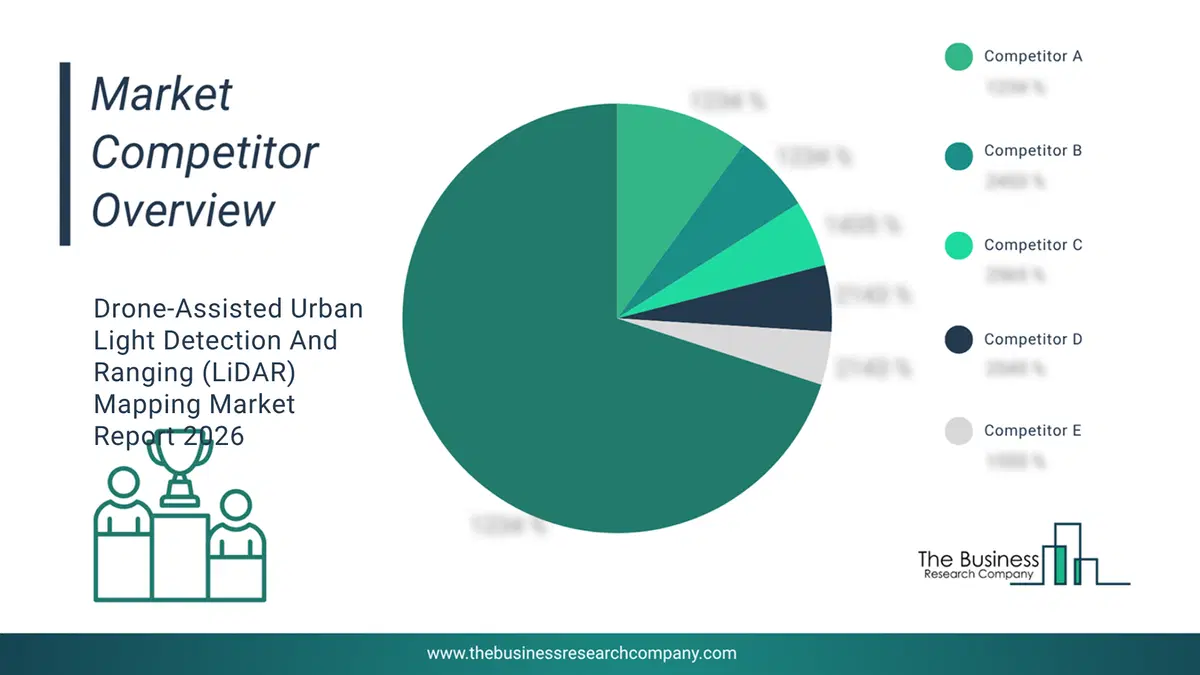
This chart is for illustrative purposes; the full report includes a detailed competitor analysis and comprehensive overview of the top 10 companies in the market.
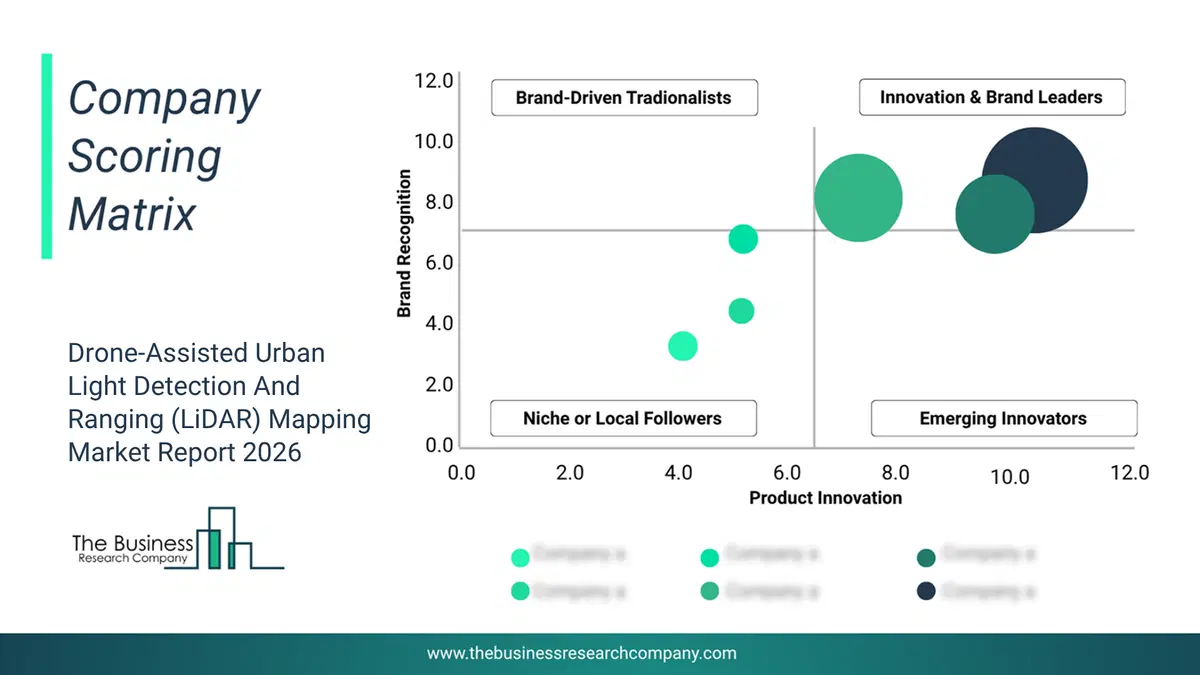
This chart maps companies by product innovation and brand strength, with bubble size indicating relative revenue, helping identify market leaders, challengers, and niche players. This is an illustrative chart; the full report provides a complete and accurate competitive analysis.
Global Drone-Assisted Urban Light Detection And Ranging (LiDAR) Mapping Market Trends and Insights
Major companies operating in the drone-assisted urban light detection and ranging (LiDAR) mapping market are focusing on integrating innovative technologies such as cloud-based analytics to enhance data processing efficiency and deliver faster, more accurate mapping insights. Cloud-based analytics refers to the use of remote servers and software over the internet to store, process, and analyze data, helping drone-assisted LiDAR mapping by enabling faster computation, easier collaboration, and scalable storage without relying on local hardware. For instance, in July 2025, Wingtra, a Switzerland-based manufacturing company, launched the WingtraRay, a vertical takeoff and landing (VTOL) drone designed for survey professionals. The system integrates WingtraGround for field data logging and WingtraCloud for cloud-based processing, enabling users to generate georeferenced orthomosaics, point clouds, and digital surface models more efficiently. The combination of rapid data collection and cloud analytics accelerates urban LiDAR mapping workflows, reduces reliance on local hardware, and supports scalable, collaborative project delivery, ultimately improving decision-making for industries such as construction, environmental monitoring, and urban planning.What Are Latest Mergers And Acquisitions In The Drone-Assisted Urban Light Detection And Ranging (LiDAR) Mapping Market?
In August 2024, YellowScan SAS, a France-based provider of high-end drone LiDAR mapping solutions, partnered with Freefly Systems Inc. to integrate YellowScan’s aerial LiDAR technology with Freefly’s advanced UAV platforms for enhanced data collection and mapping performance. Through this collaboration, YellowScan SAS aims to expand its aerial surveying capabilities and deliver more efficient, precise, and adaptable LiDAR solutions for diverse mapping applications. Freefly Systems Inc. is a U.S.-based provider of professional unmanned aerial vehicles and camera movement systems, specializing in innovative drone platforms designed for industrial, cinematic, and surveying use cases.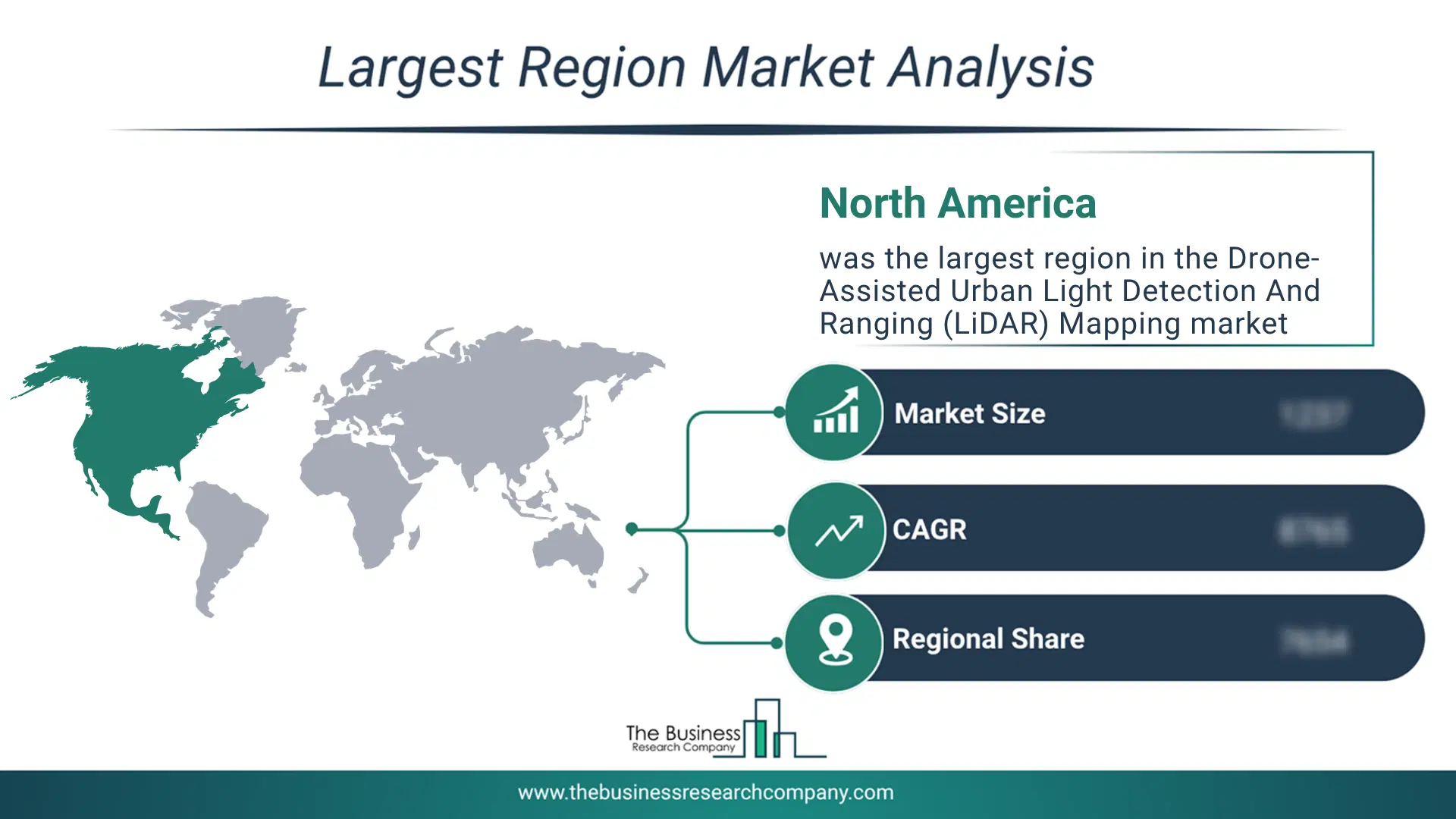
Regional Insights
North America was the largest region in the drone-assisted urban light detection and ranging (LiDAR) mapping market in 2025. Asia-Pacific is expected to be the fastest-growing region in the forecast period. The regions covered in this market report are Asia-Pacific, South East Asia, Western Europe, Eastern Europe, North America, South America, Middle East, Africa. The countries covered in this market report are Australia, Brazil, China, France, Germany, India, Indonesia, Japan, Taiwan, Russia, South Korea, UK, USA, Canada, Italy, Spain.What Defines the Drone-Assisted Urban Light Detection And Ranging (LiDAR) Mapping Market?
The drone-assisted urban light detection and ranging (LiDAR) mapping market consists of revenues earned by entities by providing services such as aerial surveying, topographic mapping, corridor mapping, bathymetric surveying, terrain modeling and DEM generation, orthophoto and imagery production, and specialized services. The market value includes the value of related goods sold by the service provider or included within the service offering. The drone-assisted urban light detection and ranging (LiDAR) mapping market also includes sales of geographic information system (GIS) software, computer-aided design (CAD) tools, LiDAR data processing software, three-dimensional (3D) mapping platforms, and urban simulation and modeling software. Values in this market are ‘factory gate’ values, that is the value of goods sold by the manufacturers or creators of the goods, whether to other entities (including downstream manufacturers, wholesalers, distributors and retailers) or directly to end customers. The value of goods in this market includes related services sold by the creators of the goods.How is Market Value Defined and Measured?
The market value is defined as the revenues that enterprises gain from the sale of goods and/or services within the specified market and geography through sales, grants, or donations in terms of the currency (in USD unless otherwise specified). The revenues for a specified geography are consumption values that are revenues generated by organizations in the specified geography within the market, irrespective of where they are produced. It does not include revenues from resales along the supply chain, either further along the supply chain or as part of other products.
This chart presents market attractiveness based on a quantitative evaluation of growth, competition, strategic alignment, and risk, offering a clear view of opportunity areas for decision-making. This chart is for illustrative purposes; the full report contains the complete analysis.

This chart highlights the Total Addressable Market (TAM) by estimating the maximum revenue opportunity using an assumption-driven approach, supporting strategic planning and opportunity sizing across markets. The chart is illustrative; the full report provides a more comprehensive analysis.
What Key Data and Analysis Are Included in theDrone-Assisted Urban Light Detection And Ranging (LiDAR) Mapping Market Report 2026?
The drone-assisted urban light detection and ranging (lidar) mapping market research report is one of a series of new reports from The Business Research Company that provides market statistics, including industry global market size, regional shares, competitors with the market share, detailed market segments, market trends and opportunities, and any further data you may need to thrive in the drone-assisted urban light detection and ranging (lidar) mapping industry. The market research report delivers a complete perspective of everything you need, with an in-depth analysis of the current and future state of the industry.Drone-Assisted Urban Light Detection And Ranging (LiDAR) Mapping Market Report Forecast Analysis
| Report Attribute | Details |
|---|---|
| Market Size Value In 2026 | $1.89 billion |
| Revenue Forecast In 2030 | $3.62 billion |
| Growth Rate | CAGR of 17.4% from 2026 to 2030 |
| Base Year For Estimation | 2025 |
| Actual Estimates/Historical Data | 2020-2025 |
| Forecast Period | 2026 - 2030 |
| Market Representation | Revenue in USD Billion and CAGR from 2026 to 2030 |
| Segments Covered | Component, Deployment Mode, End-User |
| Regional Scope | Asia-Pacific, Western Europe, Eastern Europe, North America, South America, Middle East, Africa |
| Country Scope | The countries covered in this market report are Australia, Brazil, China, France, Germany, India, Indonesia, Japan, Taiwan, Russia, South Korea, UK, USA, Canada, Italy, Spain |
| Key Companies Profiled | SZ DJI Technology Co. Ltd., Trimble Inc., Leica Geosystems AG, Microdrones GmbH, Teledyne Optech Incorporated, Velodyne Lidar Inc., Ouster Inc., Wetland Studies and Solutions Inc., Innoviz Technologies Ltd., Emesent Pty Ltd., Delair SAS, Exyn Technologies Inc., FlyGuys Inc., Cepton Inc., RIEGL Laser Measurement Systems GmbH, YELLOWSCAN S.A.S., FlyPix AI GmbH, Phoenix LiDAR Systems Inc, Geodetics Inc., Fagerman Technologies Inc. |
| Customization Scope | Request for Customization |
| Pricing And Purchase Options | Explore Purchase Options |