
Drone-Based Urban Air Quality Sensor Market Report 2026
Global Outlook – By Product Type (Fixed-Wing Drones, Rotary-Wing Drones, Hybrid Drones), By Sensor Type (Gas Sensors, Particulate Matter Sensors, Multi-Sensor Systems, Other Sensor Types), By Application (Air Pollution Monitoring, Emission Source Detection, Industrial Monitoring, Research And Academic, Other Applications), By End-User (Government And Municipalities, Environmental Agencies, Industrial, Research Institutes, Other End-Users) – Market Size, Trends, Strategies, and Forecast to 2030
Drone-Based Urban Air Quality Sensor Market Overview
• Drone-Based Urban Air Quality Sensor market size has reached to $1.36 billion in 2025 • Expected to grow to $3 billion in 2030 at a compound annual growth rate (CAGR) of 17% • Growth Driver: Increasing Air Pollution Fueling The Growth Of The Market Due To Increasing Vehicle Emissions And Need For Real-Time Monitoring • Market Trend: AI-Powered Drones Enhance Real-Time Emission Monitoring • North America was the largest region in 2025 and Asia-Pacific is the fastest growing region.What Is Covered Under Drone-Based Urban Air Quality Sensor Market?
A drone-based urban air quality sensor refers to a monitoring system mounted on unmanned aerial vehicles (UAVs) that measures pollutants such as particulate matter, nitrogen dioxide, carbon monoxide, and ozone in real time across different areas of a city. Its primary purpose is to provide real-time, high-resolution air quality data across different altitudes and hard-to-reach areas. This helps cities identify pollution hotspots, track emission sources, and support informed decision-making for public health and environmental sustainability. The main product types of drone-based urban air quality sensor are fixed-wing drones, rotary-wing drones, and hybrid drones. Fixed-wing drones refer to unmanned aerial vehicles (UAVs) that have a rigid wing structure, similar to traditional airplanes, and rely on forward motion to generate lift. It includes various sensor types, such as gas sensors, particulate matter sensors, multi-sensor systems, and others, and finds application in air pollution monitoring, emission source detection, industrial monitoring, research and academic, and others. The key end users include governments and municipalities, environmental agencies, industrial research institutes, and others.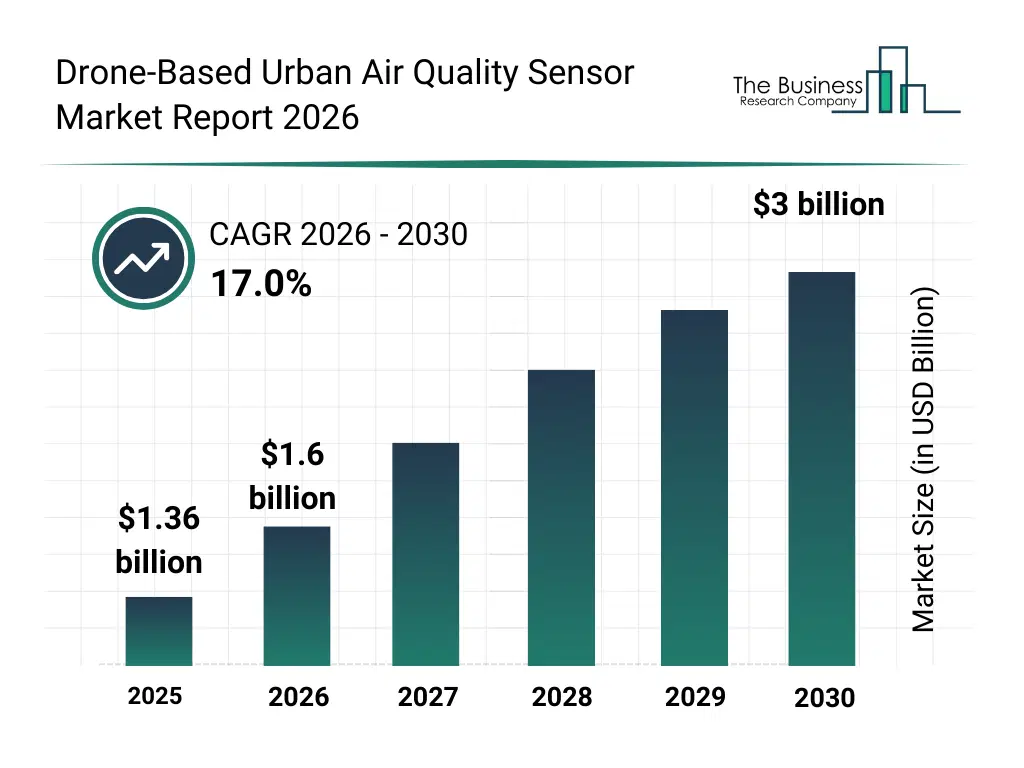
What Is The Drone-Based Urban Air Quality Sensor Market Size and Share 2026?
The drone-based urban air quality sensor market size has grown rapidly in recent years. It will grow from $1.36 billion in 2025 to $1.6 billion in 2026 at a compound annual growth rate (CAGR) of 17.6%. The growth in the historic period can be attributed to increasing urban air pollution levels, expansion of drone usage in environmental monitoring, early adoption of portable air sensors, rising public health awareness, availability of compact sensor technologies.What Is The Drone-Based Urban Air Quality Sensor Market Growth Forecast?
The drone-based urban air quality sensor market size is expected to see rapid growth in the next few years. It will grow to $3 billion in 2030 at a compound annual growth rate (CAGR) of 17.0%. The growth in the forecast period can be attributed to increasing investments in smart environmental monitoring, rising demand for real-time pollution data, expansion of drone regulations for urban operations, growing use of ai-based air quality analytics, increasing focus on climate resilience planning. Major trends in the forecast period include increasing deployment of uav-based air quality monitoring systems, rising use of multi-sensor payloads on drones, growing integration of real-time pollution mapping, expansion of high-resolution urban air analytics, enhanced focus on mobile environmental monitoring.
Global Drone-Based Urban Air Quality Sensor Market Segmentation
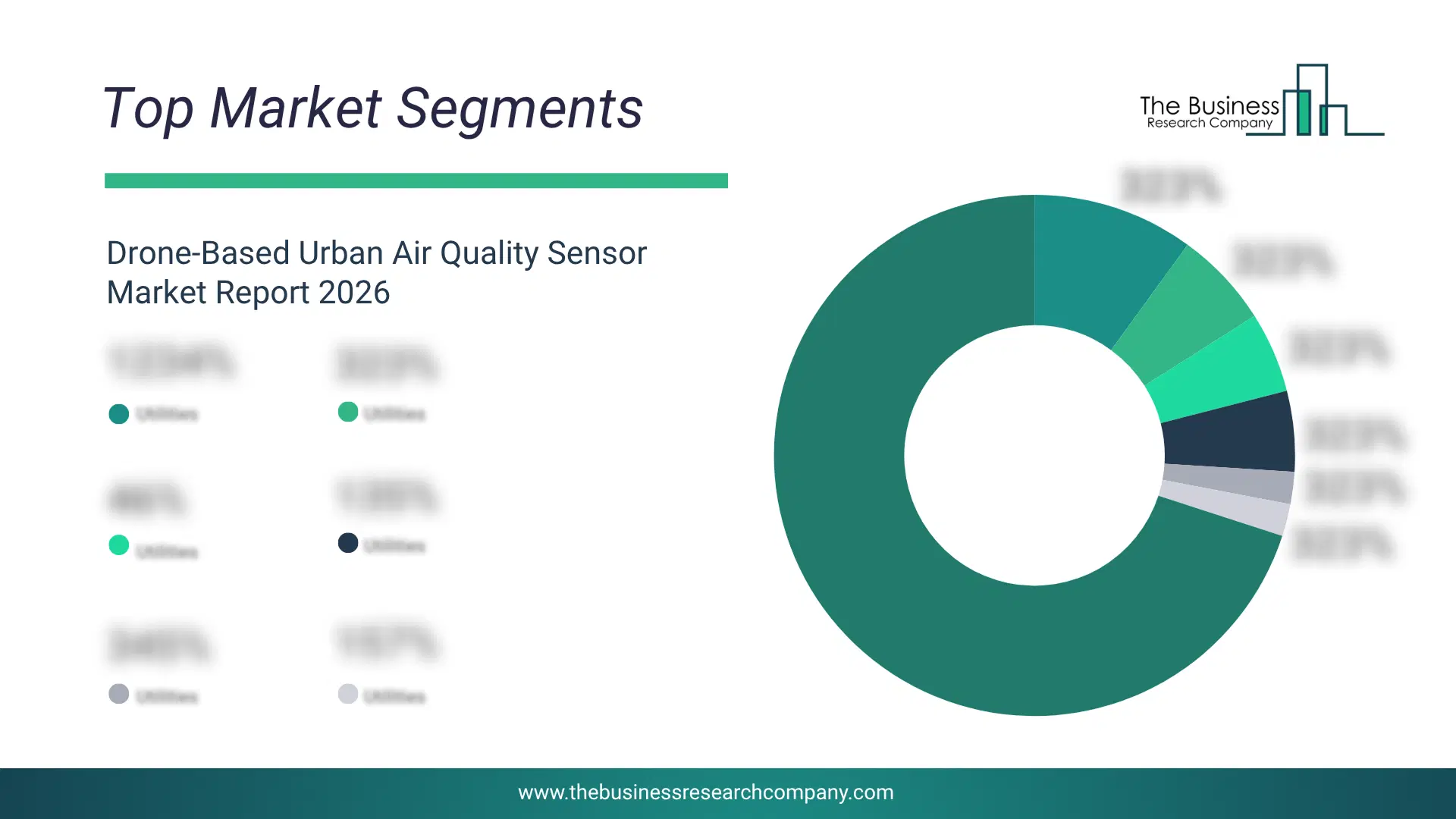
1) By Product Type: Fixed-Wing Drones, Rotary-Wing Drones, Hybrid Drones 2) By Sensor Type: Gas Sensors, Particulate Matter Sensors, Multi-Sensor Systems, Other Sensor Types 3) By Application: Air Pollution Monitoring, Emission Source Detection, Industrial Monitoring, Research And Academic, Other Applications 4) By End-User: Government And Municipalities, Environmental Agencies, Industrial, Research Institutes, Other End-Users Subsegments: 1) By Fixed-Wing Drones: Small Fixed-Wing Drones, Medium Fixed-Wing Drones, Large Fixed-Wing Drones, Solar-Powered Fixed-Wing Drones 2) By Rotary-Wing Drones: Single-Rotor Drones, Multi-Rotor Drones, Coaxial Rotor Drones, Tilt-Rotor Drones 3) By Hybrid Drones: Vertical Take-Off And Landing (VTOL) Hybrid Drones, Fixed-Wing + Multi-Rotor Hybrid Drones, Tilt-Wing Hybrid Drones, Convertible Rotor Hybrid DronesWhat Is The Driver Of The Drone-Based Urban Air Quality Sensor Market?
The increasing air pollution is expected to propel the growth of the drone-based urban air quality sensor market going forward. Air pollution refers to the presence of harmful substances in the atmosphere, such as gases, particulates, or biological molecules, that can negatively affect human health, environment, and climate. The rising air pollution is primarily due to emissions from vehicles as they release high levels of carbon dioxide, nitrogen oxides, and particulate matter into the atmosphere. Drone-based urban air quality sensors help reduce air pollution by enabling real-time monitoring of harmful emissions across cities. They enhance environmental management by identifying pollution hotspots, improving data accuracy, and supporting timely interventions for healthier urban living. For instance, in May 2025, according to the United States Environmental Protection Agency, a US-based government agency, approximately 66 million tons of pollutants were released into the atmosphere in the United States in 2023. Therefore, the increasing air pollution levels are driving the growth of the drone-based urban air quality sensor industry.Key Players In The Global Drone-Based Urban Air Quality Sensor Market
Major companies operating in the drone-based urban air quality sensor market are DJI Innovations, Parrot SA, AeroVironment Inc., Yuneec International, Delair, senseFly, Flyability SA, Atmos UAV, AirSense Analytics GmbH, Microdrones GmbH, Aeroqual Limited, Clarity Movement Co., ENVEA formerly Environnement S.A, ZainTech, Met One Instruments Inc., Volatus Aerospace Inc., Percepto Ltd., Black Swift Technologies LLC, EarthSense Systems Limited, Sniffer Robotics Inc.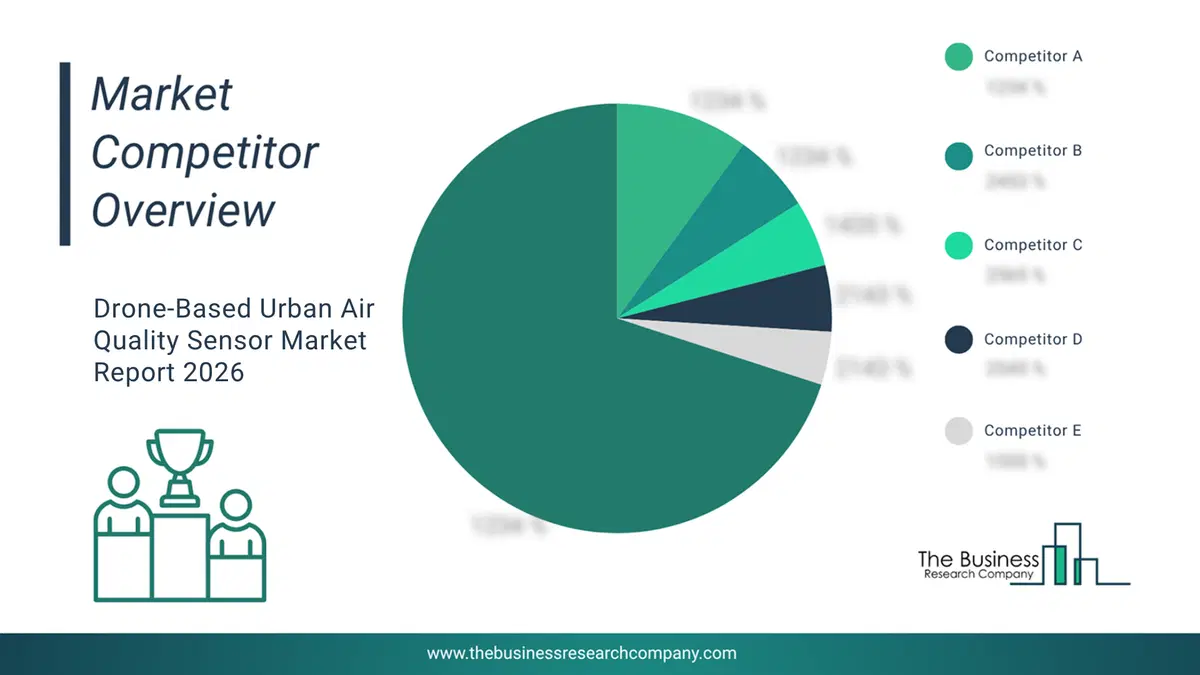
This chart is for illustrative purposes; the full report includes a detailed competitor analysis and comprehensive overview of the top 10 companies in the market.
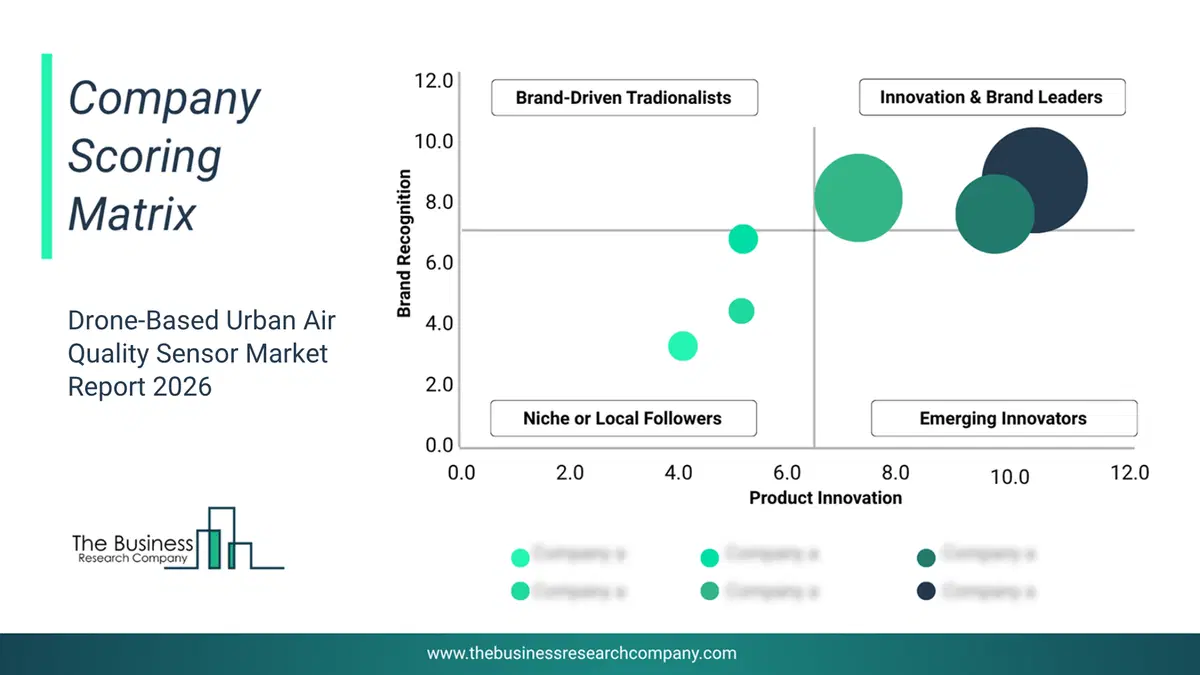
This chart maps companies by product innovation and brand strength, with bubble size indicating relative revenue, helping identify market leaders, challengers, and niche players. This is an illustrative chart; the full report provides a complete and accurate competitive analysis.
Global Drone-Based Urban Air Quality Sensor Market Trends and Insights
Major companies operating in the drone-based urban air quality sensor market are focusing on developing technologically innovative solutions, such as AI-enabled autonomous drone systems, to improve detection accuracy and real-time monitoring of emissions. Artificial intelligence (AI)-enabled autonomous drone systems refer to drones that use AI to operate, navigate, and perform tasks without human intervention. For instance, in June 2025, Percepto Ltd., an Israel-based autonomous inspection and monitoring company, launched an AI-powered emission detector designed for remote, drone-based methane surveying. This innovative solution automates optical gas imaging (OGI) inspections using autonomous drones equipped with AI algorithms that detect and flag methane emissions in real time, enabling scalable, high-frequency monitoring across large areas without increasing the field workforce. This system delivers precise alerts with geolocation, timestamps, and environmental data, helping operators respond faster, improve safety, reduce operational costs, and ensure compliance with upcoming Environmental Protection Agency (EPA) methane regulations.What Are Latest Mergers And Acquisitions In The Drone-Based Urban Air Quality Sensor Market?
In April 2025, Project Canary, a US-based environmental data and emissions monitoring provider, partnered with Sniffer Robotics Inc. This partnership aims to create an unprecedented solution that enhances methane emissions source detection, localization, and instant quantification at landfill sites to deliver actionable insights for operators to better understand, report, and reduce their environmental impact. Sniffer Robotics Inc. is a US-based environmental technology company that develops drone-based methane and greenhouse gas detection systems.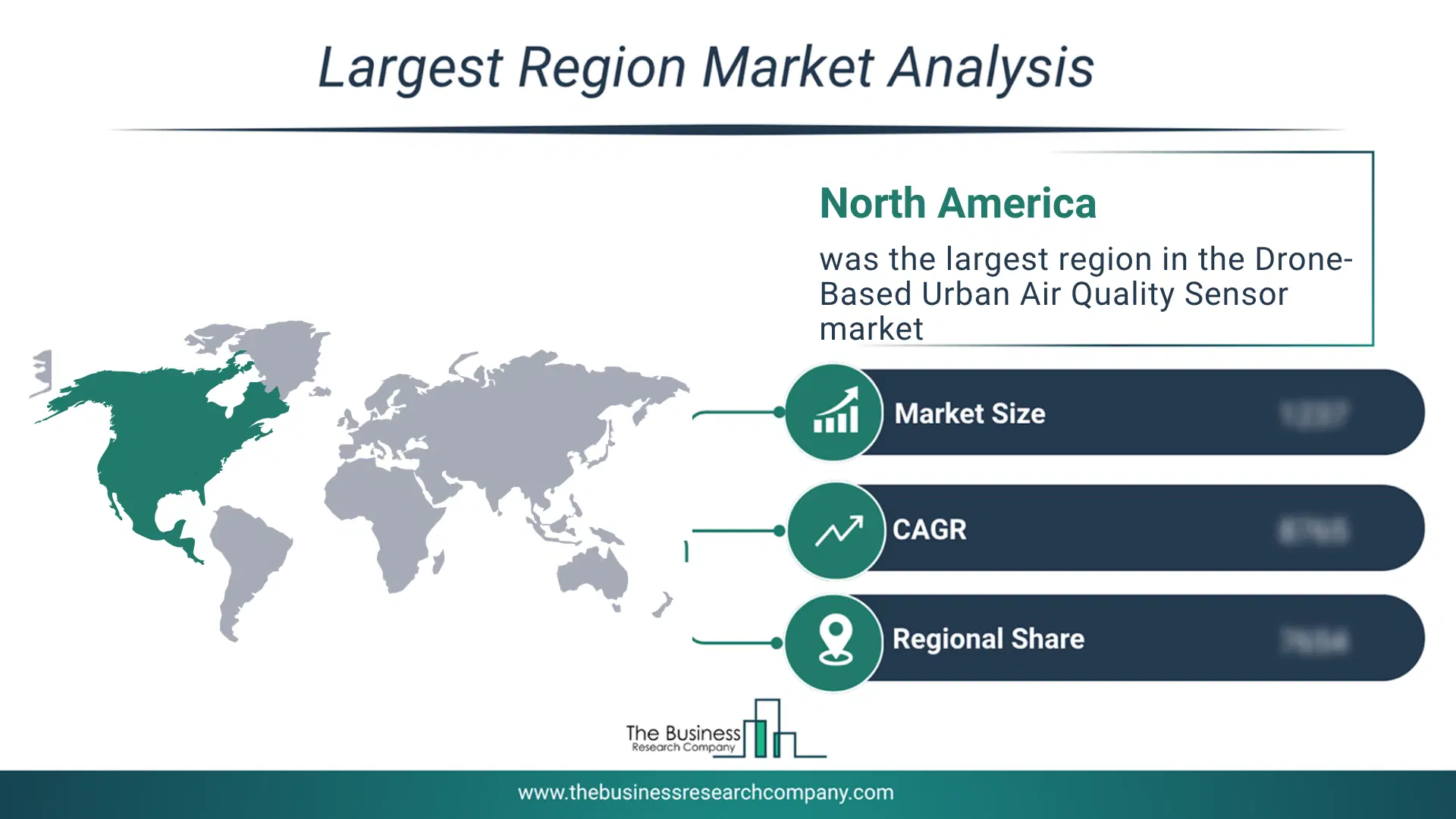
Regional Outlook
North America was the largest region in the drone-based urban air quality sensor market in 2025. Asia-Pacific is expected to be the fastest-growing region in the forecast period. The regions covered in this market report are Asia-Pacific, South East Asia, Western Europe, Eastern Europe, North America, South America, Middle East, Africa. The countries covered in this market report are Australia, Brazil, China, France, Germany, India, Indonesia, Japan, Taiwan, Russia, South Korea, UK, USA, Canada, Italy, SpainWhat Defines the Drone-Based Urban Air Quality Sensor Market?
The drone-based urban air quality sensor market consists of sales of portable calibration kits, air quality sensors, sensor calibration kits, noise and vibration dampening kits, and optical imaging sensors. Values in this market are ‘factory gate’ values, that is, the value of goods sold by the manufacturers or creators of the goods, whether to other entities (including downstream manufacturers, wholesalers, distributors, and retailers) or directly to end customers. The value of goods in this market includes related services sold by the creators of the goods.How is Market Value Defined and Measured?
The market value is defined as the revenues that enterprises gain from the sale of goods and/or services within the specified market and geography through sales, grants, or donations in terms of the currency (in USD unless otherwise specified). The revenues for a specified geography are consumption values that are revenues generated by organizations in the specified geography within the market, irrespective of where they are produced. It does not include revenues from resales along the supply chain, either further along the supply chain or as part of other products.
This chart presents market attractiveness based on a quantitative evaluation of growth, competition, strategic alignment, and risk, offering a clear view of opportunity areas for decision-making. This chart is for illustrative purposes; the full report contains the complete analysis.

This chart highlights the Total Addressable Market (TAM) by estimating the maximum revenue opportunity using an assumption-driven approach, supporting strategic planning and opportunity sizing across markets. The chart is illustrative; the full report provides a more comprehensive analysis.
What Key Data and Analysis Are Included in the Drone-Based Urban Air Quality Sensor Market Report 2026?
The drone-based urban air quality sensor market research report is one of a series of new reports from The Business Research Company that provides market statistics, including Market Report 2026?global market size, regional shares, competitors with the market share, detailed market segments, market trends and opportunities, and any further data you may need to thrive in the drone-based urban air quality sensor Market Report 2026? The market research report delivers a complete perspective of everything you need, with an in-depth analysis of the current and future state of the Market Report 2026?Drone-Based Urban Air Quality Sensor Market Report Forecast Analysis
| Report Attribute | Details |
|---|---|
| Market Size Value In 2026 | $1.6 billion |
| Revenue Forecast In 2030 | $3 billion |
| Growth Rate | CAGR of 17.6% from 2026 to 2030 |
| Base Year For Estimation | 2025 |
| Actual Estimates/Historical Data | 2020-2025 |
| Forecast Period | 2026 - 2030 - 2030 |
| Market Representation | Revenue in USD Billion and CAGR from 2026 to 2030 |
| Segments Covered | Product Type, Sensor Type, Application, End-User |
| Regional Scope | Asia-Pacific, Western Europe, Eastern Europe, North America, South America, Middle East, Africa |
| Country Scope | The countries covered in the report are Australia, Brazil, China, France, Germany, India, Indonesia, Japan, Taiwan, Russia, South Korea, UK, USA, Canada, Italy, Spain. |
| Key Companies Profiled | DJI Innovations, Parrot SA, AeroVironment Inc., Yuneec International, Delair, senseFly, Flyability SA, Atmos UAV, AirSense Analytics GmbH, Microdrones GmbH, Aeroqual Limited, Clarity Movement Co., ENVEA formerly Environnement S.A, ZainTech, Met One Instruments Inc., Volatus Aerospace Inc., Percepto Ltd., Black Swift Technologies LLC, EarthSense Systems Limited, Sniffer Robotics Inc. |
| Customization Scope | Request for Customization |
| Pricing And Purchase Options | Explore Purchase Options |