
Drone Camera Market Report 2026
Global Outlook – By Type (RGB (Visual Spectrum) Cameras, Thermal Cameras, Multispectral Cameras, Hyperspectral Cameras, LiDAR Camera Systems), By Resolution (12 MP, 12 To 20 MP, 20 To 32 MP, 32 MP, And Above), By Application (Aerial Photography And Videography, Surveying And Mapping, Agriculture Monitoring, Infrastructure Inspection, Surveillance And Security, Environmental Monitoring), By End User (Commercial, Industrial, Government And Defense, Media And Entertainment, Agriculture) – Market Size, Trends, Strategies, and Forecast to 2035
Drone Camera Market Overview
• Drone Camera market size has reached to $14.45 billion in 2025 • Expected to grow to $56.19 billion in 2030 at a compound annual growth rate (CAGR) of 31.4% • Growth Driver: Surge In Drone Utilization Across Industries Drives Growth In The Drone Camera Market • Market Trend: Driving Innovation Through Collaboration • North America was the largest region in 2025 and Asia-Pacific is the fastest growing region.Market Gains By 2030 – Top Opportunities By Segment
Market Gain identifies the most promising market opportunities by highlighting the segments or products expected to generate the highest incremental revenue growth over the next five years.
What Is Covered Under Drone Camera Market?
A drone camera refers to a camera mounted on an unmanned aerial vehicle (UAV) that captures images and videos from an aerial perspective. It is used for various applications, including aerial photography, surveying, and monitoring landscapes or infrastructure. This technology enhances visual storytelling and data collection in fields like real estate, agriculture, and filmmaking. The main types of drone cameras are SD cameras and HD cameras. SD stands for standard definition and refers to camera quality with a pixel resolution of 240P or 480P. A video image's pixels are the distinct digital dots that make up the movie. The various resolution includes 12 MP, 12 to 20 MP, 20 to 32 MP, and 32 MP and above, and various application of drone cameras include photography and videography, thermal imaging, surveillance, and various end-user including commercial, military, and homeland security.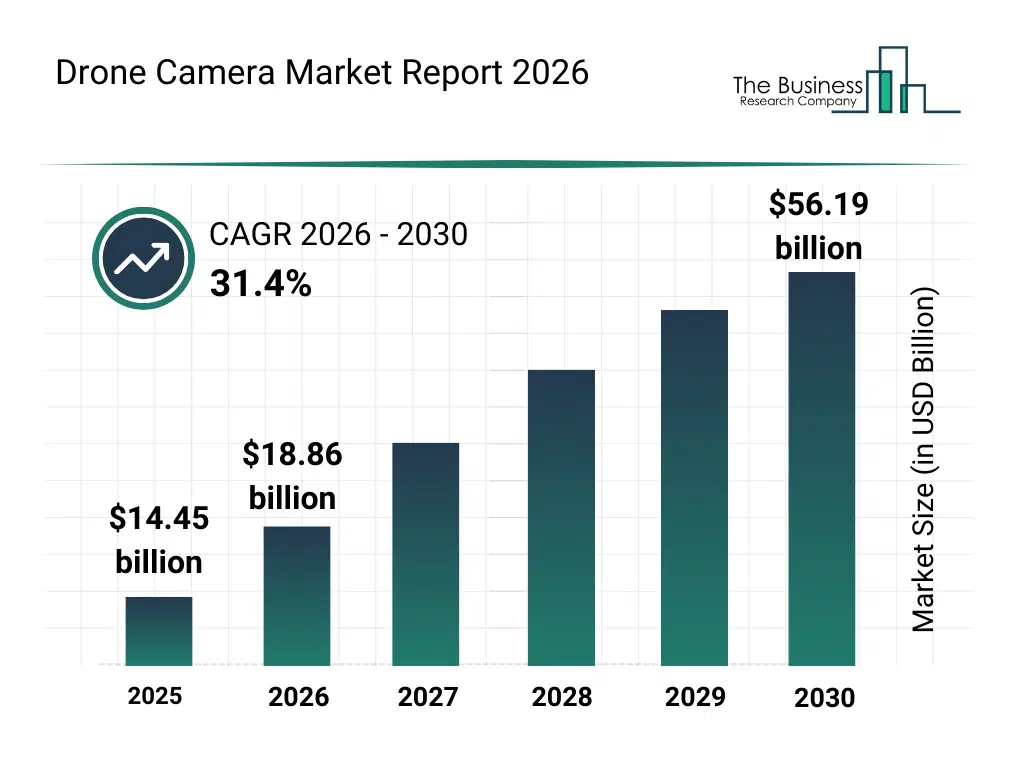
What Is The Drone Camera Market Size and Share 2026?
The drone camera market size has grown exponentially in recent years. It will grow from $14.45 billion in 2025 to $18.86 billion in 2026 at a compound annual growth rate (CAGR) of 30.6%. The growth in the historic period can be attributed to expansion of commercial drone usage, growth in aerial photography and surveying, increasing adoption in agriculture monitoring, availability of compact camera sensors, rising demand for visual data collection.What Is The Drone Camera Market Growth Forecast?
The drone camera market size is expected to see exponential growth in the next few years. It will grow to $56.19 billion in 2030 at a compound annual growth rate (CAGR) of 31.4%. The growth in the forecast period can be attributed to increasing integration of AI-driven analytics, rising demand for real-time aerial data, expansion of infrastructure inspection services, growing use of drones in public safety, increased investments in UAV technology. Major trends in the forecast period include increasing adoption of high-resolution aerial imaging, rising use of ai-based image processing, growing demand for thermal and surveillance cameras, expansion of commercial drone applications, enhanced stabilization and gimbal technologies.
Global Drone Camera Market Segmentation
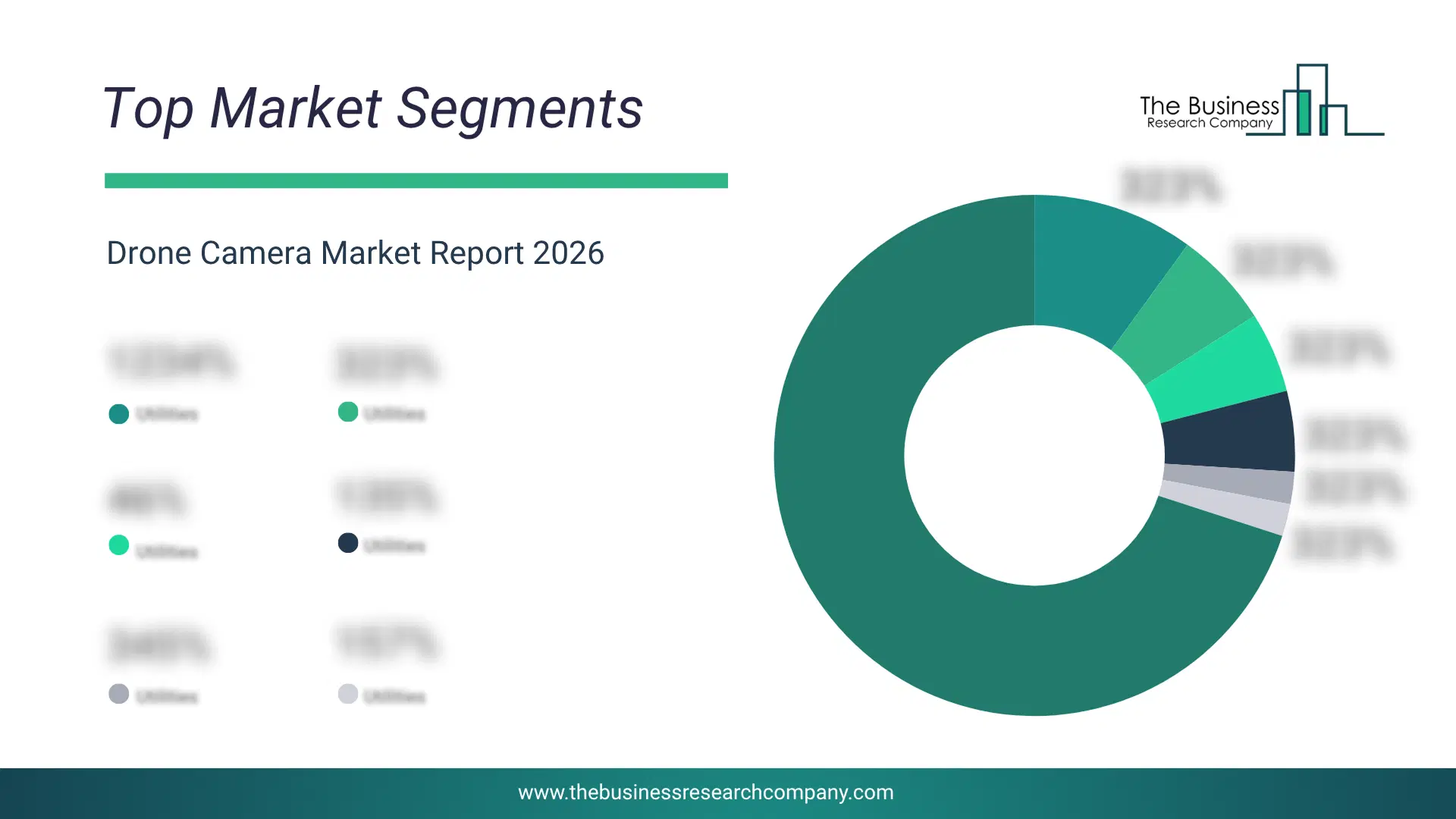
1) By Type: RGB (Visual Spectrum) Cameras, Thermal Cameras, Multispectral Cameras, Hyperspectral Cameras, LiDAR Camera Systems 2) By Resolution: 12 MP, 12 To 20 MP, 20 To 32 MP, 32 MP, And Above 3) By Application: Aerial Photography And Videography, Surveying And Mapping, Agriculture Monitoring, Infrastructure Inspection, Surveillance And Security, Environmental Monitoring 4) By End User: Commercial, Industrial, Government And Defense, Media And Entertainment, Agriculture Subsegments: 1) By RGB (Visual Spectrum) Cameras: Standard RGB Cameras, High-Resolution RGB Cameras, Low-Light Or Night RGB Cameras 2) By Thermal Cameras: Uncooled Thermal Cameras, Cooled Thermal Cameras, Radiometric Thermal Cameras 3) By Multispectral Cameras: 3–5 Band Multispectral Cameras, Agriculture-Focused Multispectral Cameras, Environmental And Mapping Multispectral Cameras 4) By Hyperspectral Cameras: Pushbroom Hyperspectral Cameras, Snapshot Hyperspectral Cameras, Research-Grade Hyperspectral Cameras 5) By LiDAR Camera Systems: Mechanical LiDAR Systems, Solid-State LiDAR Systems, LiDAR with Integrated RGB Camera The top segments in the drone camera market will be: • RGB (Visual Spectrum) Cameras will reach $7018.7 Million by 2025. • 12 To 20 MP will reach $5028.7 Million by 2025. • 20 To 32 MP will reach $3672 Million by 2025. • Aerial Photography And Videography will reach $3670.6 Million by 2025. • Surveying And Mapping will reach $3258.9 Million by 2025.What Is The Driver Of The Drone Camera Market?
The increase in the use of drones in several industries is expected to propel the growth of the drone camera market in the coming future. Drones are any automated aerial aircraft that accept small orders from their pilots or depend on technology for autonomous flying. The increase in the use of drones in several industries like agriculture, construction, and the military is expanding the drone camera market as they increase accuracy, give safer alternatives for workers, and promote efficiency. For instance, in June 2025, according to the Civil Aviation Safety Authority (CASA), an Australia-based government agency, as of 1 May 2025, the number of licensed drone operators reached 38,874, rising from just over 35,000 on 30 June the previous year, surpassing the 30,845 individuals licensed as conventional crewed pilots. Therefore, the increase in the use of drones in several industries is driving the drone camera industry.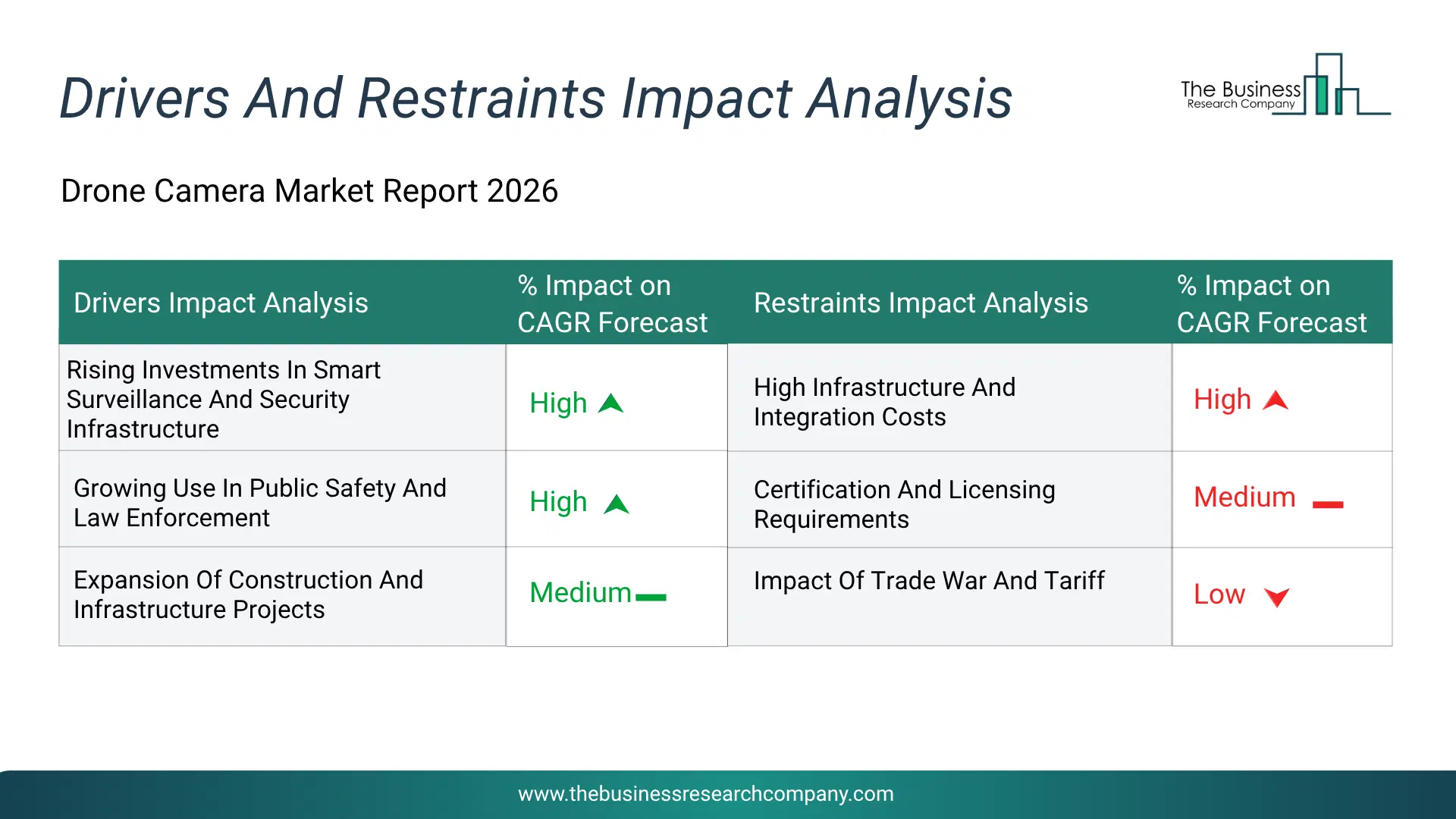
Infographic Chart Showing Key Market Drivers Analysis And Restraints For Drone Camera Market
The chart presents an impact analysis of key drivers and restraints, quantifying their relative influence on the market's growth rate and helping assess the balance between growth enablers and limiting factors. This chart offers a high-level perspective; the full report contains more detailed insights.
How Will The Drivers Impact Growth In The Global Drone Camera Market?
• Rising Investments In Smart Surveillance And Security Infrastructure (High) – The rising investments in smart surveillance and security infrastructure will become a key driver of growth in the drone camera market by 2030. Drone cameras play a crucial role in these ecosystems by providing real-time aerial imagery, high-resolution video, thermal imaging and wide-area coverage that traditional fixed surveillance systems cannot achieve. As investments increase in smart cities, border security, public safety networks, transportation hubs, industrial facilities and critical infrastructure protection, demand grows for drones equipped with sophisticated imaging payloads capable of autonomous monitoring, incident response and data collection. Furthermore, the integration of drone camera feeds with artificial intelligence, video analytics and centralized command-and-control platforms enables faster decision-making, improved security operations and more efficient resource deployment, thereby accelerating the adoption of advanced drone camera systems across surveillance and security applications. As a result, the rising investments in smart surveillance and security infrastructure is anticipated to contributing to a 2.5% annual growth in the market. • Growing Use In Public Safety And Law Enforcement (High) – The growing use in public safety and law enforcement will emerge as a major factor driving the expansion of the drone camera market by 2030. Drone cameras enable authorities to monitor large crowds, track suspects, assess accident scenes, conduct search-and-rescue missions and inspect disaster-affected areas quickly and safely without exposing personnel to unnecessary risks. Equipped with high-resolution optical sensors, thermal imaging cameras, zoom capabilities and real-time video transmission, drones provide critical intelligence that supports faster decision-making and more effective response strategies. As governments and public safety agencies expand investments in modern policing technologies and emergency preparedness programs, the demand for advanced drone camera systems continues to rise, driving market growth through increased deployment across surveillance, incident management, border security and public safety operations. Consequently, the growing use in public safety and law enforcement is projected to contributing to a 2.0% annual growth in the market. • Expansion Of Construction And Infrastructure Projects (Medium) – The expansion of construction and infrastructure projects processes will serve as a key growth catalyst for the drone camera market by 2030, as projects like highways, bridges, residential complexes and smart cities multiply, traditional ground-based inspections become time-consuming, hazardous and prone to inaccuracies. Drone cameras equipped with high-resolution imaging, LiDAR and thermal sensors enable real-time aerial data collection, 3D mapping and automated progress tracking—allowing project managers to identify structural issues, measure stockpile volumes, improve worker safety by reducing scaffold climbs and streamline compliance reporting. This efficiency reduces delays and budget overruns, making drone technology indispensable for modern infrastructure development. Consequently, rising investments in construction directly fuel demand for advanced drone cameras and analytics software, accelerating market growth. Therefore, this expansion of construction and infrastructure projects operations is projected to supporting to a 1.5% annual growth in the market. • Increasing Utilization Of Drones For Power Line And Grid Inspection (Medium) – The increasing utilization of drones for power line and grid inspection will become a significant driver contributing to the growth of the drone camera market by 2030. Drone cameras equipped with high-resolution optical sensors, thermal imaging systems and zoom capabilities can quickly inspect power lines, substations, transformers and transmission towers, identifying faults such as damaged components, vegetation encroachment, overheating equipment and structural wear without requiring workers to access hazardous locations. Compared with traditional inspection methods involving helicopters or manual field crews, drones can cover large areas faster, reduce operational downtime, improve worker safety and provide highly detailed visual data for predictive maintenance. As aging grid infrastructure, renewable energy integration and reliability requirements increase the need for frequent inspections, utilities are expanding their adoption of drone-based inspection programs, thereby driving demand for advanced drone camera systems capable of capturing accurate and actionable imagery. Consequently, the increasing utilization of drones for power line and grid inspection is projected to contributing to a 1.0% annual growth in the market.How Will The Restraints Impact Growth In The Global Drone Camera Market?
• High Infrastructure And Integration Costs (High) – High infrastructure and integration costs is expected to restrain market growth during the forecast period. It creates operational, financial, regulatory, or commercial challenges that can increase costs, delay projects, reduce investments, or discourage purchasing decisions depending on the market. These challenges can reduce product adoption, affect business confidence, and limit the ability of companies to expand efficiently across key regions. This can reduce operational efficiency, delay expansion plans, and affect the ability of companies to achieve sustainable business growth. • Certification And Licensing Requirements (High) – During the forecast period, certification and licensing requirements is likely to limit market expansion. It creates operational, financial, regulatory, or commercial challenges that can increase costs, delay projects, reduce investments, or discourage purchasing decisions depending on the market. These challenges can reduce product adoption, affect business confidence, and limit the ability of companies to expand efficiently across key regions. As a result, businesses may face increased cost pressures, slower commercial adoption, and reduced revenue opportunities. • Impact Of Trade War And Tariff (Medium) – The market is expected to face challenges due to impact of trade war and tariff over the forecast period. It creates operational, financial, regulatory, or commercial challenges that can increase costs, delay projects, reduce investments, or discourage purchasing decisions depending on the market. These challenges can reduce product adoption, affect business confidence, and limit the ability of companies to expand efficiently across key regions. This may discourage new investments, delay strategic expansion initiatives, and weaken the overall competitive position of market participants.Key Players In The Global Drone Camera Market
Major companies operating in the drone camera market are DJI, Sony Corporation, Panasonic Corporation, GoPro Inc., Teledyne FLIR LLC, Parrot Drone SAS, Autel Robotics, Skydio Inc., Yuneec International, AEE Technology, CONTROP Precision Technologies Ltd., Freefly Systems, Phase One A/S, Workswell s.r.o., Sentera Inc., MicaSense Inc., Viewpro UAV, NextVision Stabilized Systems Ltd., Gremsy, SIYI Technology, CHCNAV, Wingtra, Delair, Flyability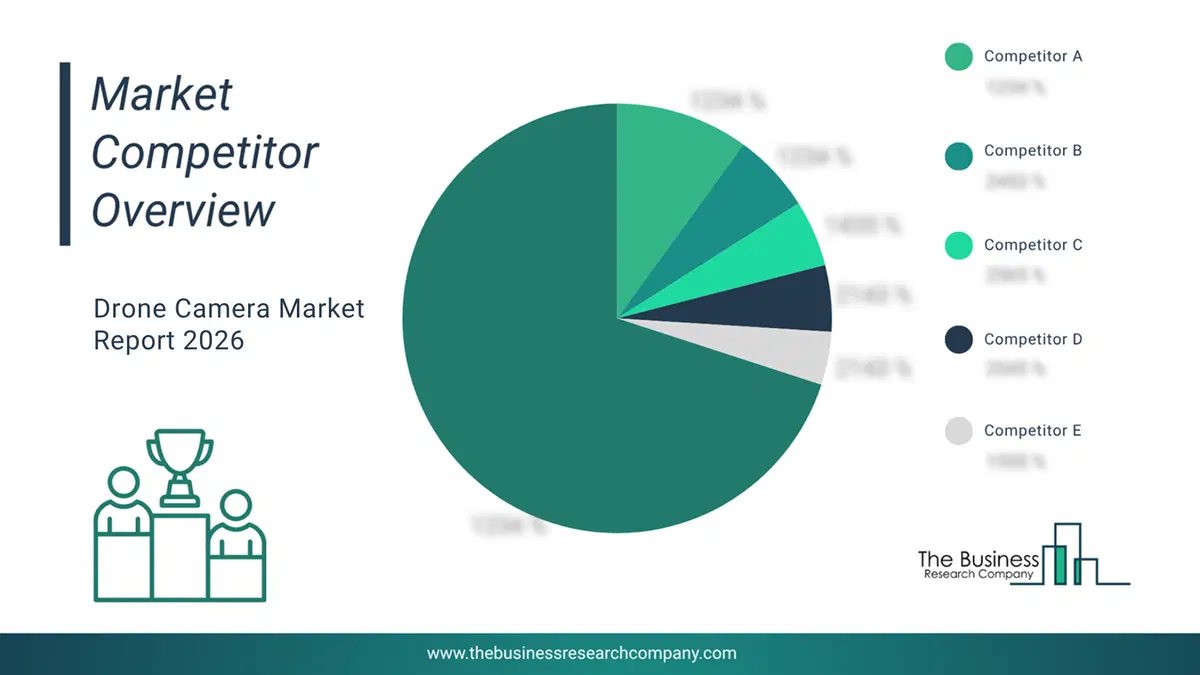
This chart is for illustrative purposes; the full report includes a detailed competitor analysis and comprehensive overview of the top 10 companies in the market.
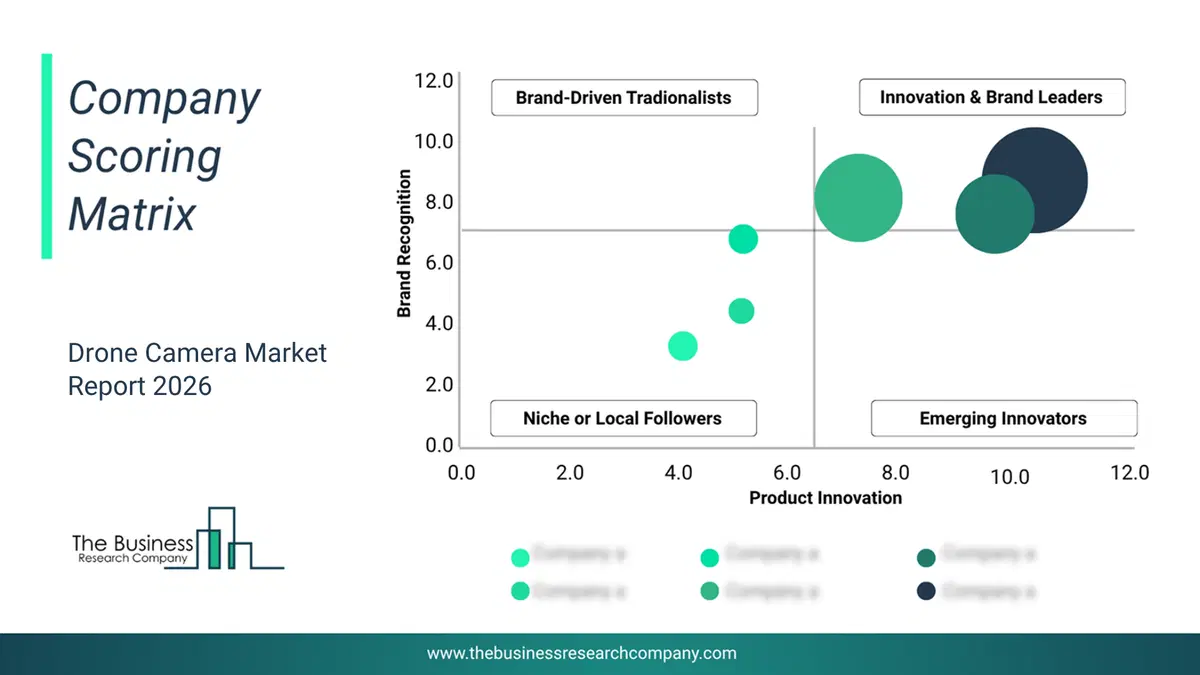
This chart maps companies by product innovation and brand strength, with bubble size indicating relative revenue, helping identify market leaders, challengers, and niche players. This is an illustrative chart; the full report provides a complete and accurate competitive analysis.
Global Drone Camera Market Trends and Insights
Major companies operating in the drone camera market are adopting a strategic partnership approach to expand their strategic partnerships to provide automated and comprehensive fleet data management for the Sony Airpeak S1 Drone with mirrorless cameras. Strategic partnerships refer to a process in which companies leverage each other's strengths and resources to achieve mutual benefits and success. For instance, in September 2023, Airdata UAV, a US-based drone technology company, partnered with Sony Electronics Inc., a US-based electronics company. With this partnership, they aim to enable Airpeak users to handle various aspects of fleet management easily and efficiently, such as equipment data, mission planning, and meeting compliance requirements for their advanced new drone, including full-frame Alpha mirrorless cameras and interchangeable-lenses management.What Are Latest Mergers And Acquisitions In The Drone Camera Market?
In March 2023, Ondas Holdings Inc., a US-based company that manufactures drones, wireless networks, and other autonomous systems, acquired the assets of Iron Drone Ltd. for an undisclosed sum. This acquisition broadens, diversifies, and enriches Onda's portfolio by adding an advanced and unique integrated security platform capable of intercepting hostile drones in various theatres such as airports, populated areas, critical infrastructure, and more. Iron Drone Ltd. is an Israel-based company that manufactures drone technologies and components.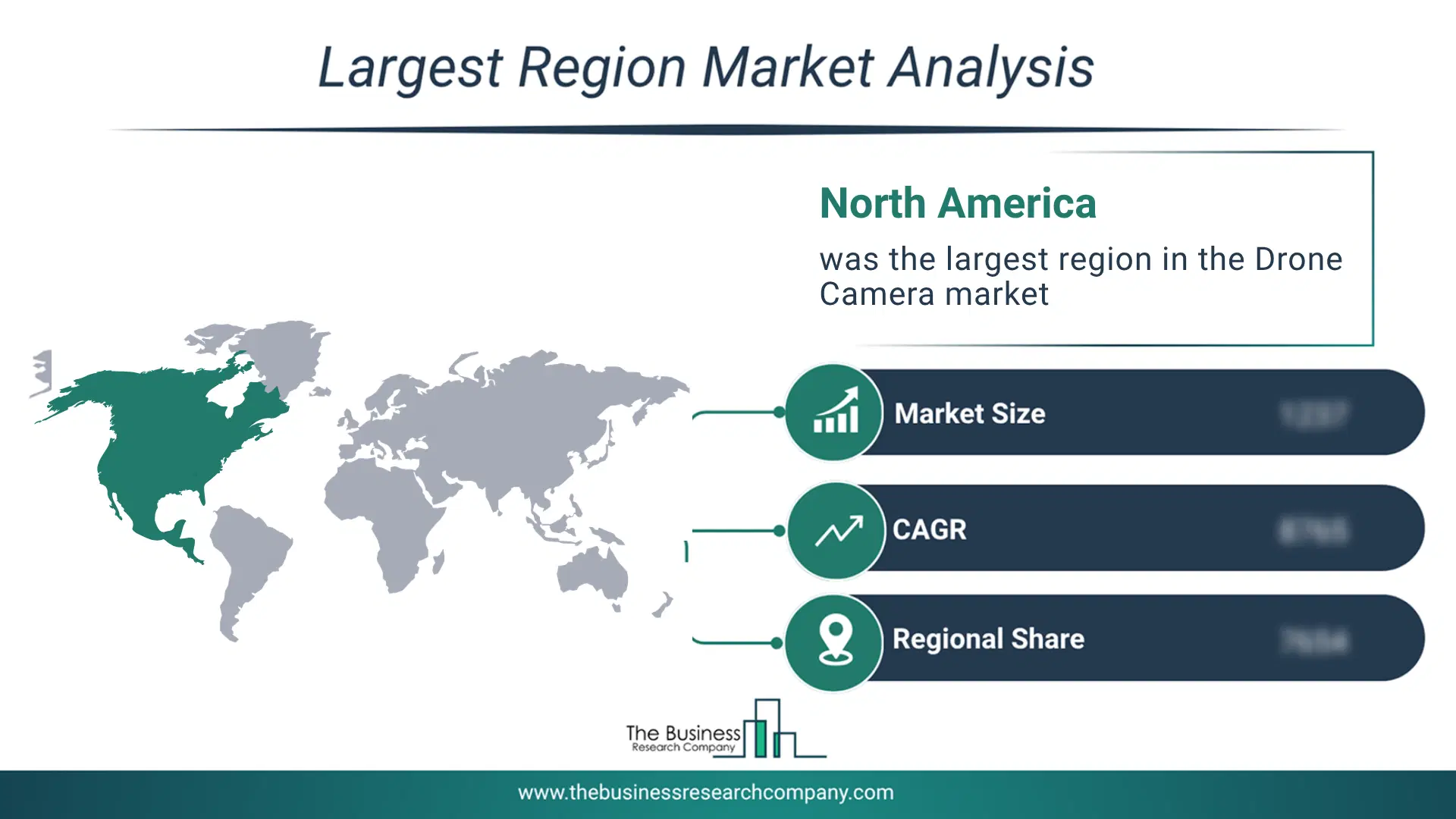
Regional Outlook
North America was the largest region in the drone camera market in 2025. Asia-Pacific is expected to be the fastest-growing region in the forecast period. The regions covered in this market report are Asia-Pacific, South East Asia, Western Europe, Eastern Europe, North America, South America, Middle East, Africa The countries covered in this market report are Australia, Brazil, China, France, Germany, India, Indonesia, Japan, Taiwan, Russia, South Korea, UK, USA, Canada, Italy, Spain.What Defines the Drone Camera Market?
The drone camera market consists of sales of HD cameras, embedded cameras, thermal cameras, infrared (IR) camera sensors, OEM camera cores and camera modules. Values in this market are ‘factory gate’ values, that is the value of goods sold by the manufacturers or creators of the goods, whether to other entities (including downstream manufacturers, wholesalers, distributors, and retailers) or directly to end customers. The value of goods in this market includes related services sold by the creators of the goods.How is Market Value Defined and Measured?
The market value is defined as the revenues that enterprises gain from the sale of goods and/or services within the specified market and geography through sales, grants, or donations in terms of the currency (in USD unless otherwise specified). The revenues for a specified geography are consumption values that are revenues generated by organizations in the specified geography within the market, irrespective of where they are produced. It does not include revenues from resales along the supply chain, either further along the supply chain or as part of other products.
This chart presents market attractiveness based on a quantitative evaluation of growth, competition, strategic alignment, and risk, offering a clear view of opportunity areas for decision-making. This chart is for illustrative purposes; the full report contains the complete analysis.

This chart highlights the Total Addressable Market (TAM) by estimating the maximum revenue opportunity using an assumption-driven approach, supporting strategic planning and opportunity sizing across markets. The chart is illustrative; the full report provides a more comprehensive analysis.
What Key Data and Analysis Are Included in the Drone Camera Market Report 2026?
The drone camera market research report is one of a series of new reports from The Business Research Company that provides market statistics, including industry global market size, regional shares, competitors with the market share, detailed market segments, market trends and opportunities, and any further data you may need to thrive in the drone camera industry. The market research report delivers a complete perspective of everything you need, with an in-depth analysis of the current and future state of the industry.Drone Camera Market Report Forecast Analysis
| Report Attribute | Details |
|---|---|
| Market Size Value In 2026 | $18.86 billion |
| Revenue Forecast In 2035 | $56.19 billion |
| Growth Rate | CAGR of 30.6% from 2026 to 2035 |
| Base Year For Estimation | 2025 |
| Actual Estimates/Historical Data | 2020-2025 |
| Forecast Period | 2026 - 2030 - 2035 |
| Market Representation | Revenue in USD Billion and CAGR from 2026 to 2035 |
| Segments Covered | Type, Resolution, Application, End User |
| Regional Scope | Asia-Pacific, Western Europe, Eastern Europe, North America, South America, Middle East, Africa |
| Country Scope | The countries covered in the report are Australia, Brazil, China, France, Germany, India, ... |
| Key Companies Profiled | DJI, Sony Corporation, Panasonic Corporation, GoPro Inc., Teledyne FLIR LLC, Parrot Drone SAS, Autel Robotics, Skydio Inc., Yuneec International, AEE Technology, CONTROP Precision Technologies Ltd., Freefly Systems, Phase One A/S, Workswell s.r.o., Sentera Inc., MicaSense Inc., Viewpro UAV, NextVision Stabilized Systems Ltd., Gremsy, SIYI Technology, CHCNAV, Wingtra, Delair, Flyability |
| Customization Scope | Request for Customization |
| Pricing And Purchase Options | Explore Purchase Options |