
Drone Communication Market Report 2026
Global Outlook – By Component (Transmitter, Receiver, Antenna, Data Link), By Technology (Radio Frequency, Cellular, Satellite, Meshed Network), By Application (Agriculture, Construction And Mining, Inspection, Oil And Gas, Other Applications), By End Use (Government And Defense Organizations, Commercial Enterprises, Private Operators) – Market Size, Trends, Strategies, and Forecast to 2030
Drone Communication Market Overview
• Drone Communication market size has reached to $3.68 billion in 2025 • Expected to grow to $8.87 billion in 2030 at a compound annual growth rate (CAGR) of 19.2% • Growth Driver: Growing Security Concerns Fueling The Growth Of The Market Due To Rising Vulnerabilities In Wireless Data Transmission • Market Trend: Innovative Multi-Link Bonded LTE Systems Revolutionize Drone Communication • North America was the largest region in 2025 and Asia-Pacific is the fastest growing region.Market Gains By 2030 – Top Opportunities By Segment
Market Gain identifies the most promising market opportunities by highlighting the segments or products expected to generate the highest incremental revenue growth over the next five years.
What Is Covered Under Drone Communication Market?
Drone communication refers to the exchange of data and control signals between a drone and its ground station or other networked devices, enabling real-time telemetry, command, and video feed transmission. This communication enables control commands, telemetry data, video feeds, and sensor information to be transmitted and received in real time, ensuring coordinated operation, navigation, and mission execution. The main types of components in drone communication are transmitter, receiver, antenna, and data link. A drone communication transmitter is a device that wirelessly sends control commands, video feeds, or telemetry data between the drone and the ground control station. It utilizes technologies such as radio frequency, cellular, satellite, and meshed networks to support a range of applications, including agriculture, construction and mining, inspection, oil and gas, and others. These systems serve diverse end users, including government and defense organizations, commercial enterprises, and private operators.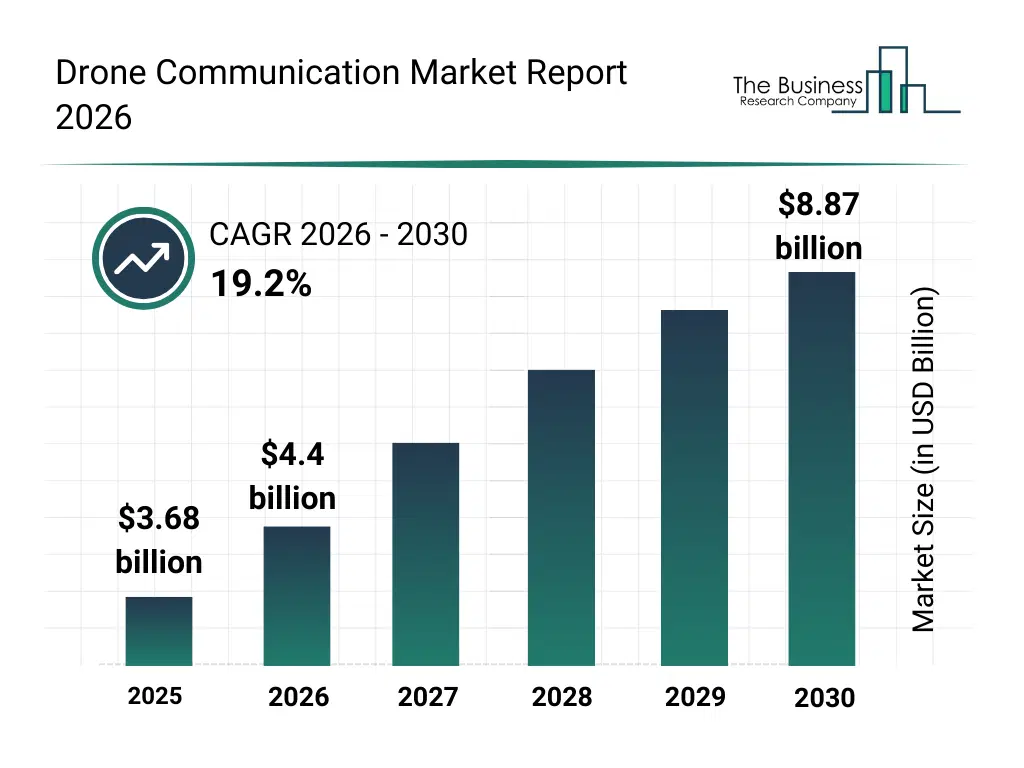
What Is The Drone Communication Market Size and Share 2026?
The drone communication market size has grown rapidly in recent years. It will grow from $3.68 billion in 2025 to $4.4 billion in 2026 at a compound annual growth rate (CAGR) of 19.6%. The growth in the historic period can be attributed to increasing adoption of drones in commercial, industrial, and defense missions requiring stable telemetry links, development of radio transceivers and modems enabling more reliable command-and-control communication, rising use of high-gain antennas and signal amplifiers to extend operational range, expansion of ground control station deployments to support multi-drone fleet operations, advancements in software-defined radio platforms improving communication adaptability and bandwidth efficiency.What Is The Drone Communication Market Growth Forecast?
The drone communication market size is expected to see rapid growth in the next few years. It will grow to $8.87 billion in 2030 at a compound annual growth rate (CAGR) of 19.2%. The growth in the forecast period can be attributed to growing demand for secure and encrypted communication systems to protect sensitive drone data flows, increasing adoption of beyond-line-of-sight connectivity for long-range and autonomous drone missions, rising need for high-definition video and sensor-data streaming in inspection, surveillance, and logistics applications, integration of 5g and satellite communication networks enhancing long-distance and low-latency drone links, development of swarm communication architectures enabling coordinated multi-drone operations. Major trends in the forecast period include increasing regulatory emphasis on secure and resilient command-and-control (c2) links for unmanned aircraft, expansion of beyond-visual-line-of-sight (bvlos) drone operations driving demand for long-range data links, growing preference for modular and upgradeable drone communication payloads and ground stations, rising localization of drone communication hardware manufacturing to reduce supply-chain and export-control risks, strong growth of vertically specialized communication solutions tailored for sectors such as agriculture, inspection, and oil & gas.
Global Drone Communication Market Segmentation
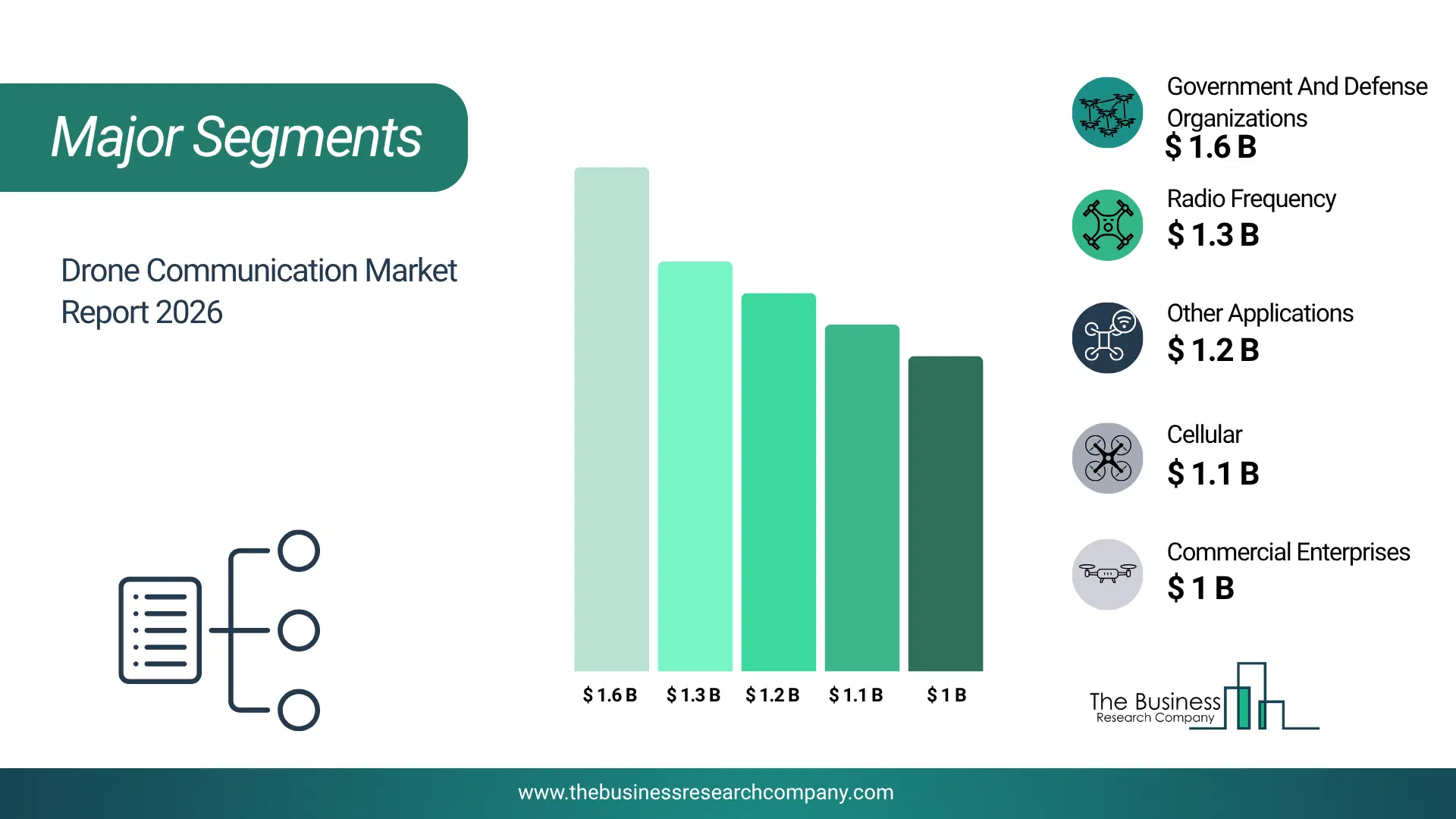
1) By Component: Transmitter, Receiver, Antenna, Data Link 2) By Technology: Radio Frequency, Cellular, Satellite, Meshed Network 3) By Application: Agriculture, Construction And Mining, Inspection, Oil And Gas, Other Applications 4) By End Use: Government And Defense Organizations, Commercial Enterprises, Private Operators Subsegments: 1) By Transmitter: RF Transmitters, Telemetry Transmitters, FPV (First-Person View) Video Transmitters, Digital Signal Transmitters, Satellite-Based Transmitters 2) By Receiver: RF Receivers, Telemetry Receivers, GPS Receivers, FPV Video Receivers, Command And Control (C2) Receivers 3) By Antenna: Omnidirectional Antennas, Directional Antennas, Patch Antennas, Helical Antennas, Phased Array Antennas 4) By Data Link: Line-Of-Sight (LOS) Data Links, Beyond Visual Line-Of-Sight (BVLOS) Data Links, Satellite Communication Links, Radio Frequency (RF) Links, Cellular (4G/5G) Data Links The top segments in the drone communication market will be: • Government And Defense Organizations will reach $1609.88 Million by 2025. • Radio Frequency will reach $1329.08 Million by 2025. • Other Applications will reach $1201.62 Million by 2025. • Cellular will reach $1182.78 Million by 2025. • Commercial Enterprises will reach $1080.78 Million by 2025.What Is Driver Of The Drone Communication Market?
The growing security concerns and vulnerabilities are expected to propel the growth of the drone communication market going forward. Security concerns and vulnerabilities refer to potential weaknesses in a system that could be exploited by attackers to gain unauthorized access, disrupt operations, or steal sensitive information. The rise in vulnerabilities is driven by increased digital connectivity, as more connected systems expand the attack surface for potential threats. Drone communication contributes to vulnerabilities by transmitting sensitive data over wireless networks, which can be intercepted or disrupted if not properly secured. For instance, in November 2024, according to the Australian Cyber Security Centre (ACSC), an Australia-based government agency, in the 2023–24 financial year, the Australian Cyber Security Hotline operated by ASD received more than 36,700 calls, marking a 12% increase compared to the previous year. Therefore, the growing security concerns and vulnerabilities are driving the growth of the drone communication industry.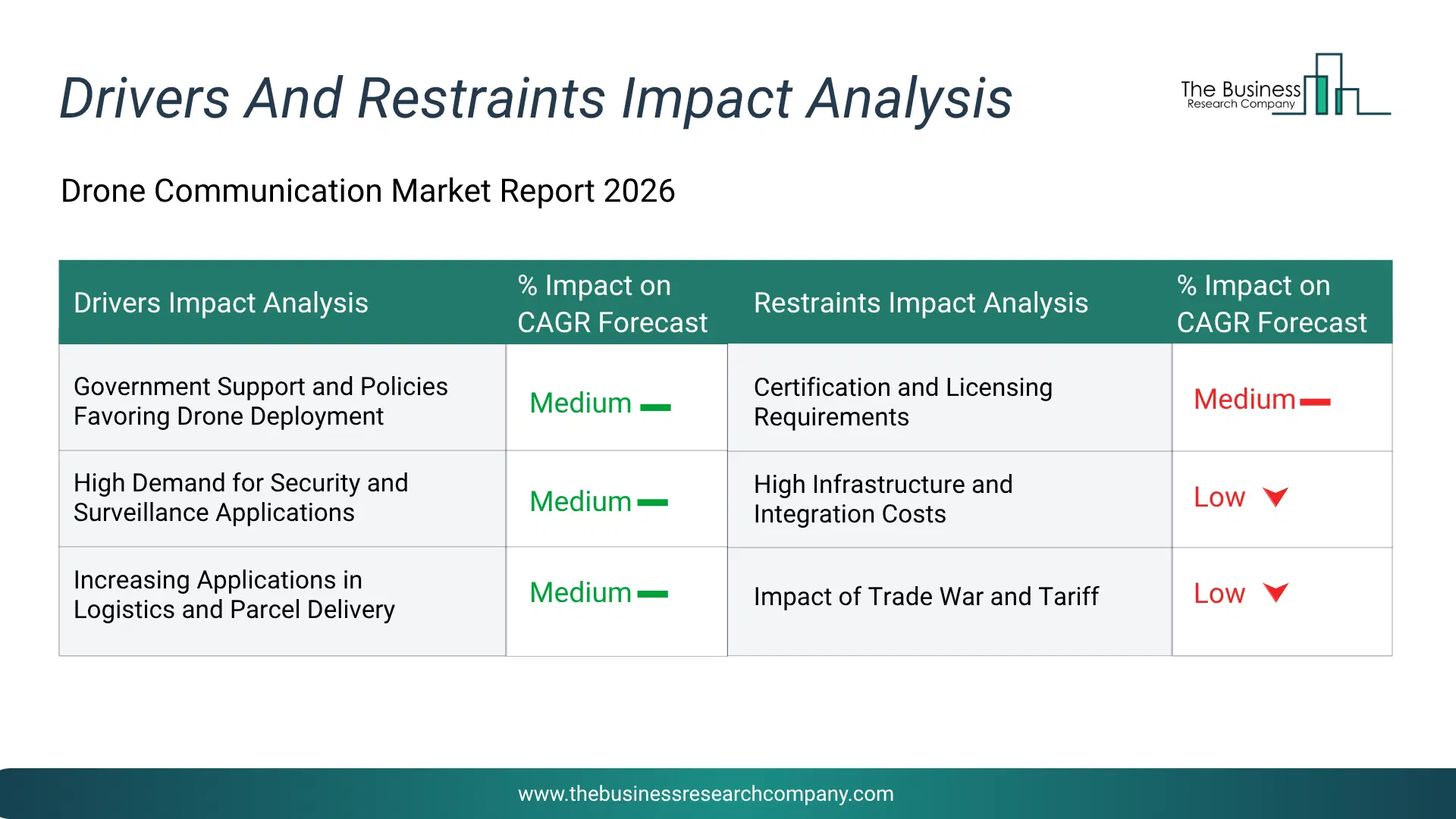
Infographic Chart Showing Key Market Drivers Analysis And Restraints For Drone Communication Market
The chart presents an impact analysis of key drivers and restraints, quantifying their relative influence on the market's growth rate and helping assess the balance between growth enablers and limiting factors. This chart offers a high-level perspective; the full report contains more detailed insights.
How Will The Drivers Impact Growth In The Global Drone Communication Market?
• Government Support and Policies Favoring Drone Deployment (Medium) – The government support and policies favoring drone deployment will become a key driver of growth in the drone communication market by 2030. Clearer regulatory frameworks for commercial operations, BVLOS (beyond visual line of sight) missions, Remote ID compliance, and airspace integration give organizations greater confidence to expand drone deployments. These initiatives also accelerate the development of secure, interoperable communication standards that ensure safe and coordinated operations in increasingly congested skies. As regulatory approvals and operational permissions become more accessible, the need for robust communication systems—such as command-and-control links, high-bandwidth data transmission, and real-time telemetry—rises significantly. Government-led airspace modernization and incentives for drone innovation further stimulate investment in advanced drone communication technologies. As a result, the government support and policies favoring drone deployment is anticipated to contributing to a 1.5% annual growth in the market. • High Demand for Security and Surveillance Applications (Medium) – The high demand for security and surveillance applications will emerge as a major factor driving the expansion of the drone communication market by 2030. Surveillance drones rely on sophisticated imaging and sensing systems that must transmit continuous video feeds, thermal readings, and positional data to control centers with minimal latency and zero disruption. This creates a strong need for robust communication networks capable of operating in harsh environments, over long distances, and with stringent encryption and security requirements. As governments, enterprises, and defense organizations scale up surveillance operations, demand will rise for communication solutions that deliver reliability, high bandwidth, and secure data transfer. The expanding use of drones for monitoring and protection activities directly boosts the adoption of advanced command-and-control systems, long-range antennas, and resilient telemetry links. Consequently, the high demand for security and surveillance applications is projected to contributing to a 1.2% annual growth in the market. • Increasing Applications in Logistics and Parcel Delivery (Medium) – The increasing applications in logistics and parcel delivery will serve as a key growth catalyst for the drone communication market by 2030. Delivery drones rely on continuous, reliable connectivity to receive navigation updates, avoid obstacles, interact with traffic management systems, and send real-time telemetry and status data back to control centers. As logistics companies scale up drone fleets to accelerate delivery operations, communication networks must adapt to support higher drone volumes, dynamic routing, and smooth integration with ground-based systems. This trend is accelerating demand for advanced BVLOS (beyond visual line of sight) communication capabilities, low-latency cellular networks, and AI-enhanced data links that can handle complex delivery workflows. As drones take on a larger role in last-mile logistics, the need for secure, resilient, and scalable communication technologies grows accordingly. Therefore, this increasing applications in logistics and parcel delivery operations is projected to supporting to a 1.0% annual growth in the market. • Increasing Focus on Precision Agriculture (Low) – The increasing focus on precision agriculture will become a significant driver contributing to the growth of the drone communication market by 2030. Modern farming increasingly relies on drones carrying advanced sensors and imaging tools that must transmit crop health data, soil indicators, and geospatial information to farm management platforms through dependable communication links. Because agricultural operations often cover large and remote areas, strong BVLOS (beyond visual line of sight) communication capabilities become essential. As farmers adopt more automated, data-driven practices, drone communication systems must enable high-frequency data transfers, stable connectivity, and seamless integration with agricultural analytics software. This shift accelerates the demand for improved transmitters, receivers, antennas, and cellular or RF-based data links, underscoring the critical role of communication technologies in advancing smarter and more efficient farming. Consequently, the increasing focus on precision agriculture is projected to contributing to a 0.6% annual growth in the market.How Will The Restraints Impact Growth In The Global Drone Communication Market?
• Certification and Licensing Requirements (Medium) – Certification and Licensing Requirements will restrict the growth of the Drone Communication market during the forecast period. Drone communication systems require certifications and licenses for operation and frequency usage. Certification requirements add to development costs and timelines. Licensing complexities can affect drone deployment and service availability, limiting market growth. • High Infrastructure and Integration Costs (Medium) – High Infrastructure and Integration Costs will restrict the growth of the Drone Communication market during the forecast period. Drone communication infrastructure requires significant investment in networks and integration with existing systems. High costs can affect the economic viability of drone communication projects. Infrastructure costs may limit the deployment of advanced drone communication solutions. • Impact of Trade War and Tariff (Low) – Impact of Trade War and Tariff will restrict the growth of the Drone Communication market during the forecast period. Drone communication technology relies on imported electronic components and equipment subject to trade tariffs. Trade barriers can increase system costs and affect availability. Trade tensions may also impact drone industry investment and deployment.Key Players In The Global Drone Communication Market
Major companies operating in the drone communication market are General Dynamics Corporation, L3Harris Technologies Inc., Honeywell International Inc., BAE Systems plc, Thales S.A., Elbit Systems Ltd., Israel Aerospace Industries Ltd., Viasat Inc., Aselsan Elektronik Sanayi ve Ticaret A.S., Iridium Communications Inc., AeroVironment Inc., Gilat Satellite Networks Ltd., Skydio Inc., Microdrones GmbH, Paras Defence and Space Technologies Limited, BRINC Drones Inc., Delair SAS, AgEagle Aerial Systems Inc., DroneShield Ltd., Freefly Systems Inc., Teal Drones Inc., Draganfly Innovations Inc., ZALA Aero Group, Mynaric AG.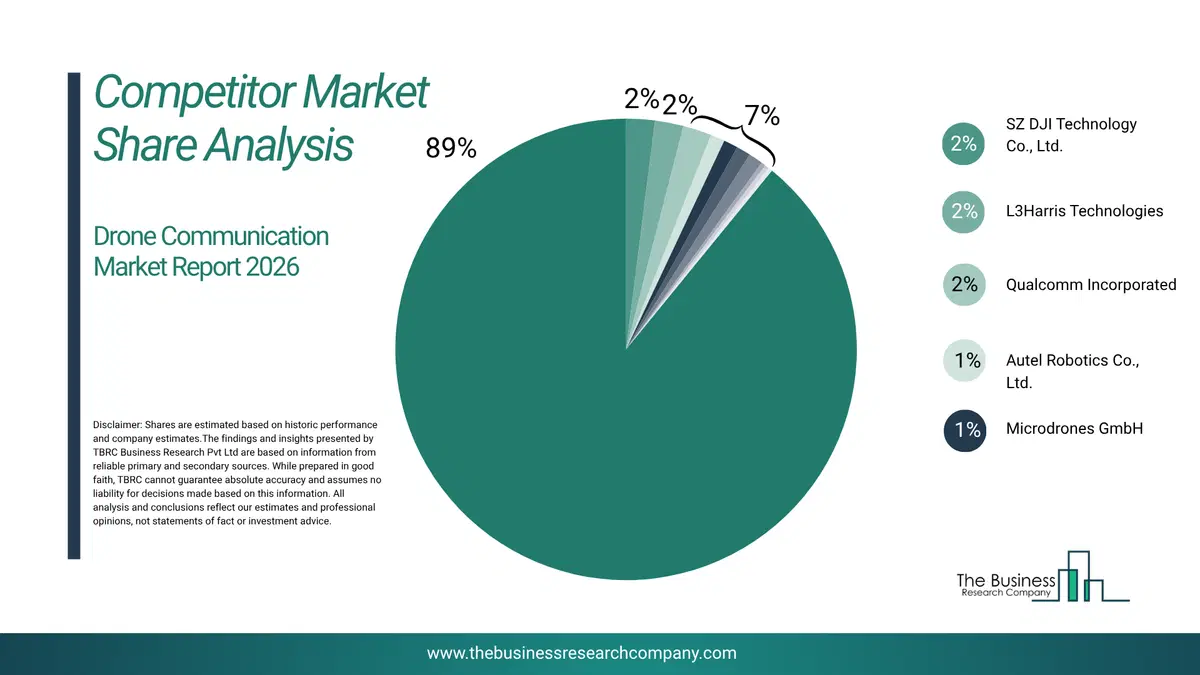
This chart is for illustrative purposes; the full report includes a detailed competitor analysis and comprehensive overview of the top 10 companies in the market.
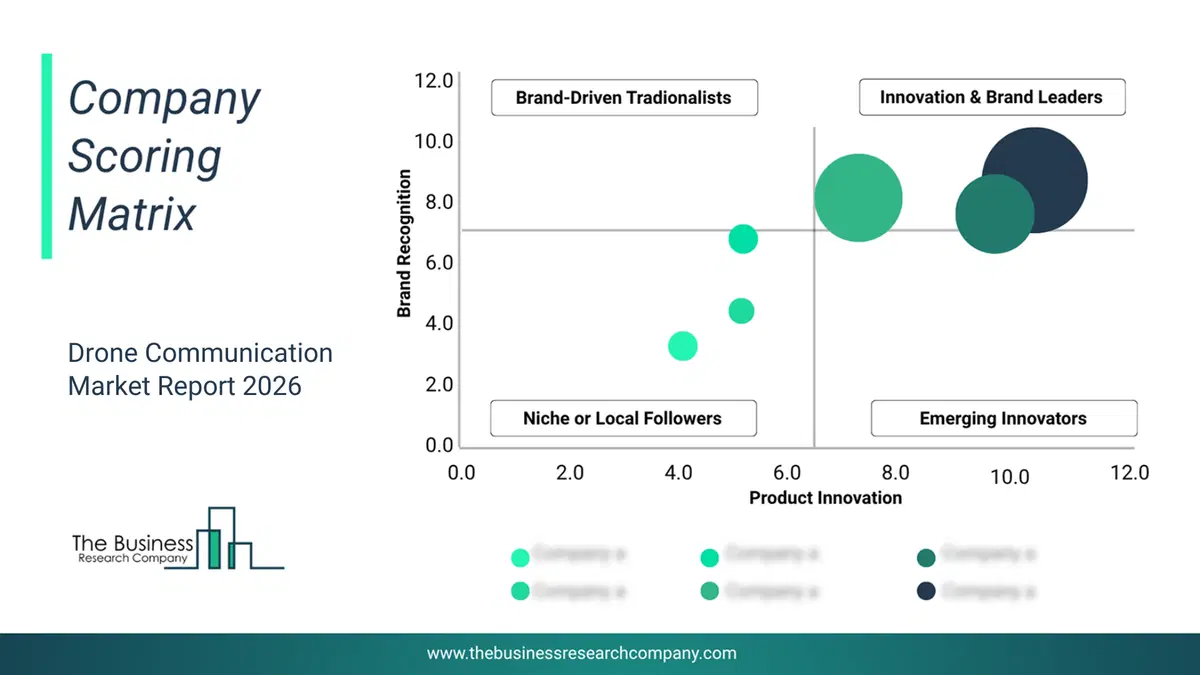
This chart maps companies by product innovation and brand strength, with bubble size indicating relative revenue, helping identify market leaders, challengers, and niche players. This is an illustrative chart; the full report provides a complete and accurate competitive analysis.
Global Drone Communication Market Trends and Insights
Major companies operating in the drone communication market are focusing on developing innovative solutions, such as multi-link bonded LTE communication systems, to enhance data transmission reliability, increase bandwidth, and ensure seamless connectivity in challenging environments. Multi-link bonded LTE communication systems refer to advanced communication solutions that combine multiple LTE (4G) network connections from different carriers or frequency bands into a single, more reliable, and high-bandwidth data stream. For instance, in September 2024, Elsight Ltd., an Israel-based technology company, launched a robust multi-link bonded LTE communication system with their DroneCommX aftermarket kit for DJI’s Matrice 30 and 350 drones. This system aggregates four LTE modems into a single bonded link, providing jam-resistant, secure communications using advanced encryption protocols such as M-TLS and AES-256. It replaces DJI’s standard 2.4 GHz peer-to-peer (P2P) communication, enabling non-line-of-sight (NLOS) flight and allowing continuous, high-bandwidth, encrypted data and video transmission to remote command centers.What Are Latest Mergers And Acquisitions In The Drone Communication Market? Axon Acquires Dedrone To Strengthen Airspace Security And Public Safety Solutions
In October 2024, Axon Enterprise, Inc., a US-based company that develops technology and weapons products for the military, acquired Dedrone Holdings for an undisclosed amount. With this acquisition, Axon Enterprise aims to enhance public safety and national security by integrating Dedrone’s advanced airspace security technology with Axon’s public safety platform, enabling faster, smarter, and more effective responses to both authorized and unauthorized drone activity and ultimately protecting more lives in more places. Dedrone Holdings is a US-based company that offers drone communication solutions, specifically through its counter-drone technology and mitigation systems.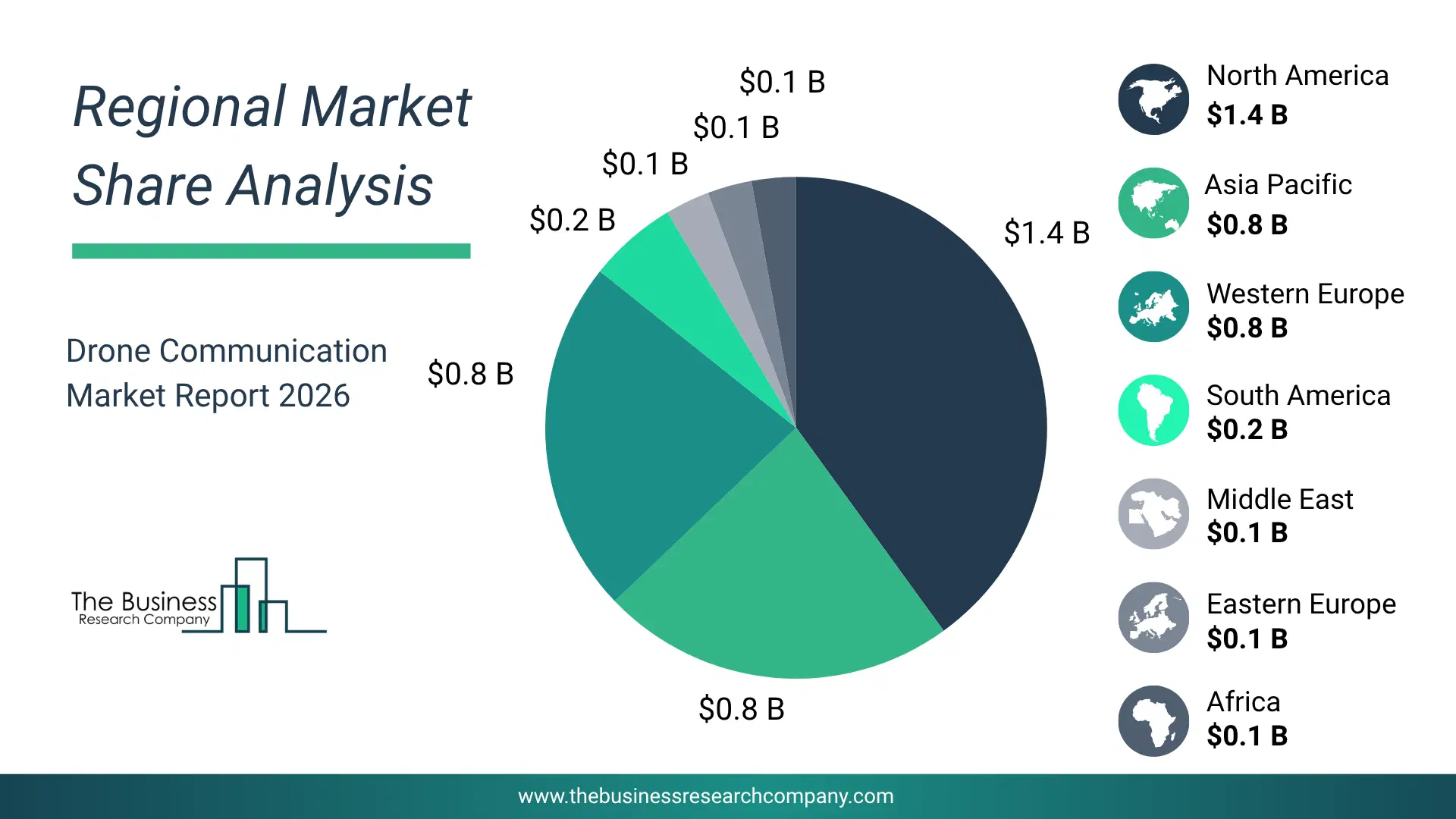
Regional Insights
North America was the largest region in the drone communication market in 2025. Asia-Pacific is expected to be the fastest-growing region in the forecast period. The regions covered in this market report are Asia-Pacific, South East Asia, Western Europe, Eastern Europe, North America, South America, Middle East, Africa. The countries covered in this market report are Australia, Brazil, China, France, Germany, India, Indonesia, Japan, Taiwan, Russia, South Korea, UK, USA, Canada, Italy, SpainWhat Defines the Drone Communication Market?
The drone communication market consists of revenues earned by entities by providing services such as real-time telemetry and command-and-control links, high-definition video and sensor-data streaming, beyond-line-of-sight connection, secure data encryption and network management, and leasing or maintenance of communication equipment. The market value includes the value of related goods sold by the service provider or included within the service offering. The drone communication market also includes sales of radio transceivers and modems, high-gain antennas and signal amplifiers, ground control stations and data-link hardware, and software-defined radio platforms. Values in this market are ‘factory gate’ values, that is, the value of goods sold by the manufacturers or creators of the goods, whether to other entities (including downstream manufacturers, wholesalers, distributors, and retailers) or directly to end customers. The value of goods in this market includes related services sold by the creators of the goods.How is Market Value Defined and Measured?
The market value is defined as the revenues that enterprises gain from the sale of goods and/or services within the specified market and geography through sales, grants, or donations in terms of the currency (in USD unless otherwise specified). The revenues for a specified geography are consumption values that are revenues generated by organizations in the specified geography within the market, irrespective of where they are produced. It does not include revenues from resales along the supply chain, either further along the supply chain or as part of other products.
This chart presents market attractiveness based on a quantitative evaluation of growth, competition, strategic alignment, and risk, offering a clear view of opportunity areas for decision-making. This chart is for illustrative purposes; the full report contains the complete analysis.

This chart highlights the Total Addressable Market (TAM) by estimating the maximum revenue opportunity using an assumption-driven approach, supporting strategic planning and opportunity sizing across markets. The chart is illustrative; the full report provides a more comprehensive analysis.
What Key Data and Analysis Are Included in the Drone Communication Market Report 2026?
The drone communication market research report is one of a series of new reports from The Business Research Company that provides market statistics, including industry global market size, regional shares, competitors with the market share, detailed market segments, market trends and opportunities, and any further data you may need to thrive in the drone communication industry. The market research report delivers a complete perspective of everything you need, with an in-depth analysis of the current and future state of the industry.Drone Communication Market Report Forecast Analysis
| Report Attribute | Details |
|---|---|
| Market Size Value In 2026 | $4.4 billion |
| Revenue Forecast In 2030 | $8.87 billion |
| Growth Rate | CAGR of 19.6% from 2026 to 2030 |
| Base Year For Estimation | 2025 |
| Actual Estimates/Historical Data | 2020-2025 |
| Forecast Period | 2026 - 2030 |
| Market Representation | Revenue in USD Billion and CAGR from 2026 to 2030 |
| Segments Covered | Component, Technology, Application, End Use |
| Regional Scope | Asia-Pacific, Western Europe, Eastern Europe, North America, South America, Middle East, Africa |
| Country Scope | The countries covered in the report are Australia, Brazil, China, France, Germany, India, Indonesia, Japan, Taiwan, Russia, South Korea, UK, USA, Canada, Italy, Spain. |
| Key Companies Profiled | General Dynamics Corporation, L3Harris Technologies Inc., Honeywell International Inc., BAE Systems plc, Thales S.A., Elbit Systems Ltd., Israel Aerospace Industries Ltd., Viasat Inc., Aselsan Elektronik Sanayi ve Ticaret A.S., Iridium Communications Inc., AeroVironment Inc., Gilat Satellite Networks Ltd., Skydio Inc., Microdrones GmbH, Paras Defence and Space Technologies Limited, BRINC Drones Inc., Delair SAS, AgEagle Aerial Systems Inc., DroneShield Ltd., Freefly Systems Inc., Teal Drones Inc., Draganfly Innovations Inc., ZALA Aero Group, Mynaric AG. |
| Customization Scope | Request for Customization |
| Pricing And Purchase Options | Explore Purchase Options |