
Drone Flight Controller System Market Report 2026
Global Outlook – By Component (Hardware, Software, Services), By Product (Flight controller, Speed Controller, Global Positioning System, Sensor, Other Products), By Technology (Autonomous, Semi-Autonomous, Manual), By Application (Fixed-wing Drone, Rotary Wing Drone, Hybrid Wing Drone), By End-User (Agriculture, Construction, Logistics, Media And Entertainment, Defense, Other End-Users) – Market Size, Trends, Strategies, and Forecast to 2030
Drone Flight Controller System Market Overview
• Drone Flight Controller System market size has reached to $8.07 billion in 2025 • Expected to grow to $14.7 billion in 2030 at a compound annual growth rate (CAGR) of 12.7% • Growth Driver: Rising Commercial Drone Adoption Accelerates Demand For The Market Due To Enhanced Operational Efficiency And Safety • Market Trend: Advancements In Autonomous And AI-Enabled Drone Flight Control Systems • North America was the largest region in 2025 and Asia-Pacific is the fastest growing region.Market Gains By 2030 – Top Opportunities By Segment
Market Gain identifies the most promising market opportunities by highlighting the segments or products expected to generate the highest incremental revenue growth over the next five years.
What Is Covered Under Drone Flight Controller System Market?
A drone flight controller system is the central unit responsible for managing and stabilizing a drone’s flight. It processes data from sensors such as gyroscopes, accelerometers, and GPS to maintain balance and orientation. The system interprets pilot or autonomous commands and adjusts motor speeds accordingly to control movement. The main types of components of drone flight controller systems are hardware, software, and services. Hardware refers to the physical components of drone flight controller systems, including sensors, processors, and communication modules. The various product offerings include flight controllers, speed controllers, GPS systems, sensors, and other products that are based on technology such as autonomous, semi-autonomous, and manual. The various applications include fixed-wing drones, rotary-wing drones, and hybrid wing drones. The main end-users include agriculture, construction, logistics, media and entertainment, defense, and other industries.
What Is The Drone Flight Controller System Market Size and Share 2026?
The drone flight controller system market size has grown rapidly in recent years. It will grow from $8.07 billion in 2025 to $9.12 billion in 2026 at a compound annual growth rate (CAGR) of 13.0%. The growth in the historic period can be attributed to increasing use of gyroscope- and accelerometer-based stabilization systems to improve drone flight accuracy, rising adoption of gps-enabled flight controllers for precise navigation and positioning, expansion of real-time flight monitoring services supporting commercial and industrial drone operations, development of firmware update and configuration tools enhancing controller performance, growing need for sensor calibration support to maintain reliable and consistent drone behavior.What Is The Drone Flight Controller System Market Growth Forecast?
The drone flight controller system market size is expected to see rapid growth in the next few years. It will grow to $14.7 billion in 2030 at a compound annual growth rate (CAGR) of 12.7%. The growth in the forecast period can be attributed to rising integration of advanced geo-fencing capabilities to ensure regulatory compliance and operational safety, increasing adoption of obstacle avoidance technologies driven by autonomous drone applications, expansion of payload control systems to support diversified commercial drone missions, growing demand for high-performance flight controllers enabling long-range and high-endurance drones, development of ai-enabled flight algorithms enhancing autonomous decision-making and mission efficiency. Major trends in the forecast period include increasing integration of advanced navigation features such as geo-fencing, return-to-home, and terrain-following in standard flight controllers, miniaturization and power-efficiency improvements enabling high-performance controller systems for smaller and lighter drone platforms, growing adoption of modular, plug-and-play flight controller architectures compatible with diverse airframes and payload configurations, rising demand for standardized interfaces and open ecosystems to simplify firmware updates, configuration, and sensor calibration across drone fleets, \expansion of after-sales services including remote diagnostics, real-time flight monitoring support, and lifecycle firmware management contracts.
Global Drone Flight Controller System Market Segmentation
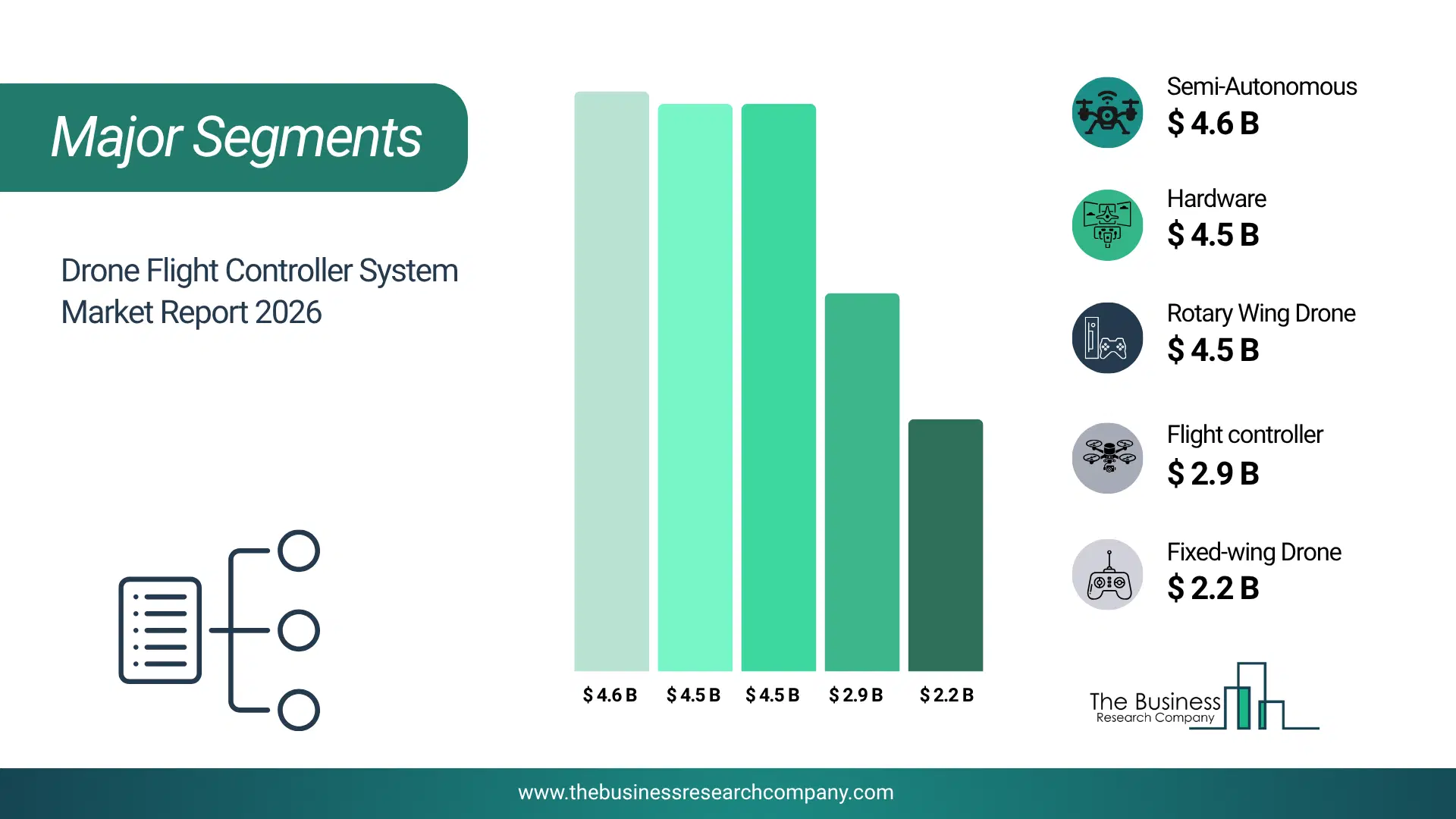
1) By Component: Hardware, Software, Services 2) By Product: Flight controller, Speed Controller, Global Positioning System, Sensor, Other Products 3) By Technology: Autonomous, Semi-Autonomous, Manual 4) By Application: Fixed-wing Drone, Rotary Wing Drone, Hybrid Wing Drone 5) By End-User: Agriculture, Construction, Logistics, Media And Entertainment, Defense, Other End-Users Subsegments: 1) By Hardware: Flight Controller Board, Sensors, Global Positioning System Module 2) By Software: Flight Control Software, Mission Planning Software, Navigation Software 3) By Services: Installation And Integration, Training And Consulting, Maintenance And Support The top segments in the drone flight controller system market will be: • Semi-Autonomous will reach $4645.4 Million by 2025. • Hardware will reach $4593.87 Million by 2025. • Rotary Wing Drone will reach $4563.17 Million by 2025. • Flight controller will reach $2929.54 Million by 2025. • Fixed-wing Drone will reach $2281.41 Million by 2025.What Is Driver Of The Drone Flight Controller System Market?
The rising use of drones in commercial applications is expected to propel the growth of the drone flight controller system market going forward. Use of drones in commercial applications refers to the deployment of unmanned aerial vehicles (UAVs) for business purposes such as inspection, delivery, surveillance, mapping, and aerial imaging across various industries. The growing use of drones in commercial applications is driven by their ability to access hard-to-reach or hazardous areas safely, reducing risks to human workers. The drone flight controller system enables precise navigation, stability, and automation, which are essential for reliable and efficient drone operations in commercial applications such as surveying, inspections, and deliveries. For instance, in May 2024, according to the International Trade Administration, a US-based government agency, VUL (Association of Unmanned Aviation) anticipates a 40% increase in the global number of commercially used drones between 2022 and 2030. Therefore, the rising use of drones in commercial applications is driving the growth of the drone flight controller system industry.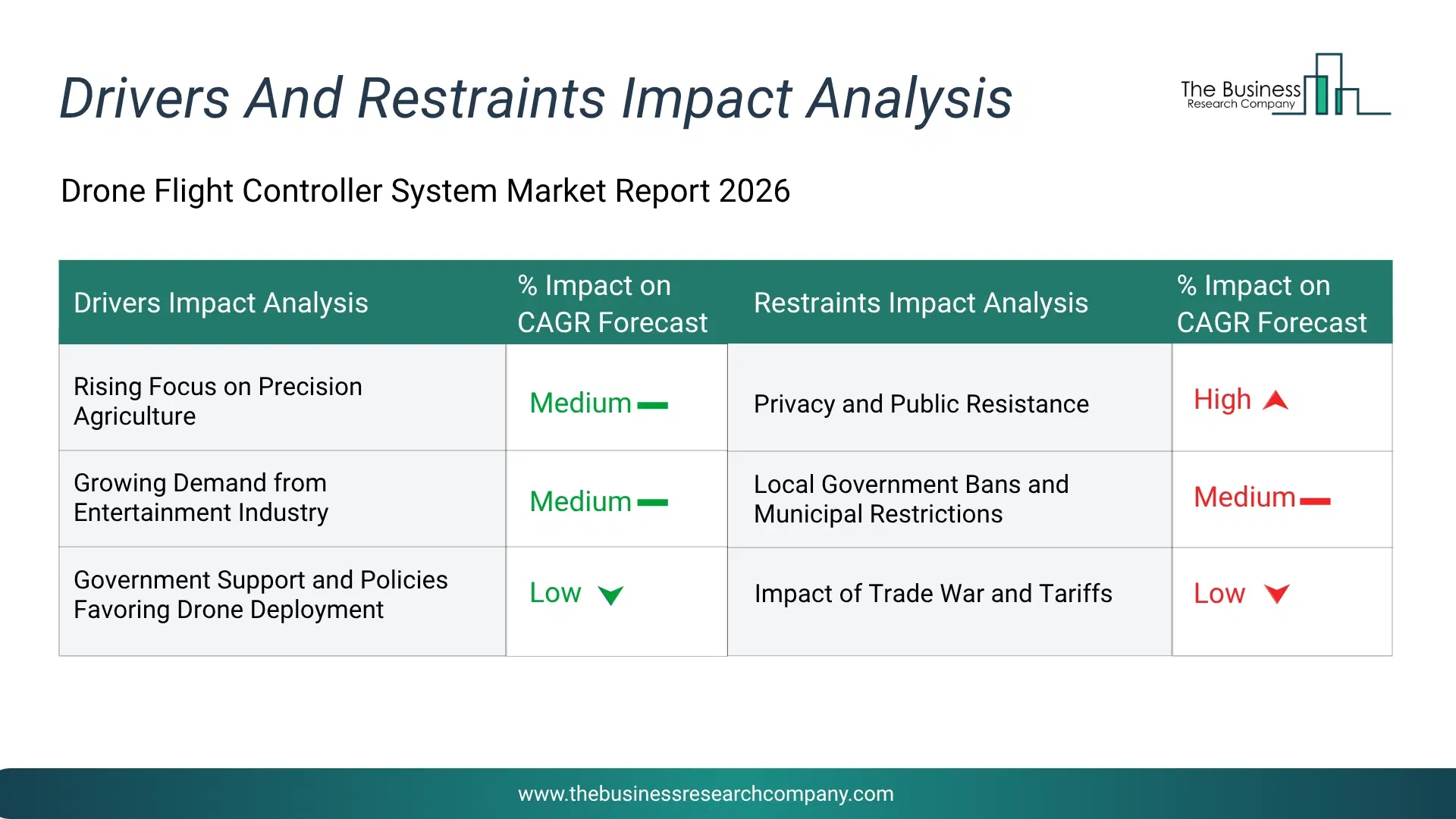
Infographic Chart Showing Key Market Drivers Analysis And Restraints For Drone Flight Controller System Market
The chart presents an impact analysis of key drivers and restraints, quantifying their relative influence on the market's growth rate and helping assess the balance between growth enablers and limiting factors. This chart offers a high-level perspective; the full report contains more detailed insights.
How Will The Drivers Impact Growth In The Global Drone Flight Controller System Market?
• Rising Focus on Precision Agriculture (Medium) – The rising focus on precision agriculture will become a key driver of growth in the drone flight controller system market by 2030. Precision agriculture relies on highly accurate, stable and autonomous drone operations to support tasks such as crop health assessment, variable-rate application, yield monitoring and field mapping, activities that require advanced flight-control capabilities to ensure consistent performance. Drones equipped with sophisticated controllers enable targeted interventions, reduce manual labour and improve overall farm productivity by delivering precise aerial insights. Moreover, the increasing adoption of drone-based remote sensing technologies, multispectral imaging and AI-enabled diagnostics is driving farmers to integrate unmanned aerial systems into routine agricultural management. As a result, the rising focus on precision agriculture is anticipated to contributing to a 1.2% annual growth in the market. • Growing Demand from Entertainment Industry (Medium) – The growing demand from entertainment industry will emerge as a major factor driving the expansion of the drone flight controller system market by 2030. Entertainment platforms increasingly leverage unmanned aerial systems to deliver complex light shows, dynamic aerial cinematography and immersive crowd-engagement experiences, applications that rely on high-precision, reliably synchronized flight-control technologies. This trend is particularly crucial as organizers seek to enhance spectacle quality, ensure safety in dense environments and differentiate live events through novel aerial performances. Moreover, as the convergence of drones with AI, swarm choreography, interactive audience participation and broadcast-grade visuals advances, the requirement for sophisticated flight-controller systems escalates accordingly. Consequently, the accelerating growing demand from entertainment industry is projected to contributing to a 1.0% annual growth in the market. • Government Support and Policies Favoring Drone Deployment (Low) – The government support and policies favoring drone deployment within digital manufacturing processes will serve as a key growth catalyst for the drone flight controller system market by 2030. State and national programs are increasingly offering subsidies, training and incentives to promote the uptake of unmanned aerial systems (UAS) in agriculture, surveillance, mapping and public-service operations, initiatives that create significant demand for high-performance flight-control solutions. This is particularly crucial as governments aim to modernize aerial operations, enhance efficiency and advance automation across diverse sectors. Moreover, policy-driven adoption helps reduce cost barriers, accelerate deployment and encourage wider integration of drone platforms, thereby increasing the need for advanced controller systems. Therefore, this government support and policies favoring drone deployment is projected to supporting to a 0.7% annual growth in the market. • Emergence of Drone-as-a-Service (DaaS) Business Models (Low) – The emergence of drone-as-a-service (DAAS) business models will become a significant driver contributing to the growth of the drone flight controller system market by 2030. These service-oriented models allow organizations to access drone capabilities and flight-controller systems on a pay-as-you-use or subscription basis, lowering the entry barrier for advanced aerial operations and increasing demand for adaptable and modular flight-controller hardware and software. This is particularly crucial as enterprises shift from owning drone hardware to outsourcing operational and avionics control to specialised service providers. Moreover, as the DaaS ecosystem scales, covering inspection, delivery, agriculture and mapping services, the requirement for high-performance, customizable flight-control solutions rises accordingly. Consequently, the emergence of drone-as-a-service (DAAS) business models is projected to contributing to a 0.5% annual growth in the market.How Will The Restraints Impact Growth In The Global Drone Flight Controller System Market?
• Privacy and Public Resistance (Medium) – Privacy and Public Resistance will restrict the growth of the Drone Flight Controller System market during the forecast period. Drone operations raise privacy concerns and public resistance about surveillance and intrusiveness. Privacy concerns can affect regulatory acceptance and adoption of drone technology. Public resistance may lead to restrictions and limitations on drone operations, impacting market growth. • Local Government Bans and Municipal Restrictions (Low) – Local Government Bans and Municipal Restrictions will restrict the growth of the Drone Flight Controller System market during the forecast period. Drone flight controller system deployment faces bans and restrictions from local governments due to safety and privacy concerns. Municipal restrictions can limit drone operations and affect market growth in urban areas. Regulatory restrictions on drone usage can create uncertainty for industry participants. • Impact of Trade War and Tariffs (Low) – Impact of Trade War and Tariffs will restrict the growth of the Drone Flight Controller System market during the forecast period. Drone flight controller systems rely on imported electronic components and sensors subject to trade tariffs. Trade barriers can increase system costs and affect product availability. Trade tensions may also impact drone manufacturing and technology transfer.Key Players In The Global Drone Flight Controller System Market
Major companies operating in the drone flight controller system market are Lockheed Martin Corporation, Honeywell Aerospace, Mitsubishi Heavy Industries Ltd., GE Aerospace, Kawasaki Heavy Industries Ltd., Israel Aerospace Industries Ltd, SZ DJI Technology Co. Ltd, Quantum-Systems, Parrot Drones SAS, Delair SAS, Auterion AG, MicroPilot Inc., Ascent AeroSystems Inc, Chengdu CUAV Technology Co. Ltd., Embention Sistemas Inteligentes S.L., Holybro, Sky-Drones Technologies Ltd, CubePilot Pty Ltd, Shenzhen JIYI Technology Co. Ltd., Pixhawk.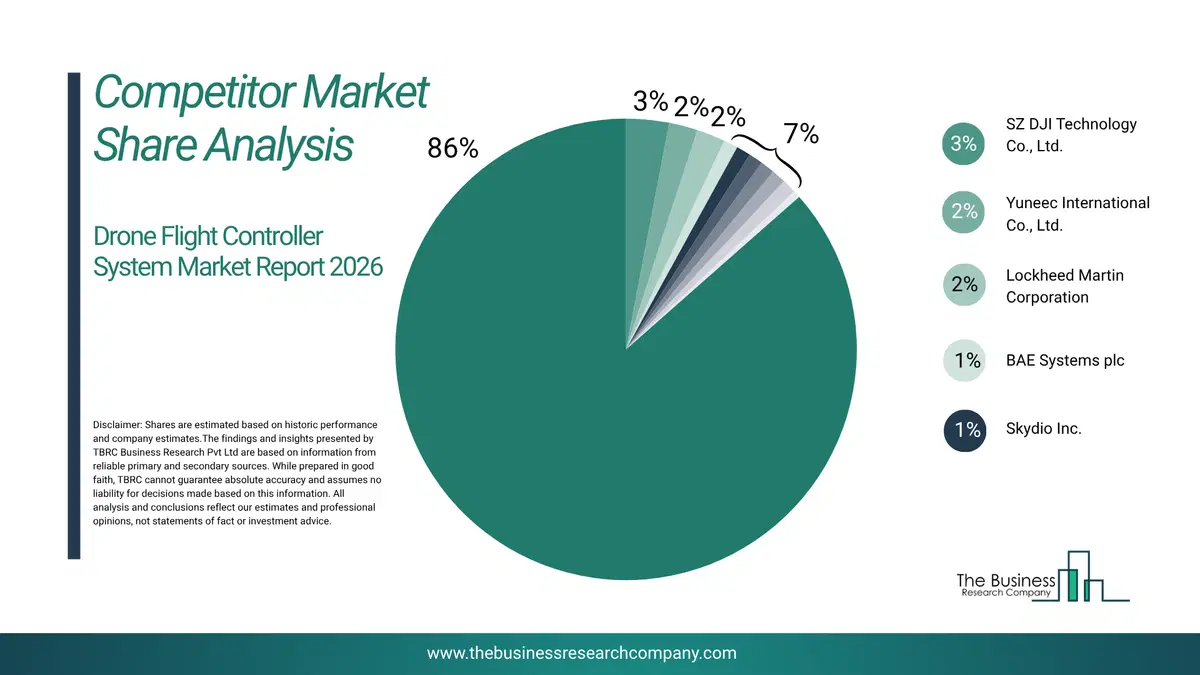
This chart is for illustrative purposes; the full report includes a detailed competitor analysis and comprehensive overview of the top 10 companies in the market.
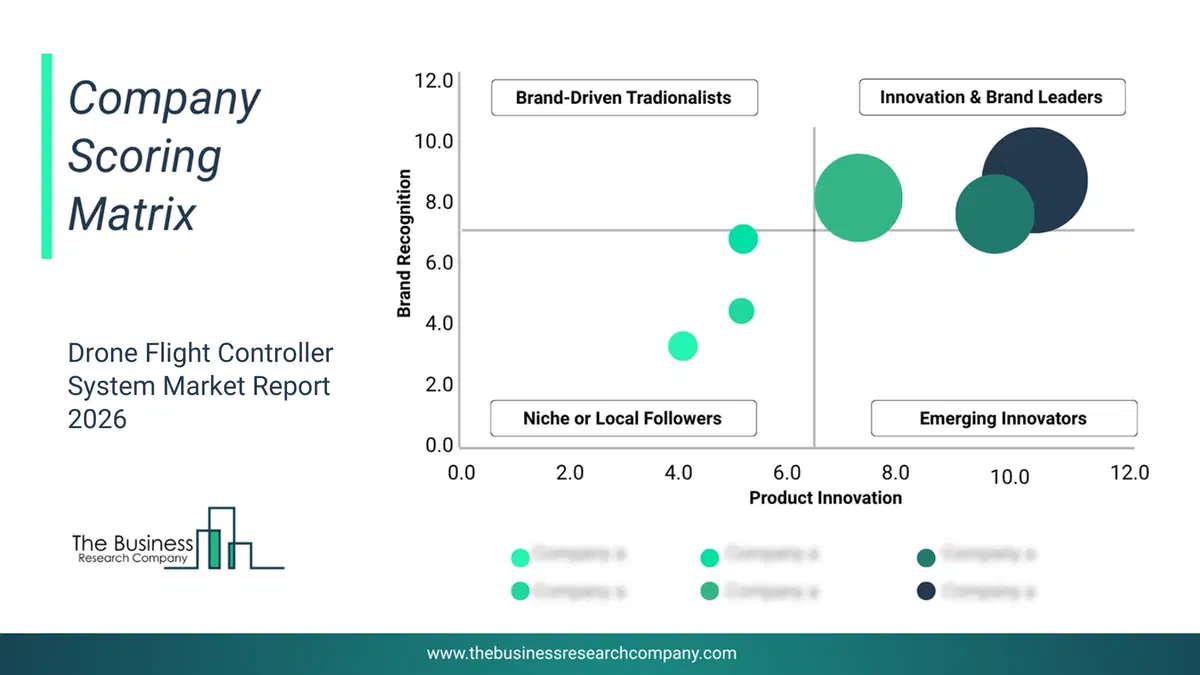
This chart maps companies by product innovation and brand strength, with bubble size indicating relative revenue, helping identify market leaders, challengers, and niche players. This is an illustrative chart; the full report provides a complete and accurate competitive analysis.
Global Drone Flight Controller System Market Trends and Insights
Major companies operating in the drone flight controller system market are focusing on developing technological advancements, such as next-generation controllers, to enhance autonomous navigation, improve flight stability, integrate AI-based decision-making, and support swarming capabilities for defense and commercial applications. Next-generation controllers are advanced drone flight control systems that integrate AI, sensor fusion, onboard computing, and enhanced security to enable autonomous, precise, and adaptive flight operations. For instance, in March 2025, Passenger Drone Research Pvt. Ltd., an India-based drone technology company, launched an Ag++ (AeroFC Ag++) flight controller. It is a plug-and-play solution designed specifically for agricultural drones, offering advanced sensors and seamless software integration for precise, efficient, and reliable crop spraying and mapping. Its key benefits include high-precision motion and altitude control, intuitive mission planning, real-time monitoring, and easy customization, all aimed at maximizing productivity and reducing operational complexity.What Are Latest Mergers And Acquisitions In The Drone Flight Controller System Market? Delair Acquires Squadrone System To Bolster Advanced Drone Flight Control Capabilities
In October 2024, DELAIR SAS, a France-based manufacturing company, acquired SQUADRONE SYSTEM SAS for an undisclsoed amount. With this acquisition, DELAIR SAS aims to strengthen its expertise in drone swarming and automated industrial inspection, accelerate its dual civil and defense development strategy, enhance its technological roadmap across key areas including energy, image processing, electronic warfare, swarms, and certification, and reinforce its competitiveness in the European and global drone markets. Squadrone System SAS is a France-based drone manufacturing company that specializes in providing drone flight controller system.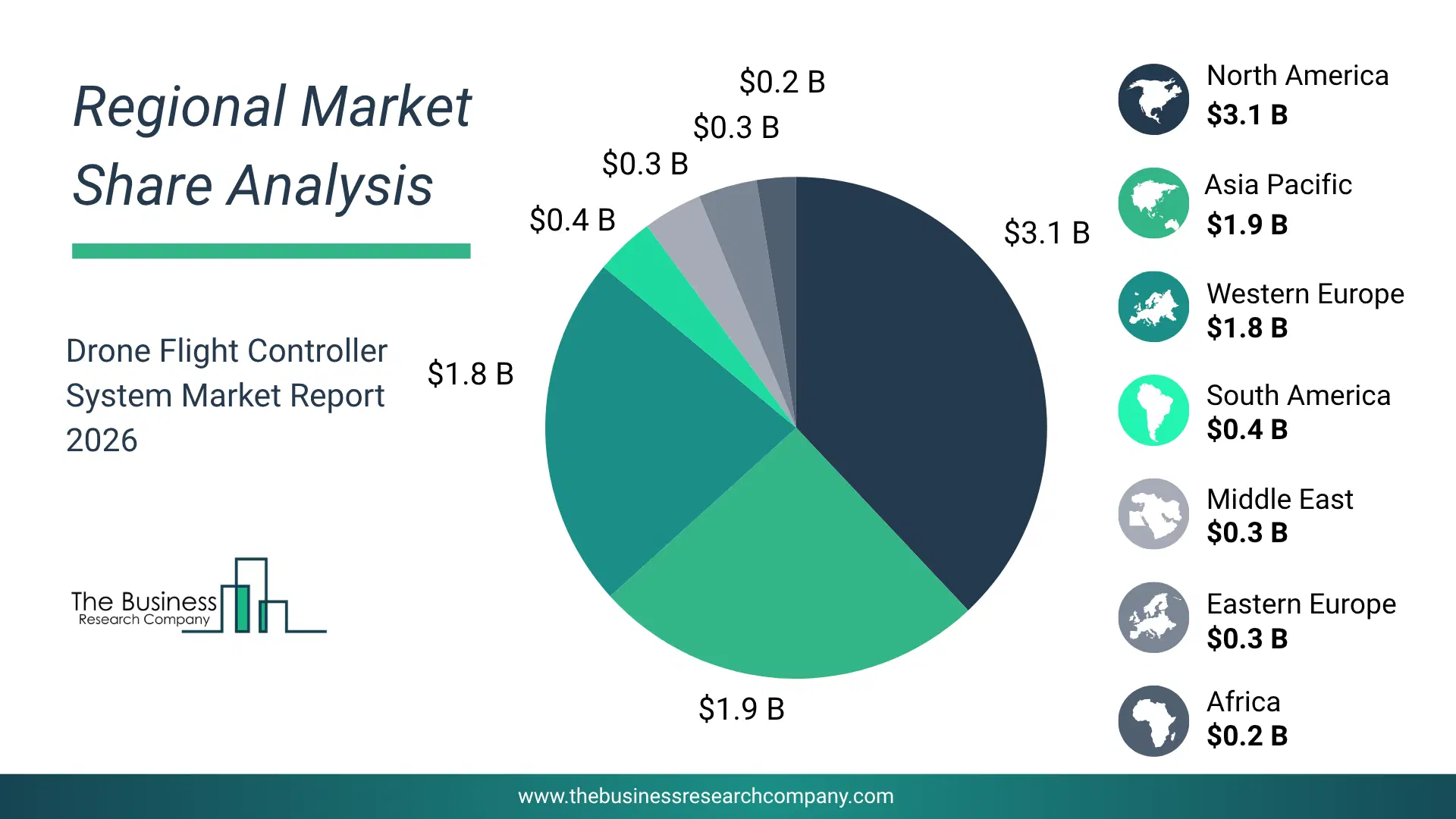
Regional Insights
North America was the largest region in the drone flight controller system market in 2025. Asia-Pacific is expected to be the fastest-growing region in the forecast period. The regions covered in this market report are Asia-Pacific, South East Asia, Western Europe, Eastern Europe, North America, South America, Middle East, Africa. The countries covered in this market report are Australia, Brazil, China, France, Germany, India, Indonesia, Japan, Taiwan, Russia, South Korea, UK, USA, Canada, Italy, SpainWhat Defines the Drone Flight Controller System Market?
The drone flight controller system market consists of revenues earned by entities by providing services such as real-time flight monitoring, firmware updates and configuration, and sensor calibration support. The market value includes the value of related goods sold by the service provider or included within the service offering. The drone flight controller system market also includes sales of geo-fencing, obstacle avoidance, and payload control. Values in this market are ‘factory gate’ values, that is, the value of goods sold by the manufacturers or creators of the goods, whether to other entities (including downstream manufacturers, wholesalers, distributors, and retailers) or directly to end customers. The value of goods in this market includes related services sold by the creators of the goods.How is Market Value Defined and Measured?
The market value is defined as the revenues that enterprises gain from the sale of goods and/or services within the specified market and geography through sales, grants, or donations in terms of the currency (in USD unless otherwise specified). The revenues for a specified geography are consumption values that are revenues generated by organizations in the specified geography within the market, irrespective of where they are produced. It does not include revenues from resales along the supply chain, either further along the supply chain or as part of other products.
This chart presents market attractiveness based on a quantitative evaluation of growth, competition, strategic alignment, and risk, offering a clear view of opportunity areas for decision-making. This chart is for illustrative purposes; the full report contains the complete analysis.

This chart highlights the Total Addressable Market (TAM) by estimating the maximum revenue opportunity using an assumption-driven approach, supporting strategic planning and opportunity sizing across markets. The chart is illustrative; the full report provides a more comprehensive analysis.
What Key Data and Analysis Are Included in the Drone Flight Controller System Market Report 2026?
The drone flight controller system market research report is one of a series of new reports from The Business Research Company that provides market statistics, including industry global market size, regional shares, competitors with the market share, detailed market segments, market trends and opportunities, and any further data you may need to thrive in the drone flight controller system industry. The market research report delivers a complete perspective of everything you need, with an in-depth analysis of the current and future state of the industry.Drone Flight Controller System Market Report Forecast Analysis
| Report Attribute | Details |
|---|---|
| Market Size Value In 2026 | $9.12 billion |
| Revenue Forecast In 2030 | $14.7 billion |
| Growth Rate | CAGR of 13.0% from 2026 to 2030 |
| Base Year For Estimation | 2025 |
| Actual Estimates/Historical Data | 2020-2025 |
| Forecast Period | 2026 - 2030 |
| Market Representation | Revenue in USD Billion and CAGR from 2026 to 2030 |
| Segments Covered | Component, Product, Technology, Application, End-User |
| Regional Scope | Asia-Pacific, Western Europe, Eastern Europe, North America, South America, Middle East, Africa |
| Country Scope | The countries covered in the report are Australia, Brazil, China, France, Germany, India, Indonesia, Japan, Taiwan, Russia, South Korea, UK, USA, Canada, Italy, Spain. |
| Key Companies Profiled | Lockheed Martin Corporation, Honeywell Aerospace, Mitsubishi Heavy Industries Ltd., GE Aerospace, Kawasaki Heavy Industries Ltd., Israel Aerospace Industries Ltd, SZ DJI Technology Co. Ltd, Quantum-Systems, Parrot Drones SAS, Delair SAS, Auterion AG, MicroPilot Inc., Ascent AeroSystems Inc, Chengdu CUAV Technology Co. Ltd., Embention Sistemas Inteligentes S.L., Holybro, Sky-Drones Technologies Ltd, CubePilot Pty Ltd, Shenzhen JIYI Technology Co. Ltd., Pixhawk. |
| Customization Scope | Request for Customization |
| Pricing And Purchase Options | Explore Purchase Options |