
Drone Jammer Market Report 2026
Global Outlook – By Type (Handheld Drone Jammers, Portable Drone Jammers, Fixed Installation Jammers, Vehicle-Mounted Jammers), By Technology (Radio Frequency Jammers, Global Positioning System (GPS) Jammers, Wi-Fi And Bluetooth Jammers, Laser-Based Jammers), By Application (Civil, Military), By End-User (Aerospace And Defense, Industrial, Homeland Security, Public Safety, Private Sector) – Market Size, Trends, Strategies, and Forecast to 2030
Drone Jammer Market Overview
• Drone Jammer market size has reached to $1.37 billion in 2025 • Expected to grow to $2.01 billion in 2030 at a compound annual growth rate (CAGR) of 8% • Growth Driver: Rising Incidents of Drone-Related Security Breaches Fueling The Growth Of The Market Due To Increasing Threats To Safety and Critical Infrastructure • Market Trend: Next-Generation Multilayer Cyber-Driven Counter-Drone System Unveiled • North America was the largest region in 2025 and Asia-Pacific is the fastest growing region.What Is Covered Under Drone Jammer Market?
Drone jammers are specialized devices that disrupt communication between drones and their operators, primarily through radio frequency interference. By neutralizing navigation and control systems, these solutions mitigate threats posed by unauthorized drone activity across military, homeland security, and commercial domains. The main types of drone jammers comprise handheld drone jammers, portable drone jammers, fixed installation jammers, and vehicle-mounted jammers. Handheld Drone Jammers refer to compact, user-operated devices designed to disrupt unauthorized drone operations in localized areas, offering portability and quick deployment. These jammers utilize various technologies such as radio frequency, GPS, Wi-Fi and Bluetooth, and laser-based systems, and are applied across civil and military domains. Key end-users include aerospace and defense, industrial sectors, homeland security, public safety agencies, and private sector organizations.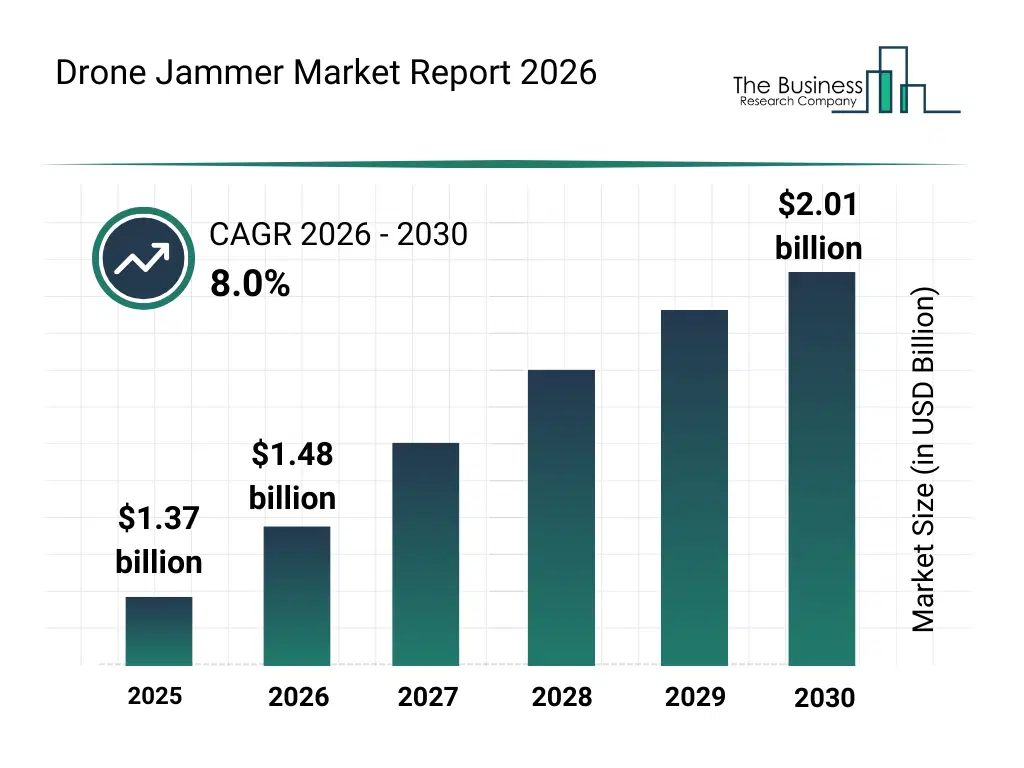
What Is The Drone Jammer Market Size and Share 2026?
The drone jammer market size has grown strongly in recent years. It will grow from $1.37 billion in 2025 to $1.48 billion in 2026 at a compound annual growth rate (CAGR) of 8.2%. The growth in the historic period can be attributed to early deployment of vehicle-mounted jammers, development of multi-band frequency jammers, adoption in military and homeland security applications, introduction of directional jammers for targeted mitigation, initial use of software-defined radio-based jammers.What Is The Drone Jammer Market Growth Forecast?
The drone jammer market size is expected to see strong growth in the next few years. It will grow to $2.01 billion in 2030 at a compound annual growth rate (CAGR) of 8.0%. The growth in the forecast period can be attributed to advancement of smart and adaptive jamming technologies, integration with autonomous threat detection systems, expansion into commercial and critical infrastructure protection, development of compact and portable jammer solutions, increasing demand for counter-drone defense services. Major trends in the forecast period include increasing demand for multi-band jamming systems due to evolving drone threats, rising use of directional jammers for precision neutralization in dense environments, growing adoption of sdr-based jammers for flexible and adaptive interference capabilities, expansion of vehicle-mounted jamming systems for border and convoy protection, integration of lightweight jamming modules into portable and handheld systems.
Global Drone Jammer Market Segmentation
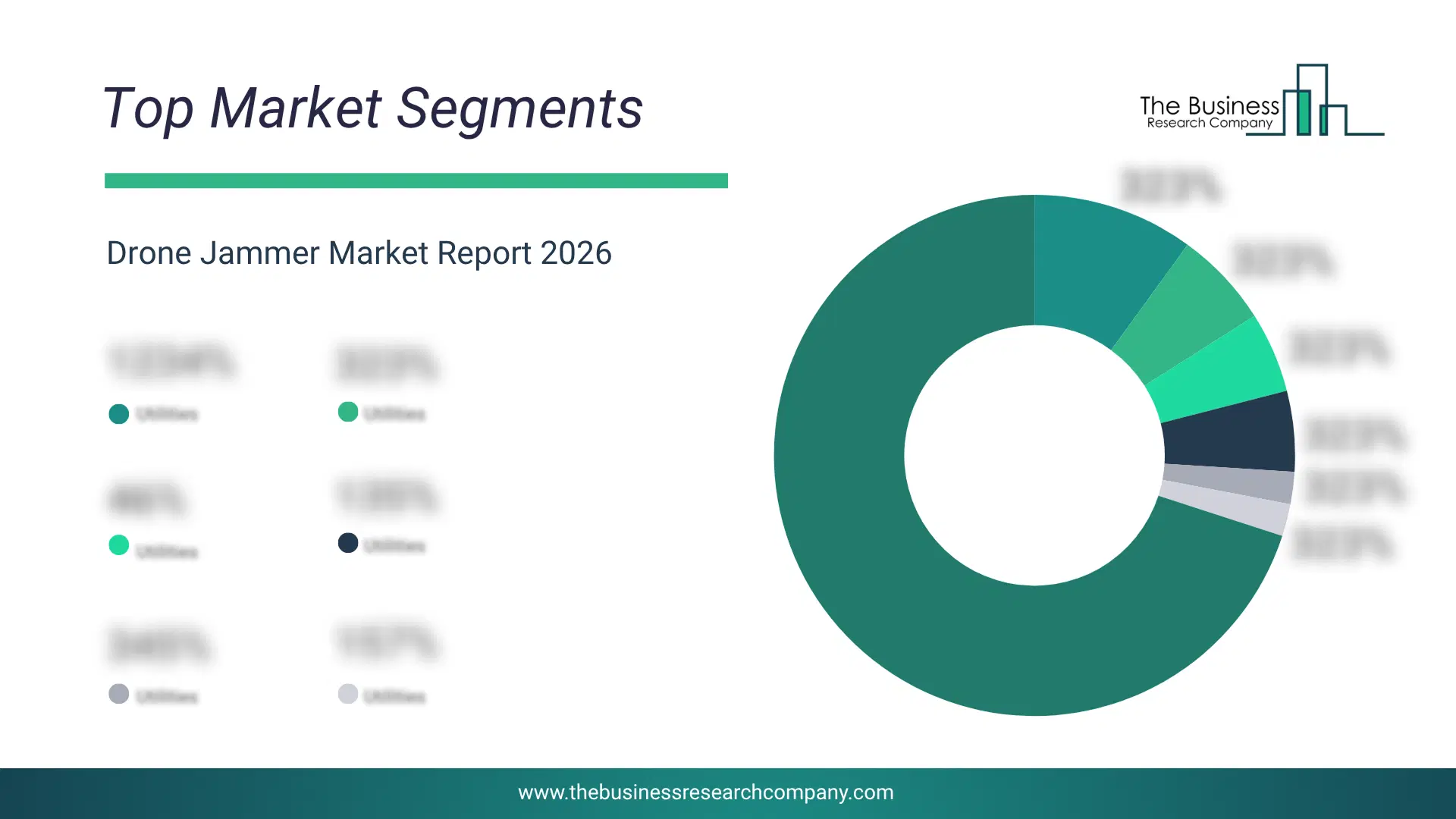
1) By Type: Handheld Drone Jammers, Portable Drone Jammers, Fixed Installation Jammers, Vehicle-Mounted Jammers 2) By Technology: Radio Frequency Jammers, Global Positioning System (GPS) Jammers, Wi-Fi And Bluetooth Jammers, Laser-Based Jammers 3) By Application: Civil, Military 4) By End-User: Aerospace And Defense, Industrial, Homeland Security, Public Safety, Private Sector Subsegments: 1) By Handheld Drone Jammers: Jammer Guns, Portable Handheld Units, Backpack Jammers 2) By Portable Drone Jammers: Vehicle-Attachable Jammers, Combined Handle Systems 3) By Fixed Installation Jammers: Permanent Site Installations, Temporary Event-Based Installations 4) By Vehicle-Mounted Jammers: Military Vehicles, Civilian Security Vehicles, Border Patrol UnitsWhat Is Driver Of The Drone Jammer Market?
The rising incidents of drone-related security breaches are expected to propel the growth of the drone jammer market going forward. Drone-related security breaches refer to the unauthorized or malicious use of drones that compromises safety, privacy, or the integrity of restricted areas and critical infrastructure. The increasing availability of low-cost commercial drones has contributed to risks such as unauthorized surveillance, smuggling, and potential attacks, compelling governments, defense agencies, and private organizations to adopt advanced counter-drone solutions. Drone jammers mitigate these threats by disrupting unauthorized drones’ communication and navigation signals, thereby protecting sensitive areas, critical infrastructure, and public events. For instance, in July 2025, according to the House Committee on Homeland Security, a US-based government agency, the Federal Aviation Administration (FAA) reported that in the first quarter of 2025 alone, there were 411 illegal drone incursions near U.S. airports, representing a 25.6% increase compared to the same period in 2024. Therefore, the rising demand for drone-related security breaches is driving the drone jammer industry.Key Players In The Global Drone Jammer Market
Major companies operating in the drone jammer market are Raytheon Technologies, Lockheed Martin Corporation, Northrop Grumman, Thales Group, Leonardo S.p.A, Rheinmetall AG, Israel Aerospace Industries, Saab AB, Shenzhen ZD TECH, ELTA Systems, Meteksan Savunma, DroneShield, Zen Technologies Ltd., Aaronia AG, NT Service UAB, Whitefox Defense Technologies, Stratign, SkyGuard (SkyCope Technologies), Keda Jammer, Hangzhou Ragine Electronic Technology, Greetwin Telecom, Battelle, Drone Defence Services Ltd.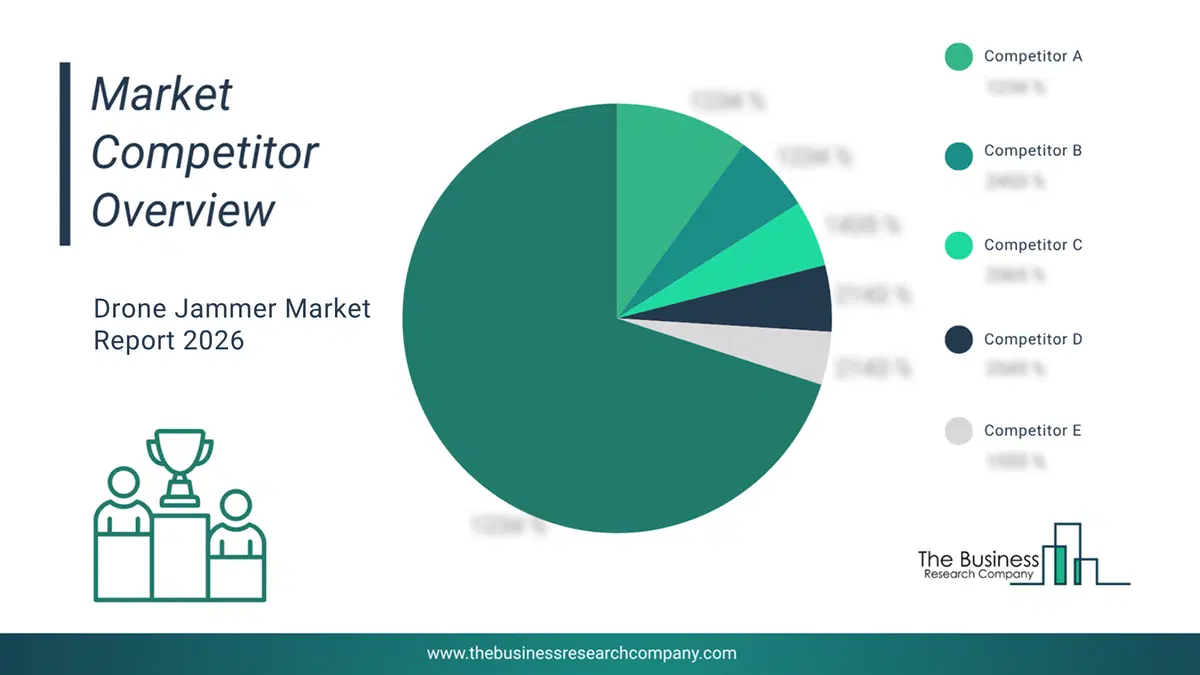
This chart is for illustrative purposes; the full report includes a detailed competitor analysis and comprehensive overview of the top 10 companies in the market.
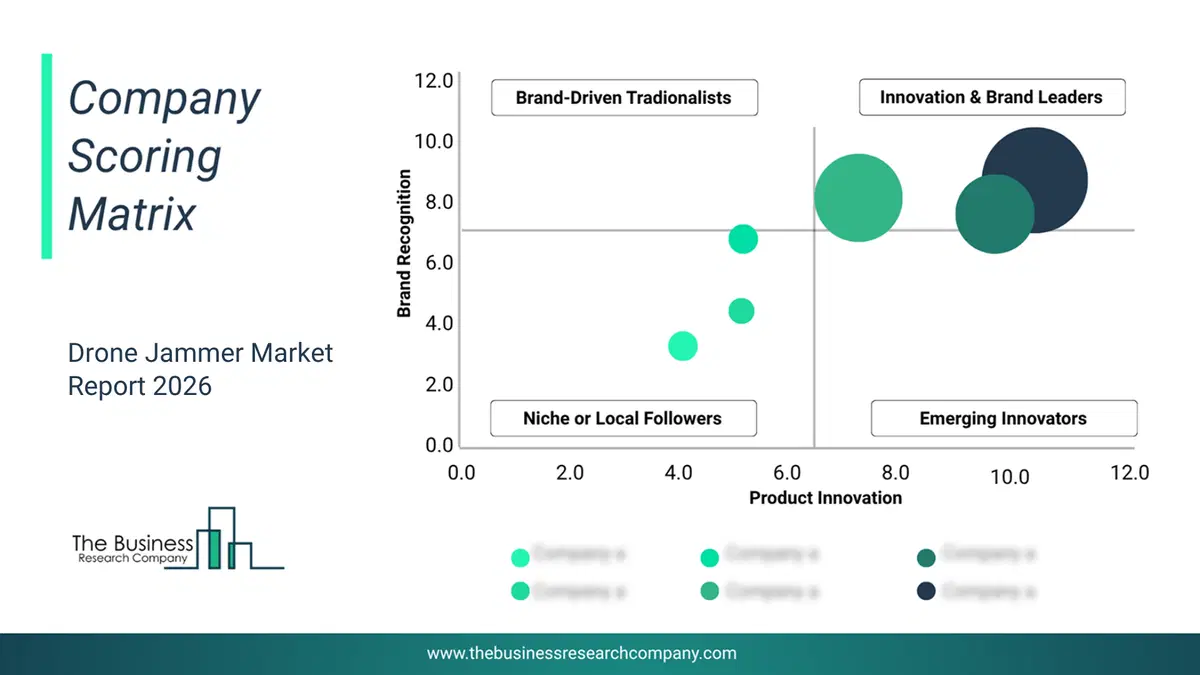
This chart maps companies by product innovation and brand strength, with bubble size indicating relative revenue, helping identify market leaders, challengers, and niche players. This is an illustrative chart; the full report provides a complete and accurate competitive analysis.
Global Drone Jammer Market Trends and Insights
Major companies in the drone jammer market are increasingly emphasizing advanced technology solutions, such as field-proven RF-cyber systems, to enhance the accuracy, reliability, and effectiveness of counter-drone operations. Field-proven RF-cyber systems in drone jammers combine traditional radio frequency (RF) disruption with advanced cyber techniques to neutralize unauthorized drones more effectively. For instance, in August 2025, D-Fend Solutions, an Israel-based security company, introduced EnforceAir PLUS, a compact, cyber-driven counter-drone platform. The system integrates RF-cyber detection and takeover capabilities, auto-calibrated radar, and a modular smart RF jamming option within a single solution. Built for rapid deployment and ease of use, EnforceAir PLUS leverages its AI-powered SmartAir fusion engine to deliver tailored responses, automated mitigation, and scalable defense across military, homeland security, and critical infrastructure environments. This reflects the industry’s move toward multi-layered, flexible systems that reduce operational complexity while strengthening protection against evolving drone threats.What Are Latest Mergers And Acquisitions In The Drone Jammer Market? Honeywell Acquires CAES To Enhance Defense Capabilities With RF And Drone Jamming Technologies
In June 2024, Honeywell International Inc., a US-based conglomerate corporation, acquired CAES Systems Holdings LLC for an undisclosed amount. With this acquisition, Honeywell’s aim is to strengthen and expand its defense and space technology solutions across land, sea, air, and space by adding high-reliability radio frequency and advanced electronic capabilities to its portfolio. CAES Systems Holdings LLC is a US-based aerospace and defense company that provides RF and electronic warfare jamming systems that support drone jammers.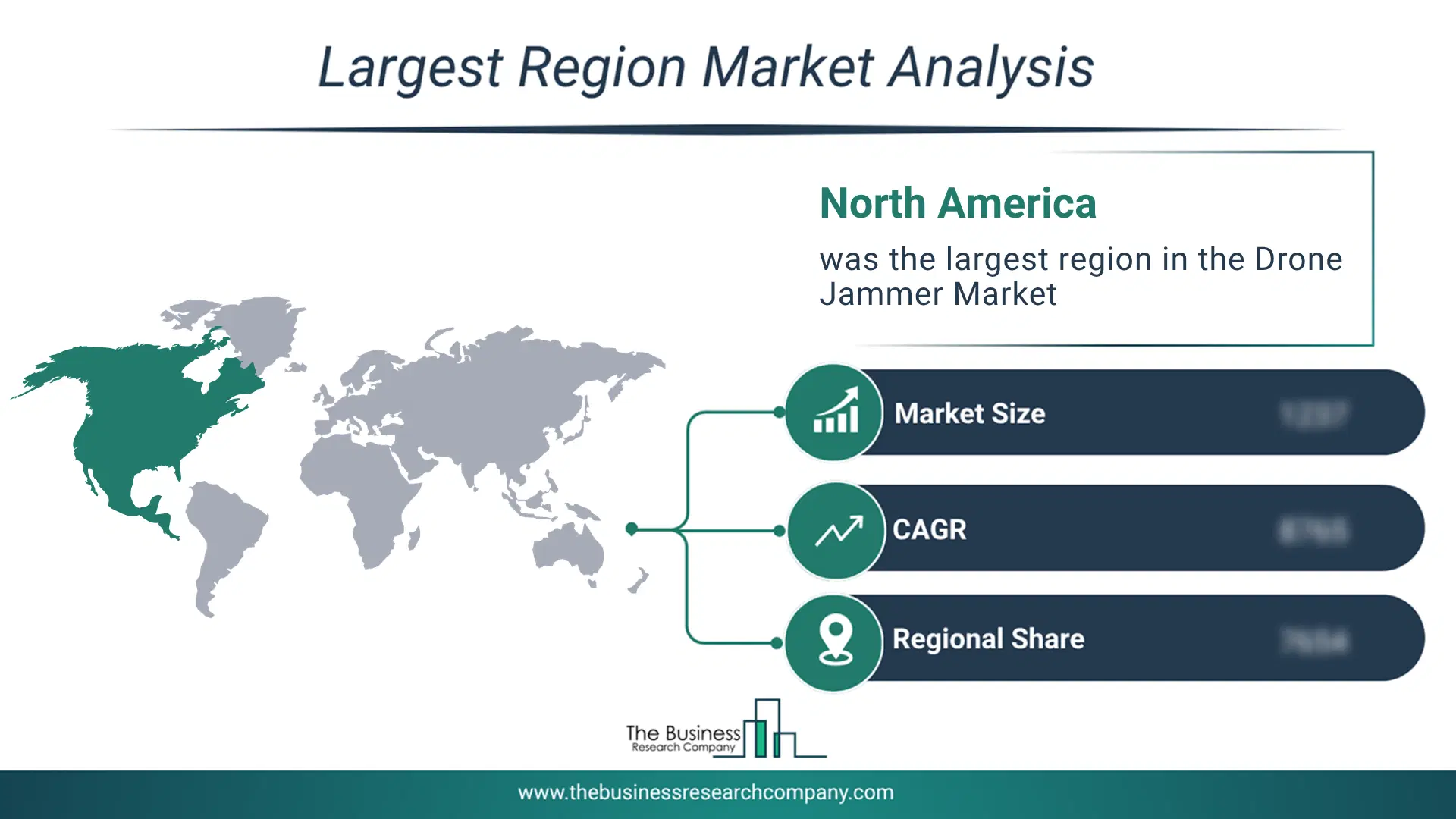
Regional Insights
North America was the largest region in the drone jammer market in 2025. Asia-Pacific is expected to be the fastest-growing region in the forecast period. The regions covered in this market report are Asia-Pacific, South East Asia, Western Europe, Eastern Europe, North America, South America, Middle East, Africa. The countries covered in this market report are Australia, Brazil, China, France, Germany, India, Indonesia, Japan, Taiwan, Russia, South Korea, UK, USA, Canada, Italy, SpainWhat Defines the Drone Jammer Market?
The drone jammer market consists of sales of vehicle-mounted drone jammers, directional jammers, static jammers, multi-band frequency jammers, and software-defined radio (SDR)-based jammers. Values in this market are ‘factory gate’ values, that is the value of goods sold by the manufacturers or creators of the goods, whether to other entities (including downstream manufacturers, wholesalers, distributors and retailers) or directly to end customers. The value of goods in this market includes related services sold by the creators of the goods.How is Market Value Defined and Measured?
The market value is defined as the revenues that enterprises gain from the sale of goods and/or services within the specified market and geography through sales, grants, or donations in terms of the currency (in USD unless otherwise specified). The revenues for a specified geography are consumption values that are revenues generated by organizations in the specified geography within the market, irrespective of where they are produced. It does not include revenues from resales along the supply chain, either further along the supply chain or as part of other products.
This chart presents market attractiveness based on a quantitative evaluation of growth, competition, strategic alignment, and risk, offering a clear view of opportunity areas for decision-making. This chart is for illustrative purposes; the full report contains the complete analysis.

This chart highlights the Total Addressable Market (TAM) by estimating the maximum revenue opportunity using an assumption-driven approach, supporting strategic planning and opportunity sizing across markets. The chart is illustrative; the full report provides a more comprehensive analysis.
What Key Data and Analysis Are Included in the Drone Jammer Market Report 2026?
The drone jammer market research report is one of a series of new reports from The Business Research Company that provides market statistics, including industry global market size, regional shares, competitors with the market share, detailed market segments, market trends and opportunities, and any further data you may need to thrive in the drone jammer industry. The market research report delivers a complete perspective of everything you need, with an in-depth analysis of the current and future state of the industry.Drone Jammer Market Report Forecast Analysis
| Report Attribute | Details |
|---|---|
| Market Size Value In 2026 | $1.48 billion |
| Revenue Forecast In 2030 | $2.01 billion |
| Growth Rate | CAGR of 8% from 2026 to 2030 |
| Base Year For Estimation | 2025 |
| Actual Estimates/Historical Data | 2020-2025 |
| Forecast Period | 2026 - 2030 |
| Market Representation | Revenue in USD Billion and CAGR from 2026 to 2030 |
| Segments Covered | Type, Technology, Application, End-User |
| Regional Scope | Asia-Pacific, Western Europe, Eastern Europe, North America, South America, Middle East, Africa |
| Country Scope | The countries covered in the drone jammer market report are Australia, Brazil, China, France, Germany, India, Indonesia, Japan, Taiwan, Russia, South Korea, UK, USA, Canada, Italy, Spain |
| Key Companies Profiled | Raytheon Technologies, Lockheed Martin Corporation, Northrop Grumman, Thales Group, Leonardo S.p.A, Rheinmetall AG, Israel Aerospace Industries, Saab AB, Shenzhen ZD TECH, ELTA Systems, Meteksan Savunma, DroneShield, Zen Technologies Ltd., Aaronia AG, NT Service UAB, Whitefox Defense Technologies, Stratign, SkyGuard (SkyCope Technologies), Keda Jammer, Hangzhou Ragine Electronic Technology, Greetwin Telecom, Battelle, Drone Defence Services Ltd. |
| Customization Scope | Request for Customization |
| Pricing And Purchase Options | Explore Purchase Options |