
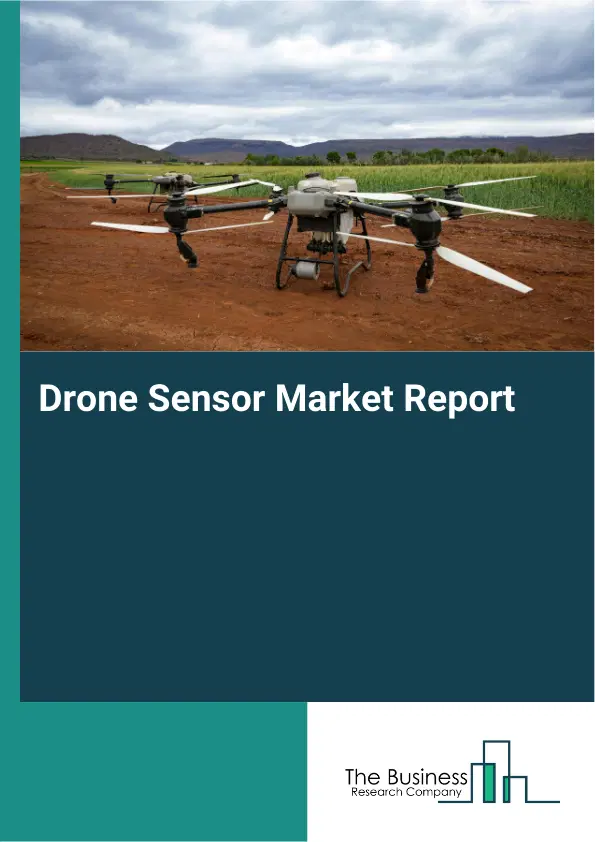
Drone Sensor Market Report 2026
Global Outlook – By Sensor Type ( Inertial Sensor, Image Sensor, Speed And Distance Sensor, Position Sensor, Pressure Sensor, Light Sensor, Ultrasonic Sensor, Current Sensor, Altimeter Sensor, Other Sensor Types), By Platform Type ( Vertical Take–Off And Landing (VTOL) Platform, Fixed-Wing Platforms, Hybrid Platform), By Application ( Collision Detection And Avoidance, Data Acquisition, Motion Detection, Air Pressure Measurement, Power Monitoring, Other Applications), By End User ( Construction, Media And Entertainment, Agriculture, Personal, Security And Surveillance, Defense, Law Enforcement, Transportation, Other End-Users) – Market Size, Trends, Strategies, and Forecast to 2030
Drone Sensor Market Overview
• Drone Sensor market size has reached to $1.32 billion in 2025 • Expected to grow to $3.2 billion in 2030 at a compound annual growth rate (CAGR) of 19% • Growth Driver: Rising Drone Adoption Fuels Growth In Drone Sensor Market • Market Trend: Advancements in Drone Technology With 4G/LTE-Enabled Next-Generation Drones With Enhanced Sensor Capabilities • North America was the largest region in 2025 and Asia-Pacific is the fastest growing region.What Is Covered Under Drone Sensor Market?
A drone sensor is a device equipped on drones to detect and measure various environmental parameters, such as temperature, humidity, light, and motion. The purpose of drone sensors is to enhance the functionality and effectiveness of drones by providing accurate and real-time information and supporting diverse industries and operations. The main sensor types of drone sensors are inertial sensors, image sensors, speed and distance sensors, position sensors, pressure sensors, light sensors, ultrasonic sensors, current sensors, altimeter sensors, and others. An inertial sensor refers to a device that measures and detects changes in velocity and orientation, typically used in navigation, motion tracking, and stabilization systems. The platform types encompass vertical take-off and landing (VTOL), fixed-wing, and hybrid platforms, used for various applications including collision detection and avoidance, data acquisition, motion detection, air pressure measurement, and power monitoring. End users span across construction, media and entertainment, agriculture, personal use, security and surveillance, defense, law enforcement, transportation, and others.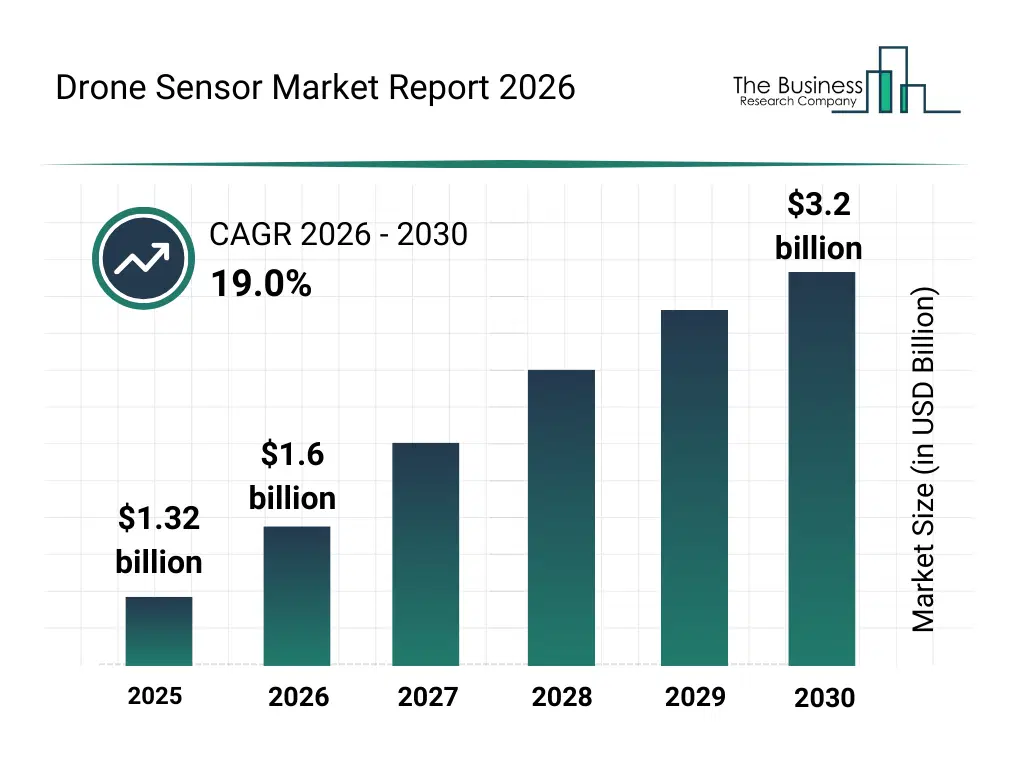
What Is The Drone Sensor Market Size 2026 And Growth Rate?
The drone sensor market size has grown exponentially in recent years. It will grow from $1.32 billion in 2025 to $1.6 billion in 2026 at a compound annual growth rate (CAGR) of 21.2%. The growth in the historic period can be attributed to advancements in drone platform technologies, early adoption in aerial photography, increasing use of drones in military surveillance, growth in remote sensing applications, declining costs of sensor components.What Is The Drone Sensor Market Growth Forecast?
The drone sensor market size is expected to see rapid growth in the next few years. It will grow to $3.2 billion in 2030 at a compound annual growth rate (CAGR) of 19.0%. The growth in the forecast period can be attributed to rising adoption of autonomous drones, expansion of commercial drone regulations, increasing use of drones in smart agriculture, growth in urban air mobility projects, advancements in AI based sensor data processing. Major trends in the forecast period include increasing integration of advanced sensor payloads in drones, growing adoption of multisensor fusion for enhanced drone accuracy, rising use of drone sensors for real time environmental monitoring, expansion of high precision imaging and lidar sensors in drones, growing demand for lightweight and energy efficient sensor systems.
Global Drone Sensor Market Segmentation
1) By Sensor Type: Inertial Sensor, Image Sensor, Speed And Distance Sensor, Position Sensor, Pressure Sensor, Light Sensor, Ultrasonic Sensor, Current Sensor, Altimeter Sensor, Other Sensor Types 2) By Platform Type: Vertical Take–Off And Landing (VTOL) Platform, Fixed-Wing Platforms, Hybrid Platform 3) By Application: Collision Detection And Avoidance, Data Acquisition, Motion Detection, Air Pressure Measurement, Power Monitoring, Other Applications 4) By End User: Construction, Media And Entertainment, Agriculture, Personal, Security And Surveillance, Defense, Law Enforcement, Transportation, Other End-Users Subsegments: 1) By Inertial Sensor: Gyroscopes, Accelerometers, Inertial Measurement Units (IMUs) 2) By Image Sensor: CMOS Image Sensors, CCD Image Sensors, Multispectral and Hyperspectral Sensors 3) By Speed and Distance Sensor: Radar-Based Speed Sensors, LIDAR-Based Distance Sensors, Optical Flow Sensors 4) By Position Sensor: GPS Modules, Magnetometers, GNSS Receivers 5) By Pressure Sensor: Barometric Pressure Sensors, Differential Pressure Sensors 6) By Light Sensor: Ambient Light Sensors, UV and Infrared Sensors 7) By Ultrasonic Sensor: Obstacle Detection Sensors, Proximity Sensors 8) By Current Sensor: Hall Effect Sensors, Shunt Resistors 9) By Altimeter Sensor: Laser Altimeters, Barometric Altimeters 10) By Other Sensor Types: Gas Sensors (for Environmental Monitoring), Temperature Sensors, Humidity SensorsWhat Is The Driver Of The Drone Sensor Market?
The high adoption of drones is expected to propel the growth of the drone sensor market going forward. Drones are unmanned aerial vehicles (UAVs) that can be remotely piloted or operated autonomously to perform a variety of tasks, such as surveillance, delivery, mapping, and data collection. The adoption of drones is driven by their efficiency, cost-effectiveness, and versatility across various applications. Drone sensors are pivotal in driving drone adoption, enabling precise data collection, navigation, and obstacle avoidance. These functionalities significantly boost the efficiency and safety of drones across diverse sectors such as agriculture and surveillance. For instance, in May 2024, according to Sphere Drones, an Australia-based drone solutions provider, industry projections indicate a substantial rise in drone flights, with an expected annual total of 60 million by 2043. Therefore, the high adoption of drones is driving the growth of the drone sensor industry.Key Players In The Global Drone Sensor Market
Major companies operating in the drone sensor market are Sony Corporation, Raytheon Technologies Corporation, TE Connectivity Corporation, Infineon Technologies AG, Teledyne Technologies Inc., ams AG, Trimble Inc., FLIR Systems Inc., Sensirion AG, Sparton Corp., InvenSense Inc., Bosch Sensortec GmbH, Velodyne Lidar Inc., Sentera Inc., PrecisionHawk Inc, Ainstein AI, LeddarTech Holdings Inc., SBG Systems, SlantRange Inc., Yost Labs Inc.
This chart is for illustrative purposes; the full report includes a detailed competitor analysis and comprehensive overview of the top 10 companies in the market.
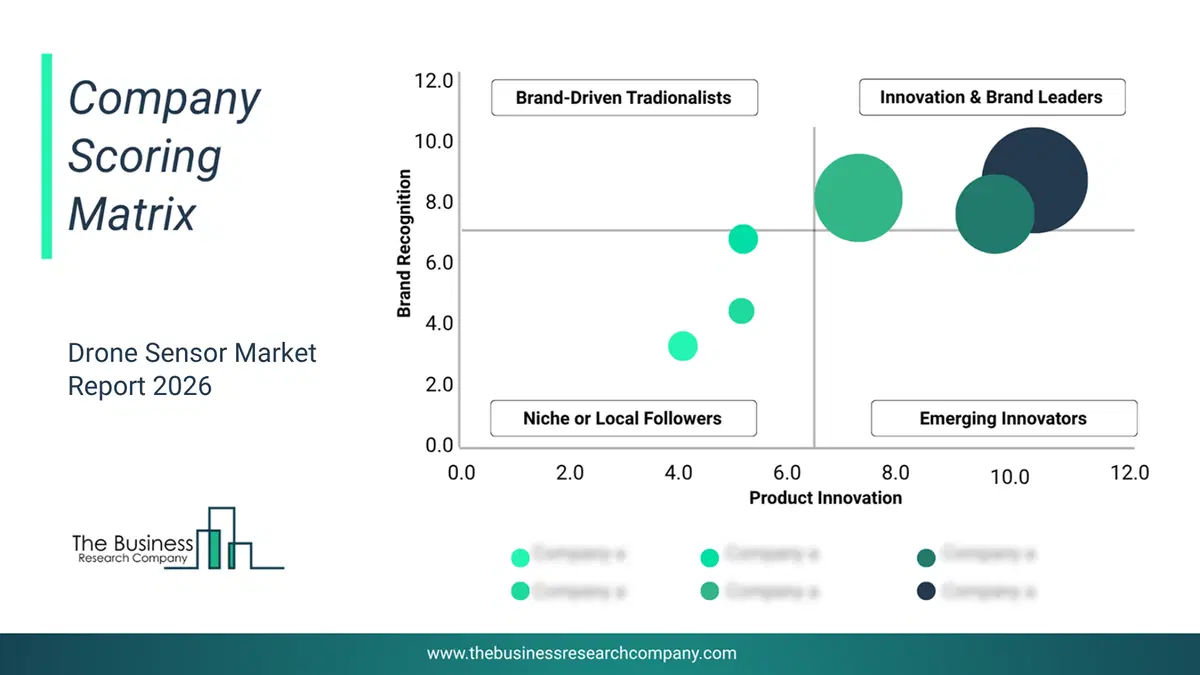
This chart maps companies by product innovation and brand strength, with bubble size indicating relative revenue, helping identify market leaders, challengers, and niche players. This is an illustrative chart; the full report provides a complete and accurate competitive analysis.
Global Drone Sensor Market Trends and Insights
Major companies operating in the drone sensor market are developing technologically advance next-generation drones such as drones having advance 4G/LTE cloud features. Next-generation drones with 4G/LTE cloud features can connect to cellular networks, enabling real-time data transmission and remote control via cloud-based platforms for improved range, reliability, and operational efficiency. For instance, in January 2023, Missiya, a Georgia-based unmanned aerial vehicles manufacturer launched the M-22Q1 Zakal drone. This drone is designed to operate effectively in various weather conditions. It can carry payloads of up to 6 kilograms and has a flight endurance of 45 to 60 minutes, with a range of up to 40 kilometers. This drone features multiple onboard sensors that provide 360-degree coverage for obstacle detection and avoidance along with 4G/LTE cloud features. The drone is portable and have professional cameras, advance technology for resolving co-ordinates.What Are Latest Mergers And Acquisitions In The Drone Sensor Market?
In June 2024, Patria Plc, a Finland-based defense, security and aviation life-cycle support service provider, acquired Nordic Drones Oy for an undisclosed amount. The acquisition aims to enhance Patria's drone sector capabilities, strengthen its defense and security portfolio and leverage Nordic Drones' expertise to bolster its market position and deliver advanced solutions. Nordic Drones Oy is a Finland-based drone manufacturing company and unmanned aerial systems company.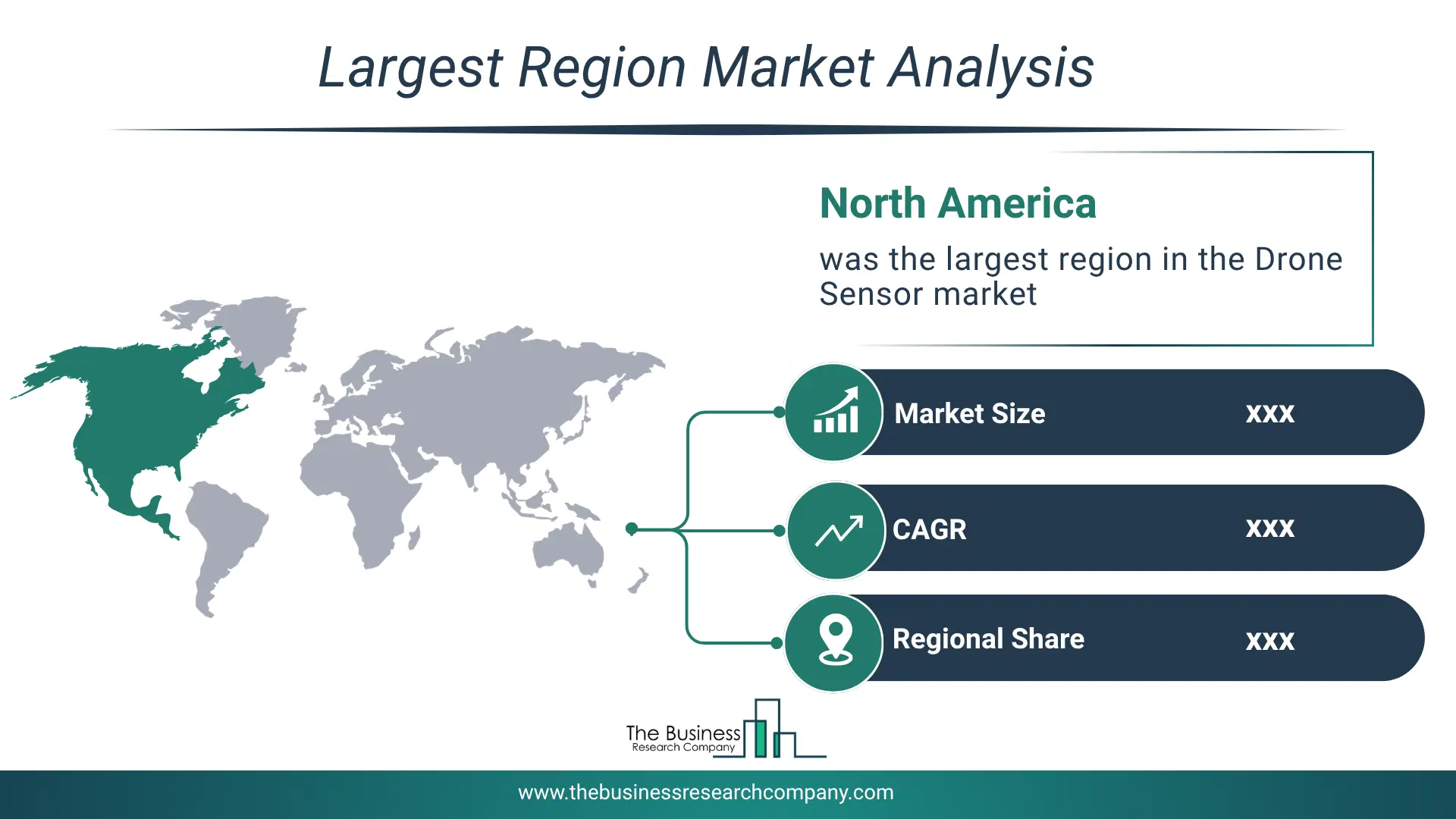
Regional Outlook
North America was the largest region in the drone sensor market in 2025. Asia-Pacific is expected to be the fastest-growing region in the forecast period. The regions covered in this market report are Asia-Pacific, South East Asia, Western Europe, Eastern Europe, North America, South America, Middle East, Africa. The countries covered in this market report are Australia, Brazil, China, France, Germany, India, Indonesia, Japan, Taiwan, Russia, South Korea, UK, USA, Canada, Italy, Spain.What Defines the Drone Sensor Market?
The drone sensor market consists of sales of proximity sensors, barometric pressure sensors, environmental sensors, hyperspectral sensors, and magnetometers. Values in this market are ‘factory gate’ values, that is the value of goods sold by the manufacturers or creators of the goods, whether to other entities (including downstream manufacturers, wholesalers, distributors and retailers) or directly to end customers. The value of goods in this market includes related services sold by the creators of the goods.How is Market Value Defined and Measured?
The market value is defined as the revenues that enterprises gain from the sale of goods and/or services within the specified market and geography through sales, grants, or donations in terms of the currency (in USD unless otherwise specified). The revenues for a specified geography are consumption values that are revenues generated by organizations in the specified geography within the market, irrespective of where they are produced. It does not include revenues from resales along the supply chain, either further along the supply chain or as part of other products.
This chart presents market attractiveness based on a quantitative evaluation of growth, competition, strategic alignment, and risk, offering a clear view of opportunity areas for decision-making. This chart is for illustrative purposes; the full report contains the complete analysis.

This chart highlights the Total Addressable Market (TAM) by estimating the maximum revenue opportunity using an assumption-driven approach, supporting strategic planning and opportunity sizing across markets. The chart is illustrative; the full report provides a more comprehensive analysis.
What Key Data and Analysis Are Included in the Drone Sensor Market Report 2026?
The drone sensor market research report is one of a series of new reports from The Business Research Company that provides market statistics, including industry global market size, regional shares, competitors with the market share, detailed market segments, market trends and opportunities, and any further data you may need to thrive in the drone sensor industry. The market research report delivers a complete perspective of everything you need, with an in-depth analysis of the current and future state of the industry.Drone Sensor Market Report Forecast Analysis
| Report Attribute | Details |
|---|---|
| Market Size Value In 2026 | $1.6 billion |
| Revenue Forecast In 2030 | $3.2 billion |
| Growth Rate | CAGR of 19% from 2026 to 2030 |
| Base Year For Estimation | 2025 |
| Actual Estimates/Historical Data | 2020-2025 |
| Forecast Period | 2026 - 2030 |
| Market Representation | Revenue in USD Billion and CAGR from 2026 to 2030 |
| Segments Covered | Sensor Type, Platform Type, Application, End User |
| Regional Scope | Asia-Pacific, Western Europe, Eastern Europe, North America, South America, Middle East, Africa |
| Country Scope | The countries covered in the report are Australia, Brazil, China, France, Germany, India, Indonesia, Japan, Taiwan, Russia, South Korea, UK, USA, Canada, Italy, Spain. |
| Key Companies Profiled | Sony Corporation, Raytheon Technologies Corporation, TE Connectivity Corporation, Infineon Technologies AG, Teledyne Technologies Inc., ams AG, Trimble Inc., FLIR Systems Inc., Sensirion AG, Sparton Corp., InvenSense Inc., Bosch Sensortec GmbH, Velodyne Lidar Inc., Sentera Inc., PrecisionHawk Inc, Ainstein AI, LeddarTech Holdings Inc., SBG Systems, SlantRange Inc., Yost Labs Inc. |
| Customization Scope | Request for Customization |
| Pricing And Purchase Options | Explore Purchase Options |