
Drone Simulator Market Report 2026
Global Outlook – By Component Type (Hardware, Software, Services), By Drone Type (Fixed Wing, Rotary Wing, Other Drone Types), By Deployment Type (On-Premises Deployment, Cloud Based Deployment, Hybrid Deployment), By Application Type (Military And Defense Training, Commercial Drone Pilot Training, Search And Rescue Operations, Agriculture And Precision Farming Training, Infrastructure Inspection Training, Surveillance And Security Operations, Mapping And Surveying Applications, Research And Development), By End User (Defense Organizations, Drone Manufacturers, Commercial Drone Operators, Training Institutes And Aviation Academies, Government Agencies, Educational Institutions, Research Organizations) – Market Size, Trends, Strategies, and Forecast to 2035
Drone Simulator Market Overview
• Drone Simulator market size has reached to $3.42 billion in 2025 • Expected to grow to $6.22 billion in 2030 at a compound annual growth rate (CAGR) of 12.6% • Growth Driver: Growing Adoption Of Drones (UAVs) Driving The Market Growth Due To Increasing Demand For Advanced Drone Training And Simulation Solutions • Market Trend: UAV Simulator Deployment Expands Advanced Drone Training Capabilities • North America was the largest region in 2025 and Asia-Pacific is the fastest growing region.What Is Covered Under Drone Simulator Market?
Drone simulators are systems designed to replicate the operation, navigation, and flight behavior of unmanned aerial vehicles (UAVs) in a virtual environment. They enable realistic pilot training, mission planning, flight testing, and system evaluation without the risks and costs associated with real-world drone operations. These simulators use physics-based modeling, environmental scenarios, and realistic control mechanisms to improve operator proficiency, optimize flight performance, and validate drone operations across various conditions. The main component types of drone simulators include hardware, software, and services. Hardware refers to physical equipment used to replicate drone flight controls, operating environments, and simulation interfaces for realistic training and operational practice. These simulators support fixed wing, rotary wing, and other drone types and are deployed through On-Premises, cloud based, and hybrid deployment models. The various applications involved are military and defense training, commercial drone pilot training, search and rescue operations, agriculture and precision farming training, infrastructure inspection training, surveillance and security operations, mapping and surveying applications, and research and development, and they are used by several end users such as defense organizations, drone manufacturers, commercial drone operators, training institutes and aviation academies, government agencies, educational institutions, and research organizations.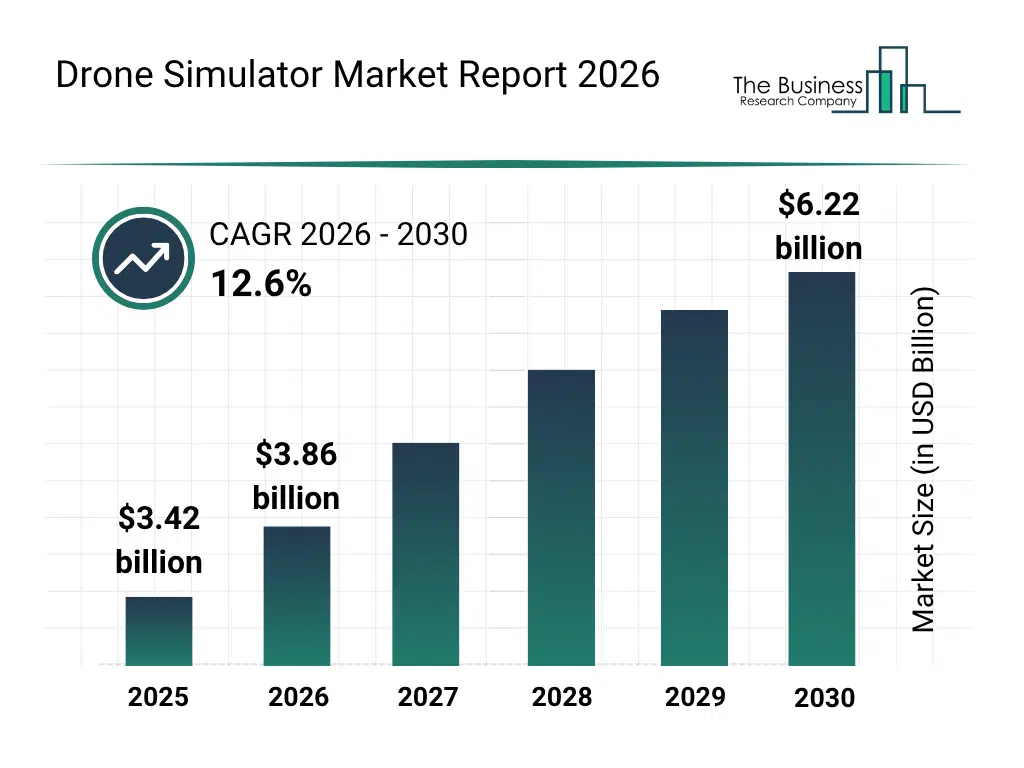
What Is The Drone Simulator Market Size and Share 2026?
The drone simulator market size has grown rapidly in recent years. It will grow from $3.42 billion in 2025 to $3.86 billion in 2026 at a compound annual growth rate (CAGR) of 13.1%. The growth in the historic period can be attributed to increasing demand for safe drone pilot training, rising adoption of UAV operations across commercial sectors, growing need to reduce risks associated with real-world flight training, expanding use of simulators for mission planning, increasing demand for standardized drone operator skill assessment.What Is The Drone Simulator Market Growth Forecast?
The drone simulator market size is expected to see rapid growth in the next few years. It will grow to $6.22 billion in 2030 at a compound annual growth rate (CAGR) of 12.6%. The growth in the forecast period can be attributed to increasing demand for complex drone mission training, rising need for multi-condition flight simulation, growing adoption of simulator-based drone testing by defense organizations, expanding demand for scalable drone training infrastructure, increasing requirement for advanced UAV performance evaluation. Major trends in the forecast period include increasing adoption of physics-based flight simulation, rising demand for realistic mission scenario replication, growing use of simulated environmental and weather conditions, expanding adoption of virtual drone flight testing, increasing demand for cost-effective UAV operator proficiency assessment.Tariff Impact On Drone Simulator Market
Tariffs are impacting the drone simulators market by increasing the cost of imported simulation control stations, flight control consoles, visual display systems, computing components, and other specialized hardware required for simulator deployment. This is slowing simulator procurement and increasing training infrastructure costs across military and defense, commercial drone pilot training, search and rescue, and infrastructure inspection applications, particularly in regions dependent on imported electronics such as Asia-Pacific and Latin America. Hardware-intensive segments such as simulation control stations, visual display systems, motion platforms, and virtual reality headsets are most affected due to global component supply chain dependencies. However, tariffs are also encouraging local manufacturing, regional supplier diversification, and greater investment in domestic UAV simulation ecosystems, creating opportunities for more resilient regional supply chains.
Global Drone Simulator Market Segmentation
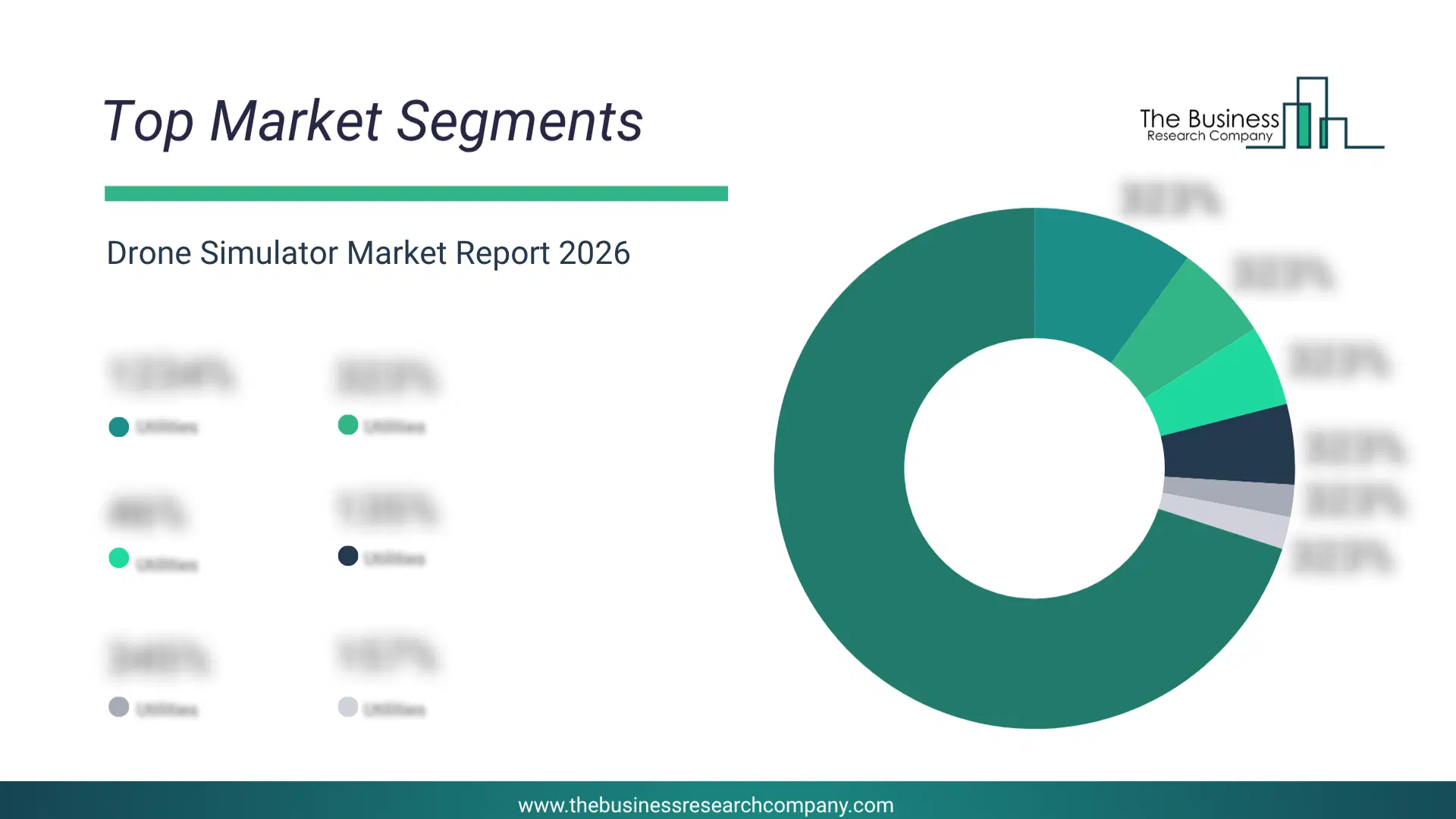
2) By Drone Type: Fixed Wing, Rotary Wing, Other Drone Types 3) By Deployment Type: On-Premises Deployment, Cloud Based Deployment, Hybrid Deployment 4) By Application Type: Military And Defense Training, Commercial Drone Pilot Training, Search And Rescue Operations, Agriculture And Precision Farming Training, Infrastructure Inspection Training, Surveillance And Security Operations, Mapping And Surveying Applications, Research And Development 5) By End User: Defense Organizations, Drone Manufacturers, Commercial Drone Operators, Training Institutes And Aviation Academies, Government Agencies, Educational Institutions, Research Organizations Subsegments: 1) By Hardware: Simulation Control Stations, Flight Control Consoles, Visual Display Systems, Motion Platforms, Virtual Reality Headsets 2) By Software: Flight Simulation Software, Mission Planning Software, Scenario Generation Software, Performance Analysis Software, Artificial Intelligence Based Simulation Software 3) By Services: Installation And Integration Services, Training Services, Maintenance And Support Services, Consulting Services, Simulation System Upgradation ServicesWhat Is The Driver Of The Drone Simulator Market?
The growing adoption of drones (UAVs) is expected to propel the growth of the drone simulator market going forward. Drones (UAVs) are unmanned aerial vehicles that are remotely controlled or autonomously operated using onboard systems and are increasingly used across industries such as defense, agriculture, logistics, surveillance, and aerial photography. The adoption of drones (UAVs) is rising due to their ability to reduce human risk by enabling safe execution of critical operations. Rising adoption of drones (UAVs) drives demand for drone simulators by increasing the need for realistic training environments that help operators develop piloting skills, test flight scenarios, improve safety, and reduce the risks associated with real-world drone operations. For instance, in September 2025, according to the International Food Policy Research Institute, a US-based international research center, in the United States, the number of agricultural drones registered with the Federal Aviation Administration (FAA) increased significantly from approximately 1,000 in January 2024 to nearly 5,500 in July 2025. Therefore, the growing adoption of drones (UAVs) is driving the growth of the drone simulator industry.Key Players In The Global Drone Simulator Market
Major companies operating in the drone simulator market are The Boeing Company, Lockheed Martin Corporation, Microsoft Corporation, NVIDIA Corporation, Siemens Aktiengesellschaft, L3Harris Technologies Inc., Dassault Systèmes SE, CAE Inc., SZ DJI Technology Co. Ltd., The MathWorks Inc., Parrot SA, Auterion AG, Horizon Hobby LLC, Little Arms Studios LLC, Orqa d.o.o., UAVPROF Software, Robotec.ai Sp. z o.o., IPACS GbR, Tecknotrove Systems, SRIZFLY Technology Co. Ltd., Ailwing Drones Private Limited, Louis SIMON, Tryp FPV Pty Ltd., VelociDrone Ltd.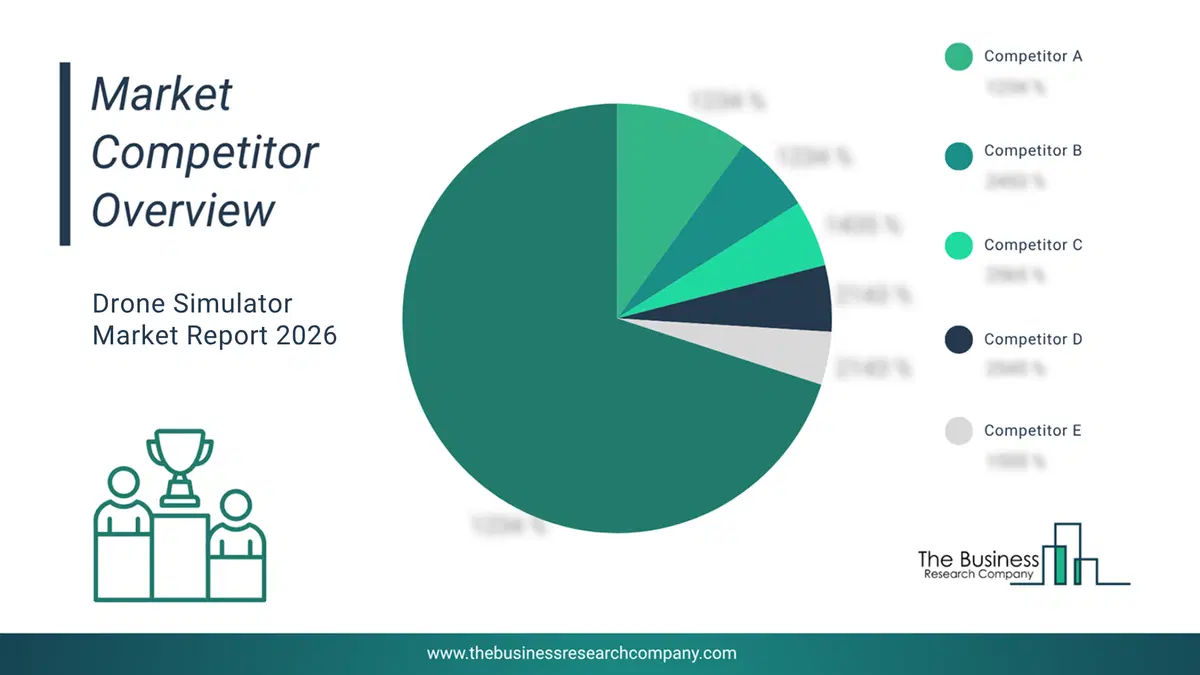
This chart is for illustrative purposes; the full report includes a detailed competitor analysis and comprehensive overview of the top 10 companies in the market.
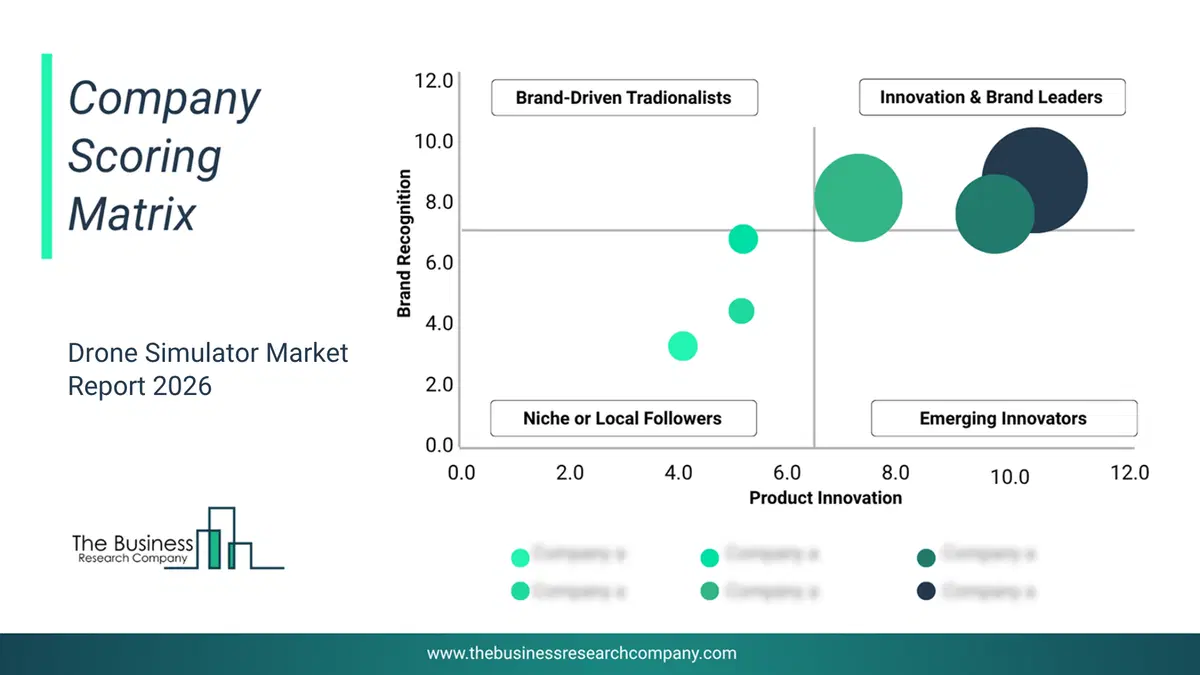
This chart maps companies by product innovation and brand strength, with bubble size indicating relative revenue, helping identify market leaders, challengers, and niche players. This is an illustrative chart; the full report provides a complete and accurate competitive analysis.
Global Drone Simulator Market Trends and Insights
Major companies operating in the drone simulator market are focusing on deploying advanced UAV simulation systems to enhance operator training, improve mission preparedness, and provide realistic training environments without relying solely on live drone operations. These systems replicate UAV flight characteristics, operating environments, and mission scenarios, enabling operators to develop and evaluate piloting skills in a controlled and repeatable environment. For instance, in June 2025, Quantum3D, a US-based simulation and training technology company, delivered a UAV drone simulator to the Kingdom of Saudi Arabia to support defense and aviation training requirements. The simulator provides a high-fidelity virtual training environment for UAV operators and supports realistic flight and mission training while reducing the need for live-flight exercises. The deployment also strengthens Quantum3D’s presence in the Middle East and demonstrates the growing use of specialized drone simulation systems for UAV operator training.What Are Latest Mergers And Acquisitions In The Drone Simulator Market?
In July 2025, PDRL Technologies Private Limited, an India-based drone technology and software company, partnered with Stratus LLC to provide advanced drone technologies and solutions in India and Russia. Through this partnership, PDRL Technologies Private Limited and Stratus LLC aim to develop and deploy advanced unmanned aerial system (UAS) technologies, strengthen drone capabilities for commercial and industrial applications, facilitate technology exchange, and expand the adoption of innovative drone solutions across both countries. Stratus LLC is a Russia-based drone technology company that specializes in providing UAVProf drone simulator.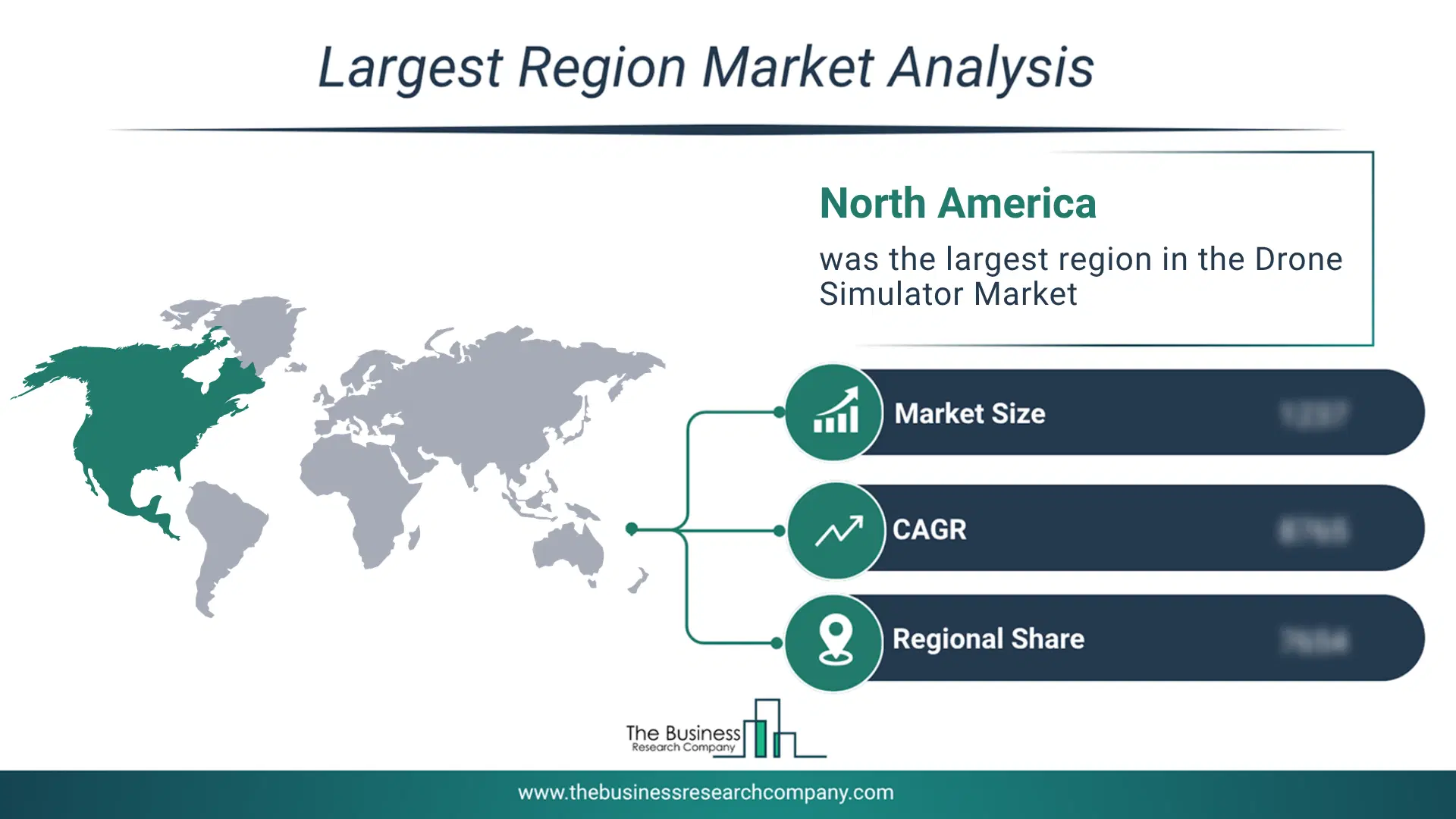
Regional Outlook/Insights
North America was the largest region in the drone simulator market in 2025. Asia-Pacific is expected to be the fastest-growing region in the forecast period. The regions covered in this market report are Asia-Pacific, South East Asia, Western Europe, Eastern Europe, North America, South America, Middle East, Africa. The countries covered in this market report are Australia, Brazil, China, France, Germany, India, Indonesia, Japan, Taiwan, Russia, South Korea, UK, USA, Canada, Italy, Spain.What Defines the Drone Simulator Market?
The drone simulator market consists of revenues earned by entities by providing simulation licensing, pilot training, scenario development, system integration, technical support, maintenance, and simulation-based testing and validation. The market value includes the value of related goods sold by the service provider or included within the service offering. The drone simulator market also includes sales of virtual drone training systems, drone simulation environments, VR drone simulators, and drone simulator control hardware. Values in this market are ‘factory gate’ values, that is, the value of goods sold by the manufacturers or creators of the goods, whether to other entities (including downstream manufacturers, wholesalers, distributors, and retailers) or directly to end customers. The value of goods in this market includes related services sold by the creators of the goods.How is Market Value Defined and Measured?
The market value is defined as the revenues that enterprises gain from the sale of goods and/or services within the specified market and geography through sales, grants, or donations in terms of the currency (in USD unless otherwise specified). The revenues for a specified geography are consumption values that are revenues generated by organizations in the specified geography within the market, irrespective of where they are produced. It does not include revenues from resales along the supply chain, either further along the supply chain or as part of other products.
This chart presents market attractiveness based on a quantitative evaluation of growth, competition, strategic alignment, and risk, offering a clear view of opportunity areas for decision-making. This chart is for illustrative purposes; the full report contains the complete analysis.

This chart highlights the Total Addressable Market (TAM) by estimating the maximum revenue opportunity using an assumption-driven approach, supporting strategic planning and opportunity sizing across markets. The chart is illustrative; the full report provides a more comprehensive analysis.
What Key Data and Analysis Are Included in the Drone Simulator Market Report 2026?
The drone simulator market research report is one of a series of new reports from The Business Research Company that provides market statistics, including industry global market size, regional shares, competitors with the market share, detailed market segments, market trends and opportunities, and any further data you may need to thrive in the drone simulator industry. The market research report delivers a complete perspective of everything you need, with an in-depth analysis of the current and future state of the industry.Drone Simulator Market Report Forecast Analysis
| Report Attribute | Details |
|---|---|
| Market Size Value In 2026 | $3.86 billion |
| Revenue Forecast In 2030 | $6.22 billion |
| Growth Rate | CAGR of 12.6% from 2026 to 2035 |
| Base Year For Estimation | 2025 |
| Actual Estimates/Historical Data | 2020-2025 |
| Forecast Period | 2026 - 2030 |
| Market Representation | Revenue in USD Billion and CAGR from 2026 to 2030 |
| Segments Covered | Component Type, Drone Type, Deployment Type, Application Type, End User |
| Regional Scope | Asia-Pacific, Western Europe, Eastern Europe, North America, South America, Middle East, Africa |
| Country Scope | The countries covered in the report are Australia, Brazil, China, France, Germany, India, Indonesia, Japan, Taiwan, Russia, South Korea, UK, USA, Canada, Italy, Spain. |
| Customization Scope | Request for Customization |
| Pricing And Purchase Options | Explore Purchase Options |