

Dry Etching Equipment Market Report 2026
Global Outlook – By Type (Inductively Coupled Plasma Etching, Capacitive Coupled Plasma Etching, Reactive Ion Etching, Deep Reactive Ion Etching, Others Types), By Component (Etch Chambers, Gas Control Systems, Power Supplies, Cooling Systems, Software And Control Systems), By Equipment Type (Batch Etchers, Single Wafer Etchers, High Volume Production Etchers, Modular Etching Systems, Etch Tools With Advanced Automation), By Application (Semiconductor Manufacturing, Micro-Electro-Mechanical Systems, Light Emitting Diode Production, Other Applications), By End-User (Electronics, Automotive, Aerospace, Healthcare, Other End-Users) – Market Size, Trends, Strategies, and Forecast to 2030
Dry Etching Equipment Market Overview
• Dry Etching Equipment market size has reached to $11.94 billion in 2025 • Expected to grow to $17.49 billion in 2030 at a compound annual growth rate (CAGR) of 7.9% • Growth Driver: The Increasing Demand For Semiconductor Devices Driving The Growth Of The Market Due To Expanding Consumer Electronics Industry • Market Trend: Innovative Plasma Etching-Based Equipment Enables Atomic-Level Precision For Advanced 3D Semiconductor Devices • Asia-Pacific was the largest region and fastest growing region.What Is Covered Under Dry Etching Equipment Market?
Dry etching equipment is a semiconductor manufacturing tool that precisely removes material from a substrate using plasma or reactive gases rather than liquid chemicals. It creates fine patterns and intricate structures on microchips with high accuracy while minimizing damage to surrounding areas. This equipment supports advanced device fabrication, including integrated circuits, through controlled, anisotropic etching. The main types of dry etching equipment are inductively coupled plasma etching, capacitively coupled plasma etching, reactive ion etching, deep reactive ion etching, and others. Inductively coupled plasma (ICP) etching refers to a high-density plasma etching technique that uses inductive coils to generate plasma, enabling precise, anisotropic, and high-aspect-ratio etching of semiconductor materials. Its key components include etch chambers, gas control systems, power supplies, cooling systems, and software and control systems, and the equipment comes in various forms, such as batch etchers, single-wafer etchers, high-volume production etchers, modular etching systems, and etch tools with advanced automation. These systems are widely used in various applications such as semiconductor manufacturing, micro-electro-mechanical systems, light-emitting diode production, and others and used by several end users, including the electronics, automotive, aerospace, healthcare, and others.
What Is The Dry Etching Equipment Market Size and Share 2026?
The dry etching equipment market size has grown strongly in recent years. It will grow from $11.94 billion in 2025 to $12.92 billion in 2026 at a compound annual growth rate (CAGR) of 8.2%. The growth in the historic period can be attributed to scaling of semiconductor nodes, growth of integrated circuit manufacturing, demand for precision patterning, expansion of foundry capacity, advancement in plasma etching technologies.What Is The Dry Etching Equipment Market Growth Forecast?
The dry etching equipment market size is expected to see strong growth in the next few years. It will grow to $17.49 billion in 2030 at a compound annual growth rate (CAGR) of 7.9%. The growth in the forecast period can be attributed to growth of advanced logic and memory chips, expansion of EV semiconductor demand, adoption of 3 nm and below nodes, rising investment in chip manufacturing plants, demand for low damage etching processes. Major trends in the forecast period include adoption of atomic layer etching, rising demand for high aspect ratio etching, integration of advanced process control software, expansion of single wafer etching systems, increased focus on yield optimization.Tariff Impact On Dry Etching Equipment Market
Tariffs have impacted the dry etching equipment market by increasing costs of imported plasma components, gas delivery systems, and control electronics. Semiconductor manufacturing equipment is most affected, particularly in asia pacific fabrication hubs. Higher capital expenditure has influenced fab expansion timelines. However, tariffs are encouraging localized tool manufacturing and supply chain resilience.
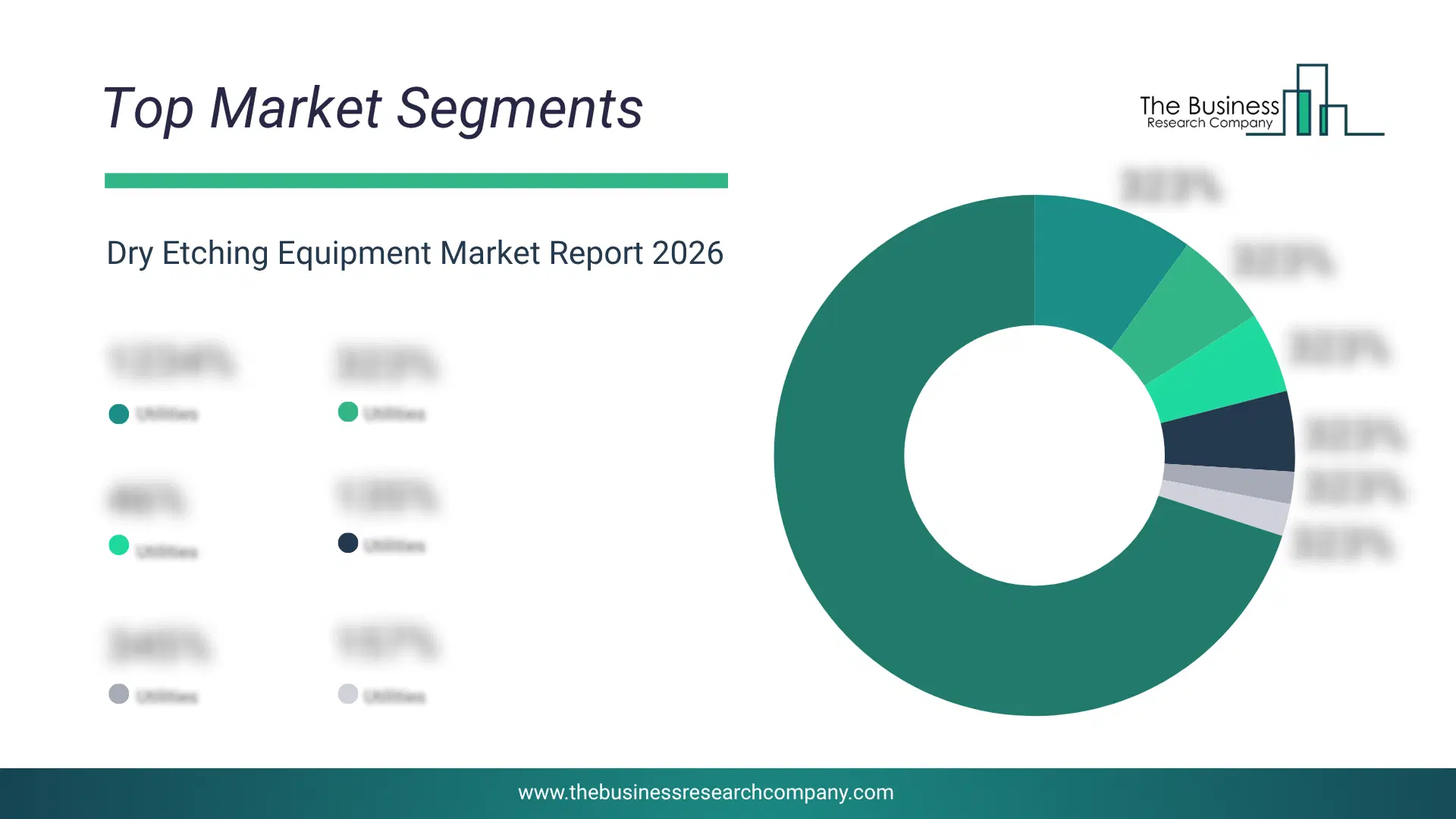
Global Dry Etching Equipment Market Segmentation
1) By Type: Inductively Coupled Plasma Etching, Capacitive Coupled Plasma Etching, Reactive Ion Etching, Deep Reactive Ion Etching, Others Types 2) By Component: Etch Chambers, Gas Control Systems, Power Supplies, Cooling Systems, Software And Control Systems 3) By Equipment Type: Batch Etchers, Single Wafer Etchers, High Volume Production Etchers, Modular Etching Systems, Etch Tools With Advanced Automation 4) By Application: Semiconductor Manufacturing, Micro-Electro-Mechanical Systems, Light Emitting Diode Production, Other Applications 5) By End-User: Electronics, Automotive, Aerospace, Healthcare, Other End-Users Subsegments: 1) By Inductively Coupled Plasma Etching: High Density Plasma Systems, Low Pressure Plasma Systems, Advanced Wafer Etching Systems 2) By Capacitive Coupled Plasma Etching: Parallel Plate Plasma Etching Systems, Medium Frequency Plasma Systems, Single Wafer Processing Systems 3) By Reactive Ion Etching: Parallel Plate Reactive Ion Etching Systems, High Selectivity Etching Systems, Low Damage Etching Systems 4) By Deep Reactive Ion Etching: Bosch Process Etching Systems, Cryogenic Process Etching Systems, High Aspect Ratio Etching Systems 5) By Others Types: Microwave Plasma Etching Systems, Neutral Beam Etching Systems, Atomic Layer Etching SystemsWhat Is The Driver Of The Dry Etching Equipment Market?
The increasing demand for semiconductor devices is expected to propel the growth of the dry etching equipment market going forward. A semiconductor device is an electronic component that regulates the flow of electrical current by leveraging the distinctive characteristics of semiconductor materials. The increasing demand for semiconductor devices is due to the rapid growth of consumer electronics, as products such as smartphones, laptops, and smart home devices rely heavily on advanced chips for performance and functionality. Dry etching equipment helps semiconductor devices by precisely shaping and patterning microscopic circuits on silicon wafers, enabling higher performance, miniaturization, and efficiency in electronic components. For instance, in April 2024, according to a report published by SEMI, a China-based semiconductor industry association, worldwide sales of semiconductor manufacturing equipment, which includes front end tools such as dry etch systems, reached US$ 106.3 billion in 2023. Therefore, increasing demand for semiconductor devices is driving the growth of the dry etching equipment industry.Key Players In The Global Dry Etching Equipment Market
Major companies operating in the dry etching equipment market are Panasonic Corporation, Applied Materials Inc., Lam Research Corporation, Tokyo Electron Limited, KLA Corporation, Hitachi High-Technologies Corporation, NAURA Technology Group Co. Ltd., DISCO Corporation, Advanced Energy Industries Inc., ULVAC Inc., Advanced Micro-Fabrication Equipment Inc., Oxford Instruments plc, Shibaura Mechatronics Corporation, GigaLane Co. Ltd., Plasma-Therm LLC, Samco Inc., SENTECH Instruments GmbH, Plasma Etch Inc., Nano-Master Inc., PVA TePla AG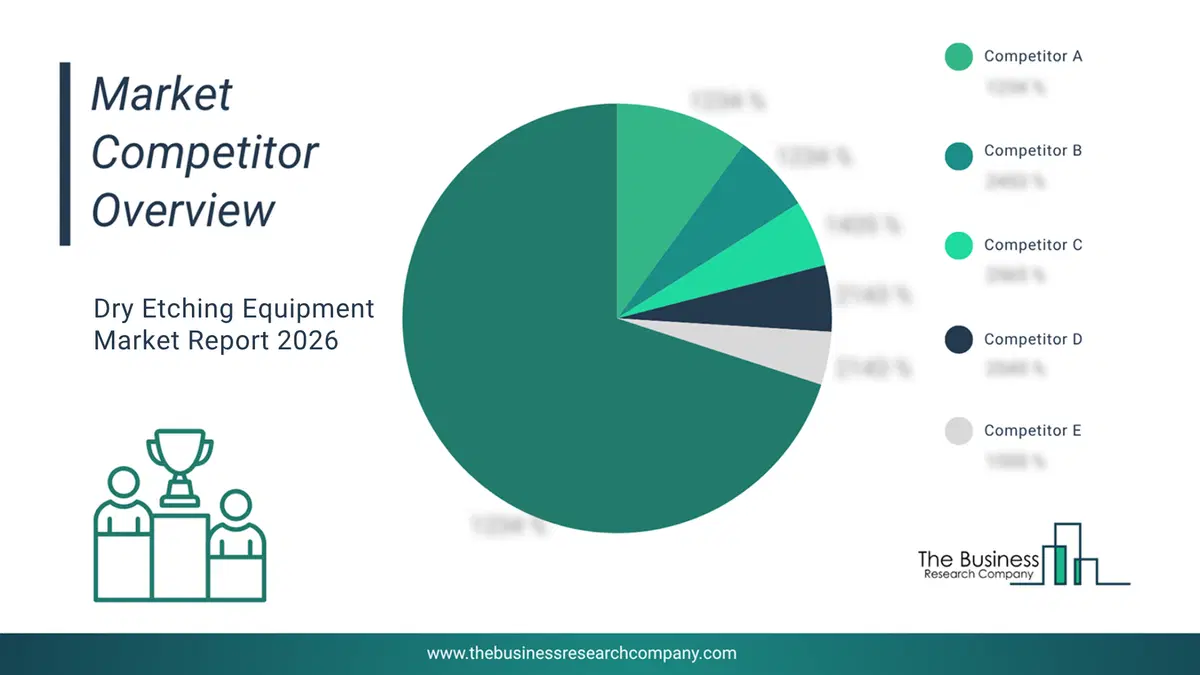
This chart is for illustrative purposes; the full report includes a detailed competitor analysis and comprehensive overview of the top 10 companies in the market.
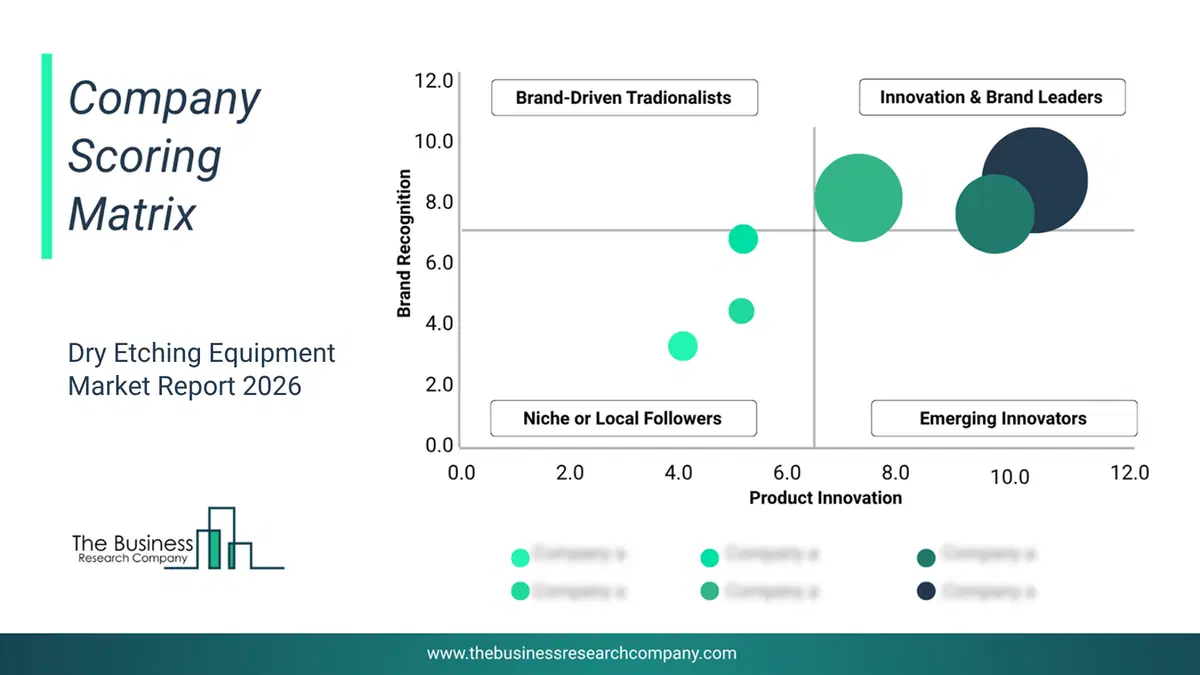
This chart maps companies by product innovation and brand strength, with bubble size indicating relative revenue, helping identify market leaders, challengers, and niche players. This is an illustrative chart; the full report provides a complete and accurate competitive analysis.
Global Dry Etching Equipment Market Trends and Insights
Major companies operating in the dry etching equipment market are focusing on developing advanced solutions, such as plasma etching-based equipment, to enhance precision, scalability, and efficiency in semiconductor manufacturing. Plasma etching-based equipment is a semiconductor manufacturing tool that uses ionized gases to remove material from a substrate and enables precise, controlled etching of micro-scale patterns and structures. For instance, in November 2024, Hitachi High-Technologies Corporation, a Japan-based technology company, launched the DCR Etch System 9060 Series, designed for precise isotropic (horizontal) etching at the atomic layer level. This system utilizes plasma etching technology and supports the fabrication of advanced three-dimensional semiconductor devices, including 3D-NAND and 3D-DRAM structures. It delivers high-throughput processing and a compact equipment footprint through a unique wafer-cooling mechanism combined with an infrared lamp that rapidly alternates wafer temperatures. This enables atomic-level control over wafer pattern shapes, which is crucial for manufacturing complex 3D semiconductor architectures. Additionally, the system is suitable for both R&D and mass production, helping to shorten development cycles, lower costs, and enhance productivity in semiconductor manufacturing.What Are Latest Mergers And Acquisitions In The Dry Etching Equipment Market?
In November 2023, Plasma-Therm LLC, a US-based provider of plasma processing equipment and technologies, acquired Thin Film Equipment SRL for an undisclosed amount. With this acquisition, Plasma-Therm LLC aims to expand its footprint in Europe as part of its long-term strategic growth initiative and significantly broaden its portfolio in the power device market by integrating TFE’s suite of physical vapor deposition (PVD) tools tailored for MEMS, power, RFID, and other semiconductor applications. Thin Film Equipment SRL is an Italy-based company that offers semiconductor or MEMS equipment for dry-etch technologies.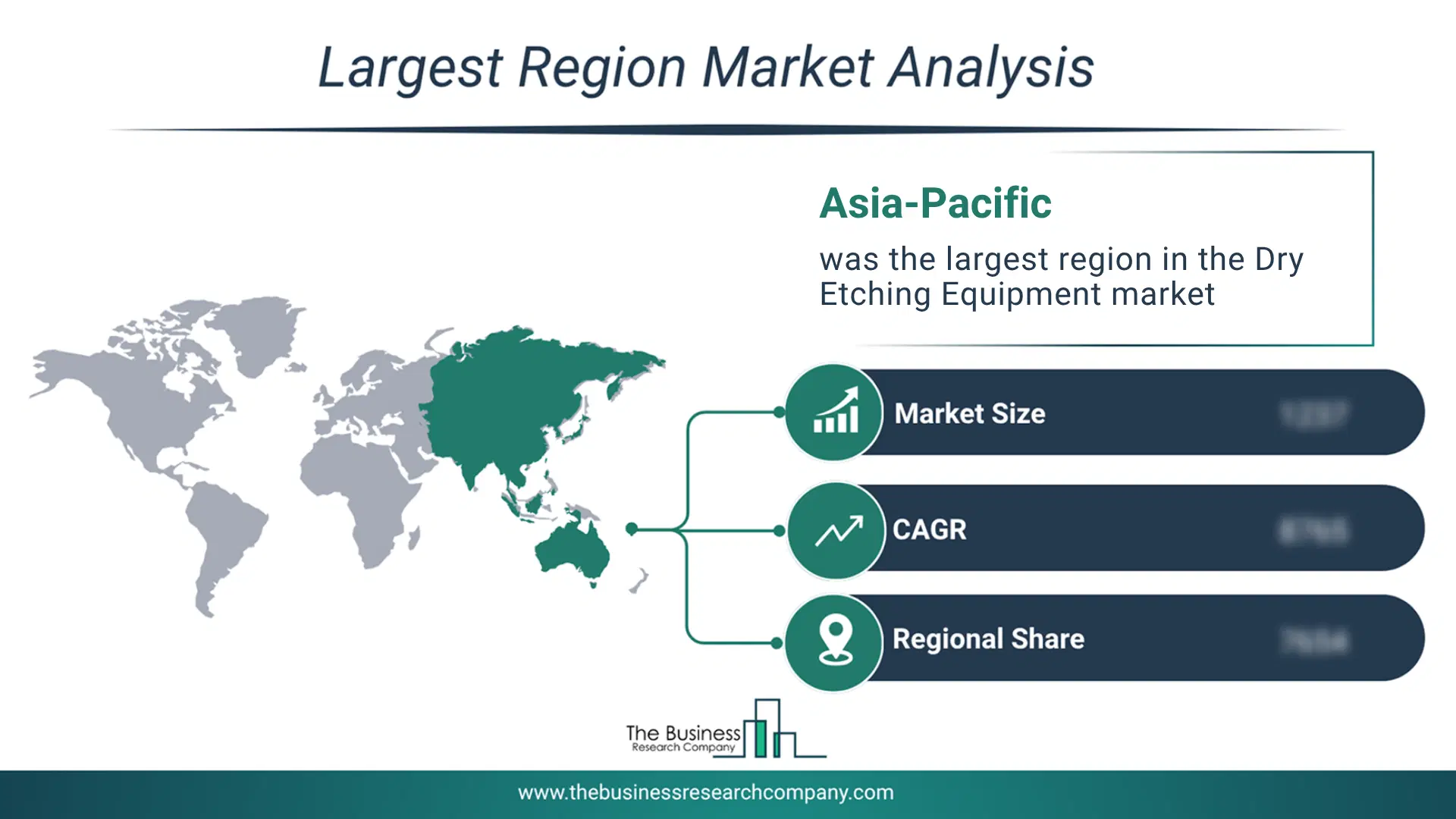
Regional Outlook
Asia-Pacific was the largest region in the dry etching equipment market in 2025. Asia-Pacific is expected to be the fastest-growing region in the forecast period. The regions covered in this market report are Asia-Pacific, South East Asia, Western Europe, Eastern Europe, North America, South America, Middle East, Africa The countries covered in this market report are Australia, Brazil, China, France, Germany, India, Indonesia, Japan, Taiwan, Russia, South Korea, UK, USA, Canada, Italy, Spain.What Defines the Dry Etching Equipment Market?
The dry etching equipment market consists of revenues earned by entities by providing services such as installation and commissioning services, maintenance and repair services, process development and optimization services, training and technical support services, and upgrade and retrofit services. The market value includes the value of related goods sold by the service provider or included within the service offering. The dry etching equipment market also includes sales of metal etching systems, dielectric etching systems, and hybrid etching systems. Values in this market are ‘factory gate’ values; that is, the value of goods sold by the manufacturers or creators of the goods, whether to other entities (including downstream manufacturers, wholesalers, distributors, and retailers) or directly to end customers. The value of goods in this market includes related services sold by the creators of the goodsHow is Market Value Defined and Measured?
The market value is defined as the revenues that enterprises gain from the sale of goods and/or services within the specified market and geography through sales, grants, or donations in terms of the currency (in USD unless otherwise specified). The revenues for a specified geography are consumption values that are revenues generated by organizations in the specified geography within the market, irrespective of where they are produced. It does not include revenues from resales along the supply chain, either further along the supply chain or as part of other products.
This chart presents market attractiveness based on a quantitative evaluation of growth, competition, strategic alignment, and risk, offering a clear view of opportunity areas for decision-making. This chart is for illustrative purposes; the full report contains the complete analysis.

This chart highlights the Total Addressable Market (TAM) by estimating the maximum revenue opportunity using an assumption-driven approach, supporting strategic planning and opportunity sizing across markets. The chart is illustrative; the full report provides a more comprehensive analysis.
What Key Data and Analysis Are Included in the Dry Etching Equipment Market Report 2026?
The dry etching equipment market research report is one of a series of new reports from The Business Research Company that provides market statistics, including industry global market size, regional shares, competitors with the market share, detailed market segments, market trends and opportunities, and any further data you may need to thrive in the dry etching equipment industry. The market research report delivers a complete perspective of everything you need, with an in-depth analysis of the current and future state of the industry.Dry Etching Equipment Market Report Forecast Analysis
| Report Attribute | Details |
|---|---|
| Market Size Value In 2026 | $12.92 billion |
| Revenue Forecast In 2030 | $17.49 billion |
| Growth Rate | CAGR of 7.9% from 2026 to 2030 |
| Base Year For Estimation | 2025 |
| Actual Estimates/Historical Data | 2020-2025 |
| Forecast Period | 2026 - 2030 |
| Market Representation | Revenue in USD Billion and CAGR from 2026 to 2030 |
| Segments Covered | Type, Component, Equipment Type, Application, End-User |
| Regional Scope | Asia-Pacific, Western Europe, Eastern Europe, North America, South America, Middle East, Africa |
| Key Companies Profiled | Panasonic Corporation, Applied Materials Inc., Lam Research Corporation, Tokyo Electron Limited, KLA Corporation, Hitachi High-Technologies Corporation, NAURA Technology Group Co. Ltd., DISCO Corporation, Advanced Energy Industries Inc., ULVAC Inc., Advanced Micro-Fabrication Equipment Inc., Oxford Instruments plc, Shibaura Mechatronics Corporation, GigaLane Co. Ltd., Plasma-Therm LLC, Samco Inc., SENTECH Instruments GmbH, Plasma Etch Inc., Nano-Master Inc., PVA TePla AG |
| Customization Scope | Request for Customization |
| Pricing And Purchase Options | Explore Purchase Options |