
Dual-Ion Batteries Market Report 2026
Global Outlook – By Type ( Metal-Metal, Zinc-Ion, Metal-Organic, Sodium-Ion, Other Types), By Application ( Portable Electronics, Medical Devices, Electric Vehicles, Renewable Energy Storage, Other Applications), By End-Use ( Electronics And Electricals, Automotive, Energy And Utilities, Infrastructure, Other End-Uses) – Market Size, Trends, Strategies, and Forecast to 2030
Dual-Ion Batteries Market Overview
• Dual-Ion Batteries market size has reached to $0.42 billion in 2025 • Expected to grow to $0.9 billion in 2030 at a compound annual growth rate (CAGR) of 16.3% • Growth Driver: Increasing EV Demand Driving The Growth Of The Market Due To Advancements In Battery Technology And Growing Environmental Concerns • Market Trend: Advancements In Dual-Ion And Dual-Mode Lithium Battery Technologies • North America was the largest region in 2025 and Asia-Pacific is the fastest growing region.What Is Covered Under Dual-Ion Batteries Market?
Dual-ion batteries refer to a type of rechargeable battery that uses two different types of ions to store and release energy, typically in the form of lithium (Li+) and anions (such as fluoride or chloride). Dual-ion batteries utilize a unique mechanism where both positive and negative ions from the electrolyte contribute to energy storage and discharge, offering higher energy density and improved cycling stability compared to traditional lithium-ion batteries. The main types of dual-ion batteries are metal-metal, zinc-ion, metal-organic, sodium-ion and other types. Metal-metal typically refers to interactions, compounds, or systems involving two or more metal elements. Various applications include portable electronics, medical devices, electric vehicles, renewable energy storage, and others and are used by various end users such as electronics and electricals, automotive, energy and utilities, infrastructure, and others.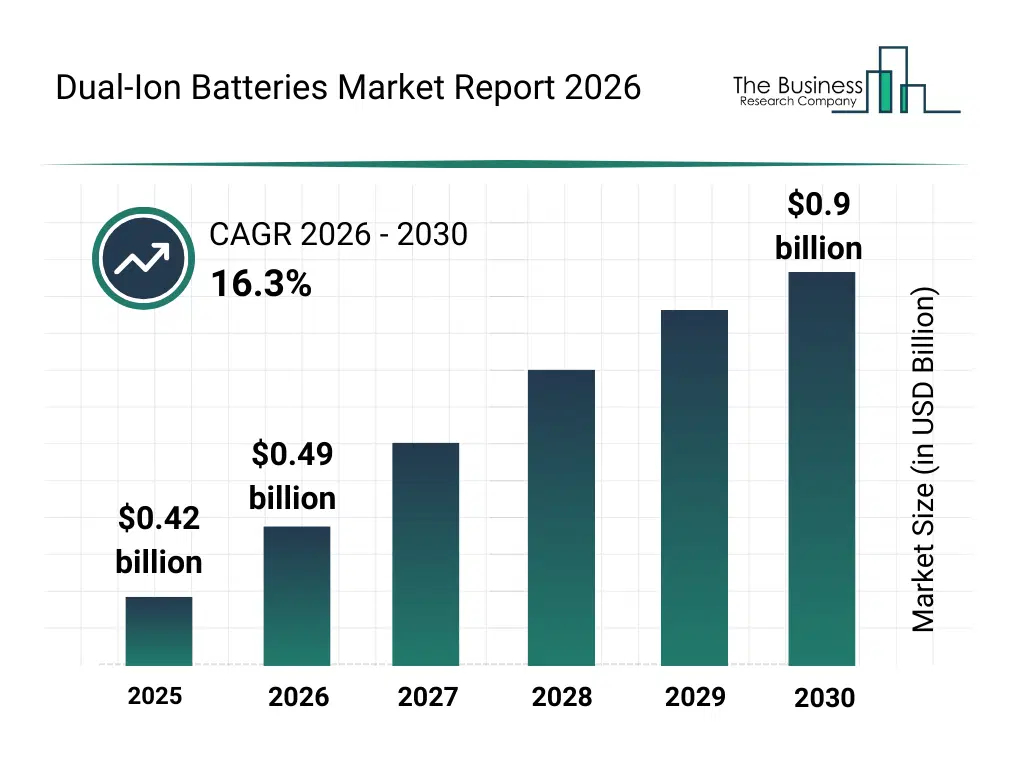
What Is The Dual-Ion Batteries Market Size 2026 And Growth Rate?
The dual-ion batteries market size has grown rapidly in recent years. It will grow from $0.42 billion in 2025 to $0.49 billion in 2026 at a compound annual growth rate (CAGR) of 16.3%. The growth in the historic period can be attributed to growing demand for lithium-ion alternatives, advancements in battery chemistry, rising electric vehicle adoption, increased portable electronics usage, limited conventional battery energy density.What Is The Dual-Ion Batteries Market Growth Forecast?
The dual-ion batteries market size is expected to see rapid growth in the next few years. It will grow to $0.9 billion in 2030 at a compound annual growth rate (CAGR) of 16.3%. The growth in the forecast period can be attributed to expansion of renewable energy storage, improvements in dual-ion battery cost efficiency, increased government incentives for clean energy, growing industrial applications, rising focus on battery recycling and circular economy. Major trends in the forecast period include high-energy-density dual-ion batteries, long-cycle-life battery systems, fast-charging energy storage, electrolyte innovation for dual-ion systems, compact & lightweight battery designs.
Global Dual-Ion Batteries Market Segmentation
1) By Type: Metal-Metal, Zinc-Ion, Metal-Organic, Sodium-Ion, Other Types 2) By Application: Portable Electronics, Medical Devices, Electric Vehicles, Renewable Energy Storage, Other Applications 3) By End-Use: Electronics And Electricals, Automotive, Energy And Utilities, Infrastructure, Other End-Uses Subsegments: 1) By Metal-Metal: Lithium-Aluminum Batteries, Magnesium-Aluminum Batteries, Calcium-Tin Batteries 2) By Zinc-Ion: Aqueous Zinc-Ion Batteries, Solid-State Zinc-Ion Batteries, Zinc-Graphite Batteries 3) By Metal-Organic: Lithium-Organic Batteries, Sodium-Organic Batteries, Magnesium-Organic Batteries 4) By Sodium-Ion: Sodium-Titanium Batteries, Sodium-Carbon Batteries, Sodium-Graphene Batteries 5) By Other Types: Potassium-Ion Batteries, Calcium-Ion Batteries, Hybrid Dual-Ion BatteriesWhat Is The Driver Of The Dual-Ion Batteries Market?
The increasing demand for electric vehicles is expected to propel the growth of the dual-ion batteries market going forward. Electric vehicles (EVs) refer to vehicles that are powered by one or more electric motors, using energy typically stored in rechargeable batteries. The increasing demand for electric vehicles is due to advancements in battery technology and the shift toward sustainable transportation solutions, coupled with rising fuel prices and the expansion of EV infrastructure. Dual-ion batteries in electric vehicles (EVs) offer the potential for lower-cost, more efficient energy storage with improved sustainability by utilizing multiple types of ions for energy storage and transfer. For instance, in January 2024, according to a report published by the International Council on Clean Transportation, a US-based professional non-profit organization, the share of new vehicle sales that are plug-in electric increased to approximately 7% in 2022, eventually exceeding 10% by Q3 2023. Therefore, the increasing demand for electric vehicles is driving the growth of the dual-ion batteries industry.Key Players In The Global Dual-Ion Batteries Market
Major companies operating in the dual-ion batteries market are Hitachi Chemical Company Ltd., BYD Company Limited, Panasonic Corporation, LG Chem Ltd., Sunwoda Electronic Co Ltd., Johnson Controls International plc, Samsung SDI Co Ltd., EVE Energy Co Ltd., EnerSys Inc., JSR Corporation, Tianjin Lishen Battery Joint-Stock Co Ltd., Ambri Inc., Ionic Materials Inc., Jenax Inc., Sion Power Corporation, Electrovaya, Amperex Technology Limited (ATL), Excellatron Solid State LLC, Tiamat Energy S.A., Prieto Battery Inc.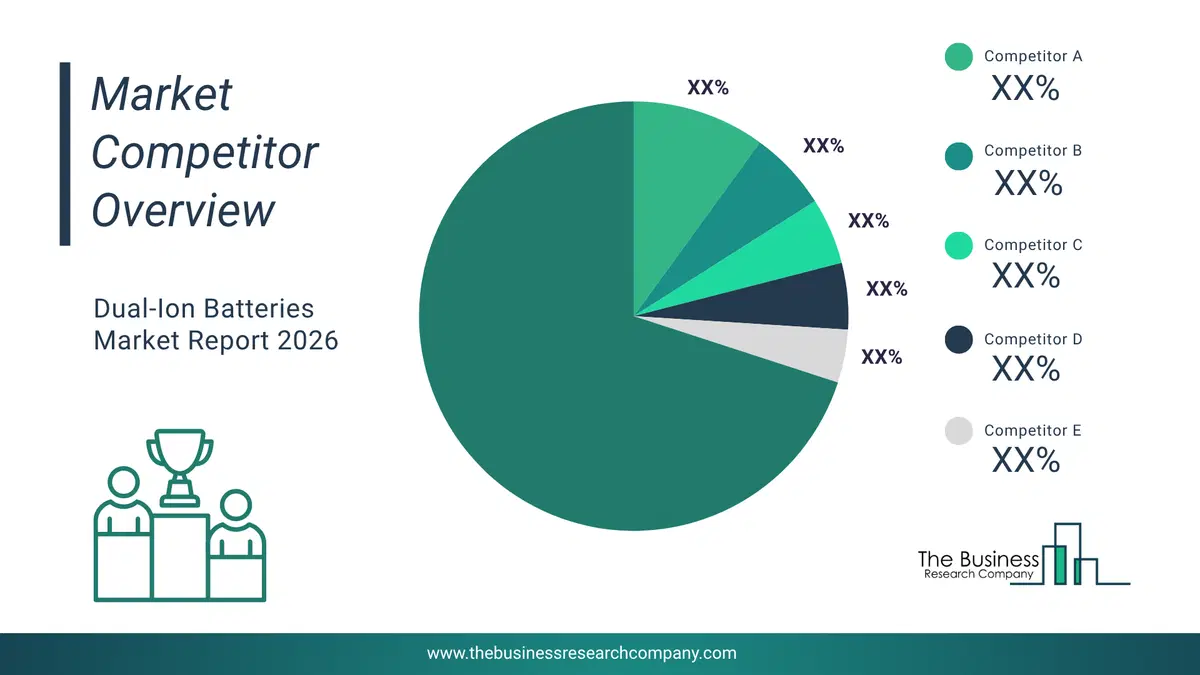
This chart is for illustrative purposes; the full report includes a detailed competitor analysis and comprehensive overview of the top 10 companies in the market.
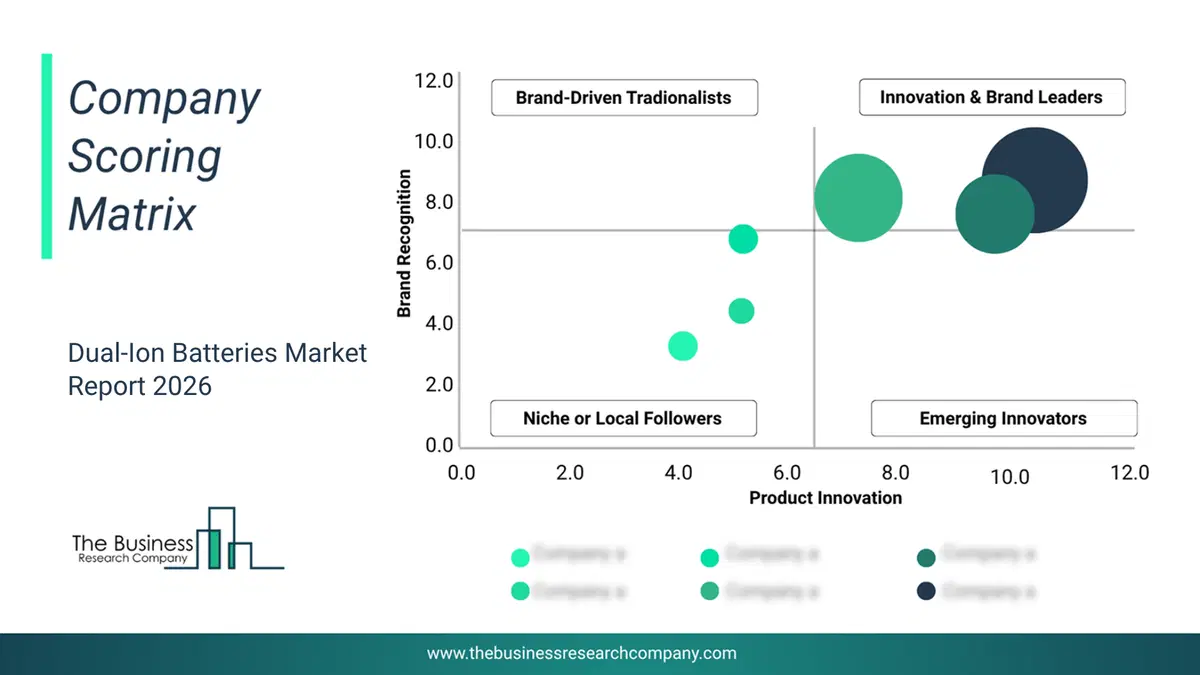
This chart maps companies by product innovation and brand strength, with bubble size indicating relative revenue, helping identify market leaders, challengers, and niche players. This is an illustrative chart; the full report provides a complete and accurate competitive analysis.
Global Dual-Ion Batteries Market Trends and Insights
Major companies operating in the dual-ion batteries market are focusing on developing advanced solutions, such as dual-mode lithium batteries, to enhance performance and efficiency in applications such as electric vehicles and portable electronics. A dual-mode lithium battery refers to a type of rechargeable battery that can operate in two distinct modes. For instance, in August 2024, Xiaomi, a China-based technology company, launched the Xiaomi MIJIA Electric Sharpener, a versatile tool designed for grinding, engraving, polishing, and drilling. It offers unique features such as a dual-mode lithium battery for versatile power options, a brushless motor with speeds up to 22,000 RPM, and a slim pen-shaped design that enhances portability and ease of use. Additionally, it supports various functions, including grinding, engraving, polishing, and drilling, making it suitable for a wide range of applications.What Are Latest Mergers And Acquisitions In The Dual-Ion Batteries Market?
In July 2024, Enerpoly AB, a Sweden-based manufacturer of zinc-ion batteries, acquired a production line and dry electrode technology from the Nilar AB for an undisclosed amount. The acquisition supports Enerpoly's dedication to sustainability, as zinc-ion batteries are known for their safer chemistry and reduced environmental impact compared to conventional lithium-ion batteries. This strategic move is expected to boost the company's growth while supporting global carbon reduction initiatives through cleaner energy storage solutions. Nilar AB is a Sweden-based company that developed and manufactured nickel metal hydride (NiMH) batteries for stationary energy storage systems.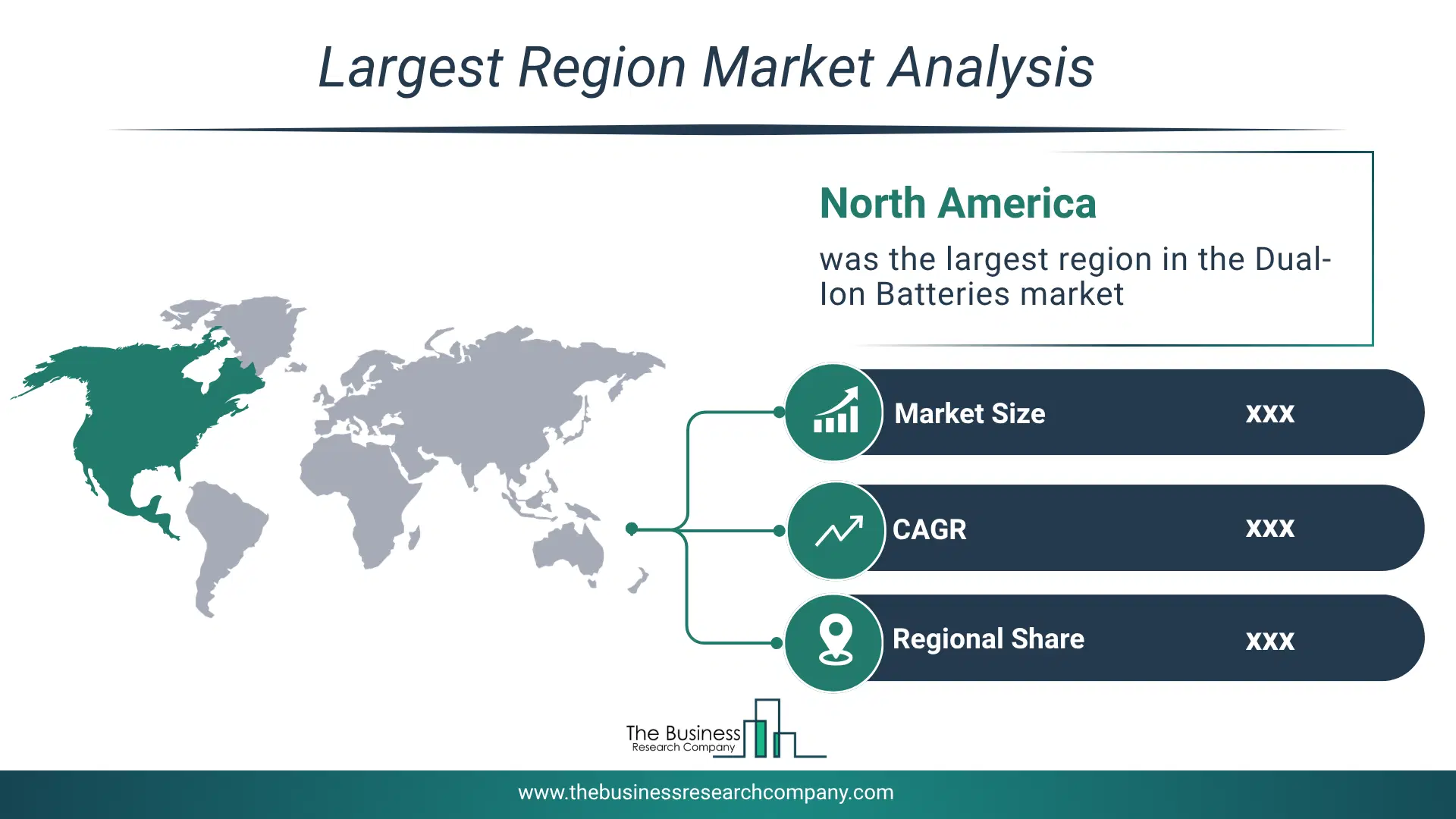
Regional Outlook
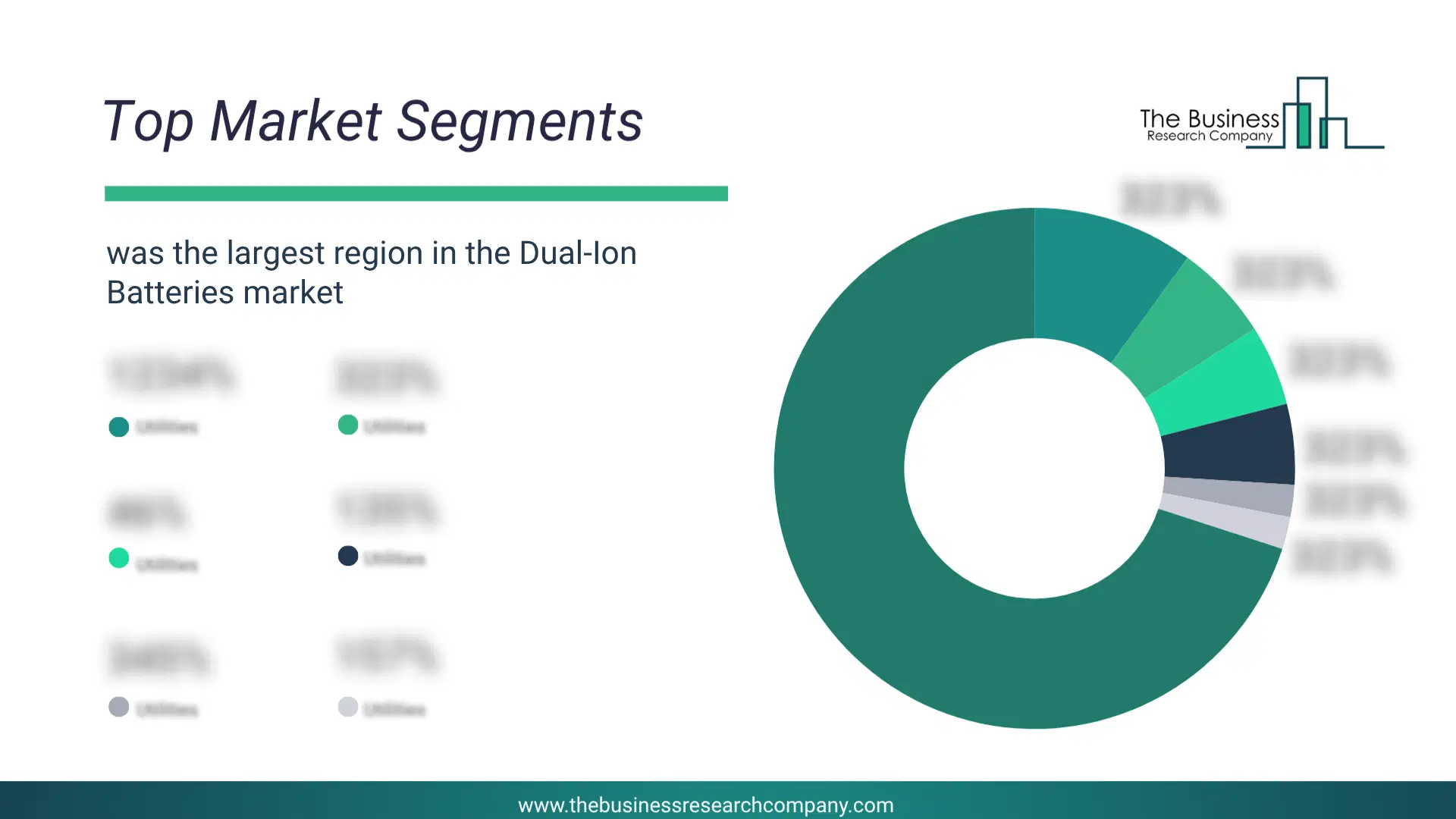
North America was the largest region in the dual-ion batteries market in 2025. Asia-Pacific is expected to be the fastest-growing region in the forecast period. The regions covered in this market report are Asia-Pacific, South East Asia, Western Europe, Eastern Europe, North America, South America, Middle East, Africa. The countries covered in this market report are Australia, Brazil, China, France, Germany, India, Indonesia, Japan, Taiwan, Russia, South Korea, UK, USA, Canada, Italy, Spain.What Defines the Dual-Ion Batteries Market?
The dual-ion batteries market consists of sales of graphite and tin disulfide (SnS₂) dual-ion batteries, silicon–graphene dual-ion batteries, WS₂-graphite dual-ion batteries, dual carbon batteries, and lithium hybrid organic batteries. Values in this market are ‘factory gate’ values, that is the value of goods sold by the manufacturers or creators of the goods, whether to other entities (including downstream manufacturers, wholesalers, distributors and retailers) or directly to end customers. The value of goods in this market includes related services sold by the creators of the goods.How is Market Value Defined and Measured?
The market value is defined as the revenues that enterprises gain from the sale of goods and/or services within the specified market and geography through sales, grants, or donations in terms of the currency (in USD unless otherwise specified). The revenues for a specified geography are consumption values that are revenues generated by organizations in the specified geography within the market, irrespective of where they are produced. It does not include revenues from resales along the supply chain, either further along the supply chain or as part of other products.
This chart presents market attractiveness based on a quantitative evaluation of growth, competition, strategic alignment, and risk, offering a clear view of opportunity areas for decision-making. This chart is for illustrative purposes; the full report contains the complete analysis.

This chart highlights the Total Addressable Market (TAM) by estimating the maximum revenue opportunity using an assumption-driven approach, supporting strategic planning and opportunity sizing across markets. The chart is illustrative; the full report provides a more comprehensive analysis.
What Key Data and Analysis Are Included in the Dual-Ion Batteries Market Report 2026?
The dual-ion batteries market research report is one of a series of new reports from The Business Research Company that provides market statistics, including industry global market size, regional shares, competitors with the market share, detailed market segments, market trends and opportunities, and any further data you may need to thrive in the dual-ion batteries industry. The market research report delivers a complete perspective of everything you need, with an in-depth analysis of the current and future state of the industry.Dual-Ion Batteries Market Report Forecast Analysis
| Report Attribute | Details |
|---|---|
| Market Size Value In 2026 | $0.49 billion |
| Revenue Forecast In 2030 | $0.9 billion |
| Growth Rate | CAGR of 16.3% from 2026 to 2030 |
| Base Year For Estimation | 2025 |
| Actual Estimates/Historical Data | 2020-2025 |
| Forecast Period | 2026 - 2030 |
| Market Representation | Revenue in USD Billion and CAGR from 2026 to 2030 |
| Segments Covered | Type, Application, End-Use |
| Regional Scope | Asia-Pacific, Western Europe, Eastern Europe, North America, South America, Middle East, Africa |
| Country Scope | The countries covered in the report are Australia, Brazil, China, France, Germany, India, Indonesia, Japan, Taiwan, Russia, South Korea, UK, USA, Canada, Italy, Spain. |
| Key Companies Profiled | Hitachi Chemical Company Ltd., BYD Company Limited, Panasonic Corporation, LG Chem Ltd., Sunwoda Electronic Co Ltd., Johnson Controls International plc, Samsung SDI Co Ltd., EVE Energy Co Ltd., EnerSys Inc., JSR Corporation, Tianjin Lishen Battery Joint-Stock Co Ltd., Ambri Inc., Ionic Materials Inc., Jenax Inc., Sion Power Corporation, Electrovaya, Amperex Technology Limited (ATL), Excellatron Solid State LLC, Tiamat Energy S.A., Prieto Battery Inc. |
| Customization Scope | Request for Customization |
| Pricing And Purchase Options | Explore Purchase Options |