
Dynamic Tint Automotive Display Market Report 2026
Global Outlook – By Product Type (Organic Light-Emitting Diode (OLED) Displays, Liquid Crystal Display (LCD) Displays, Light-Emitting Diode (LED) Displays, Other Product Types), By Vehicle Type (Passenger Cars, Commercial Vehicles, Electric Vehicles), By Technology (Electrochromic, Suspended Particle Device, Polymer Dispersed Liquid Crystal, Other Technologies), By Sales Channel (Original Equipment Manufacturer (OEM), Aftermarket), By Application (Infotainment Systems, Instrument Clusters, Head-Up Displays, Rear-View Mirrors, Sunroofs, Side Windows, Other Applications) – Market Size, Trends, Strategies, and Forecast to 2030
Dynamic Tint Automotive Display Market Overview
• Dynamic Tint Automotive Display market size has reached to $1.21 billion in 2025 • Expected to grow to $2.77 billion in 2030 at a compound annual growth rate (CAGR) of 18% • Growth Driver: Rise Of Autonomous Vehicles Fueling The Growth Of The Market Due To Enhanced Safety And Passenger Comfort • Market Trend: Next-Generation Automotive OLED Displays Transform Vehicle Interfaces And Aesthetics • North America was the largest region in 2025 and Asia-Pacific is the fastest growing region.What Is Covered Under Dynamic Tint Automotive Display Market?
A dynamic tint automotive display refers to an innovative vehicle display system that intelligently adjusts its tint or transparency levels in real time according to changing ambient light conditions, driving environments, or user preferences. This technology enhances driver comfort and safety by minimizing glare, improving visibility and readability of display information, and contributing to overall energy efficiency and interior aesthetics of the vehicle. The main types of products in dynamic tint automotive displays are organic light-emitting diode (OLED) displays, liquid crystal display (LCD) displays, light-emitting diode (LED) displays, and others. Organic light-emitting diode (OLED) displays are thin, flexible, and high-contrast screens that produce light directly from organic compounds. It is used for various vehicle types, such as passenger cars, commercial vehicles, and electric vehicles, and includes technologies such as electrochromic, suspended particle device, polymer dispersed liquid crystal, and others. These products, distributed via various sales channels, such as original equipment manufacturer (OEM) and aftermarket, cater to applications such as infotainment systems, instrument clusters, head-up displays, rearview mirrors, sunroofs, side windows, and others.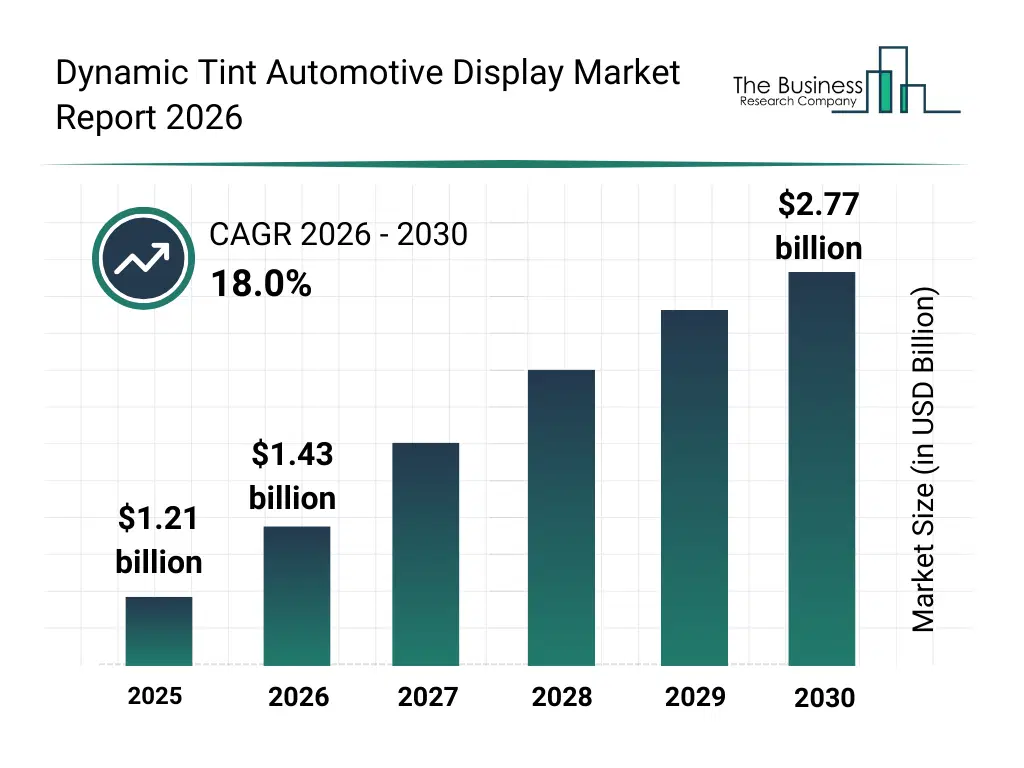
What Is The Dynamic Tint Automotive Display Market Size and Share 2026?
The dynamic tint automotive display market size has grown rapidly in recent years. It will grow from $1.21 billion in 2025 to $1.43 billion in 2026 at a compound annual growth rate (CAGR) of 18.3%. The growth in the historic period can be attributed to digital cockpit adoption, premium vehicle demand, driver comfort enhancement, HUD integration growth, display technology advancements.What Is The Dynamic Tint Automotive Display Market Growth Forecast?
The dynamic tint automotive display market size is expected to see rapid growth in the next few years. It will grow to $2.77 billion in 2030 at a compound annual growth rate (CAGR) of 18.0%. The growth in the forecast period can be attributed to electric vehicle interior innovation, autonomous driving displays, energy efficiency requirements, advanced human machine interface demand, smart glass technology adoption. Major trends in the forecast period include integration of smart tint displays, growth of in-vehicle user experience technologies, demand for glare reduction solutions, expansion of transparent display applications, adoption in premium vehicles.
Global Dynamic Tint Automotive Display Market Segmentation
1) By Product Type: Organic Light-Emitting Diode (OLED) Displays, Liquid Crystal Display (LCD) Displays, Light-Emitting Diode (LED) Displays, Other Product Types 2) By Vehicle Type: Passenger Cars, Commercial Vehicles, Electric Vehicles 3) By Technology: Electrochromic, Suspended Particle Device, Polymer Dispersed Liquid Crystal, Other Technologies 4) By Sales Channel: Original Equipment Manufacturer (OEM), Aftermarket 5) By Application: Infotainment Systems, Instrument Clusters, Head-Up Displays, Rear-View Mirrors, Sunroofs, Side Windows, Other Applications Subsegments: 1) By Organic Light-Emitting Diode Displays: Flexible Organic Light-Emitting Diode Displays, Transparent Organic Light-Emitting Diode Displays, Curved Organic Light-Emitting Diode Displays 2) By Liquid Crystal Display Displays: Thin-Film Transistor Liquid Crystal Display, Super Twisted Nematic Liquid Crystal Display, In-Plane Switching Liquid Crystal Display 3) By Light-Emitting Diode Displays: Micro Light-Emitting Diode Displays, Mini Light-Emitting Diode Displays, Conventional Light-Emitting Diode Displays 4) By Other Product Types: Electrophoretic Displays, Electrochromic Displays, Suspended Particle DisplaysWhat Is The Driver Of The Dynamic Tint Automotive Display Market?
The rise of autonomous vehicles is expected to drive the growth of the dynamic tint automotive display market in the future. Autonomous vehicles are self-driving cars that use sensors, cameras, and artificial intelligence to navigate and operate without human intervention. Autonomous vehicles are gaining popularity as their advanced sensors and artificial intelligence systems can drastically reduce accidents caused by human error, making roads safer and transportation more reliable. Dynamic tint automotive displays benefit autonomous vehicles by automatically adjusting window transparency to reduce glare and heat, enhancing passenger comfort and safety. For instance, according to the Insurance Institute for Highway Safety, a US-based non-profit organization, the number of self-driving vehicles on U.S. roads is expected to increase from 3.5 million in 2025 to 4.5 million by 2030. Therefore, the rise of autonomous vehicles is driving the growth of the dynamic tint automotive display industry.Key Players In The Global Dynamic Tint Automotive Display Market
Major companies operating in the dynamic tint automotive display market report include Continental Aktiengesellschaft, Magna International Inc., LG Display Co. Ltd., AGC Inc., Corning Incorporated, Visteon Corporation, Guardian Industries, Gentex Corporation, Mativ Holdings Inc., BenQ Materials Corporation, Asahi India Glass Limited, View Inc., Gauzy Ltd., Argotec LLC, Polytronix Inc., Huichi Glass, Miru Smart Technologies, ElectraTint, Smart Tint, Innoptec
This chart is for illustrative purposes; the full report includes a detailed competitor analysis and comprehensive overview of the top 10 companies in the market.
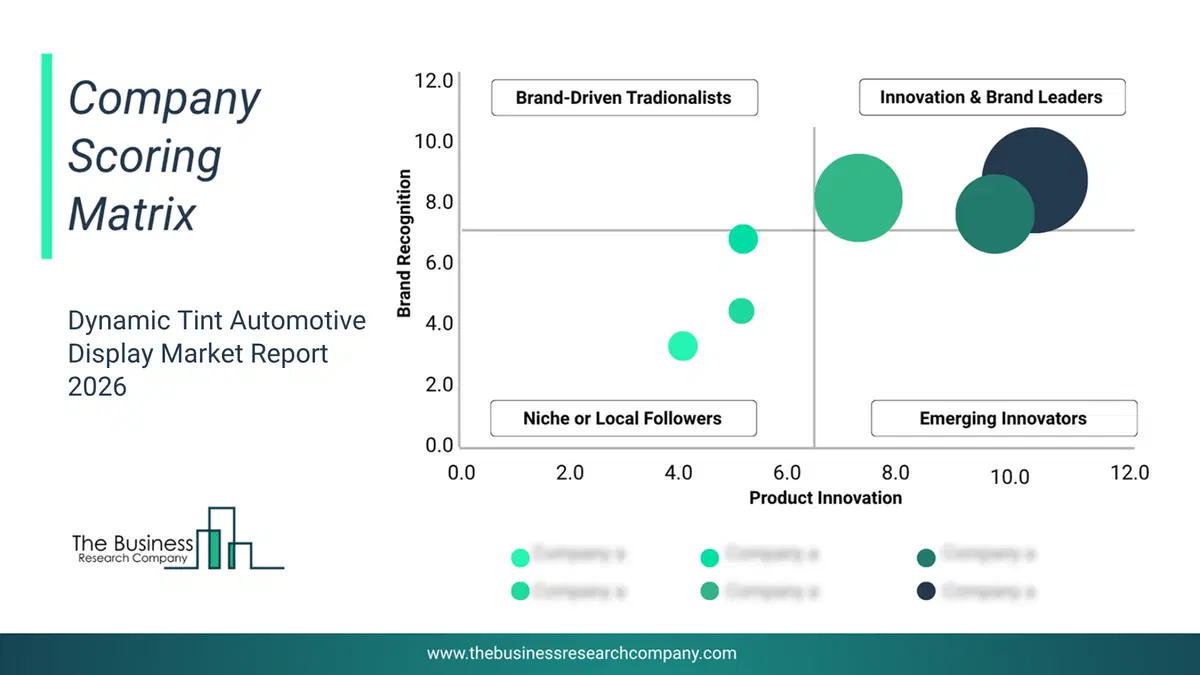
This chart maps companies by product innovation and brand strength, with bubble size indicating relative revenue, helping identify market leaders, challengers, and niche players. This is an illustrative chart; the full report provides a complete and accurate competitive analysis.
Global Dynamic Tint Automotive Display Market Trends and Insights
Major companies operating in the dynamic tint automotive display market are focusing on technological advancements, such as next-generation automotive OLED displays, to enhance vehicle aesthetics, improve user interfaces, and support the growing demand for electric and connected vehicles. Next-generation automotive OLED displays refer to advanced, flexible, and energy-efficient display panels designed for vehicles, offering high resolution, dynamic brightness, and seamless integration into dashboards and infotainment systems. For instance, in January 2023, LG Display Co., Ltd., a South Korea-based manufacturer of thin-film transistor liquid crystal display panels, unveiled a range of next-generation automotive display solutions featuring P-OLED and LTPS LCD technologies. Key launches included the industry’s first 18-inch slidable automotive OLED panel, a 34-inch seamless P-OLED dashboard, a 12.3-inch Hole-in-Display cluster, a flexible 12.8-inch P-OLED control pad, and a 12-inch ultra-bright HUD LTPS LCD. LG also introduced Tandem OLED technology for brighter, more durable, and energy-efficient displays, as well as Advanced Thin OLED (ATO) technology, which reduces panel thickness by 20%. Additionally, the company showcased Switchable Privacy Mode for enhanced driver focus and passenger privacy, alongside the Thin Actuator Sound Solution, which delivers immersive 3D audio by using the car body as speakers.What Are Latest Mergers And Acquisitions In The Dynamic Tint Automotive Display Market?
In March 2025, Argotec Srl, an Italy-based aerospace company, partnered with Miru Smart Technologies to develop electrochromic sunroof windows for the automotive industry. The aim of this partnership is to develop and commercialize the largest electrochromic sunroof window for vehicles, enhancing energy efficiency, passenger comfort, and smart glazing adoption in the automotive industry. Miru Smart Technologies is a Canada-based glass manufacturer that offers dynamic electrochromic technology for automotive applications.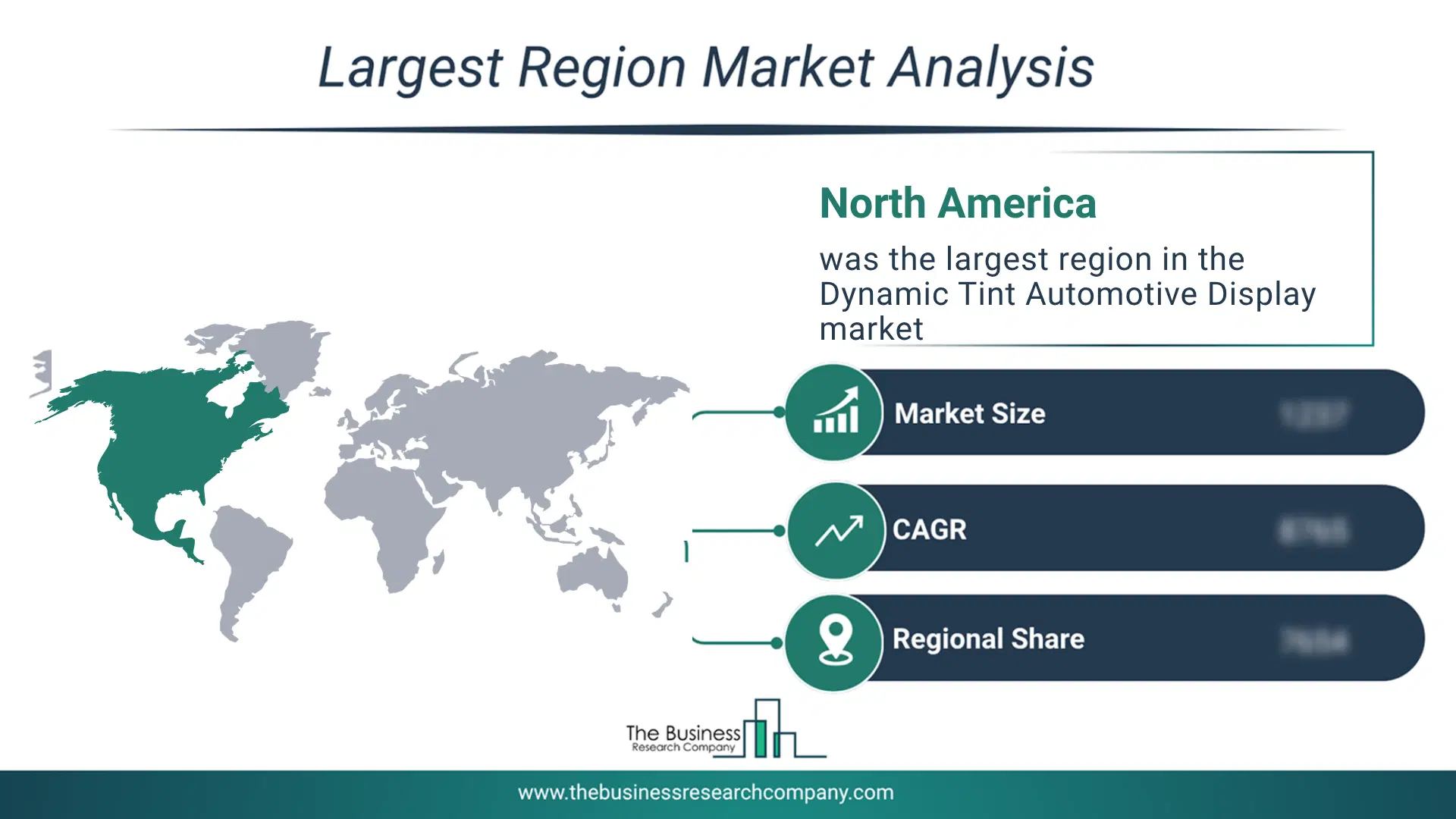
Regional Outlook
North America was the largest region in the dynamic tint automotive display market in 2025. Asia-Pacific is expected to be the fastest-growing region in the forecast period. The regions covered in this market report include Asia-Pacific, South East Asia, Western Europe, Eastern Europe, North America, South America, Middle East, Africa. The countries covered in this market report include Australia, Brazil, China, France, Germany, India, Indonesia, Japan, Taiwan, Russia, South Korea, UK, USA, Canada, Italy, SpainWhat Defines the Dynamic Tint Automotive Display Market?
The dynamic tint automotive display market consists of sales of head-up displays, instrument clusters, infotainment panels, windshields, suspended particle devices, and polymer-dispersed liquid crystals. Values in this market are ‘factory gate’ values, that is, the value of goods sold by the manufacturers or creators of the goods, whether to other entities (including downstream manufacturers, wholesalers, distributors, and retailers) or directly to end customers. The value of goods in this market includes related services sold by the creators of the goods.How is Market Value Defined and Measured?
The market value is defined as the revenues that enterprises gain from the sale of goods and/or services within the specified market and geography through sales, grants, or donations in terms of the currency (in USD unless otherwise specified). The revenues for a specified geography are consumption values that are revenues generated by organizations in the specified geography within the market, irrespective of where they are produced. It does not include revenues from resales along the supply chain, either further along the supply chain or as part of other products.
This chart presents market attractiveness based on a quantitative evaluation of growth, competition, strategic alignment, and risk, offering a clear view of opportunity areas for decision-making. This chart is for illustrative purposes; the full report contains the complete analysis.

This chart highlights the Total Addressable Market (TAM) by estimating the maximum revenue opportunity using an assumption-driven approach, supporting strategic planning and opportunity sizing across markets. The chart is illustrative; the full report provides a more comprehensive analysis.
What Key Data and Analysis Are Included in the Dynamic Tint Automotive Display Market Report 2026?
The dynamic tint automotive display market research report is one of a series of new reports from The Business Research Company that provides market statistics, including industry global market size, regional shares, competitors with the market share, detailed market segments, market trends and opportunities, and any further data you may need to thrive in the dynamic tint automotive display industry. The market research report delivers a complete perspective of everything you need, with an in-depth analysis of the current and future state of the industry.Dynamic Tint Automotive Display Market Report Forecast Analysis
| Report Attribute | Details |
|---|---|
| Market Size Value In 2026 | $1.43 billion |
| Revenue Forecast In 2030 | $2.77 billion |
| Growth Rate | CAGR of 18.3% from 2026 to 2030 |
| Base Year For Estimation | 2025 |
| Actual Estimates/Historical Data | 2020-2025 |
| Forecast Period | 2026 - 2030 - 2030 |
| Market Representation | Revenue in USD Billion and CAGR from 2026 to 2030 |
| Segments Covered | Product Type, Vehicle Type, Technology, Sales Channel, Application |
| Regional Scope | Asia-Pacific, Western Europe, Eastern Europe, North America, South America, Middle East, Africa |
| Country Scope | The countries covered in the report are Australia, Brazil, China, France, Germany, India, Indonesia, Japan, Taiwan, Russia, South Korea, UK, USA, Canada, Italy, Spain. |
| Key Companies Profiled | Continental Aktiengesellschaft, Magna International Inc., LG Display Co. Ltd., AGC Inc., Corning Incorporated, Visteon Corporation, Guardian Industries, Gentex Corporation, Mativ Holdings Inc., BenQ Materials Corporation, Asahi India Glass Limited, View Inc., Gauzy Ltd., Argotec LLC, Polytronix Inc., Huichi Glass, Miru Smart Technologies, ElectraTint, Smart Tint, Innoptec |
| Customization Scope | Request for Customization |
| Pricing And Purchase Options | Explore Purchase Options |