
Dynamic Vision Sensors Market Report 2026
Global Outlook – By Component ( Hardware, Software, Services), By Technology ( Event, Frame, Hybrid (Event + Frame), Time-Of-Flight, Complementary Metal-Oxide-Semiconductor (CMOS), Other Technologies), By Functionality ( Three-Dimensional (3D) Vision Sensing, Two-Dimensional (2D) Vision Sensing, Image Processing, Motion Detection), By Application ( Machine Vision, Robotics, Autonomous Vehicles, Security Systems), By End-User ( Automotive, Consumer Electronics, Industrial, Healthcare, Robotics, Other End-Users) – Market Size, Trends, Strategies, and Forecast to 2030
Dynamic Vision Sensors Market Overview
• Dynamic Vision Sensors market size has reached to $1.34 billion in 2025 • Expected to grow to $2.28 billion in 2030 at a compound annual growth rate (CAGR) of 11.2% • Growth Driver: The Increasing Adoption Of Autonomous Vehicles Is Fueling The Dynamic Vision Sensors Market Growth Due To Enhance Real-Time Perception And Motion Detection • Market Trend: New Vision Sensor Launch Signals Leap In Smart Device Imaging Capabilities • North America was the largest region in 2025 and Asia-Pacific is the fastest growing region.What Is Covered Under Dynamic Vision Sensors Market?
Dynamic vision sensors (DVS) are specialized image sensors that capture changes in a scene rather than recording full frames at fixed intervals. They operate asynchronously, with each pixel independently detecting variations in brightness, enabling high-speed and low-latency vision processing. This approach significantly reduces data volume while enhancing motion detection and temporal resolution. The main components of dynamic vision sensors (DVS) are hardware, software, and services. Hardware in DVS refers to physical components such as sensors, processors, and memory, which capture and process visual data in real-time for dynamic vision applications. Various technologies are used, including event-based, frame-based, hybrid (event + frame), time-of-flight, complementary metal-oxide-semiconductor (CMOS), and others, with functionalities such as three-dimensional (3D) vision sensing, two-dimensional (2D) vision sensing, image processing, and motion detection. These components are applied in machine vision, robotics, autonomous vehicles, and security systems, serving end-users in automotive, consumer electronics, industrial, healthcare, robotics, and other sectors.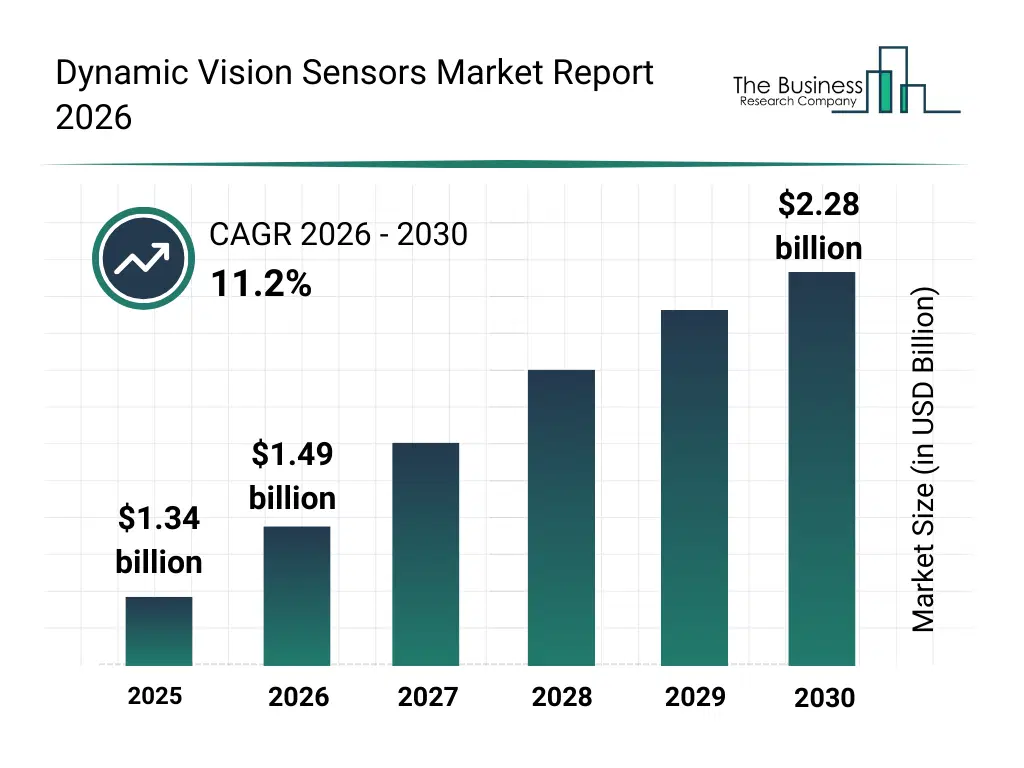
What Is The Dynamic Vision Sensors Market Size 2026 And Growth Rate?
The dynamic vision sensors market size has grown rapidly in recent years. It will grow from $1.34 billion in 2025 to $1.49 billion in 2026 at a compound annual growth rate (CAGR) of 11.2%. The growth in the historic period can be attributed to growth of machine vision adoption in industrial automation, limitations of frame-based sensors in high-speed environments, demand for low-power vision solutions, advancements in neuromorphic engineering research, early adoption in robotics and surveillance.What Is The Dynamic Vision Sensors Market Growth Forecast?
The dynamic vision sensors market size is expected to see rapid growth in the next few years. It will grow to $2.28 billion in 2030 at a compound annual growth rate (CAGR) of 11.2%. The growth in the forecast period can be attributed to increasing deployment of autonomous robots and vehicles, rising demand for real-time edge vision processing, integration of dvs with AI accelerators, growing need for energy-efficient sensing technologies, expanding applications in smart manufacturing and healthcare. Major trends in the forecast period include ultra-low-latency vision processing, event-based sensing for high-speed motion capture, reduced data bandwidth and power consumption, sensor fusion with conventional imaging systems, miniaturization of vision sensors for embedded systems.
Global Dynamic Vision Sensors Market Segmentation
1) By Component: Hardware, Software, Services 2) By Technology: Event, Frame, Hybrid (Event + Frame), Time-Of-Flight, Complementary Metal-Oxide-Semiconductor (CMOS), Other Technologies 3) By Functionality: Three-Dimensional (3D) Vision Sensing, Two-Dimensional (2D) Vision Sensing, Image Processing, Motion Detection 4) By Application: Machine Vision, Robotics, Autonomous Vehicles, Security Systems 5) By End-User: Automotive, Consumer Electronics, Industrial, Healthcare, Robotics, Other End-Users Subsegments: 1) By Hardware: Image Sensors, Lens Modules, Processing Units, Power Supply Units, Interface Components 2) By Software: Firmware, Driver Software, Image Processing Software, Computer Vision Algorithms, Analytics Platforms 3) By Services: Installation Services, Maintenance Services, Consulting Services, Integration Services, Training ServicesWhat Is The Driver Of The Dynamic Vision Sensors Market?
The increasing adoption of autonomous vehicles is expected to propel the growth of dynamic vision sensors market going forward. Autonomous vehicles refer to self-driving vehicles that can navigate and operate without human intervention by using sensors, cameras, artificial intelligence, and machine learning algorithms. The increasing adoption of autonomous vehicles is due to advancements in artificial intelligence (AI) and light detection and ranging (LiDAR) sensor technologies, which enhance real-time decision-making and environmental perception for safer and more efficient driving. Dynamic vision sensors (DVS) help autonomous vehicles by providing high-speed, low-latency visual data that enables precise motion detection and obstacle tracking in real time, even under challenging lighting conditions. For instance, in June 2024, according to the Organisation for Economic Co-operation and Development (OECD), a France-based intergovernmental transport body, governments and cities expanded AV testing and pilot programmes in 2023 compared with 2022, supporting larger-scale trials of shared automated shuttles and robotaxi services. Furthermore, in June 2023, according to the U.S. National Highway Traffic Safety Administration, a US-based government safety agency, regulators documented growing ADS testing activity and research efforts addressing safety, indicating larger operational trials in 2023 versus 2022. Therefore, the increasing adoption of autonomous vehicles is driving the growth of the dynamic vision sensors industry.Key Players In The Global Dynamic Vision Sensors Market
Major companies operating in the dynamic vision sensors market are Samsung Electronics Co. Ltd., Sony Group Corporation, Infineon Technologies AG, STMicroelectronics N.V., Analog Devices Inc., ON Semiconductor Corporation, Pepperl+Fuchs SE, Himax Technologies Inc., GalaxyCore Inc., Austrian Institute of Technology GmbH, PixArt Imaging Inc., IDS Imaging Development Systems GmbH, Prophesee S.A., pmdtechnologies ag, SynSense AG, Innatera Nanosystems B.V., iniLabs AG, CenturyArks Co. Ltd., AlpsenTek Co. Ltd., Zivid AS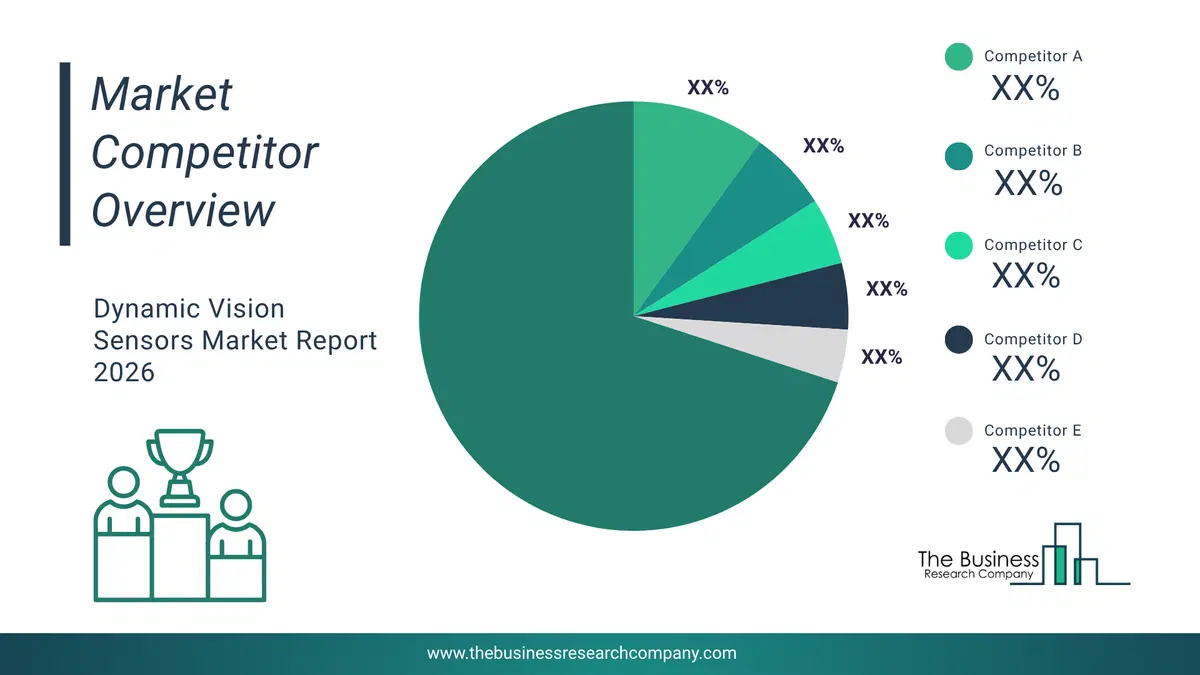
This chart is for illustrative purposes; the full report includes a detailed competitor analysis and comprehensive overview of the top 10 companies in the market.
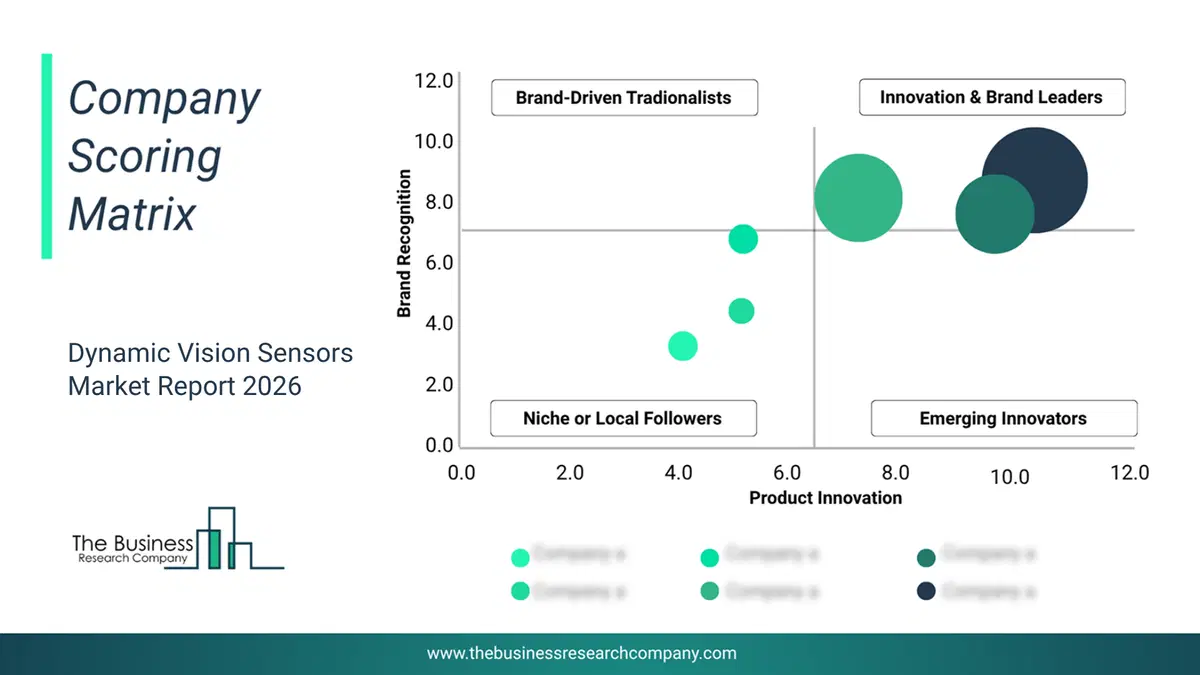
This chart maps companies by product innovation and brand strength, with bubble size indicating relative revenue, helping identify market leaders, challengers, and niche players. This is an illustrative chart; the full report provides a complete and accurate competitive analysis.
Global Dynamic Vision Sensors Market Trends and Insights
Major companies operating in the dynamic vision sensors market are focusing on developing innovative products such as ultra-low-power event-based vision sensors to enhance real-time motion detection and energy efficiency. Ultra-low-power event-based vision sensors are cameras that detect changes in a scene asynchronously, capturing only moving objects while consuming minimal energy. They help by enabling faster, more efficient motion detection and reducing power consumption in devices. For instance, in October 2023, Prophesee SA, a France-based semiconductor manufacturing company, launched the GenX320 event-based metavision sensor, the industry’s smallest and most power-efficient event-based vision sensor. The GenX320 features a 320×320 6.3μm pixel BSI stacked design in a tiny 3x4mm die, offering a 1/5” optical format. It provides microsecond-level timestamping of events, on-chip intelligent power management that reduces consumption to as low as 36 µW, and supports deep sleep and standby modes. The sensor offers easy integration with standard SoCs via MIPI or CPI interfaces, on-chip data preprocessing, and AI-ready histogram outputs compatible with multiple AI accelerators.What Are Latest Mergers And Acquisitions In The Dynamic Vision Sensors Market?
In February 2024, SynSense AG, a Switzerland-based neuromorphic computing company, acquired iniVation AG for an undisclosed amount. With this acquisition, SynSense aims to combine its ultra-low-power neuromorphic processing expertise with iniVation’s high-performance neuromorphic vision systems to create the world’s first fully neuromorphic, end-to-end sensing and processing company, delivering advanced intelligent vision solutions across industrial and consumer markets. IniVation AG is a Switzerland-based neuromorphic vision systems company that specialises in providing dynamic vision sensors.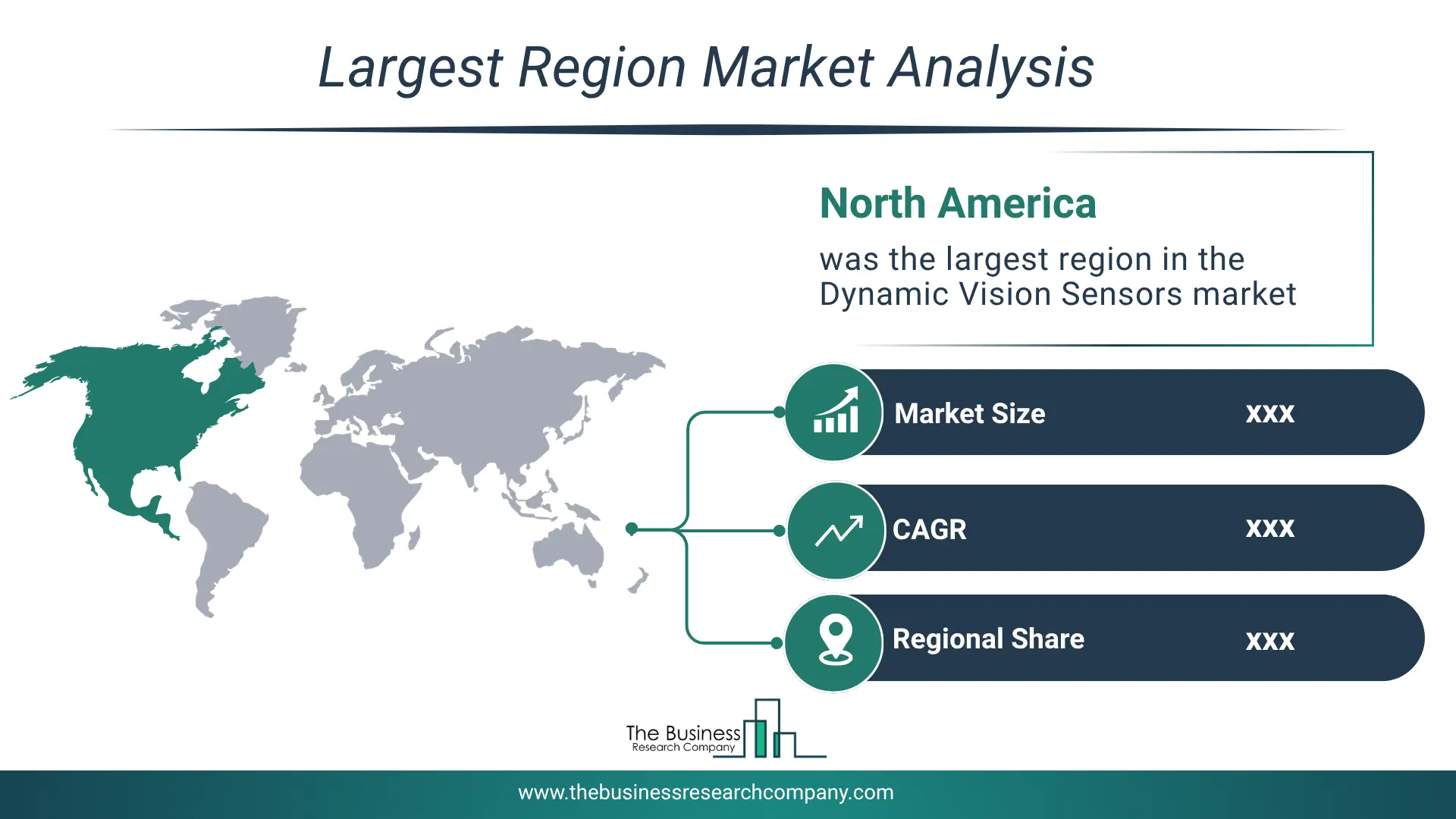
Regional Outlook
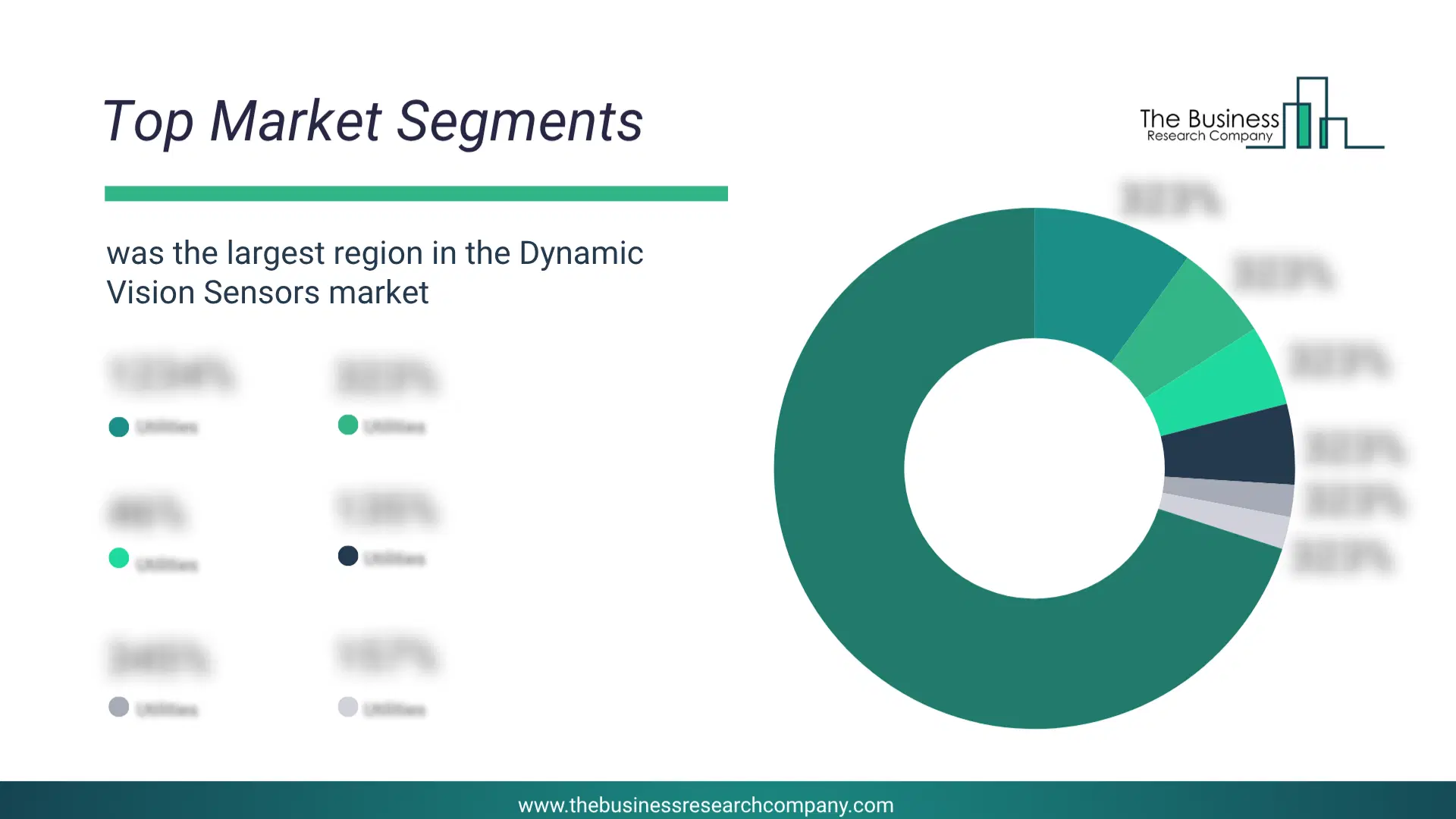
North America was the largest region in the dynamic vision sensors market in 2025. Asia-Pacific is expected to be the fastest-growing region in the forecast period. The regions covered in this market report are Asia-Pacific, South East Asia, Western Europe, Eastern Europe, North America, South America, Middle East, Africa. The countries covered in this market report are Australia, Brazil, China, France, Germany, India, Indonesia, Japan, Taiwan, Russia, South Korea, UK, USA, Canada, Italy, Spain.What Defines the Dynamic Vision Sensors Market?
The dynamic vision sensors market consists of revenues earned by entities providing services such as high-speed object tracking, autonomous navigation, gesture recognition, industrial automation, and augmented reality visual input solutions. The market value includes the value of related goods sold by the service provider or included within the service offering. The dynamic vision sensors market also includes sales of event-based cameras, neuromorphic processors, vision modules, sensor development kits, and embedded vision systems. Values in this market are ‘factory gate’ values, that is the value of goods sold by the manufacturers or creators of the goods, whether to other entities (including downstream manufacturers, wholesalers, distributors and retailers) or directly to end customers. The value of goods in this market includes related services sold by the creators of the goods.How is Market Value Defined and Measured?
The market value is defined as the revenues that enterprises gain from the sale of goods and/or services within the specified market and geography through sales, grants, or donations in terms of the currency (in USD unless otherwise specified). The revenues for a specified geography are consumption values that are revenues generated by organizations in the specified geography within the market, irrespective of where they are produced. It does not include revenues from resales along the supply chain, either further along the supply chain or as part of other products.
This chart presents market attractiveness based on a quantitative evaluation of growth, competition, strategic alignment, and risk, offering a clear view of opportunity areas for decision-making. This chart is for illustrative purposes; the full report contains the complete analysis.

This chart highlights the Total Addressable Market (TAM) by estimating the maximum revenue opportunity using an assumption-driven approach, supporting strategic planning and opportunity sizing across markets. The chart is illustrative; the full report provides a more comprehensive analysis.
What Key Data and Analysis Are Included in the Dynamic Vision Sensors Market Report 2026?
The dynamic vision sensors market research report is one of a series of new reports from The Business Research Company that provides market statistics, including industry global market size, regional shares, competitors with the market share, detailed market segments, market trends and opportunities, and any further data you may need to thrive in the dynamic vision sensors industry. The market research report delivers a complete perspective of everything you need, with an in-depth analysis of the current and future state of the industry.Dynamic Vision Sensors Market Report Forecast Analysis
| Report Attribute | Details |
|---|---|
| Market Size Value In 2026 | $1.49 billion |
| Revenue Forecast In 2030 | $2.28 billion |
| Growth Rate | CAGR of 11.2% from 2026 to 2030 |
| Base Year For Estimation | 2025 |
| Actual Estimates/Historical Data | 2020-2025 |
| Forecast Period | 2026 - 2030 |
| Market Representation | Revenue in USD Billion and CAGR from 2026 to 2030 |
| Segments Covered | Component, Technology, Functionality, Application, End-User |
| Regional Scope | Asia-Pacific, Western Europe, Eastern Europe, North America, South America, Middle East, Africa |
| Country Scope | The countries covered in the report are Australia, Brazil, China, France, Germany, India, Indonesia, Japan, Taiwan, Russia, South Korea, UK, USA, Canada, Italy, Spain. |
| Key Companies Profiled | Samsung Electronics Co. Ltd., Sony Group Corporation, Infineon Technologies AG, STMicroelectronics N.V., Analog Devices Inc., ON Semiconductor Corporation, Pepperl+Fuchs SE, Himax Technologies Inc., GalaxyCore Inc., Austrian Institute of Technology GmbH, PixArt Imaging Inc., IDS Imaging Development Systems GmbH, Prophesee S.A., pmdtechnologies ag, SynSense AG, Innatera Nanosystems B.V., iniLabs AG, CenturyArks Co. Ltd., AlpsenTek Co. Ltd., Zivid AS |
| Customization Scope | Request for Customization |
| Pricing And Purchase Options | Explore Purchase Options |