
Dysautonomia (Autonomic Dysfunction) Market Report 2026
Global Outlook – By Type (Neurogenic Orthostatic Hypotension (NOH), Postural Orthostatic Tachycardia Syndrome (POTS), Multiple System Atrophy (MSA), Pure Autonomic Failure (PAF), Other Types), By Tests (Cardiovagal and Vasomotor Function Tests, Thermoregulatory Sweat Test (TST), Sympathetic Skin Response (SSR), Quantitative Sudomotor Axon Reflex Test, Other Tests), By Treatment (Physical Therapy, Exercise Therapy, Counseling, Other Treatments), By Distribution Channel (Hospital Pharmacy, Online Pharmacy, Retail Pharmacy), By End User (Hospitals, Clinics, Diagnostic Centers, Research Institutes) - Market Size, Trends, Strategies, and Forecast to 2030
Dysautonomia (Autonomic Dysfunction) Market Overview
• Dysautonomia (Autonomic Dysfunction) market size has reached to $2.92 billion in 2025 • Expected to grow to $4.98 billion in 2030 at a compound annual growth rate (CAGR) of 11.2% • Growth Driver: Rising Prevalence Of Chronic Diseases Driving Growth In The Market • Market Trend: Advancements In Gene Therapy Driving Innovation In The Market • North America was the largest region in 2025 and Asia-Pacific is the fastest growing region.What Is Covered Under Dysautonomia (Autonomic Dysfunction) Market?
Dysautonomia, or autonomic dysfunction, refers to a condition where the autonomic nervous system (ANS) does not function properly, affecting involuntary bodily functions such as heart rate, blood pressure, digestion, and temperature regulation. It can result from various causes, including genetic factors, injuries, or underlying health conditions, leading to symptoms like dizziness, fainting, and irregular heartbeat. The main types of dysautonomia (autonomic dysfunction) are neurogenic orthostatic hypotension (NOH), postural orthostatic tachycardia syndrome (POTS), multiple system atrophy (MSA), pure autonomic failure (PAF), and other types. Neurogenic orthostatic hypotension is a condition caused by autonomic nervous system dysfunction, leading to a significant drop in blood pressure upon standing, resulting in dizziness, lightheadedness, and fainting. Diagnosis of dysautonomia involves various tests, including cardiovagal and vasomotor function tests, the thermoregulatory sweat test (TST), sympathetic skin response (SSR), the quantitative sudomotor axon reflex test, and others. Treatment options include physical therapy, exercise therapy, counseling, and additional therapeutic interventions. The distribution of treatment and medications occurs through hospital pharmacies, online pharmacies, and retail pharmacies, while key end users include hospitals, clinics, diagnostic centers, and research institutes.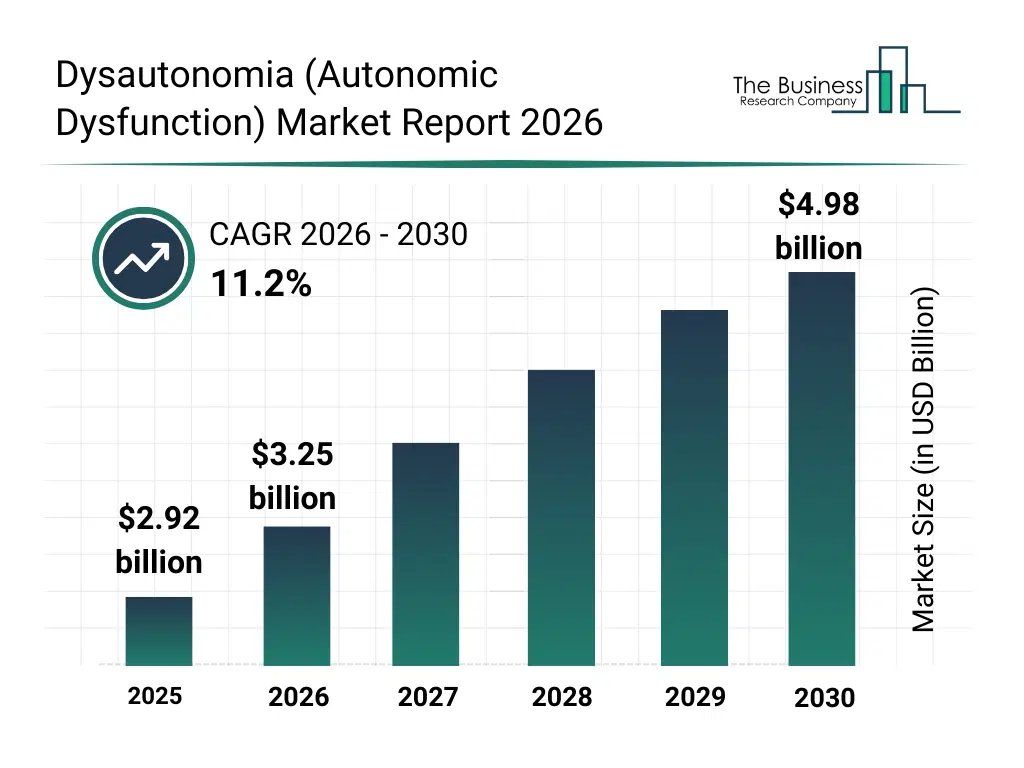
What Is The Dysautonomia (Autonomic Dysfunction) Market Size and Share 2026?
The dysautonomia (autonomic dysfunction) market size has grown rapidly in recent years. It will grow from $2.92 billion in 2025 to $3.25 billion in 2026 at a compound annual growth rate (CAGR) of 11.5%. The growth in the historic period can be attributed to neurological disorder prevalence, diagnostic test availability, autonomic research growth, specialist clinic expansion, patient advocacy initiatives.What Is The Dysautonomia (Autonomic Dysfunction) Market Growth Forecast?
The dysautonomia (autonomic dysfunction) market size is expected to see rapid growth in the next few years. It will grow to $4.98 billion in 2030 at a compound annual growth rate (CAGR) of 11.2%. The growth in the forecast period can be attributed to wearable monitoring adoption, personalized treatment protocols, genetic research expansion, digital health integration, long-term care demand. Major trends in the forecast period include rising awareness of autonomic nervous system disorders, increased use of comprehensive diagnostic testing, growth of multidisciplinary treatment approaches, expansion of symptom management therapies, increasing focus on chronic disease monitoring.
Global Dysautonomia (Autonomic Dysfunction) Market Segmentation
1) By Type: Neurogenic Orthostatic Hypotension (NOH), Postural Orthostatic Tachycardia Syndrome (POTS), Multiple System Atrophy (MSA), Pure Autonomic Failure (PAF), Other Types 2) By Tests: Cardiovagal and Vasomotor Function Tests, Thermoregulatory Sweat Test (TST), Sympathetic Skin Response (SSR), Quantitative Sudomotor Axon Reflex Test, Other Tests 3) By Treatment: Physical Therapy, Exercise Therapy, Counseling, Other Treatments 4) By Distribution Channel: Hospital Pharmacy, Online Pharmacy, Retail Pharmacy 5) By End User: Hospitals, Clinics, Diagnostic Centers, Research Institutes Subsegments: 1) By Neurogenic Orthostatic Hypotension (NOH): Primary NOH, Secondary NOH (due to Parkinson's Disease, Diabetes, etc.), Pharmacological Management of NOH, Non-Pharmacological Interventions 2) By Postural Orthostatic Tachycardia Syndrome (POTS): Hyperadrenergic POTS, Hypovolemic POTS, Neuropathic POTS, Autoimmune POTS, Treatment With Beta-Blockers, Fludrocortisone, And Salt Supplements 3) By Multiple System Atrophy (MSA): MSA-P (Parkinsonism), MSA-C (Cerebellar), MSA-A (Autonomic), Disease-Modifying and Symptomatic Treatment 4) By Pure Autonomic Failure (PAF): Idiopathic PAF, Secondary PAF (due to neurodegenerative diseases), Autonomic Supportive Treatments 5) By Other Types: Familial Dysautonomia (FD), Diabetic Autonomic Neuropathy, Horner's Syndrome, Autoimmune Autonomic Ganglionopathy, Chronic Fatigue Syndrome-related DysautonomiaWhat Are The Drivers Of The Dysautonomia (Autonomic Dysfunction) Market?
The increasing prevalence of chronic diseases is expected to propel the growth of the dysautonomia (autonomic dysfunction) market going forward. Chronic diseases are long-lasting health conditions that typically persist for three months or more and often require continuous medical care. The rise in chronic diseases is driven by increased multimorbidity, where individuals develop several chronic conditions simultaneously due to aging populations, sedentary lifestyles, poor diets, and environmental risk factors. The dysautonomia (autonomic dysfunction) market supports this trend because autonomic impairment worsens cardiovascular, metabolic, and neurological symptoms in chronic disease patients by disrupting heart rate control, blood pressure regulation, digestion, and other essential functions. For instance, in September 2023, according to the World Health Organization, a Switzerland-based intergovernmental public health agency, chronic noncommunicable diseases were responsible for 41 million deaths annually, representing 74% of all global deaths. Therefore, the increasing prevalence of chronic diseases is driving the growth of the dysautonomia (autonomic dysfunction) industry. An increase in autoimmune and neurological disorders is expected to propel the growth of the dysautonomia (autonomic dysfunction) market going forward. Autoimmune and neurological disorders are conditions in which the immune system or pathological processes damage the central or peripheral nervous system, leading to inflammation, nerve dysfunction, and impaired autonomic regulation. The rise in these disorders is driven by genetic susceptibility, environmental exposures, lifestyle changes, infectious triggers, and improved diagnostic detection. The dysautonomia (autonomic dysfunction) market supports this trend by helping clinicians detect early autonomic involvement in conditions such as Sjögren’s syndrome, multiple sclerosis, Parkinson’s disease, and multiple system atrophy (MSA), enabling better monitoring and tailored therapeutic strategies. For instance, in March 2023, according to the Alzheimer's Association, a US-based nonprofit voluntary health organization, in 2023, approximately 6.7 million Americans aged 65 and older are living with Alzheimer's dementia, and this number is projected to rise to 13.8 million by 2060. Therefore, an increase in autoimmune and neurological disorders is driving the growth of the dysautonomia (autonomic dysfunction) industry.Key Players In The Global Dysautonomia (Autonomic Dysfunction) Market
Major companies operating in the dysautonomia (autonomic dysfunction) market are Teva Pharmaceutical Industries Ltd., Aurobindo Pharma Limited, Hikma Pharmaceuticals PLC, Cadila Healthcare Limited Zydus Cadila, Lupin Limited, Nemours Children’s Health Delaware, Aurora Health Care Inc., Camber Pharmaceuticals Inc., DyAnsys Inc., Mylan Pharmaceuticals Private Limited, Chelsea Therapeutics International Ltd., Tikun Therapeutics Inc., Pfizer Inc., Novartis AG, Takeda Pharmaceutical Company Limited, Eli Lilly and Company, GlaxoSmithKline plc, Merck and Co Inc., AstraZeneca plc, UCB S.A., Amgen Inc., Johnson and Johnson, Bausch Health Companies Inc., AbbVie Inc., Robinhood Therapeutics, Santhera Pharmaceuticals AG, Valeant Pharmaceuticals
This chart is for illustrative purposes; the full report includes a detailed competitor analysis and comprehensive overview of the top 10 companies in the market.
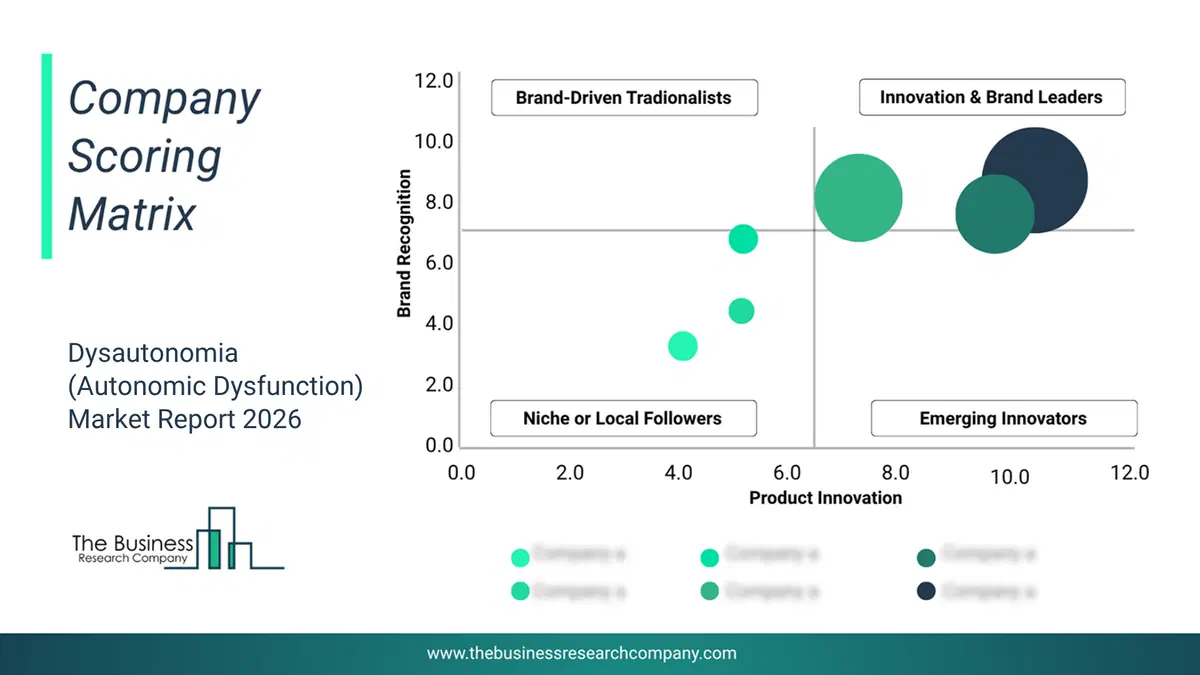
This chart maps companies by product innovation and brand strength, with bubble size indicating relative revenue, helping identify market leaders, challengers, and niche players. This is an illustrative chart; the full report provides a complete and accurate competitive analysis.
Global Dysautonomia (Autonomic Dysfunction) Market Trends and Insights
Major companies operating in the dysautonomia (autonomic dysfunction) market are focusing on advancing gene therapy approaches, such as recombinant adeno-associated virus (rAAV) systems, to improve targeted gene delivery and enhance therapeutic outcomes for patients with genetic forms of dysautonomia. Recombinant adeno-associated virus refers to a modified, non-pathogenic viral vector engineered to deliver therapeutic genes into specific cells, enabling long-term expression of corrected or functional proteins without causing disease. For instance, in January 2025, Tikun Therapeutics Inc., a US-based biotechnology company, received U.S. Food and Drug Administration (FDA) approval for Orphan Drug and Rare Pediatric Disease Designations for rAAV2-U1a-hELP1, a gene therapy candidate for optic neuropathy in familial dysautonomia, and BPN-36964, a small-molecule splicing modulator for systemic treatment. These therapies aim to correct the underlying genetic defects responsible for familial dysautonomia, offering the potential for durable, disease-modifying benefits beyond symptomatic management.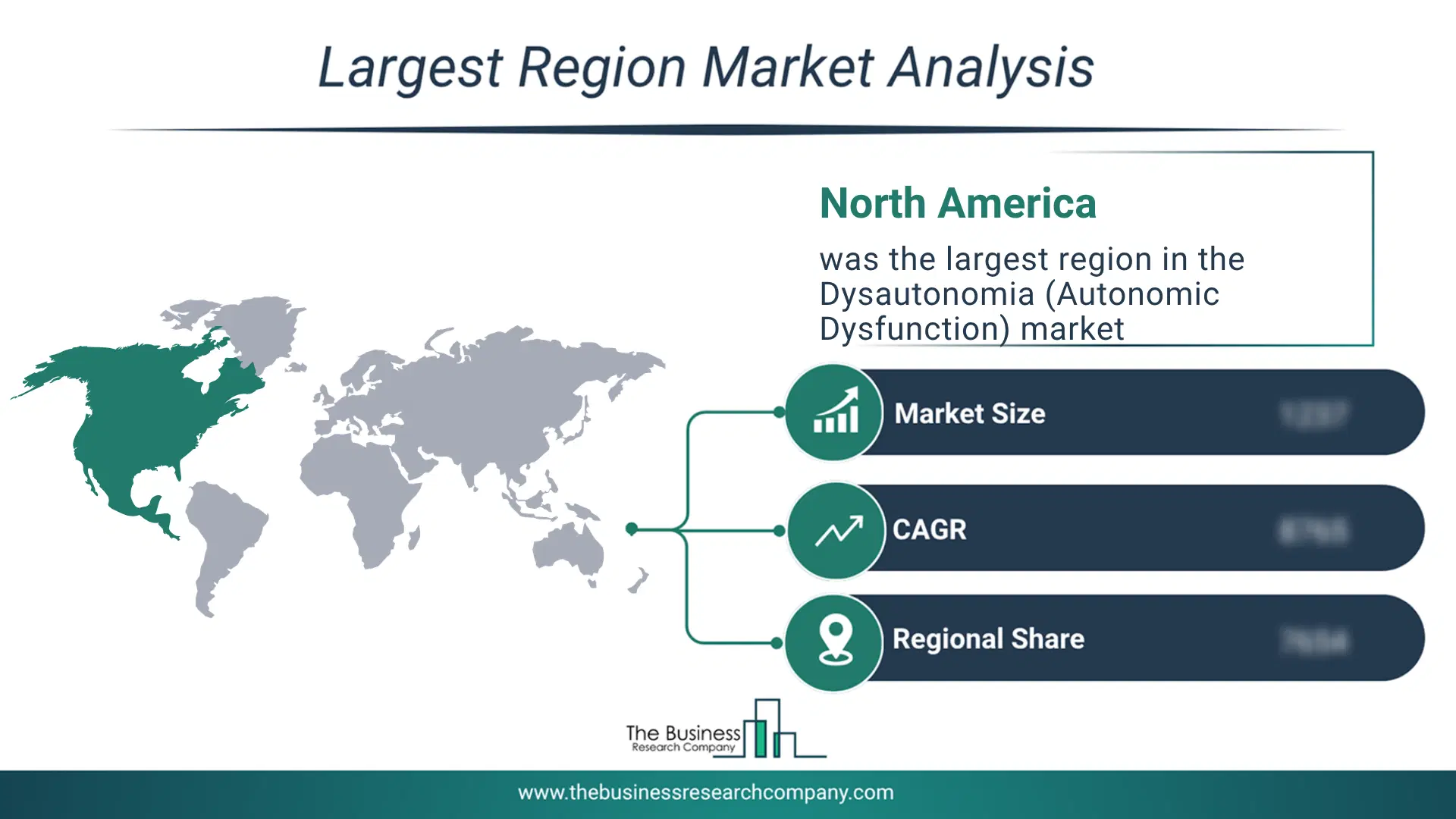
Regional Outlook
North America was the largest region in the dysautonomia (autonomic dysfunction) market in 2025. Asia-Pacific is expected to be the fastest-growing region in the forecast period. The regions covered in this market report are Asia-Pacific, South East Asia, Western Europe, Eastern Europe, North America, South America, Middle East, Africa. The countries covered in this market report are Australia, Brazil, China, France, Germany, India, Indonesia, Japan, Taiwan, Russia, South Korea, UK, USA, Canada, Italy, Spain.What Defines the Dysautonomia (Autonomic Dysfunction) Market?
The dysautonomia (autonomic dysfunction) market consists of revenues earned by entities by providing services such as pharmaceutical treatment, radiation therapy, diagnostic services, and surgical interventions. The market value includes the value of related goods sold by the service provider or included within the service offering. The dysautonomia (autonomic dysfunction) market also includes sales of diagnostic tools, intravenous therapies, neurostimulatory devices, compression garments, and electrolyte supplements. Values in this market are ‘factory gate’ values, that is, the value of goods sold by the manufacturers or creators of the goods, whether to other entities (including downstream manufacturers, wholesalers, distributors, and retailers) or directly to end customers. The value of goods in this market includes related services sold by the creators of the goods.How is Market Value Defined and Measured?
The market value is defined as the revenues that enterprises gain from the sale of goods and/or services within the specified market and geography through sales, grants, or donations in terms of the currency (in USD unless otherwise specified). The revenues for a specified geography are consumption values that are revenues generated by organizations in the specified geography within the market, irrespective of where they are produced. It does not include revenues from resales along the supply chain, either further along the supply chain or as part of other products.
This chart presents market attractiveness based on a quantitative evaluation of growth, competition, strategic alignment, and risk, offering a clear view of opportunity areas for decision-making. This chart is for illustrative purposes; the full report contains the complete analysis.

This chart highlights the Total Addressable Market (TAM) by estimating the maximum revenue opportunity using an assumption-driven approach, supporting strategic planning and opportunity sizing across markets. The chart is illustrative; the full report provides a more comprehensive analysis.
What Key Data and Analysis Are Included in the Dysautonomia (Autonomic Dysfunction) Market Report 2026?
The dysautonomia (autonomic dysfunction) market research report is one of a series of new reports from The Business Research Company that provides market statistics, including industry global market size, regional shares, competitors with the market share, detailed market segments, market trends and opportunities, and any further data you may need to thrive in the dysautonomia (autonomic dysfunction) industry. The market research report delivers a complete perspective of everything you need, with an in-depth analysis of the current and future state of the industry.Dysautonomia (Autonomic Dysfunction) Market Report Forecast Analysis
| Report Attribute | Details |
|---|---|
| Market Size Value In 2026 | $3.25 billion |
| Revenue Forecast In 2030 | $4.98 billion |
| Growth Rate | CAGR of 11.2% from 2026 to 2030 |
| Base Year For Estimation | 2025 |
| Actual Estimates/Historical Data | 2020-2025 |
| Forecast Period | 2026 - 2030 |
| Market Representation | Revenue in USD Billion and CAGR from 2026 to 2030 |
| Segments Covered | Type, Tests, Treatment, Distribution Channel, End User |
| Regional Scope | Asia-Pacific, Western Europe, Eastern Europe, North America, South America, Middle East, Africa |
| Country Scope | The countries covered in the report are Australia, Brazil, China, France, Germany, India, Indonesia, Japan, Taiwan, Russia, South Korea, UK, USA, Canada, Italy, Spain |
| Key Companies Profiled | Teva Pharmaceutical Industries Ltd., Aurobindo Pharma Limited, Hikma Pharmaceuticals PLC, Cadila Healthcare Limited Zydus Cadila, Lupin Limited, Nemours Children’s Health Delaware, Aurora Health Care Inc., Camber Pharmaceuticals Inc., DyAnsys Inc., Mylan Pharmaceuticals Private Limited, Chelsea Therapeutics International Ltd., Tikun Therapeutics Inc., Pfizer Inc., Novartis AG, Takeda Pharmaceutical Company Limited, Eli Lilly and Company, GlaxoSmithKline plc, Merck and Co Inc., AstraZeneca plc, UCB S.A., Amgen Inc., Johnson and Johnson, Bausch Health Companies Inc., AbbVie Inc., Robinhood Therapeutics, Santhera Pharmaceuticals AG, Valeant Pharmaceuticals |
| Customization Scope | Request for Customization |
| Pricing And Purchase Options | Explore Purchase Options |