
E-Textile Health Monitoring Market Report 2026
Global Outlook – By Product Type (Wearable Health-Monitoring E-Textiles, Medical-Grade Monitoring E-Textiles, Consumer Fitness & Wellness E-Textiles, Rehabilitation & Assistive E-Textiles, Other Product Types), By Technology (Sensor Integration, Wireless Communication, Conductive Materials, Other Technologies), By Material (Conductive Yarns, Conductive Fabrics, Other Materials), By Application (Cardiac Monitoring, Respiratory Monitoring, Activity Monitoring, Temperature Monitoring, Other Applications), By End-User (Hospitals And Clinics, Homecare Settings, Sports And Fitness, Military And Defense, Other End-Users) – Market Size, Trends, Strategies, and Forecast to 2030
E-Textile Health Monitoring Market Overview
• E-Textile Health Monitoring market size has reached to $3.59 billion in 2025 • Expected to grow to $12.09 billion in 2030 at a compound annual growth rate (CAGR) of 27.4% • Growth Driver: Surge In Remote Patient Monitoring Solutions Fueling The Growth Of The Market Due To Rising Demand For Continuous, At-Home Chronic Care • North America was the largest region in 2025 and Asia-Pacific is the fastest growing region.What Is Covered Under E-Textile Health Monitoring Market?
E-textile health monitoring refers to smart fabrics embedded with electronic sensors that can detect and measure various physiological signals such as heart rate, respiration, and body temperature. These textiles enable continuous, real-time health monitoring, offering comfort, flexibility, and remote medical assessment capabilities. The main product types of e-textile health monitoring are wearable e-textiles, implantable e-textiles, and others. Wearable e-textiles are fabrics or garments embedded with electronic components and sensors, enabling real-time monitoring, tracking, or interaction with physiological, biomechanical, or environmental data. It uses technologies such as sensor integration, wireless communication, and conductive materials, and other and different materials include conductive yarns, conductive fabrics, sensors, and others. These textiles are applied in cardiac monitoring, respiratory monitoring, activity monitoring, temperature monitoring, and others, serving end-users including hospitals and clinics, homecare settings, sports and fitness, military and defense, and others.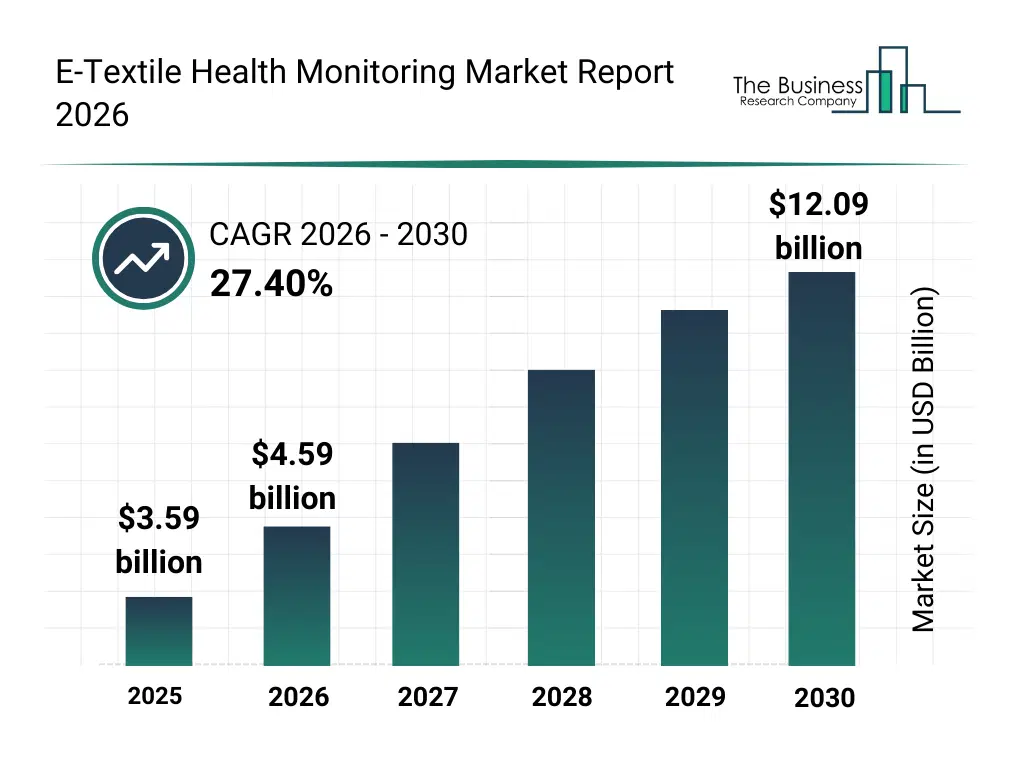
What Is The E-Textile Health Monitoring Market Size and Share 2026?
The e-textile health monitoring market size has grown exponentially in recent years. It will grow from $3.59 billion in 2025 to $4.59 billion in 2026 at a compound annual growth rate (CAGR) of 27.7%. The growth in the historic period can be attributed to rising adoption of wearable health devices, advancements in flexible electronics, increasing prevalence of chronic diseases, growing demand for remote patient monitoring, development of conductive textile materials.What Is The E-Textile Health Monitoring Market Growth Forecast?
The e-textile health monitoring market size is expected to see exponential growth in the next few years. It will grow to $12.09 billion in 2030 at a compound annual growth rate (CAGR) of 27.4%. The growth in the forecast period can be attributed to integration with ai-driven health platforms, expansion of wireless communication protocols, increasing adoption in sports and fitness sectors, regulatory approvals for clinical applications, growing demand for personalized healthcare. Major trends in the forecast period include real-time health data analytics, wearable sensor integration, remote patient monitoring, predictive health assessment, smart textile-enabled diagnostics.
Global E-Textile Health Monitoring Market Segmentation
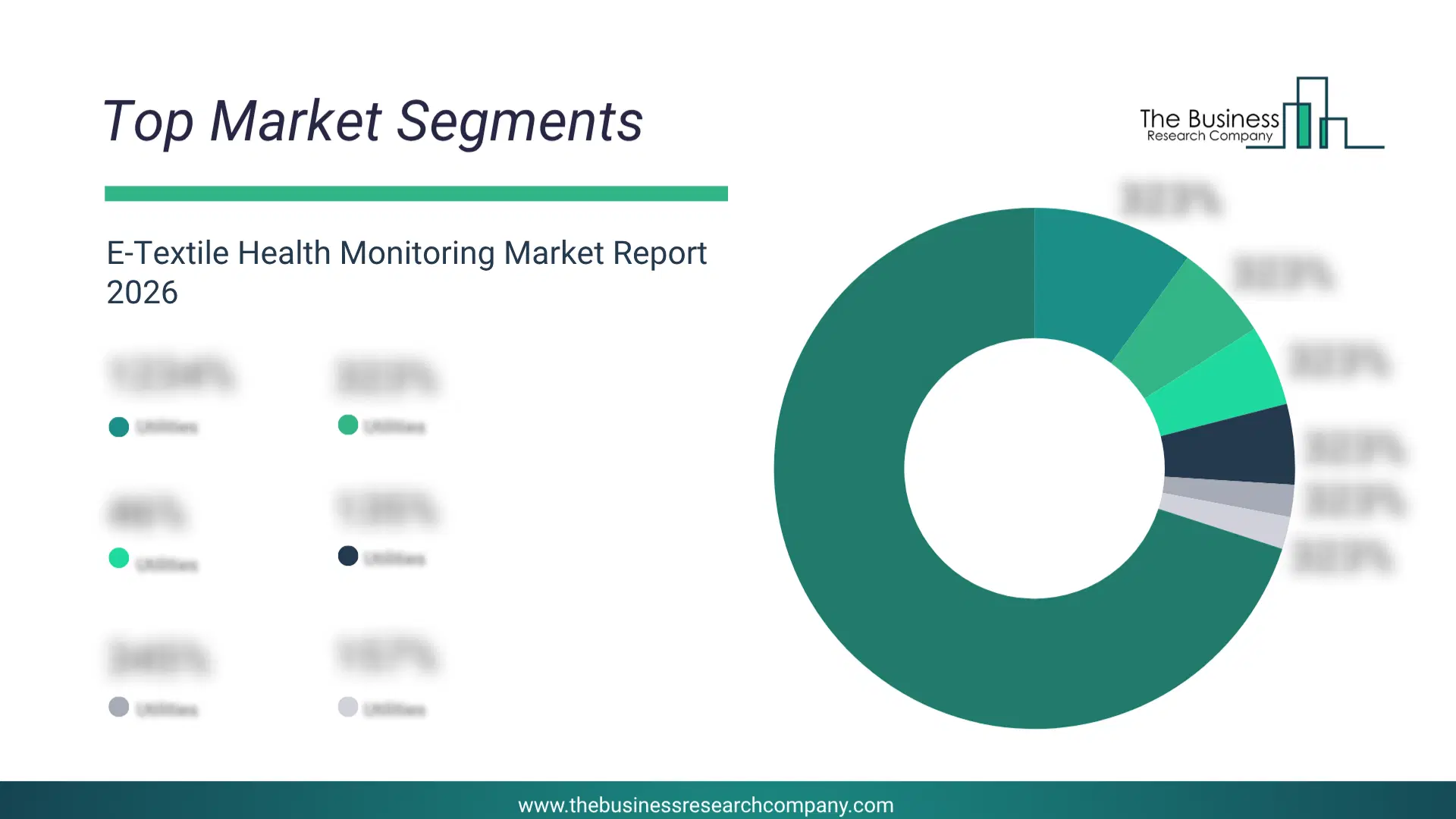
1) By Product Type: Wearable Health-Monitoring E-Textiles, Medical-Grade Monitoring E-Textiles, Consumer Fitness & Wellness E-Textiles, Rehabilitation & Assistive E-Textiles, Other Product Types 2) By Technology: Sensor Integration, Wireless Communication, Conductive Materials, Other Technologies 3) By Material: Conductive Yarns, Conductive Fabrics, Other Materials 4) By Application: Cardiac Monitoring, Respiratory Monitoring, Activity Monitoring, Temperature Monitoring, Other Applications 5) By End-User: Hospitals And Clinics, Homecare Settings, Sports And Fitness, Military And Defense, Other End-Users Subsegments: 1) By Wearable Health-Monitoring E-Textiles: Smart Shirts and Tops, Smart Pants and Leggings, Smart Socks and Footwear, Smart Undergarments 2) By Medical-Grade Monitoring E-Textiles: Cardiac Monitoring Garments, Respiratory Monitoring Garments, Continuous Vital-Sign Monitoring Textiles, Clinical Remote Patient Monitoring Textiles 3) By Consumer Fitness & Wellness E-Textiles: Fitness Tracking Apparel, Sports Performance Monitoring Clothing, Posture and Movement Monitoring Apparel 4) By Rehabilitation & Assistive E-Textiles: Physiotherapy Monitoring Garments, Gait and Mobility Monitoring Textiles, Recovery and Rehabilitation Smart Textiles 5) By Other E-Textile Health-Monitoring Products: Sensor-Embedded Textile Patches, Smart Bandages for Health Monitoring, Textile-Based Monitoring AccessoriesWhat Are The Drivers Of The E-Textile Health Monitoring Market?
The increasing demand for remote patient monitoring solutions is expected to propel the growth of the e-textile health monitoring market going forward. Remote patient monitoring (RPM) solutions refer to technologies that enable healthcare providers to track and manage patients’ health data remotely using connected devices and digital platforms. The increasing adoption of remote patient monitoring solutions is driven by the growing prevalence of chronic diseases, as these technologies allow continuous tracking of vital signs and early detection of health issues, enabling timely interventions and reducing hospital readmissions. E-textile health monitoring helps remote patient monitoring solutions by integrating sensors into fabrics to continuously measure physiological parameters such as heart rate, respiration, and body temperature, allowing real-time health data transmission for continuous and comfortable remote tracking of patients. For instance, in August 2025, according to the Department of Health and Human Services, a US-based government administration, in 2024, nearly 1 million enrollees received remote patient monitoring, a 27% increase from 2023. Therefore, the increasing demand for remote patient monitoring solutions is driving the growth of the e-textile health monitoring industry. The rising respiratory disorders is expected to propel the growth of the e-textile health monitoring market going forward. Respiratory disorders are health conditions that disrupt normal lung and airway function, making breathing and oxygen exchange difficult. Respiratory disorders are rising due to increasing air pollution, which damages lung tissue and triggers conditions like asthma, chronic bronchitis, and other breathing difficulties. E-textile health monitoring aids respiratory disorder management by constantly monitoring breathing patterns, allowing for early detection of abnormalities and prompt medical response to prevent complications. For instance, in October 2024, according to the Center for Infectious Disease Research and Policy (CIDRAP), a US-based public health organization, 8.2 million people were newly diagnosed with tuberculosis (TB) in 2023, reflecting a rise from 7.5 million new cases reported in 2022. Therefore, the rising respiratory disorders is driving the growth of the e-textile health monitoring industry.Key Players In The Global E-Textile Health Monitoring Market
Major companies operating in the e-textile health monitoring market are Myant Health Inc., Smartex Srl, Siren Care Inc., Carre Technologies Inc., BioSerenity, Chronolife SAS, Sensoria Health Inc., Xenoma Inc., AiQ Smart Clothing Inc., Embro GmbH, Interactive Wear AG, Loomia Technologies Inc., Ohmatex ApS, Nextiles Inc., Wearable X Inc., Sensing Tex S.L., TexRay Industrial Co. Ltd., Clothing Plus Oy, HealthWatch Ltd., Athos Works Inc.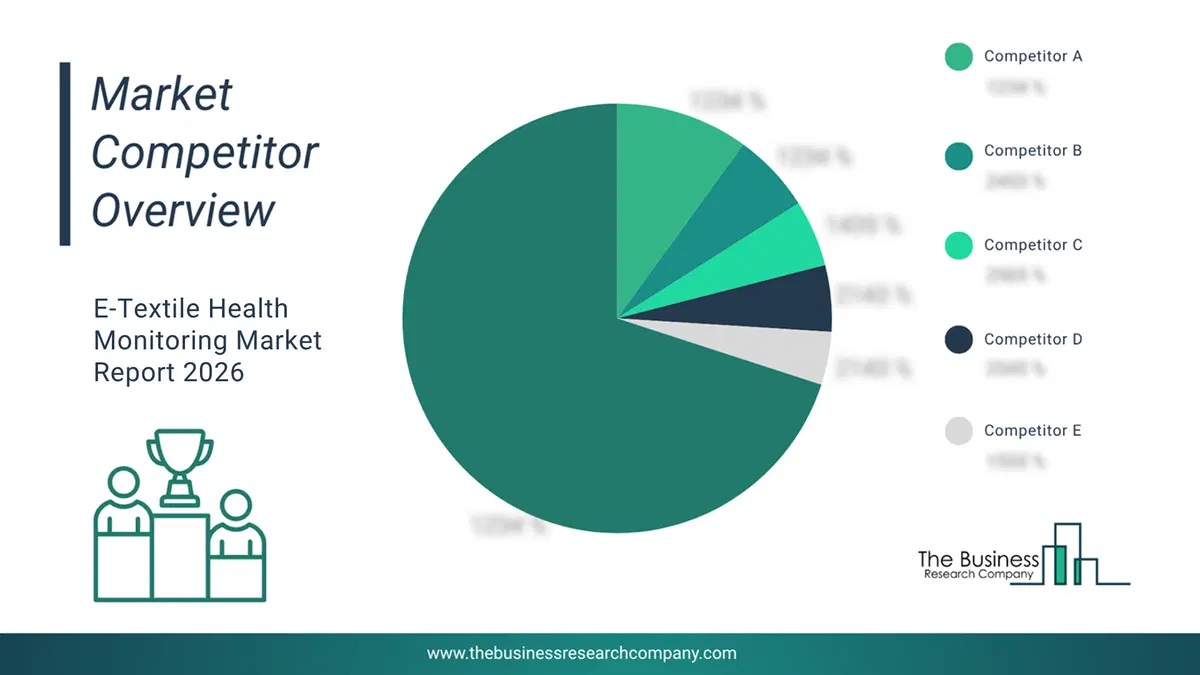
This chart is for illustrative purposes; the full report includes a detailed competitor analysis and comprehensive overview of the top 10 companies in the market.
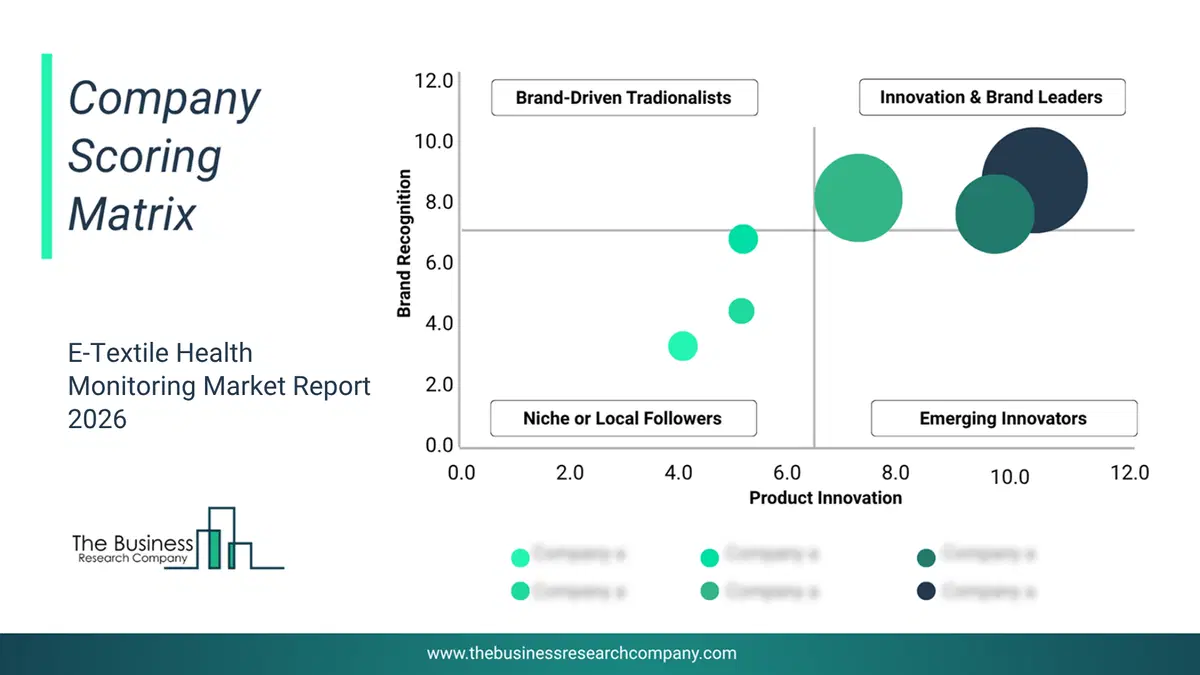
This chart maps companies by product innovation and brand strength, with bubble size indicating relative revenue, helping identify market leaders, challengers, and niche players. This is an illustrative chart; the full report provides a complete and accurate competitive analysis.
What Are Latest Mergers And Acquisitions In The E-Textile Health Monitoring Market?
In November 2024, Myant Corp., a Canada-based technology company, acquired Nanoleq AG for an undisclosed amount. With this acquisition, Myant Corp. aims to transform healthcare by embedding intelligence into everyday textiles to enable proactive, preventive health management through continuous real-time monitoring, while expanding its presence in European and Middle Eastern markets. Nanoleq AG is a Switzerland-based smart textiles company that offers e-textile health monitoring.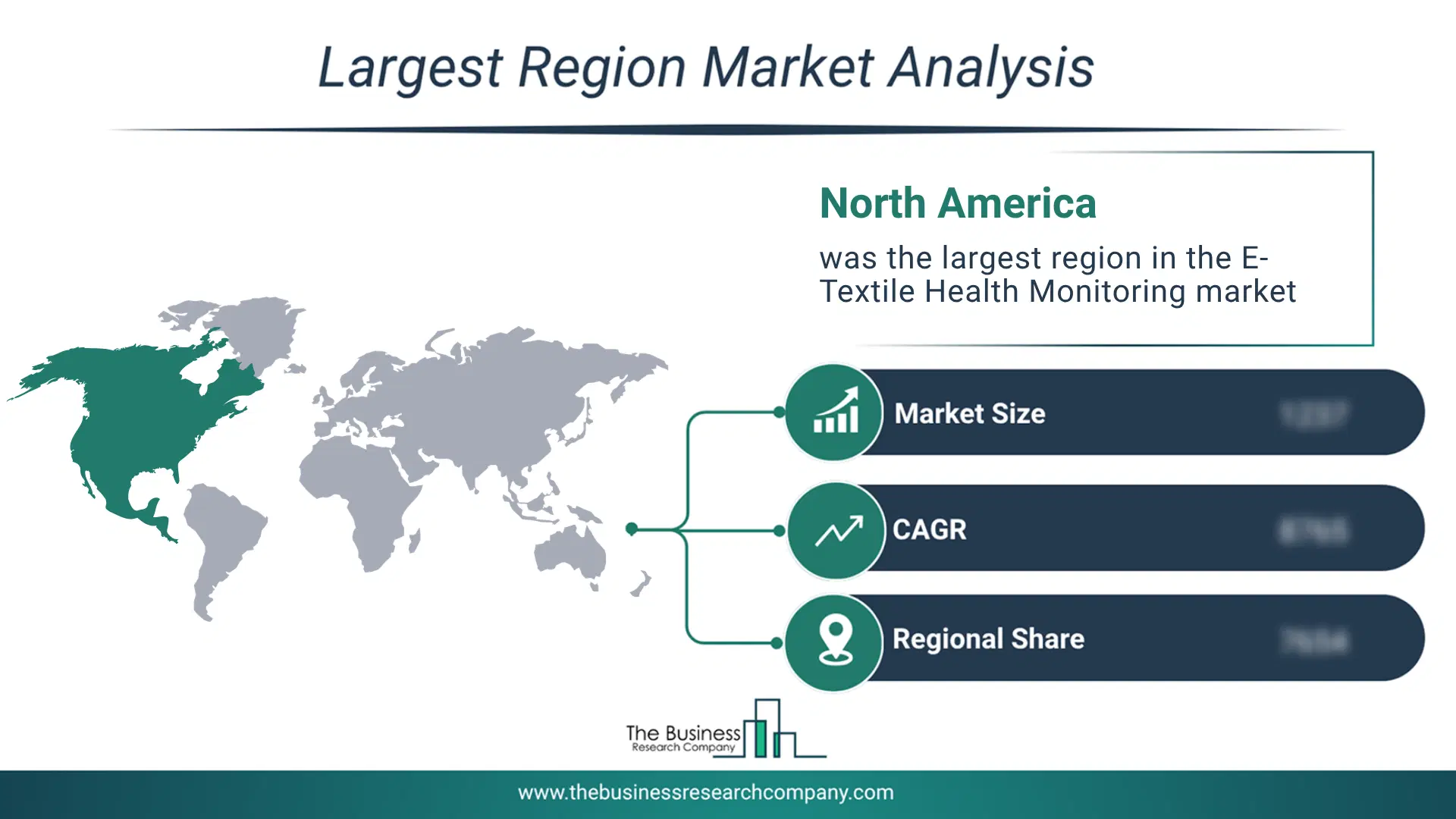
Regional Outlook
North America was the largest region in the e-textile health monitoring market in 2025. Asia-Pacific is expected to be the fastest-growing region in the forecast period. The regions covered in this market report are Asia-Pacific, South East Asia, Western Europe, Eastern Europe, North America, South America, Middle East, Africa. The countries covered in this market report are Australia, Brazil, China, France, Germany, India, Indonesia, Japan, Taiwan, Russia, South Korea, UK, USA, Canada, Italy, SpainWhat Defines the E-Textile Health Monitoring Market?
The e-textile health monitoring market consists of revenues earned by entities by providing services such as fall detection and motion analysis, postural monitoring, stress and fatigue assessment, and rehabilitation tracking. The market value includes the value of related goods sold by the service provider or contained within the service offering. The e-textile health monitoring market consists of sales of smart bedding systems, e-textile bandages, smart footwear, e-textile gloves, smart compression garments, and e-textile patches. Values in this market are ‘factory gate’ values, that is, the value of goods sold by the manufacturers or creators of the goods, whether to other entities (including downstream manufacturers, wholesalers, distributors, and retailers) or directly to end customers. The value of goods in this market includes related services sold by the creators of the goods.How is Market Value Defined and Measured?
The market value is defined as the revenues that enterprises gain from the sale of goods and/or services within the specified market and geography through sales, grants, or donations in terms of the currency (in USD unless otherwise specified). The revenues for a specified geography are consumption values that are revenues generated by organizations in the specified geography within the market, irrespective of where they are produced. It does not include revenues from resales along the supply chain, either further along the supply chain or as part of other products.
This chart presents market attractiveness based on a quantitative evaluation of growth, competition, strategic alignment, and risk, offering a clear view of opportunity areas for decision-making. This chart is for illustrative purposes; the full report contains the complete analysis.

This chart highlights the Total Addressable Market (TAM) by estimating the maximum revenue opportunity using an assumption-driven approach, supporting strategic planning and opportunity sizing across markets. The chart is illustrative; the full report provides a more comprehensive analysis.
What Key Data and Analysis Are Included in the E-Textile Health Monitoring Market Report 2026?
The e-textile health monitoring market research report is one of a series of new reports from The Business Research Company that provides market statistics, including industry global market size, regional shares, competitors with the market share, detailed market segments, market trends and opportunities, and any further data you may need to thrive in the e-textile health monitoring industry. The market research report delivers a complete perspective of everything you need, with an in-depth analysis of the current and future state of the industry.E-Textile Health Monitoring Market Report Forecast Analysis
| Report Attribute | Details |
|---|---|
| Market Size Value In 2026 | $4.59 billion |
| Revenue Forecast In 2030 | $12.09 billion |
| Growth Rate | CAGR of 27.4% from 2026 to 2030 |
| Base Year For Estimation | 2025 |
| Actual Estimates/Historical Data | 2020-2025 |
| Forecast Period | 2026 - 2030 |
| Market Representation | Revenue in USD Billion and CAGR from 2026 to 2030 |
| Segments Covered | Product Type, Technology, Material, Application, End-User |
| Regional Scope | Asia-Pacific, Western Europe, Eastern Europe, North America, South America, Middle East, Africa |
| Country Scope | The countries covered in the report are Australia, Brazil, China, France, Germany, India, Indonesia, Japan, Taiwan, Russia, South Korea, UK, USA, Canada, Italy, Spain. |
| Key Companies Profiled | Myant Health Inc., Smartex Srl, Siren Care Inc., Carre Technologies Inc., BioSerenity, Chronolife SAS, Sensoria Health Inc., Xenoma Inc., AiQ Smart Clothing Inc., Embro GmbH, Interactive Wear AG, Loomia Technologies Inc., Ohmatex ApS, Nextiles Inc., Wearable X Inc., Sensing Tex S.L., TexRay Industrial Co. Ltd., Clothing Plus Oy, HealthWatch Ltd., Athos Works Inc. |
| Customization Scope | Request for Customization |
| Pricing And Purchase Options | Explore Purchase Options |