
Ear Biometrics Market Report 2026
Global Outlook – By Component (Hardware, Software, Services), By Authentication Type (Passive, Active), By Deployment Mode (On-Premises, Cloud), By Application (Access Control, Authentication, Surveillance And Monitoring, Forensics, Other Applications), By End-User (Banking And Finance, Government And Defense, Healthcare, Consumer Electronics, Automotive, Other End-Users) – Market Size, Trends, Strategies, and Forecast to 2030
Ear Biometrics Market Overview
• Ear Biometrics market size has reached to $1.07 billion in 2025 • Expected to grow to $2.2 billion in 2030 at a compound annual growth rate (CAGR) of 15.5% • Growth Driver: Surge In Cyber Threats And Data Breaches Driving The Market Growth Due To Rising Digital Crime • North America was the largest region in 2025 and Asia-Pacific is the fastest growing region.What Is Covered Under Ear Biometrics Market?
Ear biometrics is a biometric identification technique that uses the unique anatomical structure of a person’s ear to recognize or verify their identity. It relies on distinctive features such as the ear’s shape, contours, ridges, and relative proportions, which are largely stable over time and differ from one individual to another. Ear biometric systems typically capture ear images using cameras and analyze these features through pattern recognition algorithms, making the method non-intrusive and suitable for use alone or in combination with other biometric modalities for enhanced security and identification accuracy. The main components of ear biometrics include hardware, software, and services. Hardware includes sensors and scanners used to capture ear features for identification and verification. They are classified into passive and active authentication types and are deployed through on-premises and cloud. They find application in access control, authentication, surveillance and monitoring, forensics, and other applications, serving end users including banking and finance, government and defense, healthcare, consumer electronics, automotive, and other end-users.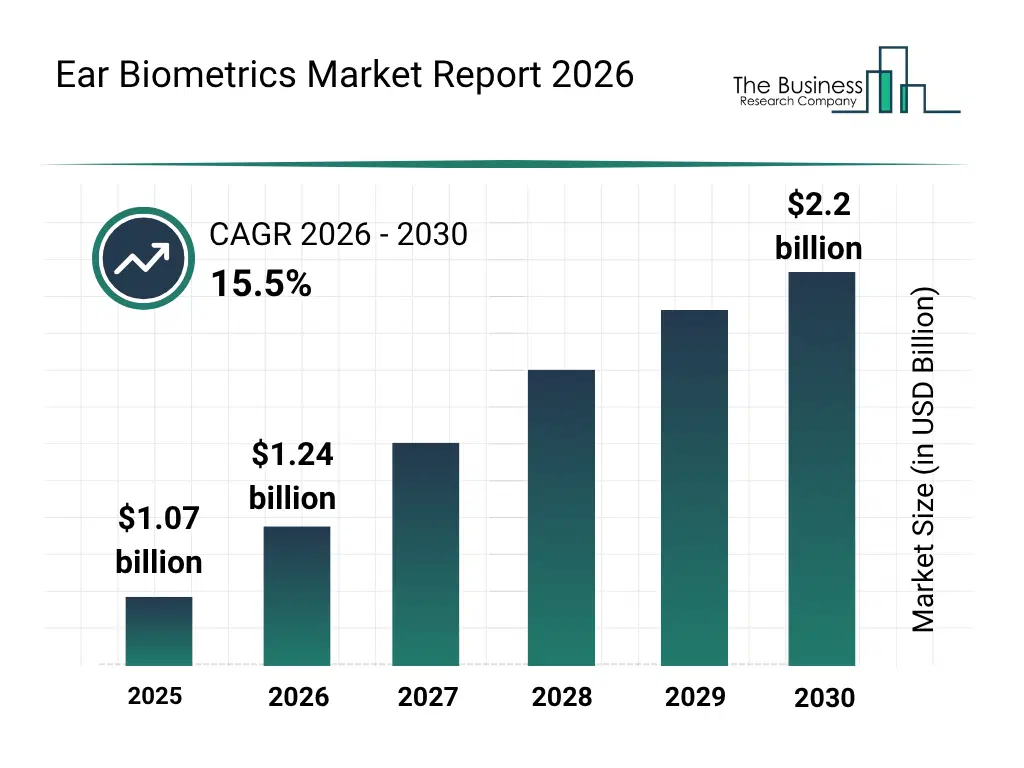
What Is The Ear Biometrics Market Size and Share 2026?
The ear biometrics market size has grown rapidly in recent years. It will grow from $1.07 billion in 2025 to $1.24 billion in 2026 at a compound annual growth rate (CAGR) of 15.2%. The growth in the historic period can be attributed to increasing focus on multi-modal biometrics, adoption of ear recognition in security-sensitive sectors, rising investment in biometric R&D, growth of surveillance infrastructure, demand for non-intrusive authentication methods.What Is The Ear Biometrics Market Growth Forecast?
The ear biometrics market size is expected to see rapid growth in the next few years. It will grow to $2.2 billion in 2030 at a compound annual growth rate (CAGR) of 15.5%. The growth in the forecast period can be attributed to growing adoption of AI-enabled pattern recognition, increasing cloud deployment of biometric systems, rising integration with IoT-enabled security devices, expansion of government and defense biometric programs, increasing demand for real-time authentication and monitoring. Major trends in the forecast period include growing adoption of ear biometric authentication in banking and finance, rising integration with access control systems, expansion of surveillance and monitoring applications, increasing use in forensic investigations, rising demand for cloud-based biometric platforms.
Global Ear Biometrics Market Segmentation
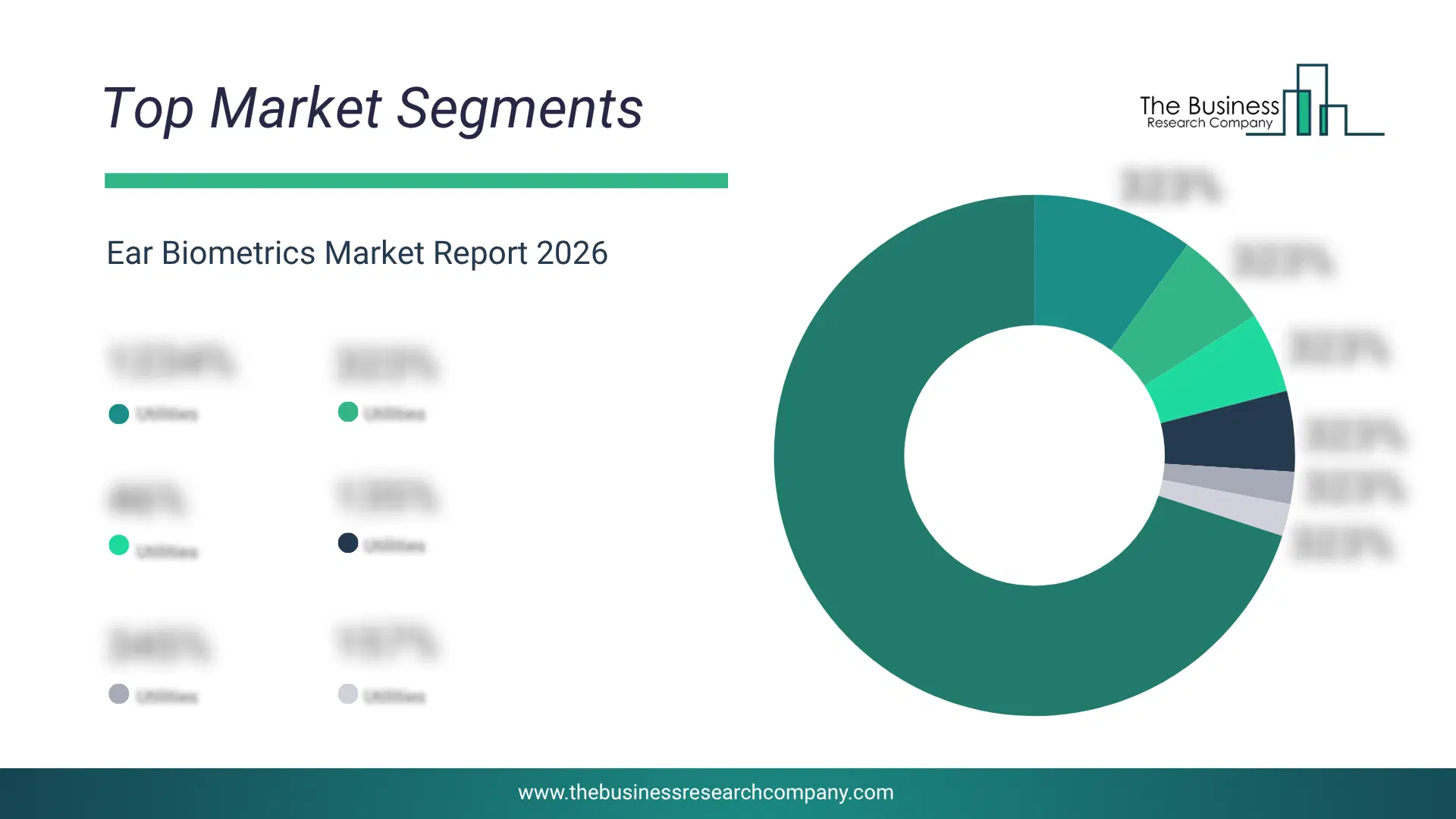
1) By Component: Hardware, Software, Services 2) By Authentication Type: Passive, Active 3) By Deployment Mode: On-Premises, Cloud 4) By Application: Access Control, Authentication, Surveillance And Monitoring, Forensics, Other Applications 5) By End-User: Banking And Finance, Government And Defense, Healthcare, Consumer Electronics, Automotive, Other End-Users Subsegments: 1) By Hardware: Image Capture Devices, Biometric Sensors, Cameras, Storage Devices, Processing Units, Peripheral Equipment 2) By Software: Image Processing Software, Pattern Recognition Software, Matching And Identification Software, Database Management Software, Security And Encryption Software, Integration Software 3) By Services: Consulting Services, System Integration Services, Deployment Services, Support And Maintenance Services, Training Services, Managed ServicesWhat Are The Drivers Of The Ear Biometrics Market?
The rising incidence of cyber threats and data breaches is expected to drive the growth of the ear biometrics market in the coming years. Cyber threats and data breaches refer to increasingly frequent and sophisticated unauthorized digital attacks that compromise sensitive information, digital identities, and networked systems. The rising incidence of cyber threats and data breaches is largely associated with rapid digital transformation, widespread cloud adoption, and growing reliance on interconnected digital platforms, all of which have expanded the attack surface and created additional vulnerabilities for cybercriminals to exploit. Ear biometrics offer enhanced protection against cyber threats by enabling secure and reliable physiological authentication based on unique ear shape and structure, which are difficult to replicate or spoof. For instance, in April 2025, the Federal Bureau of Investigation (FBI), a US-based government agency, reported that cybercrime complaints reached 859,532 in 2024, with reported losses exceeding $16.6 billion, representing a 33% increase compared to 2023. Therefore, the surge in cyber threats and data breaches is driving the growth of the ear biometrics industry. The proliferation of smart devices is expected to drive the growth of the ear biometrics market in the coming years. Smart devices include electronic products such as smartphones, tablets, smartwatches, and other connected gadgets that leverage internet connectivity, onboard sensors, and software to process data and interact with users or other devices. The adoption of smart devices has been increasing steadily, supported by expanding internet penetration and the widespread availability of high-speed networks, which enable seamless access to digital services, cloud-based applications, and real-time communication. The growing integration of biometric authentication in smart devices is enhancing both security and user convenience by enabling fast, device-level identity verification using unique physiological characteristics. While fingerprint and facial recognition remain dominant, emerging biometric modalities such as ear biometrics are gaining attention for their potential advantages in terms of passive authentication, compatibility with wearable devices, and resistance to spoofing. For instance, in March 2024, according to ConsumerAffairs, a US-based consumer news and advocacy organization, American ownership of smartphones increased to 92% in 2023 from 86% in 2022. Therefore, the proliferation of smart devices is driving the growth of the ear biometrics industry. The growing emphasis on contactless authentication solutions is expected to propel the growth of the ear biometrics market going forward. Contactless authentication solutions refer to technologies that verify a person's identity without requiring physical contact, using biometric traits such as facial features, iris patterns, or ear geometry. The emphasis on contactless authentication solutions is rising due to the growing demand for seamless user experiences, as individuals and organizations increasingly prefer fast, frictionless, and hygienic verification methods that eliminate physical interaction while maintaining high security standards. Ear biometrics support contactless authentication solutions by enabling touch-free identity verification through the unique shape and structural patterns of an individual’s ear, allowing secure, accurate, and hygienic user authentication without requiring physical contact with devices or sensors. For instance, in January 2024, according to the Transportation Security Administration (TSA), a US-based government agency, in 2023, the transportation security administration (TSA) installed 457 CAT-2 upgrade kits incorporating facial recognition technology. Therefore, the growing emphasis on contactless authentication solutions is driving the growth of the ear biometrics industry.Key Players In The Global Ear Biometrics Market
Major companies operating in the ear biometrics market are NEC Corporation, IDEMIA Group, Verint Systems Inc., M2SYS Technology, Daon Inc., Neurotechnology, Aculab plc, Integrated Biometrics LLC, Sensory Inc., Rank One Computing Corporation, Suprema Inc., Phonexia s.r.o., Innovatrics s.r.o., Herta Security, Ayonix Corporation, BIO-key International Inc., FaceFirst Inc., B-Secur Ltd., KeyLemon SA, Auraya Systems Pty Ltd., BioID GmbH, Sonavation Inc., and Clearview AI Inc.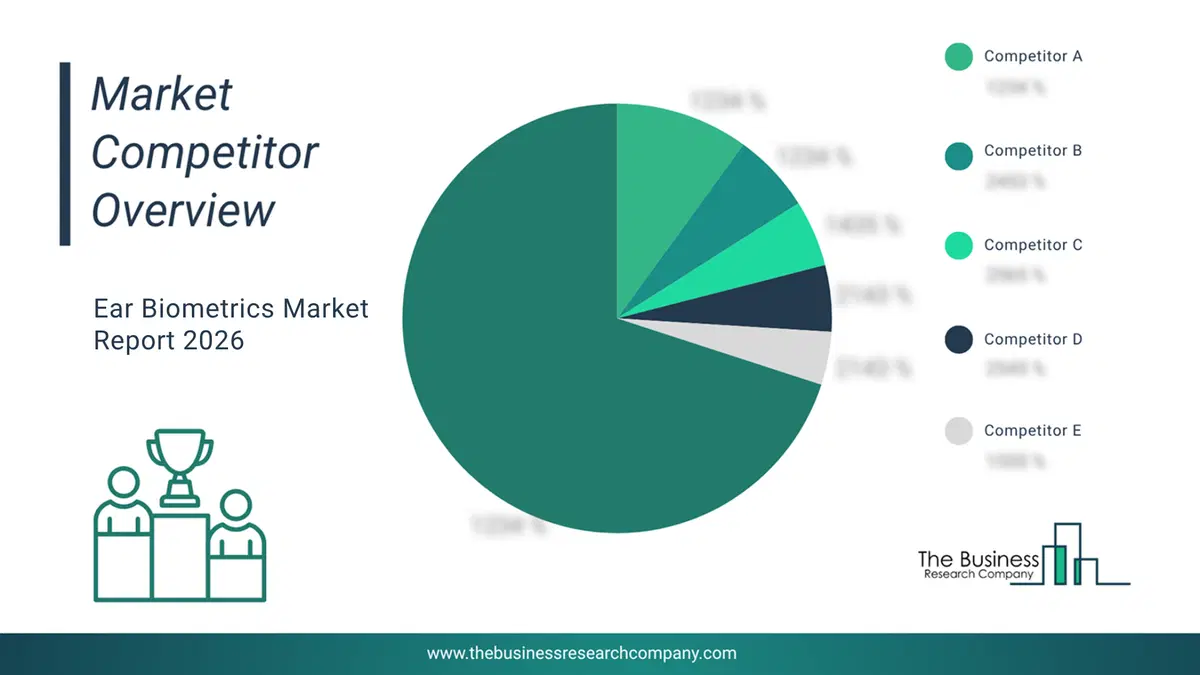
This chart is for illustrative purposes; the full report includes a detailed competitor analysis and comprehensive overview of the top 10 companies in the market.
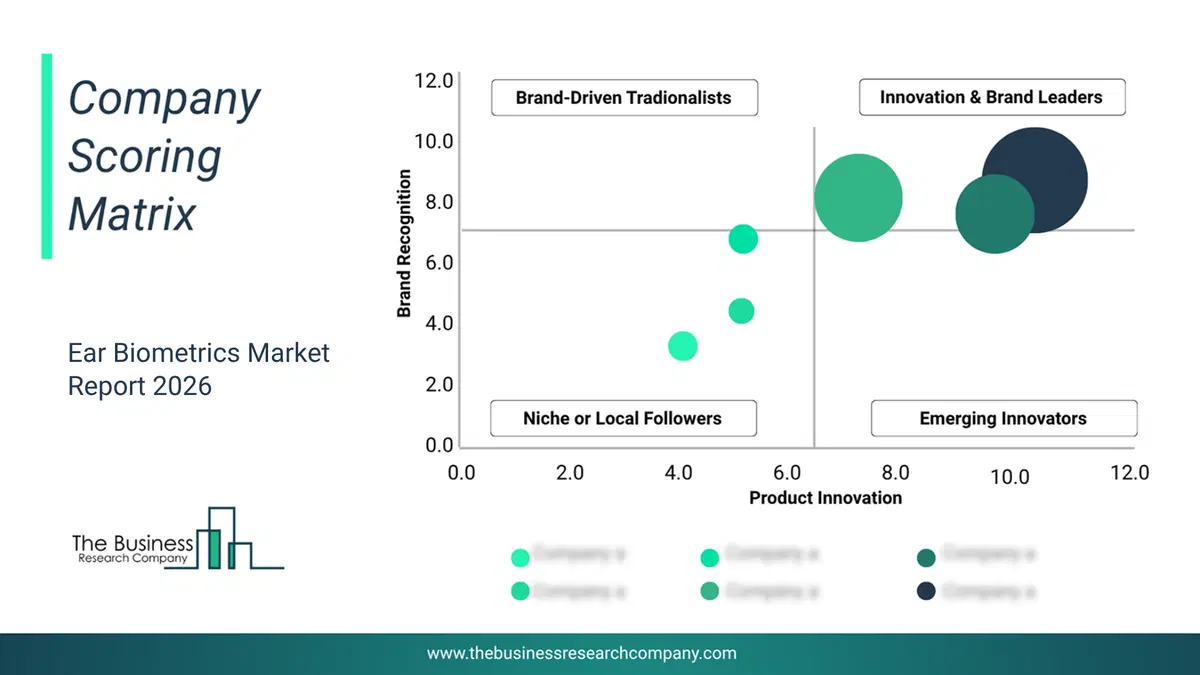
This chart maps companies by product innovation and brand strength, with bubble size indicating relative revenue, helping identify market leaders, challengers, and niche players. This is an illustrative chart; the full report provides a complete and accurate competitive analysis.
Regional Insights
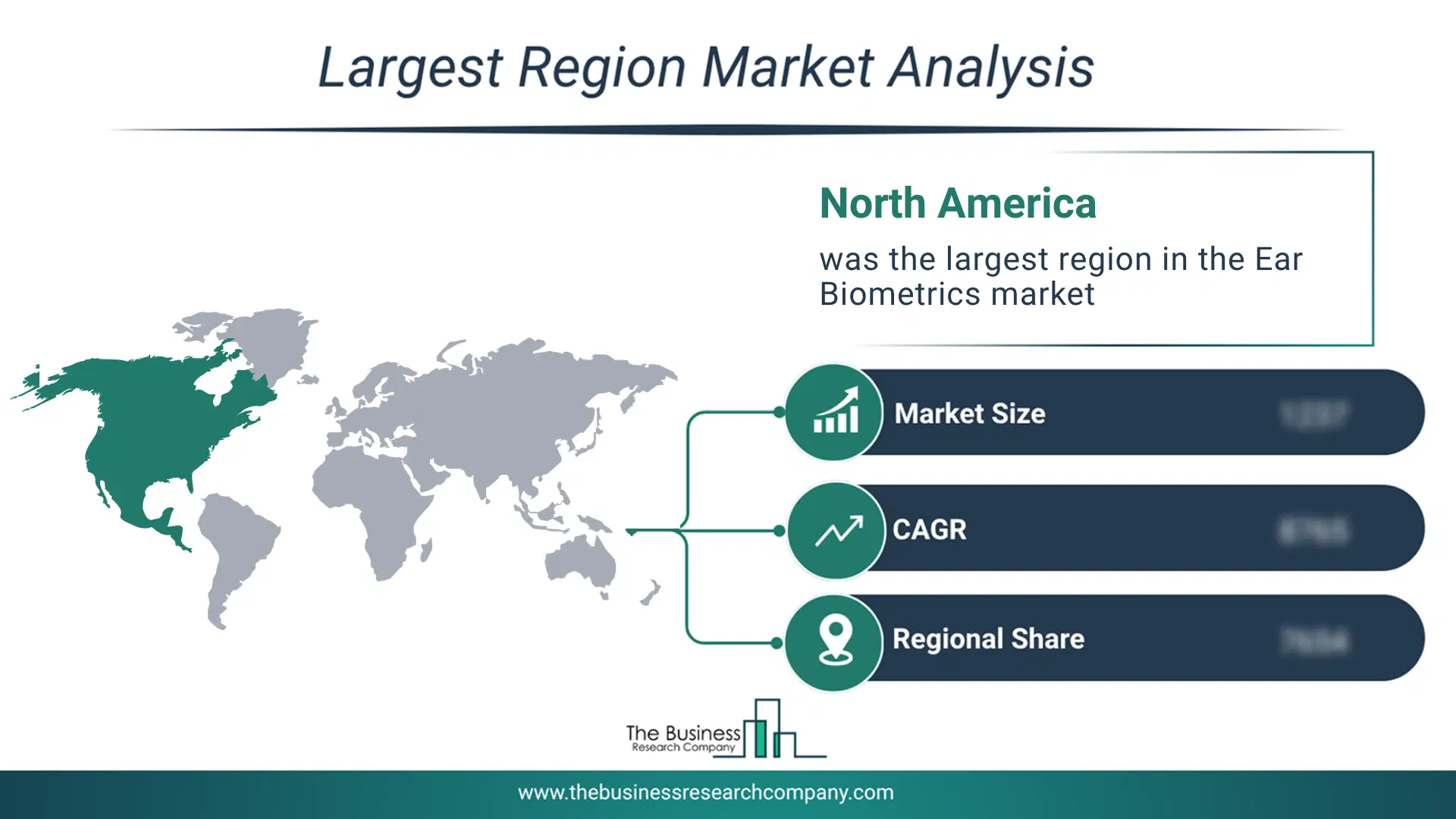
North America was the largest region in the ear biometrics market in 2025. Asia-Pacific is expected to be the fastest-growing region in the forecast period. The regions covered in this market report are Asia-Pacific, South East Asia, Western Europe, Eastern Europe, North America, South America, Middle East, Africa. The countries covered in this market report are Australia, Brazil, China, France, Germany, India, Indonesia, Japan, Taiwan, Russia, South Korea, UK, USA, Canada, Italy, Spain.What Defines the Ear Biometrics Market?
The ear biometrics market consists of revenues earned by entities by providing services such as identity verification services, access control management services, system maintenance and support services, software development and customization services, enrollment and verification services. The market value includes the value of related goods sold by the service provider or included within the service offering. The ear biometrics market also includes sales of ear recognition sensors and biometric scanning devices, ear biometric identification and access control systems, and software algorithms. Values in this market are ‘factory gate’ values, that is the value of goods sold by the manufacturers or creators of the goods, whether to other entities (including downstream manufacturers, wholesalers, distributors and retailers) or directly to end customers. The value of goods in this market includes related services sold by the creators of the goods.How is Market Value Defined and Measured?
The market value is defined as the revenues that enterprises gain from the sale of goods and/or services within the specified market and geography through sales, grants, or donations in terms of the currency (in USD unless otherwise specified). The revenues for a specified geography are consumption values that are revenues generated by organizations in the specified geography within the market, irrespective of where they are produced. It does not include revenues from resales along the supply chain, either further along the supply chain or as part of other products.
This chart presents market attractiveness based on a quantitative evaluation of growth, competition, strategic alignment, and risk, offering a clear view of opportunity areas for decision-making. This chart is for illustrative purposes; the full report contains the complete analysis.

This chart highlights the Total Addressable Market (TAM) by estimating the maximum revenue opportunity using an assumption-driven approach, supporting strategic planning and opportunity sizing across markets. The chart is illustrative; the full report provides a more comprehensive analysis.
What Key Data And Analysis Are Included In The Ear Biometrics Market Report 2026?
The ear biometrics market research report is one of a series of new reports from The Business Research Company that provides market statistics, including industry global market size, regional shares, competitors with the market share, detailed market segments, market trends and opportunities, and any further data you may need to thrive in the ear biometrics industry. The market research report delivers a complete perspective of everything you need, with an in-depth analysis of the current and future state of the industry.Ear Biometrics Market Report Forecast Analysis
| Report Attribute | Details |
|---|---|
| Market Size Value In 2026 | $1.24 billion |
| Revenue Forecast In 2030 | $2.2 billion |
| Growth Rate | CAGR of 15.5% from 2026 to 2030 |
| Base Year For Estimation | 2025 |
| Actual Estimates/Historical Data | 2020-2025 |
| Forecast Period | 2026 - 2030 |
| Market Representation | Revenue in USD Billion and CAGR from 2026 to 2030 |
| Segments Covered | Component, Authentication Type, Deployment Mode, Application, End-User |
| Regional Scope | Asia-Pacific, Western Europe, Eastern Europe, North America, South America, Middle East, Africa |
| Country Scope | The Countries Covered In This Market Report Are Australia, Brazil, China, France, Germany, India, Indonesia, Japan, Taiwan, Russia, South Korea, Uk, Usa, Canada, Italy, Spain. |
| Key Companies Profiled | NEC Corporation, IDEMIA Group, Verint Systems Inc., M2SYS Technology, Daon Inc., Neurotechnology, Aculab plc, Integrated Biometrics LLC, Sensory Inc., Rank One Computing Corporation, Suprema Inc., Phonexia s.r.o., Innovatrics s.r.o., Herta Security, Ayonix Corporation, BIO-key International Inc., FaceFirst Inc., B-Secur Ltd., KeyLemon SA, Auraya Systems Pty Ltd., BioID GmbH, Sonavation Inc., and Clearview AI Inc. |
| Customization Scope | Request for Customization |
| Pricing And Purchase Options | Explore Purchase Options |