
East‑West Threat Detection Appliance Market Report 2026
Global Outlook – By Component (Hardware, Software, Services), By Deployment Mode (On-Premises, Cloud), By Organization Size (Small And Medium Enterprises, Large Enterprises), By Application (Network Security, Data Center Security, Cloud Security, Other Applications), By End-User (Banking, Financial Services, And Insurance (BFSI), Healthcare, Information Technology And Telecom, Government, Retail, Manufacturing, Other End-Users) – Market Size, Trends, Strategies, and Forecast to 2035
East‑West Threat Detection Appliance Market Overview
• East‑West Threat Detection Appliance market size has reached to $3.06 billion in 2025 • Expected to grow to $6.72 billion in 2030 at a compound annual growth rate (CAGR) of 17% • Growth Driver: Rising Sophistication Of Network-Level Attacks Fuelling The Growth Of The Market Amid Increasing Use Of Interconnected Cloud And Hybrid Networks • Market Trend: Leveraging Artificial Intelligence (AI) For Enhanced East-West Threat Detection • North America was the largest region in 2025 and Asia-Pacific is the fastest growing region.What Is Covered Under East‑West Threat Detection Appliance Market?
An east-west threat detection appliance is a security tool that monitors and inspects traffic moving inside a data centre or cloud network, specifically between internal servers, workloads, and applications. It works by analysing internal communication in real time, using deep inspection, analytics, or behavioural techniques to identify hidden malware, lateral movement, and other suspicious activities that traditional perimeter tools often miss. These appliances are important because they help organizations detect stealthy attacks early, prevent internal spread, and strengthen zero-trust security across complex environments. The main components of east-west threat detection appliances are hardware, software, and services. Deployment modes include on-premises and cloud-based models. Hardware refers to the physical components such as sensors, processing units, detection modules, and network connectivity units that enable the monitoring, analysis, and prevention of lateral threats within an organization’s internal network. These appliances are adopted by organizations of various sizes, including small and medium enterprises and large enterprises. They are used for multiple applications such as network security, data center security, cloud security, and other related applications. They cater to various end-users, including banking, financial services, and insurance (BFSI), healthcare, information technology and telecom, government, retail, manufacturing, and other industries.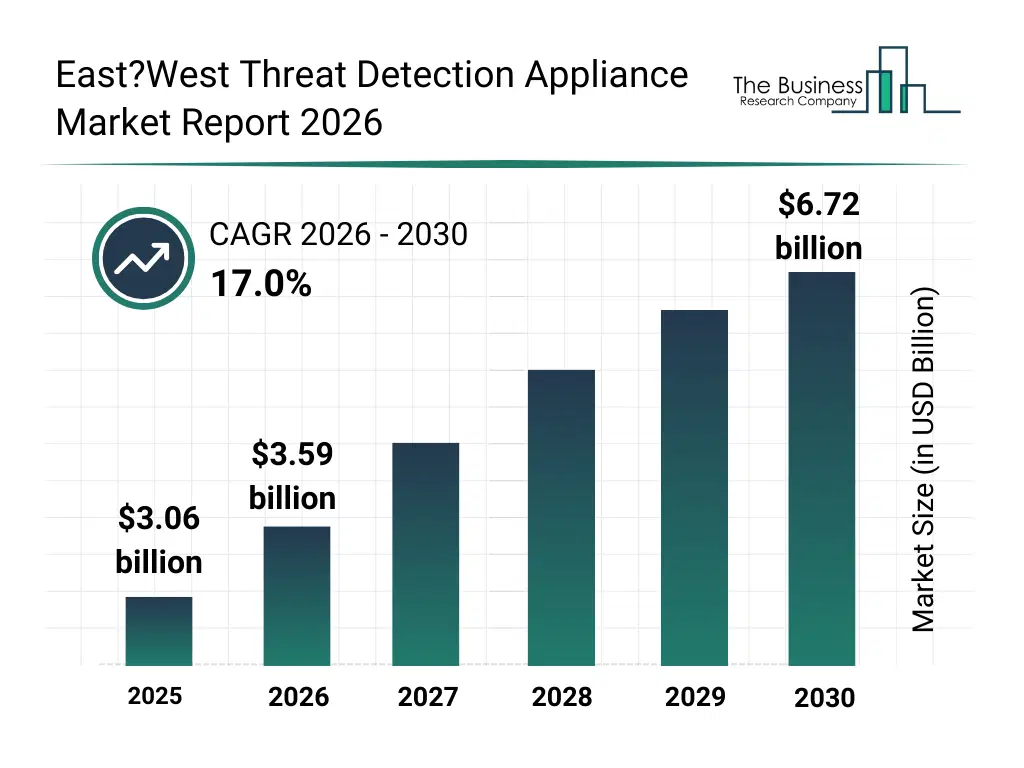
What Is The East‑West Threat Detection Appliance Market Size and Share 2026?
The east‑west threat detection appliance market size has grown rapidly in recent years. It will grow from $3.06 billion in 2025 to $3.59 billion in 2026 at a compound annual growth rate (CAGR) of 17.3%. The growth in the historic period can be attributed to rise in ransomware and internal propagation attacks, growth of virtualized and cloud workloads, limitations of perimeter-only security models, increasing regulatory scrutiny on breaches, expansion of SOC and SIEM deployments.What Is The East‑West Threat Detection Appliance Market Growth Forecast?
The east‑west threat detection appliance market size is expected to see rapid growth in the next few years. It will grow to $6.72 billion in 2030 at a compound annual growth rate (CAGR) of 17.0%. The growth in the forecast period can be attributed to AI-assisted anomaly detection at line rate, greater adoption of microsegmentation policies, integration with cloud-native security controls, demand for unified visibility across hybrid networks, increased focus on insider threat detection. Major trends in the forecast period include lateral movement detection in data centers, behavioral analytics for east-west traffic, encrypted traffic inspection and visibility, zero trust microsegmentation monitoring, integrated ndr and soc workflows.
Global East‑West Threat Detection Appliance Market Segmentation
1) By Component: Hardware, Software, Services 2) By Deployment Mode: On-Premises, Cloud 3) By Organization Size: Small And Medium Enterprises, Large Enterprises 4) By Application: Network Security, Data Center Security, Cloud Security, Other Applications 5) By End-User: Banking, Financial Services, And Insurance (BFSI), Healthcare, Information Technology And Telecom, Government, Retail, Manufacturing, Other End-Users Subsegments: 1) By Hardware Type: Sensors, Detection Modules, Processing Units, User Interface Panels, Network Connectivity Units 2) By Software Type: Threat Analytics Software, Data Visualization Software, Device Management Software, Alert Management Software, Reporting And Dashboard Software 3) By Services Type: Installation And Setup Services, Maintenance And Support Services, System Integration Services, Training And Education Services, Managed Detection ServicesWhat Is The Driver Of The East‑West Threat Detection Appliance Market?
The rising sophistication of network-level attacks is expected to propel the growth of the east-west threat detection appliance market going forward. Network-level attacks refer to cyber intrusions that exploit vulnerabilities in interconnected systems, allowing adversaries to move laterally across internal networks to steal data or disrupt operations. Network-level attacks are surging due to the increasing use of interconnected cloud and hybrid networks, which give attackers more entry points and pathways for lateral movement inside enterprise environments. East‑west threat detection appliances monitor and analyze lateral traffic between systems within a data center or cloud environment, enabling the detection and prevention of network-level attacks such as lateral movement, malware propagation, and insider threats by providing deep visibility, real-time anomaly detection, and automated response capabilities across internal network segments. For instance, in April 2025, according to the Federal Bureau of Investigation (FBI), a US-based government law-enforcement agency, internet-crime losses in the United States exceeded US $16 billion in 2024, representing a 33% increase compared to 2023. Therefore, the rising sophistication of network-level attacks is driving the growth for the east-west threat detection appliance market.Key Players In The Global East‑West Threat Detection Appliance Market
Major companies operating in the east‑west threat detection appliance market are Cisco Systems Inc., Broadcom Inc., Palo Alto Networks Inc., Arista Networks Inc., Fortinet Inc., AkamAI Technologies Inc., Check Point Software Technologies Ltd, Nutanix Inc., Zscaler Inc., Trend Micro Incorporated, Sangfor Technologies Inc., Netskope Inc., Rapid7 Inc., Bitdefender LLC, ExtraHop Networks Inc., Vectra AI Inc., Illumio Inc., Corelight Inc., ColorTokens Inc., Tigera Inc.Global East‑West Threat Detection Appliance Market Trends and Insights
Major companies operating in the east-west threat detection appliance market are focusing on incorporating advancements in technology such as artificial intelligence (AI) network security solution to enhance network visibility, monitoring, and threat prevention. Artificial intelligence (AI) network security solution is a system that leverages artificial intelligence and machine learning to monitor, detect, and respond to cyber threats in real time, enhancing protection against malware, intrusions, and anomalous network behavior. For instance, in September 2025, Huawei Technologies Co. Ltd., a China-based provider of telecommunications and enterprise network infrastructure, launched the Upgraded Xinghe AI Network Security Solution, an AI-powered zero-trust platform designed to secure enterprise branches, campuses, and data centres, featuring east-west application-layer threat detection, automatic policy generation, and unified AI-driven security management. Xinghe AI Network Security improves real-time detection, automated response, and internal attack prevention.What Are Latest Mergers And Acquisitions In The East‑West Threat Detection Appliance Market?
In October 2024, Thoma Bravo, a US-based private equity firm specializing in software and technology investments, acquired Darktrace for $ 5.3 billion. With this acquisition, Thoma Bravo gains access to Darktrace’s artificial intelligence (AI)-driven cybersecurity platform and its network detection and response capabilities that monitor internal (east-west) traffic, thereby enhancing its position in the east-west threat detection appliance segment while expanding operational scale across enterprise networks. Darktrace,is a UK-based company that offers east west threat detection appliance.Regional Insights
North America was the largest region in the east‑west threat detection appliance market in 2025. Asia-Pacific is expected to be the fastest-growing region in the forecast period. The regions covered in the east‑west threat detection appliance market report are Asia-Pacific, South East Asia, Western Europe, Eastern Europe, North America, South America, Middle East, Africa. The countries covered in the east‑west threat detection appliance market report are Australia, Brazil, China, France, Germany, India, Indonesia, Japan, Taiwan, Russia, South Korea, UK, USA, Canada, Italy, Spain.What Defines the East‑West Threat Detection Appliance Market?
The east‑west threat detection appliance market consists of revenues earned by entities by providing services such as risk assessment services, incident response services, forensic investigation services, compliance auditing services, vulnerability assessment services, and threat hunting services. The market value includes the value of related goods sold by the service provider or included within the service offering. The east‑west threat detection appliance market also includes sales of packet capture appliances, flow monitoring appliances, sandboxing appliances, intrusion detection appliances, log collection appliances, and anomaly detection appliances. Values in this market are ‘factory gate’ values, that is the value of goods sold by the manufacturers or creators of the goods, whether to other entities (including downstream manufacturers, wholesalers, distributors and retailers) or directly to end customers. The value of goods in this market includes related services sold by the creators of the goods.How is Market Value Defined and Measured?
The market value is defined as the revenues that enterprises gain from the sale of goods and/or services within the specified market and geography through sales, grants, or donations in terms of the currency (in USD unless otherwise specified). The revenues for a specified geography are consumption values that are revenues generated by organizations in the specified geography within the market, irrespective of where they are produced. It does not include revenues from resales along the supply chain, either further along the supply chain or as part of other products.What Key Data and Analysis Are Included in the East‑West Threat Detection Appliance Market Report 2026?
The east‑west threat detection appliance market research report is one of a series of new reports from The Business Research Company that provides market statistics, including industry global market size, regional shares, competitors with the market share, detailed market segments, market trends and opportunities, and any further data you may need to thrive in the east‑west threat detection appliance industry. The market research report delivers a complete perspective of everything you need, with an in-depth analysis of the current and future state of the industry.East‑West Threat Detection Appliance Market Report Forecast Analysis
| Report Attribute | Details |
|---|---|
| Market Size Value In 2026 | $3.59 billion |
| Revenue Forecast In 2035 | $6.72 billion |
| Growth Rate | CAGR of 17.3% from 2026 to 2035 |
| Base Year For Estimation | 2025 |
| Actual Estimates/Historical Data | 2020-2025 |
| Forecast Period | 2026 - 2030 - 2035 |
| Market Representation | Revenue in USD Billion and CAGR from 2026 to 2035 |
| Segments Covered | Component, Deployment Mode, Organization Size, Application, End-User |
| Regional Scope | Asia-Pacific, Western Europe, Eastern Europe, North America, South America, Middle East, Africa |
| Country Scope | The countries covered in the report are Australia, Brazil, China, France, Germany, India, ... |
| Key Companies Profiled | Cisco Systems Inc., Broadcom Inc., Palo Alto Networks Inc., Arista Networks Inc., Fortinet Inc., AkamAI Technologies Inc., Check Point Software Technologies Ltd, Nutanix Inc., Zscaler Inc., Trend Micro Incorporated, Sangfor Technologies Inc., Netskope Inc., Rapid7 Inc., Bitdefender LLC, ExtraHop Networks Inc., Vectra AI Inc., Illumio Inc., Corelight Inc., ColorTokens Inc., Tigera Inc. |
| Customization Scope | Request for Customization |
| Pricing And Purchase Options | Explore Purchase Options |