

Edge Controller Market Report 2026
Global Outlook – By Component ( Hardware, Software, Services), By Technology Type ( Information Technology, Programmable Logic Controller, General Motion Control, Computer Numerical Control And Industrial Personal Computer, Operating Technology, Factory Automation, Other Technologies), By Deployment Mode ( On-Premises, Cloud), By Application ( Power Generation, Power Distribution, Energy Storage, Energy Consumption), By End-User Industry ( Energy, Utility, Power, Oil And Gas, Healthcare, Automotive Industry, Other End-User Industries) – Market Size, Trends, Strategies, and Forecast to 2030
Edge Controller Market Overview
• Edge Controller market size has reached to $4.49 billion in 2025 • Expected to grow to $9.43 billion in 2030 at a compound annual growth rate (CAGR) of 15.9% • Growth Driver: The Increasing Number Of Data Centers Drives The Growth Of The Market Due To Rising Cloud Computing Demands • Market Trend: Advancements In Quantum-Safe Edge Communication And Secure Key Management • North America was the largest region in 2025 and Asia-Pacific is the fastest growing region.What Is Covered Under Edge Controller Market?
An edge controller is a device or software system that manages and processes data at the edge of a network, close to where the data is generated, rather than relying solely on a central cloud or data center. It enables real-time decision-making, reduces latency, and optimizes bandwidth by handling tasks locally before sending necessary information to the cloud. The main components of edge controllers include hardware, software, and services. Hardware refers to the physical components of a computer or electronic system, such as processors, memory, storage devices, and input or output peripherals, that enable the system to function. It encompasses various technology types, including information technology, programmable logic controllers, general motion control, computer numerical control and industrial personal computers, operating technology, factory automation, and others, and can be deployed through different modes, including on-premises and cloud. They support a wide range of applications, such as power generation, power distribution, energy storage, and energy consumption, and serve diverse end-user industries, including energy, utility, power, oil and gas, healthcare, the automotive industry, and others.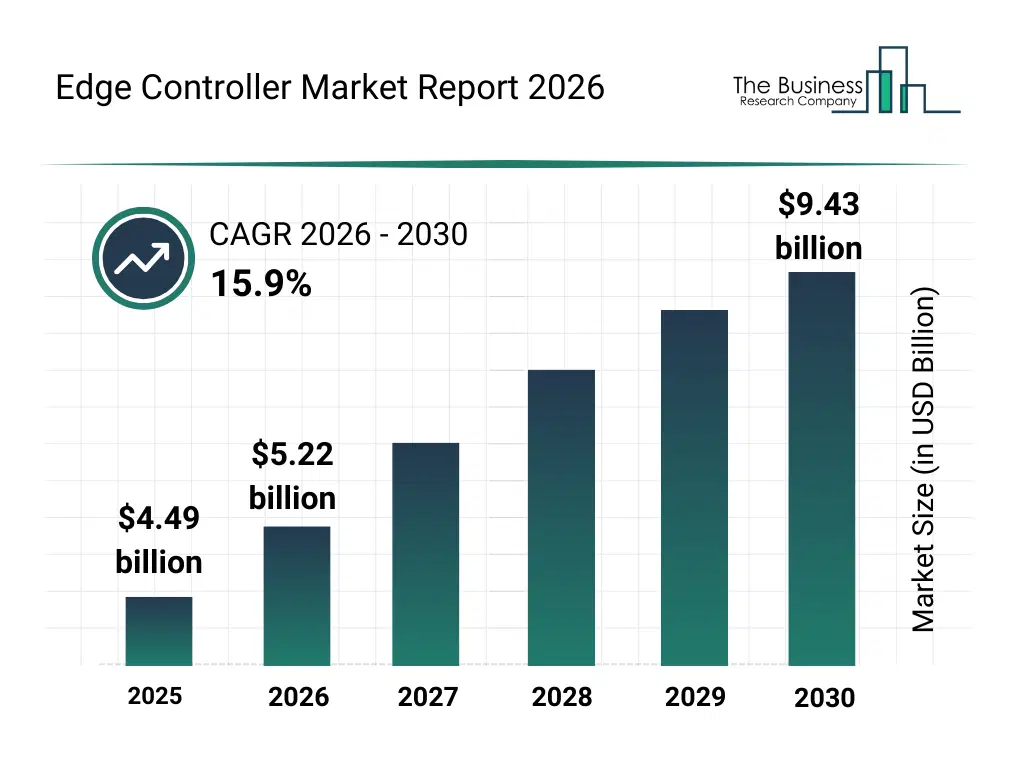
What Is The Edge Controller Market Size 2026 And Growth Rate?
The edge controller market size has grown rapidly in recent years. It will grow from $4.49 billion in 2025 to $5.22 billion in 2026 at a compound annual growth rate (CAGR) of 16.3%. The growth in the historic period can be attributed to industrial automation expansion, plc-based control adoption, rising need for latency reduction, growth of distributed energy assets, increasing factory floor digital control.What Is The Edge Controller Market Growth Forecast?
The edge controller market size is expected to see rapid growth in the next few years. It will grow to $9.43 billion in 2030 at a compound annual growth rate (CAGR) of 15.9%. The growth in the forecast period can be attributed to edge-native application demand, real-time analytics at source, scalable edge orchestration needs, growth of autonomous industrial operations, demand for resilient local control systems. Major trends in the forecast period include real-time edge control and decision execution, low-latency data processing architectures, decentralized control system deployment, enhanced edge interoperability standards, modular and scalable edge controller design.
Global Edge Controller Market Segmentation
1) By Component: Hardware, Software, Services 2) By Technology Type: Information Technology, Programmable Logic Controller, General Motion Control, Computer Numerical Control And Industrial Personal Computer, Operating Technology, Factory Automation, Other Technologies 3) By Deployment Mode: On-Premises, Cloud 4) By Application: Power Generation, Power Distribution, Energy Storage, Energy Consumption 5) By End-User Industry: Energy, Utility, Power, Oil And Gas, Healthcare, Automotive Industry, Other End-User Industries Subsegments: 1) By Hardware: Microcontrollers, Processors, Sensors, Actuators 2) By Software: Edge Analytics Software, Edge Device Management Software 3) By Services: Consulting Services, System Integration Services, Support And Maintenance ServicesWhat Is The Driver Of The Edge Controller Market?
The increasing numbers of data centers are expected to propel the growth of the edge controller market going forward. A data center refers to a centralized facility that houses computing, networking, and storage resources used to manage, process, and distribute large volumes of data and applications. The increasing number of data centers is due to the rapid growth of cloud computing, as organizations require scalable infrastructure to store, process, and deliver vast amounts of data and applications efficiently. Edge controllers help data centers by enabling real-time processing, efficient resource management, and reduced latency, ensuring seamless performance and optimized operations across distributed networks. For instance, in September 2024, according to the National Telecommunications and Information Administration, a US-based government agency, the United States has around 5,000 data centers, and demand for these facilities is expected to increase by approximately 9% annually until 2030. Therefore, the increasing number of data centers is driving the growth of the edge controller industry.Key Players In The Global Edge Controller Market
Major companies operating in the edge controller market are Siemens AG, Schneider Electric SE, Rockwell Automation Inc., Mitsubishi Electric Corporation, Honeywell International Inc., Emerson Electric Co., ABB Ltd., Bosch Rexroth AG, Omron Corporation, Advantech Co. Ltd., WAGO Kontakttechnik GmbH & Co. KG, Phoenix Contact, HMS Networks AB, Ifm electronic GmbH, Beckhoff Automation GmbH & Co. KG, Lenovo, Dell Technologies, Cisco Systems Inc., ClearBlade Inc., ADLINK Technology Inc.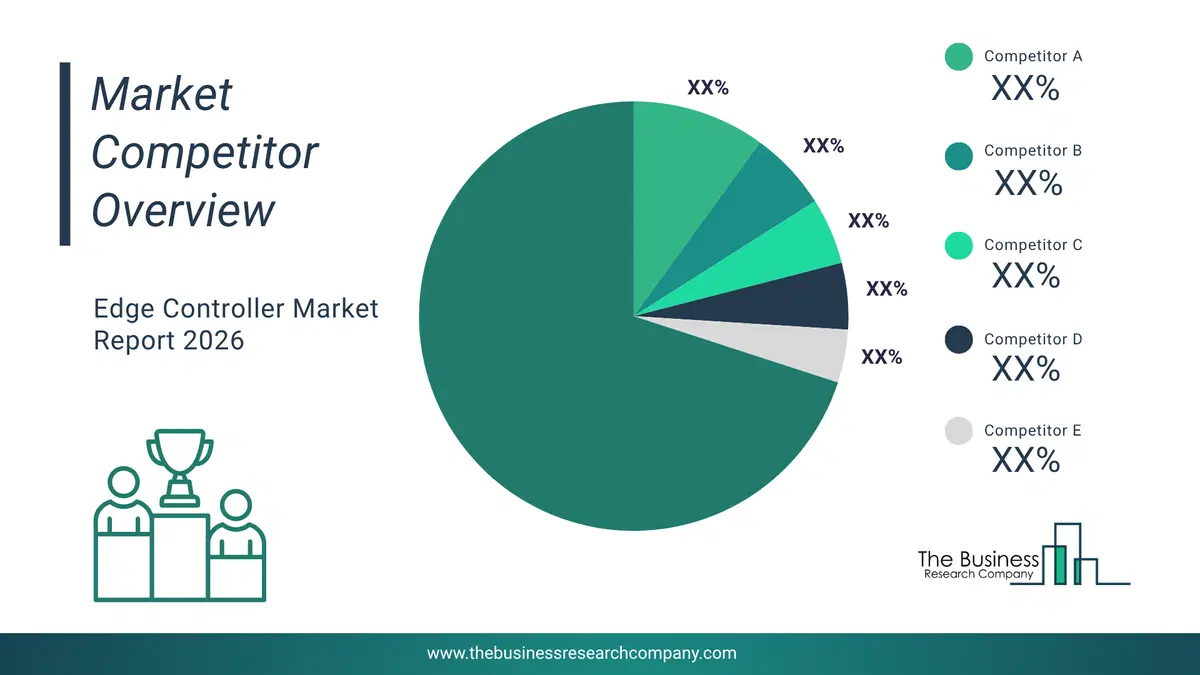
This chart is for illustrative purposes; the full report includes a detailed competitor analysis and comprehensive overview of the top 10 companies in the market.
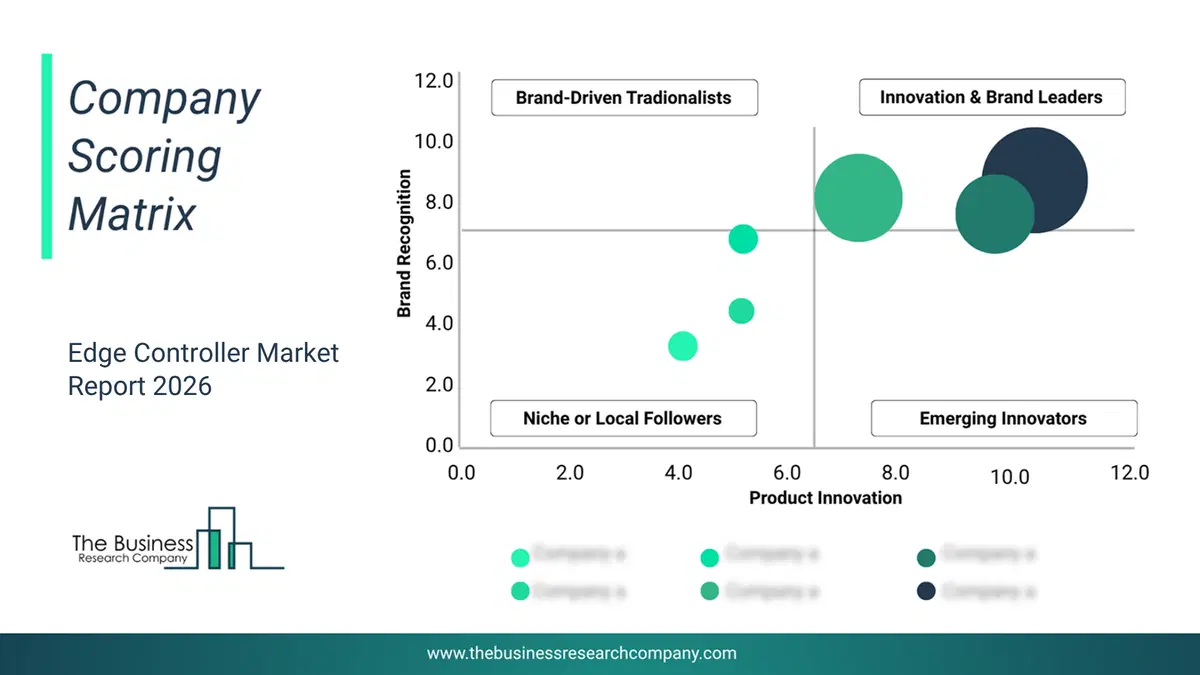
This chart maps companies by product innovation and brand strength, with bubble size indicating relative revenue, helping identify market leaders, challengers, and niche players. This is an illustrative chart; the full report provides a complete and accurate competitive analysis.
Global Edge Controller Market Trends and Insights
Major companies operating in the edge controller market are focusing on developing advanced solutions, such as quantum-safe symmetric key agreement (SKA) communications platforms, to enable secure key management and encryption without requiring frequent key updates, reducing operational complexity. Quantum-safe symmetric key agreement (SKA) communications platforms are systems that create and manage symmetric encryption keys using quantum-resistant cryptographic techniques to maintain secure communication against future quantum threats. For instance, in July 2025, Arqit Quantum Inc., a UK-based quantum-safe encryption technology company, launched SKA Edge Controller (SKA-EC), a ruggedized, quantum-safe symmetric key agreement (SKA) communications platform. The system is designed for forward-deployed defense operations, allowing quick establishment of secure, scalable command and control (C2) nodes in high-risk and disconnected environments without depending on traditional encryption methods. SKA-EC extends the SKA-Platform to the tactical edge, enabling mobile and distributed forces to operate securely using compact hardware such as BioDigitalPC cards, COTS servers, or virtualized cloud nodes. It generates symmetric encryption keys dynamically across trusted endpoints, reducing the risks of pre-shared keys (PSKs) and the complexity of public key infrastructure (PKI). This solution is crypto-agile, zero-trust-ready, and optimized for high-tempo, mission-critical operations.What Are Latest Mergers And Acquisitions In The Edge Controller Market?
In May 2025, AVPro Global Holdings, a US-based audio and video signal distribution company, acquired RTI Control for an undisclosed amount. With this acquisition, AVPro Global Holdings aims to drive accelerated innovation, expand integration capabilities, and deliver a seamless experience for end users across its residential and commercial control and automation solutions portfolio. RTI Control is a US-based company that provides edge controllers as part of its comprehensive control and automation solutions.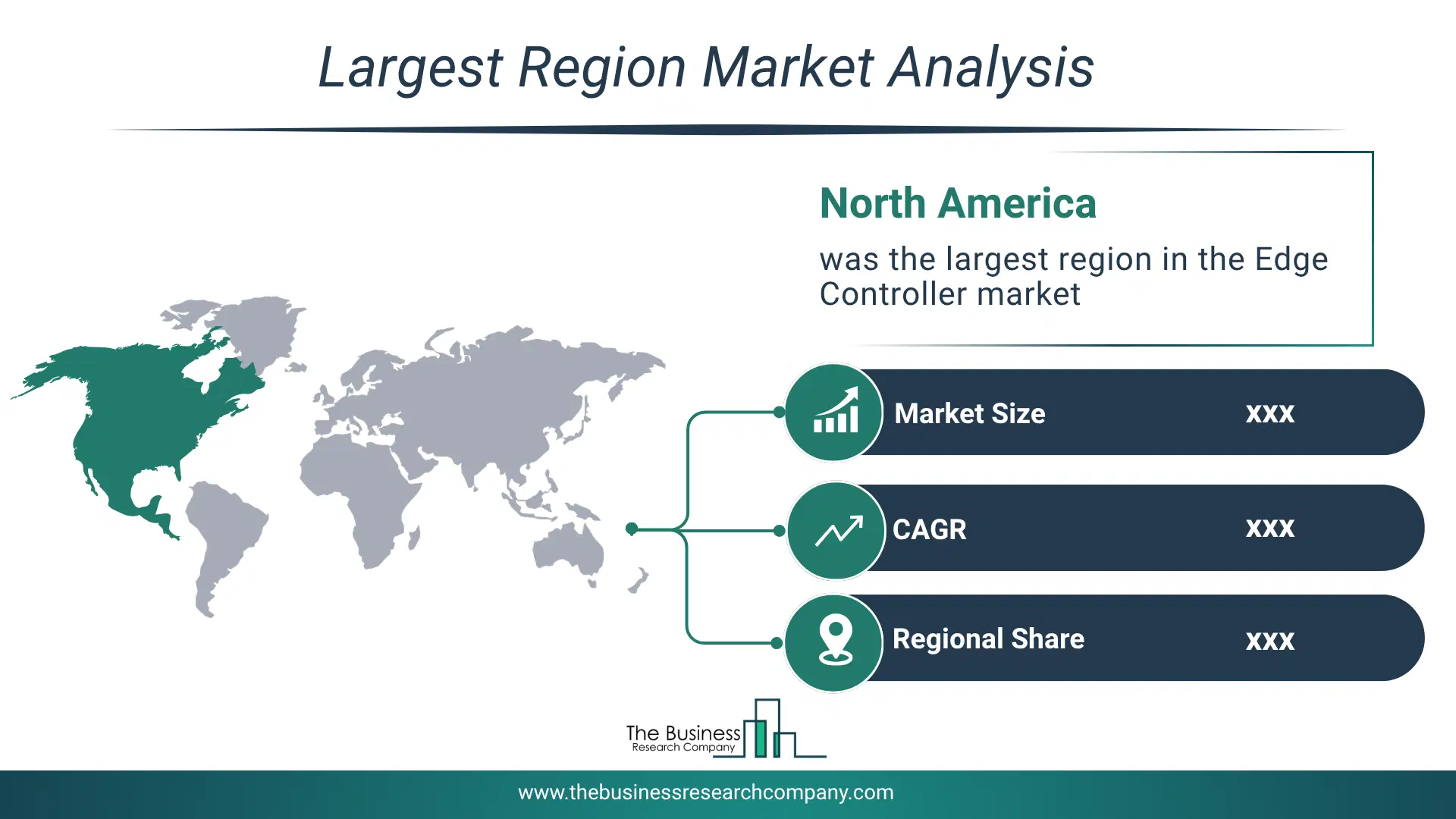
Regional Outlook
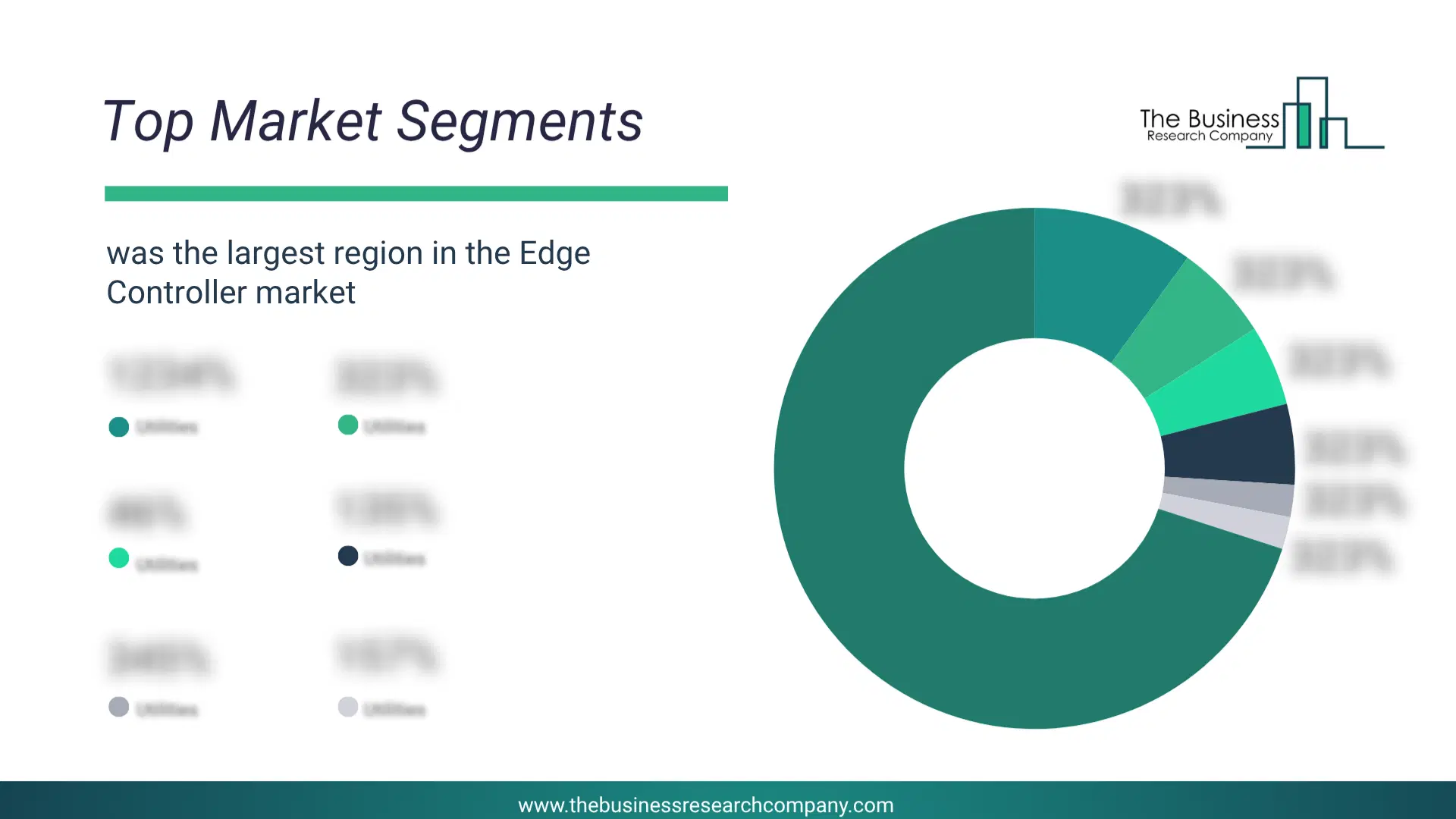
North America was the largest region in the edge controller market in 2025. Asia-Pacific is expected to be the fastest-growing region in the forecast period. The regions covered in this market report are Asia-Pacific, South East Asia, Western Europe, Eastern Europe, North America, South America, Middle East, Africa. The countries covered in this market report are Australia, Brazil, China, France, Germany, India, Indonesia, Japan, Taiwan, Russia, South Korea, UK, USA, Canada, Italy, Spain.What Defines the Edge Controller Market?
The edge controller market consists of revenues earned by entities by providing services such as real-time data processing, remote device management, predictive maintenance analytics, edge-based security monitoring, and local automation control services. The market value includes the value of related goods sold by the service provider or included within the service offering. The edge controller market also includes sales of programmable logic controllers, industrial ethernet switches, power supply units, and edge enclosures. Values in this market are ‘factory gate’ values; that is, the value of goods sold by the manufacturers or creators of the goods, whether to other entities (including downstream manufacturers, wholesalers, distributors, and retailers) or directly to end customers. The value of goods in this market includes related services sold by the creators of the goods.How is Market Value Defined and Measured?
The market value is defined as the revenues that enterprises gain from the sale of goods and/or services within the specified market and geography through sales, grants, or donations in terms of the currency (in USD unless otherwise specified). The revenues for a specified geography are consumption values that are revenues generated by organizations in the specified geography within the market, irrespective of where they are produced. It does not include revenues from resales along the supply chain, either further along the supply chain or as part of other products.
This chart presents market attractiveness based on a quantitative evaluation of growth, competition, strategic alignment, and risk, offering a clear view of opportunity areas for decision-making. This chart is for illustrative purposes; the full report contains the complete analysis.

This chart highlights the Total Addressable Market (TAM) by estimating the maximum revenue opportunity using an assumption-driven approach, supporting strategic planning and opportunity sizing across markets. The chart is illustrative; the full report provides a more comprehensive analysis.
What Key Data and Analysis Are Included in the Edge Controller Market Report 2026?
The edge controller market research report is one of a series of new reports from The Business Research Company that provides market statistics, including industry global market size, regional shares, competitors with the market share, detailed market segments, market trends and opportunities, and any further data you may need to thrive in the edge controller industry. The market research report delivers a complete perspective of everything you need, with an in-depth analysis of the current and future state of the industry.Edge Controller Market Report Forecast Analysis
| Report Attribute | Details |
|---|---|
| Market Size Value In 2026 | $5.22 billion |
| Revenue Forecast In 2030 | $9.43 billion |
| Growth Rate | CAGR of 15.9% from 2026 to 2030 |
| Base Year For Estimation | 2025 |
| Actual Estimates/Historical Data | 2020-2025 |
| Forecast Period | 2026 - 2030 |
| Market Representation | Revenue in USD Billion and CAGR from 2026 to 2030 |
| Segments Covered | Component, Technology Type, Deployment Mode, Application, End-User Industry |
| Regional Scope | Asia-Pacific, Western Europe, Eastern Europe, North America, South America, Middle East, Africa |
| Country Scope | The countries covered in the report are Australia, Brazil, China, France, Germany, India, Indonesia, Japan, Taiwan, Russia, South Korea, UK, USA, Canada, Italy, Spain. |
| Key Companies Profiled | Siemens AG, Schneider Electric SE, Rockwell Automation Inc., Mitsubishi Electric Corporation, Honeywell International Inc., Emerson Electric Co., ABB Ltd., Bosch Rexroth AG, Omron Corporation, Advantech Co. Ltd., WAGO Kontakttechnik GmbH & Co. KG, Phoenix Contact, HMS Networks AB, Ifm electronic GmbH, Beckhoff Automation GmbH & Co. KG, Lenovo, Dell Technologies, Cisco Systems Inc., ClearBlade Inc., ADLINK Technology Inc. |
| Customization Scope | Request for Customization |
| Pricing And Purchase Options | Explore Purchase Options |