
Edge Orchestration Market Report 2026
Global Outlook – By Component (Platform, Services), By Deployment Mode (On Premises, Cloud), By Organization Size (Large Enterprises, Small And Medium Enterprises), By Application (Network Management, Resource Allocation, Data Analytics, Security And Compliance, Other Applications), By End User (Telecommunications, Healthcare, Manufacturing, Retail, Energy And Utilities, Transportation And Logistics) – Market Size, Trends, Strategies, and Forecast to 2030
Edge Orchestration Market Overview
• Edge Orchestration market size has reached to $2.22 billion in 2025 • Expected to grow to $5.09 billion in 2030 at a compound annual growth rate (CAGR) of 18.1% • Growth Driver: Proliferation Of IoT Devices Driving The Market Growth Due To Increasing Connectivity, Affordable Sensors, And Demand For Smart Automation • Market Trend: Innovation Accelerates Edge Intelligence Through Streamlined AI Workflows • North America was the largest region in 2025 and Asia-Pacific is the fastest growing region.What Is Covered Under Edge Orchestration Market?
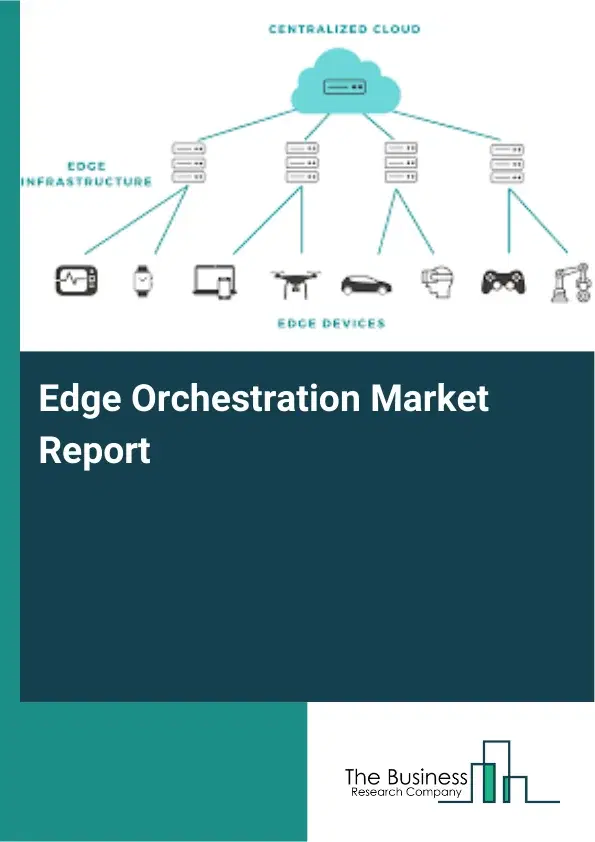
Edge orchestration refers to the process of managing, coordinating, and automating workloads, applications, and data processing across distributed edge computing environments. It helps to ensure efficient resource utilization, low-latency processing, and seamless operation of edge devices and services. It enables organizations to dynamically allocate workloads, monitor performance, and maintain security at the network edge. The main components of edge orchestration are platform and services. Platform refers to solutions that enable the management, coordination, and automation of computing, networking, and storage resources at the edge of the network to improve performance, scalability, and efficiency. These solutions can be deployed on-premises or in the cloud and are adopted by organizations of different sizes, including large enterprises and small and medium enterprises. These are used to various applications such as network management, resource allocation, data analytics, security and compliance, and other applications, and serve diverse end-users, including telecommunications, healthcare, manufacturing, Retail, energy and utilities, and transportation and logistics.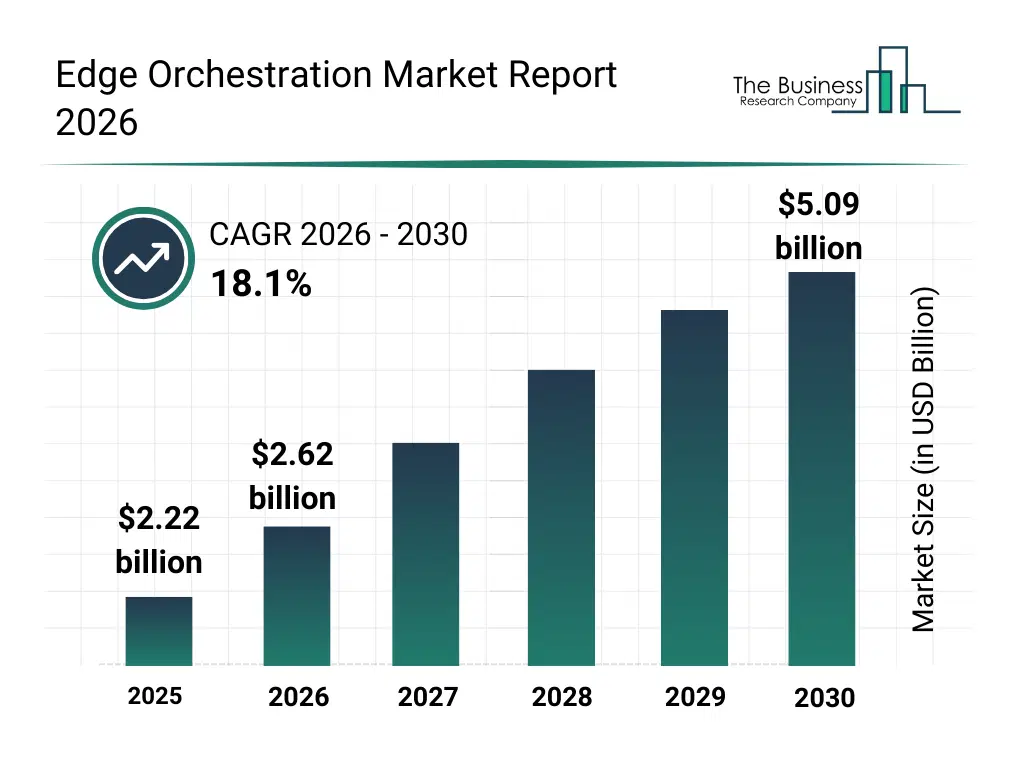
What Is The Edge Orchestration Market Size and Share 2026?
The edge orchestration market size has grown rapidly in recent years. It will grow from $2.22 billion in 2025 to $2.62 billion in 2026 at a compound annual growth rate (CAGR) of 17.8%. The growth in the historic period can be attributed to growth of edge computing infrastructure, increasing iot device deployment, rising demand for low-latency applications, early adoption of cloud-edge hybrid models, expansion of industrial automation initiatives.What Is The Edge Orchestration Market Growth Forecast?
The edge orchestration market size is expected to see rapid growth in the next few years. It will grow to $5.09 billion in 2030 at a compound annual growth rate (CAGR) of 18.1%. The growth in the forecast period can be attributed to adoption of ai-driven orchestration tools, integration of distributed edge platforms, growth in managed orchestration services, increasing focus on edge security and compliance, expansion of real-time data analytics at the edge. Major trends in the forecast period include real-time workload orchestration, dynamic resource allocation, application and service provisioning, performance monitoring and optimization, security and access management.
Global Edge Orchestration Market Segmentation
1) By Component: Platform, Services 2) By Deployment Mode: On Premises, Cloud 3) By Organization Size: Large Enterprises, Small And Medium Enterprises 4) By Application: Network Management, Resource Allocation, Data Analytics, Security And Compliance, Other Applications 5) By End User: Telecommunications, Healthcare, Manufacturing, Retail, Energy And Utilities, Transportation And Logistics Subsegments: 1) By Platform: Centralized Orchestration Platform, Distributed Edge Management Platform, Application Orchestration Platform, Data Processing And Control Platform, Monitoring And Analytics Platform 2) By Services: Consulting And Strategy Services, Deployment And Integration Services, Managed Orchestration Services, Support And Maintenance Services, Training And Optimization ServicesWhat Is The Driver Of The Edge Orchestration Market?
The proliferation of internet of things (IoT) devices is expected to propel the growth of the edge orchestration market going forward. Internet of things (IoT) devices refer to everyday physical objects that are connected to the internet, allowing them to send, receive, and exchange data. The use of internet of things (IoT) devices is rising due to the increasing availability of affordable sensors, which makes it easier for devices to collect and share data, enabling smarter homes, businesses, and cities. Use of internet of things (IoT) devices supports edge orchestration by generating real-time data at the network edge, enabling local processing, intelligent decision-making, and efficient coordination of distributed resources without relying solely on centralized cloud servers. For instance, in July 2025, according to the European Commission, a Belgium-based governing body, in 2023, there were approximately 40 billion IoT-connected devices in use, and this number is expected to rise to 49 billion by 2026, reflecting an annual growth rate of 7%. Therefore, the proliferation of internet of things (IoT) devices is driving the growth of the edge orchestration industry.Key Players In The Global Edge Orchestration Market
Major companies operating in the edge orchestration market are Amazon Web Services (AWS) Inc., Microsoft Corporation, Alibaba Group Holding Limited, Dell Technologies Inc., Huawei Technologies Co. Ltd., Tencent Holdings Limited, International Business Machines Corporation, Cisco Systems Inc., Intel Corporation, Oracle Corporation, Hewlett Packard Enterprise Company, Ericsson AB, Akamai Technologies Inc., F5 Inc., Cloudflare Inc., Fastly Inc., Vercel Inc., Netlify Inc., Zededa Inc., ClearBlade Inc., Edgeworx Inc.
This chart is for illustrative purposes; the full report includes a detailed competitor analysis and comprehensive overview of the top 10 companies in the market.
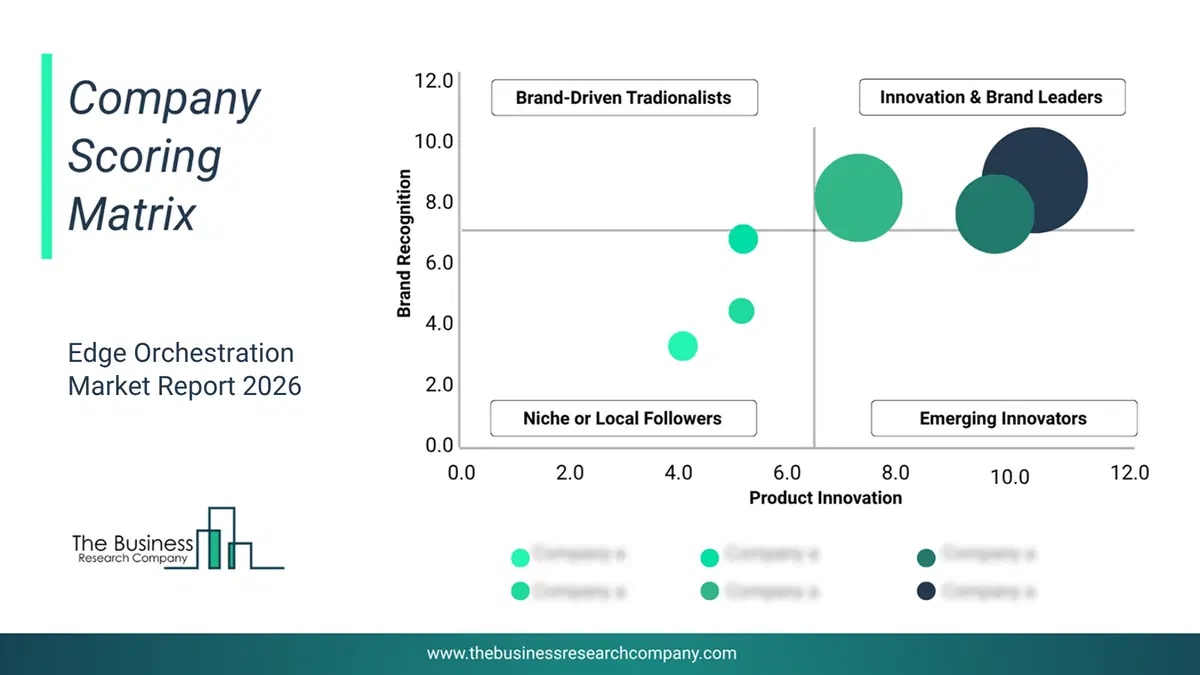
This chart maps companies by product innovation and brand strength, with bubble size indicating relative revenue, helping identify market leaders, challengers, and niche players. This is an illustrative chart; the full report provides a complete and accurate competitive analysis.
Global Edge Orchestration Market Trends and Insights
Major companies operating in the edge orchestration market are focusing on leveraging innovative technologies, such as no-code visual orchestration platforms, to accelerate AI deployment at the edge and simplify complex workflows. No-code visual orchestration platforms are software tools that let users design, configure, and deploy applications through intuitive drag-and-drop interfaces without writing code, helping accelerate deployment, automate complex processes, and make edge AI accessible to non-experts. For instance, in September 2025, Lantronix Inc., a US-based technology company, launched EdgeFabric.ai, a visual orchestration platform designed specifically for its Open-Q System-on-Module solutions. EdgeFabric.ai enables developers to quickly prototype and deploy Edge AI applications by auto-generating production-ready Python and C++ code, seamlessly optimizing performance across CPUs, GPUs, DSPs, and NPUs. The platform supports real-time visualization, pre-built templates for common use cases such as surveillance and anomaly detection, and simplified pipeline adjustments, allowing businesses to accelerate AI adoption without extensive in-house expertise.What Are Latest Mergers And Acquisitions In The Edge Orchestration Market?
In January 2024, Hewlett Packard Enterprise Company (HPE), a US-based enterprise technology and hybrid cloud solutions company, acquired Juniper Networks Inc. for $14 billion. With this acquisition, HPE aimed to expand and strengthen its AI native and cloud native networking portfolio to drive innovation across edge to cloud infrastructure, accelerate revenue growth, and position itself as a leader in secure, high performance networking for hybrid cloud and AI workloads. Juniper Networks Inc. is a US-based technology company that offers edge orchestration solutions.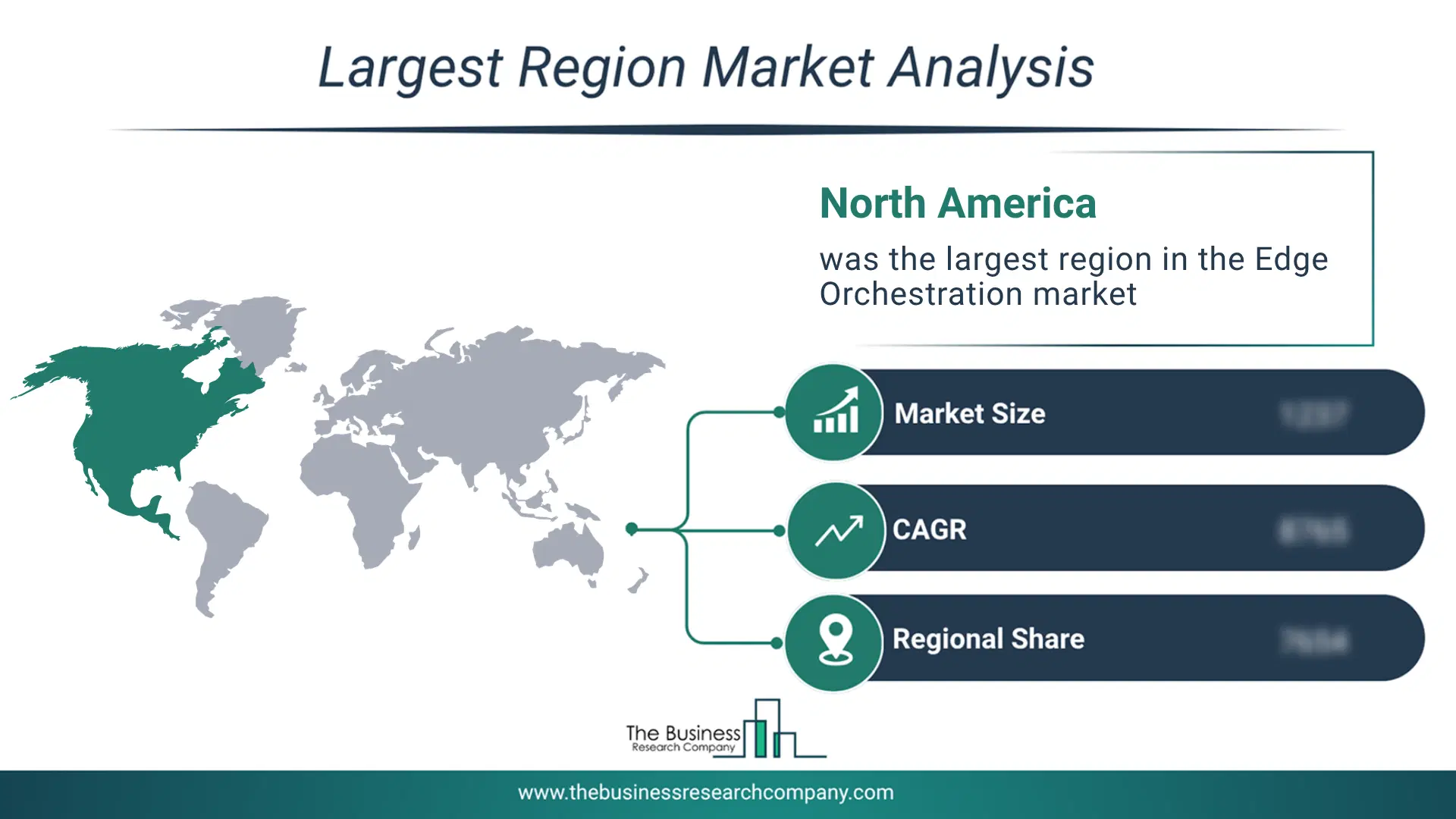
Regional Outlook
North America was the largest region in the edge orchestration market in 2025. Asia-Pacific is expected to be the fastest-growing region in the forecast period. The regions covered in this market report are Asia-Pacific, South East Asia, Western Europe, Eastern Europe, North America, South America, Middle East, Africa. The countries covered in this market report are Australia, Brazil, China, France, Germany, India, Indonesia, Japan, Taiwan, Russia, South Korea, UK, USA, Canada, Italy, Spain.What Defines the Edge Orchestration Market?
The edge orchestration market includes revenues earned by entities through real-time workload orchestration, resource allocation and scaling, application and service provisioning, monitoring and performance optimization, and security and access management. The market value includes the value of related goods sold by the service provider or included within the service offering. Only goods and services traded between entities or sold to end consumers are included.How is Market Value Defined and Measured?
The market value is defined as the revenues that enterprises gain from the sale of goods and/or services within the specified market and geography through sales, grants, or donations in terms of the currency (in USD unless otherwise specified). The revenues for a specified geography are consumption values that are revenues generated by organizations in the specified geography within the market, irrespective of where they are produced. It does not include revenues from resales along the supply chain, either further along the supply chain or as part of other products.
This chart presents market attractiveness based on a quantitative evaluation of growth, competition, strategic alignment, and risk, offering a clear view of opportunity areas for decision-making. This chart is for illustrative purposes; the full report contains the complete analysis.

This chart highlights the Total Addressable Market (TAM) by estimating the maximum revenue opportunity using an assumption-driven approach, supporting strategic planning and opportunity sizing across markets. The chart is illustrative; the full report provides a more comprehensive analysis.
What Key Data and Analysis Are Included in the Edge Orchestration Market Report 2026?
The edge orchestration market research report is one of a series of new reports from The Business Research Company that provides market statistics, including industry global market size, regional shares, competitors with the market share, detailed market segments, market trends and opportunities, and any further data you may need to thrive in the edge orchestration industry. The market research report delivers a complete perspective of everything you need, with an in-depth analysis of the current and future state of the industry.Edge Orchestration Market Report Forecast Analysis
| Report Attribute | Details |
|---|---|
| Market Size Value In 2026 | $2.62 billion |
| Revenue Forecast In 2030 | $5.09 billion |
| Growth Rate | CAGR of 18.1% from 2026 to 2030 |
| Base Year For Estimation | 2025 |
| Actual Estimates/Historical Data | 2020-2025 |
| Forecast Period | 2026 - 2030 |
| Market Representation | Revenue in USD Billion and CAGR from 2026 to 2030 |
| Segments Covered | Component, Deployment Mode, Organization Size, Application, End User |
| Regional Scope | Asia-Pacific, Western Europe, Eastern Europe, North America, South America, Middle East, Africa |
| Country Scope | The Countries Covered In This Market Report Are Australia, Brazil, China, France, Germany, India, Indonesia, Japan, Taiwan, Russia, South Korea, Uk, Usa, Canada, Italy, Spain. |
| Key Companies Profiled | Amazon Web Services (AWS) Inc., Microsoft Corporation, Alibaba Group Holding Limited, Dell Technologies Inc., Huawei Technologies Co. Ltd., Tencent Holdings Limited, International Business Machines Corporation, Cisco Systems Inc., Intel Corporation, Oracle Corporation, Hewlett Packard Enterprise Company, Ericsson AB, Akamai Technologies Inc., F5 Inc., Cloudflare Inc., Fastly Inc., Vercel Inc., Netlify Inc., Zededa Inc., ClearBlade Inc., Edgeworx Inc. |
| Customization Scope | Request for Customization |
| Pricing And Purchase Options | Explore Purchase Options |