
Edible Three-Dimensional (3D) Printing Market Report 2026
Global Outlook – By Technology (Extrusion-Based Printing, Binder Jetting, Inkjet Printing), By Application (Three-Dimensional (3D) Printed Sugar, Three-Dimensional (3D) Printed Chocolate, Three-Dimensional (3D) Printed Pasta, Other Applications), By End-User (Restaurants, Bakery And Confectionary, Individual Consumer) – Market Size, Trends, Strategies, and Forecast to 2030
Edible Three-Dimensional (3D) Printing Market Overview
• Edible Three-Dimensional (3D) Printing market size has reached to $1.11 billion in 2025 • Expected to grow to $2.92 billion in 2030 at a compound annual growth rate (CAGR) of 21.3% • Growth Driver: Rising Demand For Ready-To-Eat Foods Boosting Market Growth Due To Changing Lifestyles And Increasing Convenience Preferences • Market Trend: Advancements In Industrial-Scale 3D Food Printing Technology To Offer High-Volume Production • North America was the largest region in 2025 and Asia-Pacific is the fastest growing region.What Is Covered Under Edible Three-Dimensional (3D) Printing Market?
Edible 3D printing is a technology that creates customized, three-dimensional food structures by layering edible materials, such as chocolate, dough, or puree, using a 3D food printer. This method allows precise control over shape, texture, flavor, and nutritional content, making it useful for personalized nutrition, culinary creativity, and specialized diets. The main types of edible three-dimensional (3D) printing technology are extrusion-based printing, binder jetting, selective laser sintering, and inkjet printing. Extrusion-based printing builds 3D food shapes by layering soft materials like chocolate or dough through a nozzle. It is applicable in various applications such as three-dimensional (3D) printed sugar, three-dimensional (3D) printed chocolate, three-dimensional (3D) printed pasta, and others, and is used by several end-users, including restaurants, bakeries and confectionaries, and individual consumers.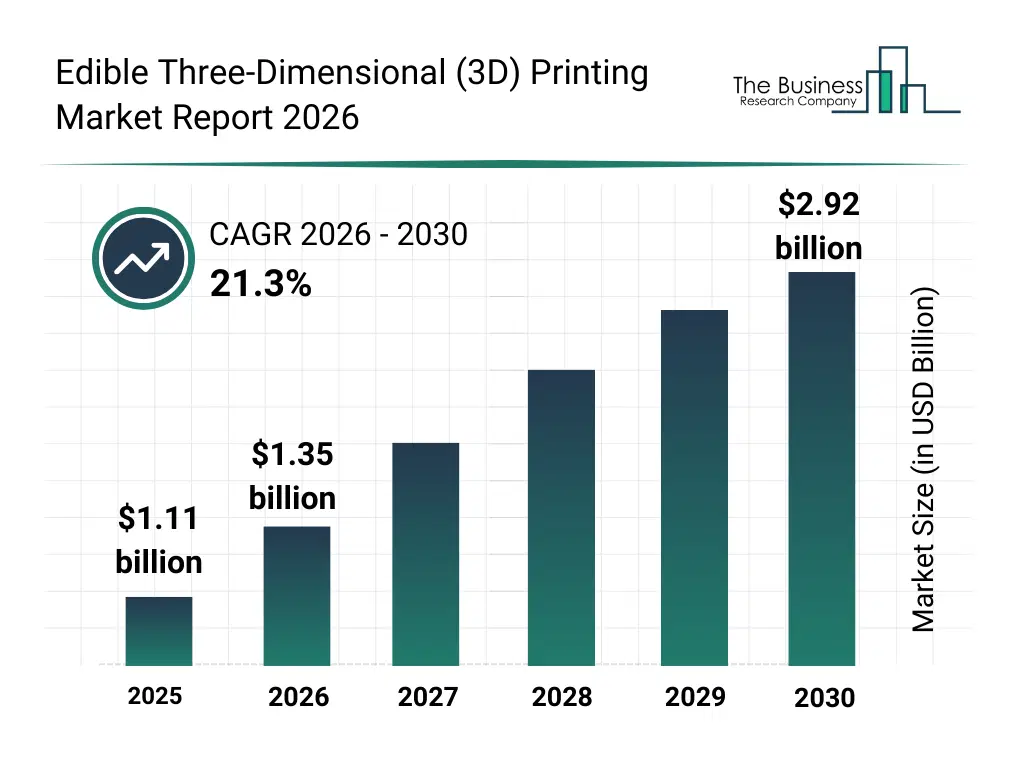
What Is The Edible Three-Dimensional (3D) Printing Market Size and Share 2026?
The edible three-dimensional (3d) printing market size has grown exponentially in recent years. It will grow from $1.11 billion in 2025 to $1.35 billion in 2026 at a compound annual growth rate (CAGR) of 21.6%. The growth in the historic period can be attributed to advancements in additive manufacturing technologies, experimentation in culinary innovation, demand for customized food presentation, growth of specialty food services, early adoption in high-end restaurants.What Is The Edible Three-Dimensional (3D) Printing Market Growth Forecast?
The edible three-dimensional (3d) printing market size is expected to see exponential growth in the next few years. It will grow to $2.92 billion in 2030 at a compound annual growth rate (CAGR) of 21.3%. The growth in the forecast period can be attributed to expansion of personalized healthcare nutrition, increasing adoption in elderly and clinical diets, rising investment in smart kitchen technologies, growing focus on sustainable food production, wider consumer acceptance of printed foods. Major trends in the forecast period include growing use of personalized nutrition designs, expansion of customizable food structures, rising adoption of alternative protein printing, increased focus on texture and nutrient precision, integration of smart food printers.
Global Edible Three-Dimensional (3D) Printing Market Segmentation
1) By Technology: Extrusion-Based Printing, Binder Jetting, Inkjet Printing 2) By Application: Three-Dimensional (3D) Printed Sugar, Three-Dimensional (3D) Printed Chocolate, Three-Dimensional (3D) Printed Pasta, Other Applications 3) By End-User: Restaurants, Bakery And Confectionary, Individual Consumer Subsegments: 1) By Extrusion-Based Printing: Fused Deposition Modeling (FDM), Syringe-based Extrusion 2) By Binder Jetting: Powder-based Binder Jetting, Gel-based Binder Jetting 3) By Inkjet Printing: Drop-on-Demand Inkjet Printing, Continuous Inkjet PrintingWhat Is The Driver Of The Edible Three-Dimensional (3D) Printing Market?
The increasing demand for ready-to-eat food products is expected to propel the growth of the edible 3D printing market going forward. Ready-to-eat (RTE) food products are fully prepared, packaged, and designed for instant consumption without additional cooking or preparation. The demand for ready-to-eat food products is driven by busy lifestyles, urbanization, improved availability, and time-saving meal options. The demand for ready-to-eat food fuels edible 3D printing by enabling fast, customized, and visually appealing meal production. This technology enhances convenience by automating preparation while meeting consumer preferences for healthy and innovative foods. For instance, in October 2023, according to Archer Daniels Midland, the US-based food processing company, in 2022, the ready-to-eat meal market experienced a 10.6% surge in sales, reaching approximately $16.4 billion. Further, the market is projected to grow by 21% between 2022 and 2027, with an estimated $19.9 billion by the end of the forecast period. Therefore, the increasing demand for ready-to-eat food products is driving the growth of the edible 3D printing market.Key Players In The Global Edible Three-Dimensional (3D) Printing Market
Major companies operating in the edible three-dimensional (3d) printing market are BeeHex LLC, Revo Foods, 3P Innovation, Wiiboox, Biozoon GmbH, Cocoa Press LLC, FELIXprinters B.V., ByFlow, Natural Machines Ltd., Sugar Lab Inc., Dovetailed, Print4Taste GmbH, La Pâtisserie Numérique SAS, Chocola3D, Changxing Shiyin Technology Co. Ltd., 3Desserts Graphiques, The Hershey Company, Barilla Group, Miam Factory, WASP (World’s Advanced Saving Project)
This chart is for illustrative purposes; the full report includes a detailed competitor analysis and comprehensive overview of the top 10 companies in the market.
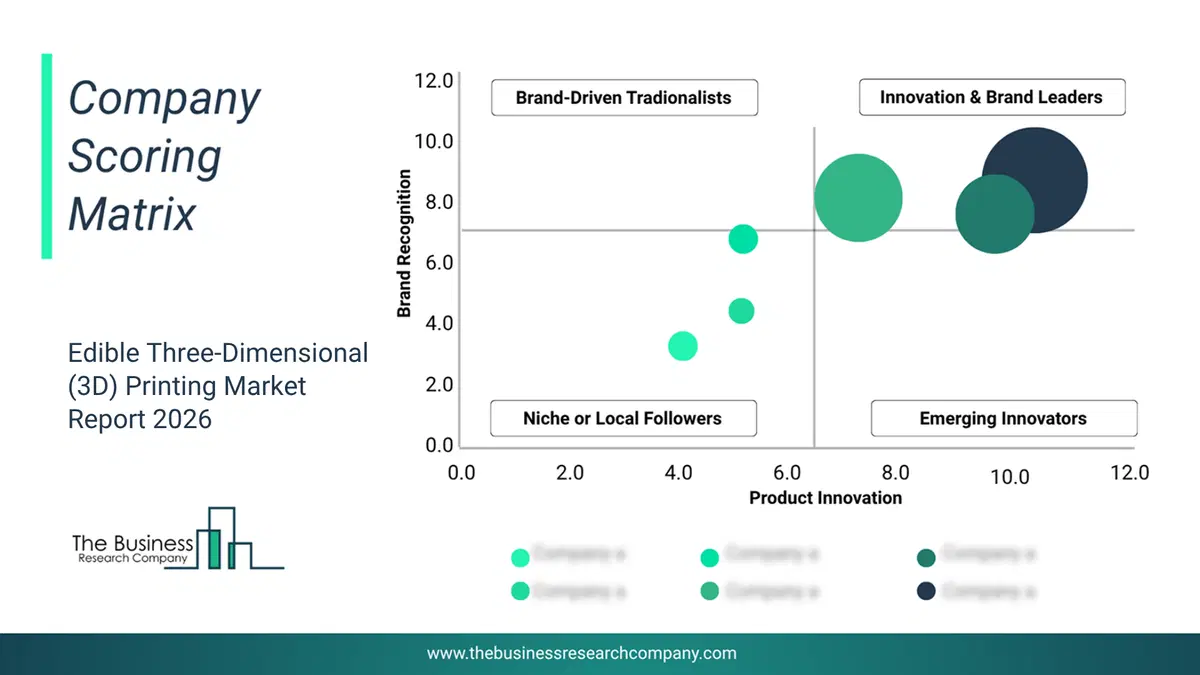
This chart maps companies by product innovation and brand strength, with bubble size indicating relative revenue, helping identify market leaders, challengers, and niche players. This is an illustrative chart; the full report provides a complete and accurate competitive analysis.
Global Edible Three-Dimensional (3D) Printing Market Trends and Insights
Major companies operating in the edible 3D printing market are focusing on developing advanced products, such as food 3D printers, to provide personalized nutrition solutions. A food 3D printer is a machine that uses additive manufacturing technology to create food items by layering ingredients according to a digital design, allowing for customized shapes, textures, and structures. For instance, in January 2024, Revo Foods GmbH, an Austria-based food-tech company, launched the Food Fabricator X2, the world’s first industrial-scale 3D printer for food production. This innovative technology features a multi-nozzle system for continuous production and a high-precision extrusion system that allows manufacturers to combine different ingredients into predefined structures. The food fabricator X2 enables mass customization, allowing for flexible control of product parameters such as size, shape, material, and texture without requiring hardware adjustments. Revo Foods plans to use the technology to scale production and offers public investment opportunities to expand its operations.What Are Latest Mergers And Acquisitions In The Edible Three-Dimensional (3D) Printing Market?
In November 2024, Revo Foods GmbH, an Austria-based food-tech company, partnered with Paleo NV, to upgrade Revo’s 3D-printed vegan salmon filet “THE FILET – Inspired by Salmon.” Through this partnership, Revo Foods plans to integrate Paleo’s precision-fermented myoglobin protein to enhance flavour, colour, iron content, and overall similarity to conventional salmon. Paleo NV is a Belgium-based biotechnology company that specializes in producing animal-free proteins using precision fermentation.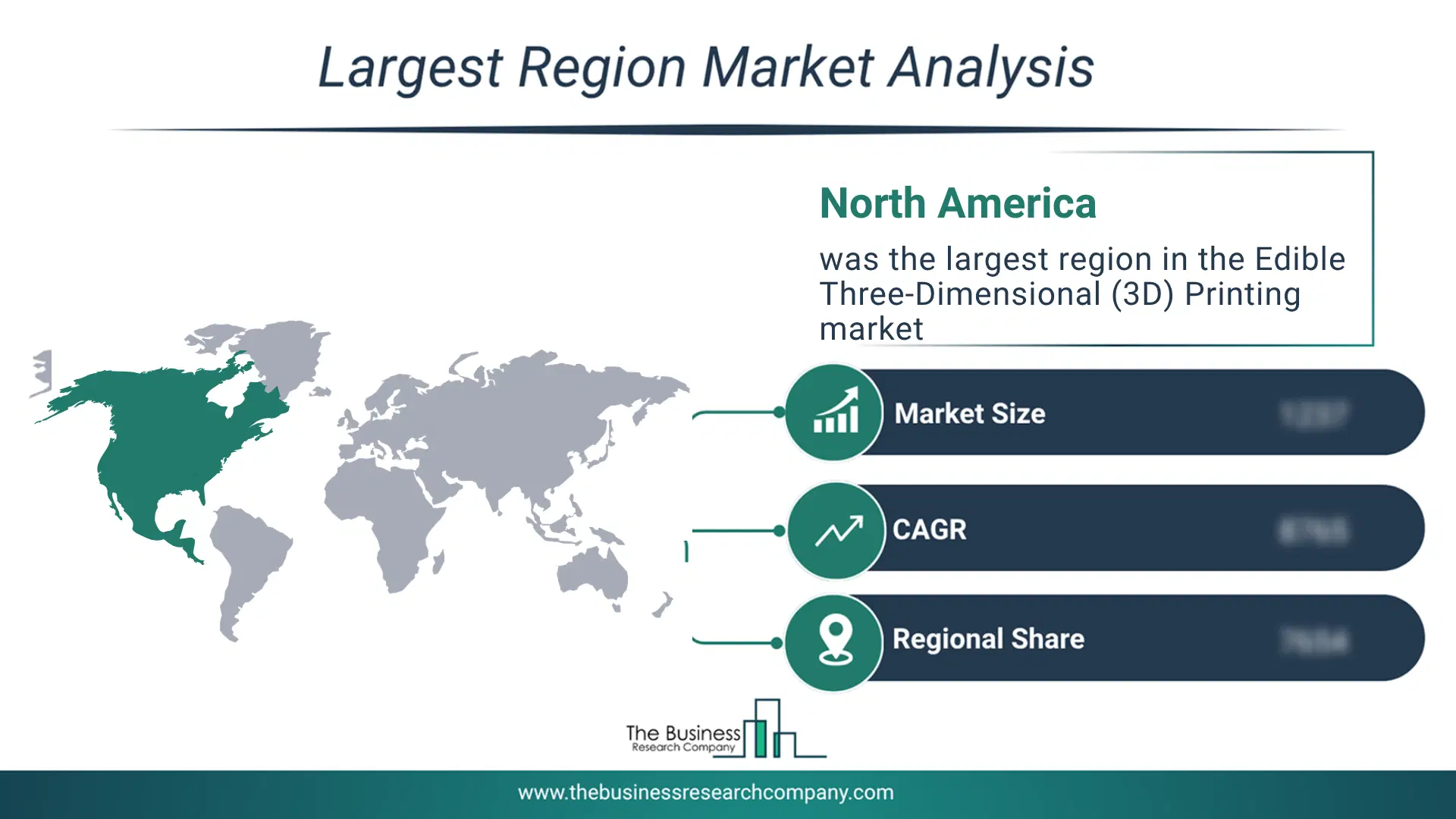
Regional Outlook
North America was the largest region in the edible three-dimensional (3D) printing market in 2025. Asia-Pacific is expected to be the fastest-growing region in the forecast period. The regions covered in this market report are Asia-Pacific, South East Asia, Western Europe, Eastern Europe, North America, South America, Middle East and Africa. The countries covered in this market report are Australia, Brazil, China, France, Germany, India, Indonesia, Japan, Taiwan, Russia, South Korea, UK, USA, Italy, Spain, CanadaWhat Defines the Edible Three-Dimensional (3D) Printing Market?
The edible three-dimensional (3D) printing market consists of revenues earned by entities by providing services such as nutritional personalization, education and culinary innovation, and alternative protein production. The market value includes the value of related goods sold by the service provider or included within the service offering. The edible three-dimensional (3D) printing market includes sales of three-dimensional (3D) printers, food printing materials, and custom-designed food items. Values in this market are ‘factory gate’ values, that is, the value of goods sold by the manufacturers or creators of the goods, whether to other entities (including downstream manufacturers, wholesalers, distributors, and retailers) or directly to end customers. The value of goods in this market includes related services sold by the creators of the goods.How is Market Value Defined and Measured?
The market value is defined as the revenues that enterprises gain from the sale of goods and/or services within the specified market and geography through sales, grants, or donations in terms of the currency (in USD unless otherwise specified). The revenues for a specified geography are consumption values that are revenues generated by organizations in the specified geography within the market, irrespective of where they are produced. It does not include revenues from resales along the supply chain, either further along the supply chain or as part of other products.
This chart presents market attractiveness based on a quantitative evaluation of growth, competition, strategic alignment, and risk, offering a clear view of opportunity areas for decision-making. This chart is for illustrative purposes; the full report contains the complete analysis.

This chart highlights the Total Addressable Market (TAM) by estimating the maximum revenue opportunity using an assumption-driven approach, supporting strategic planning and opportunity sizing across markets. The chart is illustrative; the full report provides a more comprehensive analysis.
What Key Data and Analysis Are Included in the Edible Three-Dimensional (3D) Printing Market Report 2026?
The edible three-dimensional (3d) printing market research report is one of a series of new reports from The Business Research Company that provides market statistics, including industry global market size, regional shares, competitors with the market share, detailed market segments, market trends and opportunities, and any further data you may need to thrive in the edible three-dimensional (3d) printing industry. The market research report delivers a complete perspective of everything you need, with an in-depth analysis of the current and future state of the industry.Edible Three-Dimensional (3D) Printing Market Report Forecast Analysis
| Report Attribute | Details |
|---|---|
| Market Size Value In 2026 | $1.35 billion |
| Revenue Forecast In 2030 | $2.92 billion |
| Growth Rate | CAGR of 21.6% from 2026 to 2030 |
| Base Year For Estimation | 2025 |
| Actual Estimates/Historical Data | 2020-2025 |
| Forecast Period | 2026 - 2030 |
| Market Representation | Revenue in USD Billion and CAGR from 2026 to 2030 |
| Segments Covered | Technology, Application, End-User |
| Regional Scope | Asia-Pacific, Western Europe, Eastern Europe, North America, South America, Middle East, Africa |
| Country Scope | The countries covered in the report are Australia, Brazil, China, France, Germany, India, Indonesia, Japan, Taiwan, Russia, South Korea, UK, USA, Canada, Italy, Spain. |
| Key Companies Profiled | BeeHex LLC, Revo Foods, 3P Innovation, Wiiboox, Biozoon GmbH, Cocoa Press LLC, FELIXprinters B.V., ByFlow, Natural Machines Ltd., Sugar Lab Inc., Dovetailed, Print4Taste GmbH, La Pâtisserie Numérique SAS, Chocola3D, Changxing Shiyin Technology Co. Ltd., 3Desserts Graphiques, The Hershey Company, Barilla Group, Miam Factory, WASP (World’s Advanced Saving Project) |
| Customization Scope | Request for Customization |
| Pricing And Purchase Options | Explore Purchase Options |