
Electric Baggage Cart Market Report 2026
Global Outlook – By Type (Electric Baggage Towing Carts, Electric Platform Baggage Carts, Electric Belt Loader Integrated Carts, Autonomous Electric Baggage Carts), By Battery Type (Lead Acid, Lithium Ion, Other Battery Types), By Application (Airports, Railway Stations, Bus Terminals, Other Applications), By End User (Commercial, Military, Other End Users) – Market Size, Trends, Strategies, and Forecast to 2030
Electric Baggage Cart Market Report 2026 Market Overview
• Electric Baggage Cart Market Report 2026 market size has reached to $1.27 billion in 2025 • Expected to grow to $2.04 billion in 2030 at a compound annual growth rate (CAGR) of 9.9% • Growth Driver: Surge In Air Passenger Traffic Fueling The Growth Of The Market Due To Increasing Airport Congestion • Market Trend: Advancing Zero-Emission Airside Logistics Through Autonomous Baggage Cart Deployments • North America was the largest region in 2025 and Asia-Pacific is the fastest growing region.What Is Covered Under Electric Baggage Cart Market?
An electric baggage cart is a battery-powered vehicle designed to transport luggage efficiently over short distances. It operates using electric motors and rechargeable batteries, offering a quiet and emission-free alternative to fuel-powered carts. An electric baggage cart is engineered for durability, ease of manoeuvrability, and reliable performance in high-traffic environments. The main types of electric baggage cart include electric baggage towing carts, electric platform baggage carts, electric belt loader integrated carts, and autonomous electric baggage carts. Electric baggage towing carts refer to powered vehicles designed to transport and tow baggage efficiently across transportation facilities with reduced manual effort. These carts use battery types such as lead acid, lithium ion, and other battery types. The key applications of airports, railway stations, bus terminals, and others, while the end-users commercial, military, and others.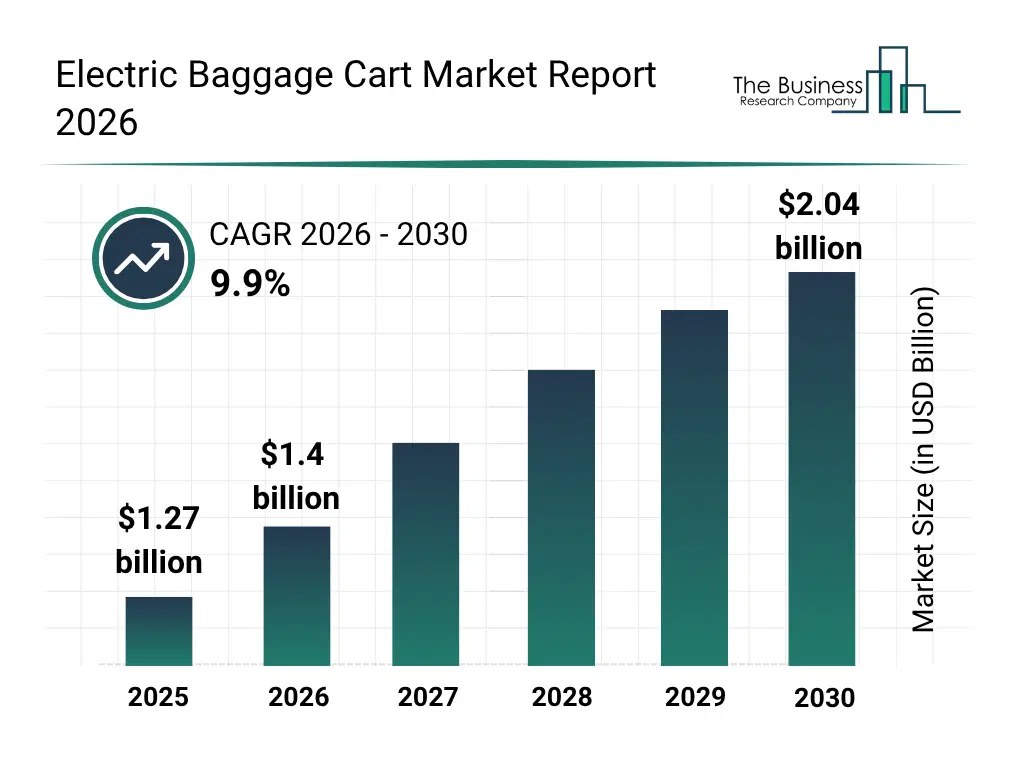
What Is The Electric Baggage Cart Market Size and Share 2026?
The electric baggage cart market size has grown rapidly in recent years. It will grow from $1.27 billion in 2025 to $1.4 billion in 2026 at a compound annual growth rate (CAGR) of 10.3%. The growth in the historic period can be attributed to increasing global air passenger traffic, rising adoption of mechanized airport ground handling equipment, growing demand for efficient baggage transportation systems, early transition from manual carts to motorized baggage carts, expansion of airport infrastructure in emerging economies.What Is The Electric Baggage Cart Market Growth Forecast?
The electric baggage cart market size is expected to see strong growth in the next few years. It will grow to $2.04 billion in 2030 at a compound annual growth rate (CAGR) of 9.9%. The growth in the forecast period can be attributed to rising demand for autonomous airport ground support equipment, increasing electrification of airport ground operations, growth in smart airport and digital aviation infrastructure, expansion of lithium-ion battery adoption in industrial vehicles, increasing focus on reducing airport carbon emissions. Major trends in the forecast period include autonomous ai-enabled electric baggage carts for smart airport ground handling operations, iot-connected fleet management systems for real-time baggage cart tracking and coordination, lithium-ion battery-powered high-efficiency carts with extended operational runtime, smart sensor-based collision avoidance and navigation systems for airport logistics, modular high-capacity electric baggage carts optimized for heavy airport traffic environments.
Global Electric Baggage Cart Market Segmentation
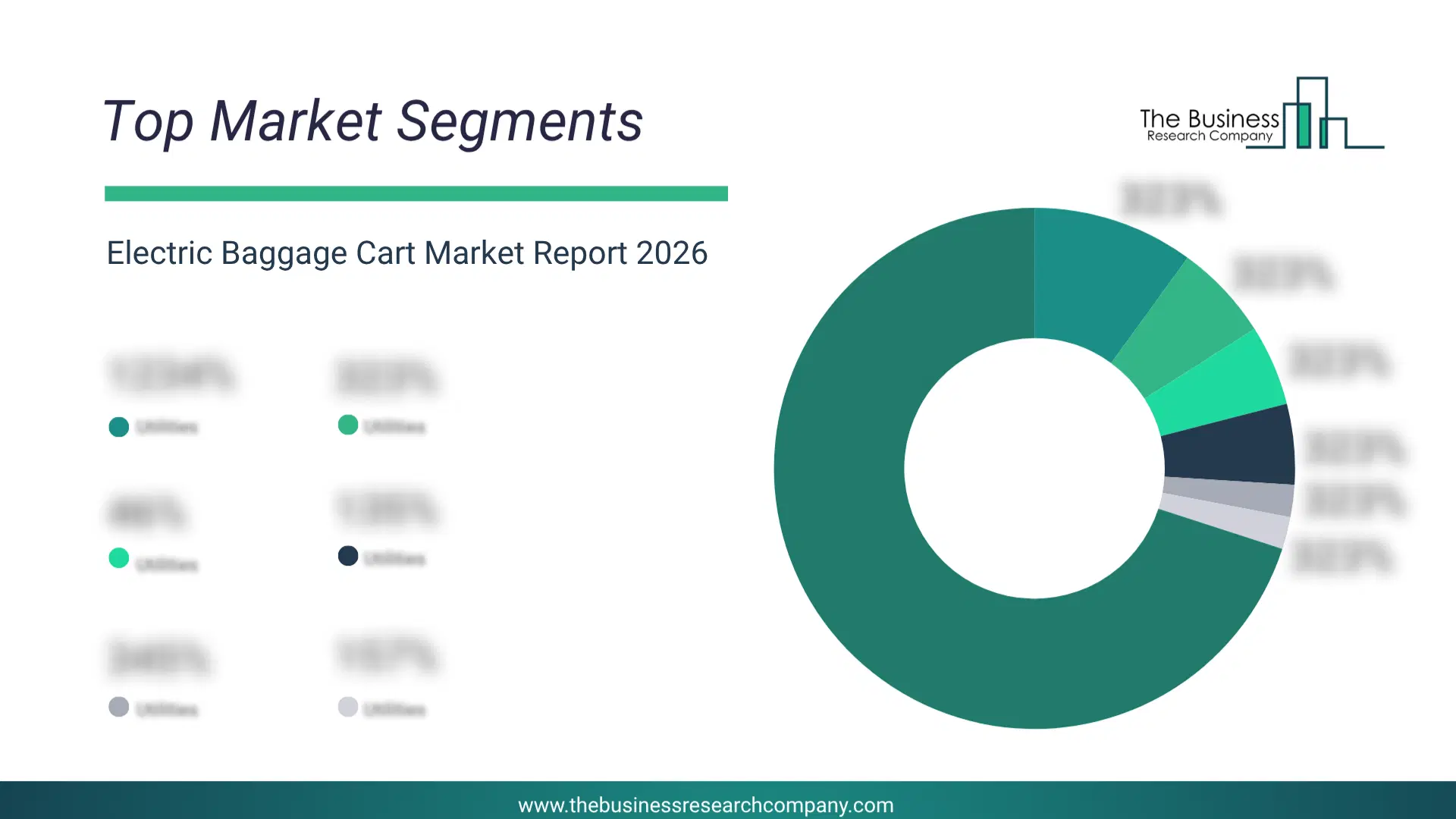
1) By Type: Electric Baggage Towing Carts, Electric Platform Baggage Carts, Electric Belt Loader Integrated Carts, Autonomous Electric Baggage Carts 2) By Battery Type: Lead Acid, Lithium Ion, Other Battery Types 3) By Application: Airports, Railway Stations, Bus Terminals, Other Applications 4) By End User: Commercial, Military, Other End Users Subsegments: 1) By Electric Baggage Towing Carts: Light Duty Electric Baggage Towing Carts, Medium Duty Electric Baggage Towing Carts, Heavy Duty Electric Baggage Towing Carts, Multi Trailer Electric Baggage Towing Carts, Compact Electric Baggage Towing Carts, High Speed Electric Baggage Towing Carts 2) By Electric Platform Baggage Carts: Flatbed Electric Platform Baggage Carts, Enclosed Electric Platform Baggage Carts, Low Floor Electric Platform Baggage Carts, High Capacity Electric Platform Baggage Carts, Foldable Electric Platform Baggage Carts, Multi Purpose Electric Platform Baggage Carts 3) By Electric Belt Loader Integrated Carts: Self Propelled Electric Belt Loader Integrated Carts, Adjustable Height Electric Belt Loader Integrated Carts, Compact Electric Belt Loader Integrated Carts, Heavy Load Electric Belt Loader Integrated Carts, Aircraft Cargo Electric Belt Loader Integrated Carts, Automated Electric Belt Loader Integrated Carts 4) By Autonomous Electric Baggage Carts: Fully Autonomous Electric Baggage Carts, Semi Autonomous Electric Baggage Carts, Sensor Guided Electric Baggage Carts, Artificial Intelligence Enabled Electric Baggage Carts, Remote Controlled Autonomous Electric Baggage Carts, Fleet Connected Autonomous Electric Baggage CartsWhat Is The Driver Of The Electric Baggage Cart Market?
The rapid expansion of air passenger traffic is expected to propel the growth of the electric baggage cart market going forward. Air passenger traffic refers to the increasing movement of passengers through airports for domestic and international air travel. The growing volume of air travelers is increasing due to pressure on airport infrastructure and ground handling operations, creating a stronger need for efficient baggage transportation systems that can support faster aircraft turnaround and minimize operational disruptions. Electric baggage carts support air passenger traffic by providing energy-efficient, low-emission, and reliable baggage handling solutions that enhance operational productivity and reduce downtime in airport logistics operations. For instance, in July 2025, according to the Airports Council International (ACI) World, a Canada-based global nonprofit organization representing airports worldwide, global passenger traffic in 2024 surpassed 9.4 billion travelers, up 8.4% from 2023. Therefore, the rapid expansion of air passenger traffic is driving the growth of the electric baggage cart industry.Key Players In The Global Electric Baggage Cart Market
Major companies operating in the electric baggage cart market report are Hangcha Group Co. Ltd., Waev Inc., Sinfonia Technology Co. Ltd., Weihai Guangtai Airport Equipment Co. Ltd., Mallaghan Engineering Ltd., Suzhou Dalu Electric Vehicle Co. Ltd., Motrec International Inc., Harlan Global Manufacturing LLC, DENGE Airport Equipment, Simai S.p.A., Alkè S.r.l., MULAG Fahrzeugwerk Heinz Wössner GmbH u. Co. KG, Tronair Inc., Oshkosh Corporation, Aakash Engineers, Toyota Industries Corporation, Textron Specialized Vehicles, Oshkosh AeroTech LLC, Bradshaw Electric Vehicles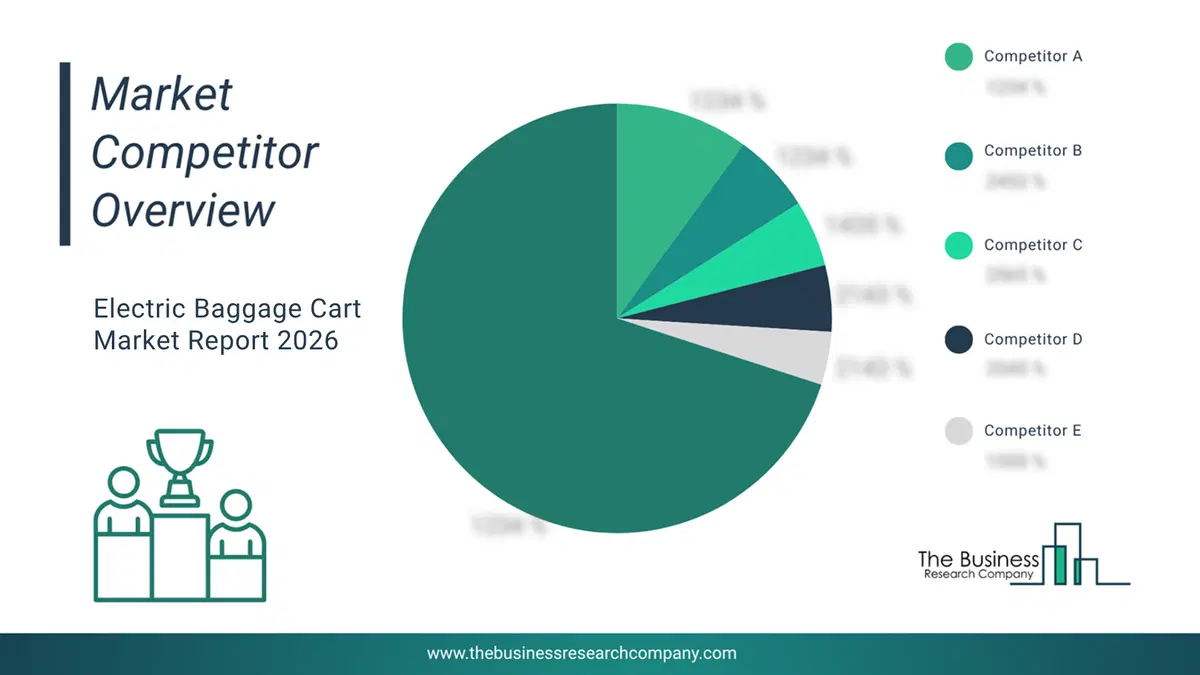
This chart is for illustrative purposes; the full report includes a detailed competitor analysis and comprehensive overview of the top 10 companies in the market.
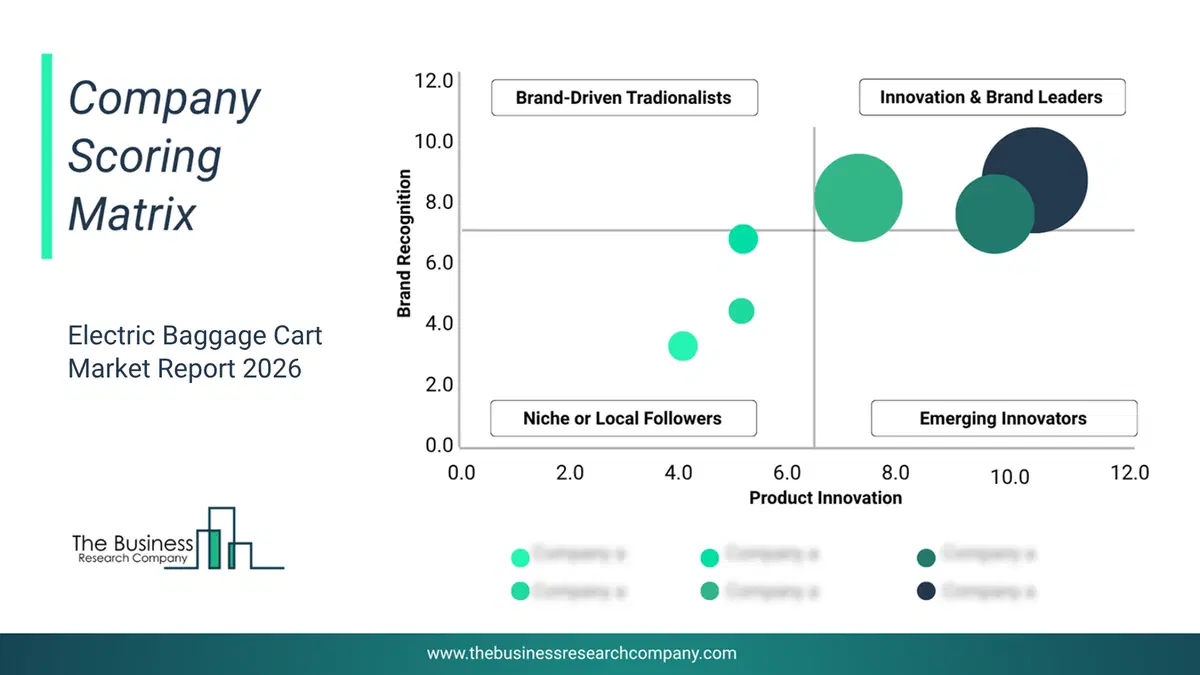
This chart maps companies by product innovation and brand strength, with bubble size indicating relative revenue, helping identify market leaders, challengers, and niche players. This is an illustrative chart; the full report provides a complete and accurate competitive analysis.
Global Electric Baggage Cart Market Trends and Insights
Major companies operating in the electric baggage cart market are focusing on strategic partnerships to accelerate the commercialization and large-scale deployment of autonomous ground support solutions and support the transition toward zero-emission airport logistics. Strategic partnerships are also aimed at scaling pilot-tested technologies into global airport networks, thereby improving baggage handling speed and reducing aircraft turnaround times. For instance, in April 2025, Aurrigo International PLC, a UK-based advanced engineering and autonomous vehicle technology company, partnered with Aviation Solutions B.V., a Netherlands-based aviation services and consultancy firm, to commercialize and deploy its Auto-DollyTug autonomous electric baggage vehicle across a network of more than 60 airports worldwide. The collaboration builds on successful validation trials conducted at Amsterdam Airport Schiphol and is focused on scaling autonomous baggage handling operations to enhance efficiency, reduce turnaround times, and support zero-emission airside logistics. The deployment strategy is designed to transition Auto-DollyTug from pilot testing phases into broader commercial rollout across international airport operations.What Are Latest Mergers And Acquisitions In The Electric Baggage Cart Market?
In January 2024, Changi Airport Group, a Singapore-based airport operator, collaborated with Aurrigo International plc to trial an electric-powered autonomous baggage handling vehicle, Auto-DollyTug, at Changi Airport. Through this collaboration, the partners aim to evaluate the efficiency, maneuverability, and operational performance of autonomous ground handling systems to improve aircraft turnaround times and advance automation in airport airside operations. Aurrigo International plc is a UK-based engineering and autonomous vehicle technology company specializing in airport and ground support automation solutions, including autonomous baggage handling and electric airport vehicles.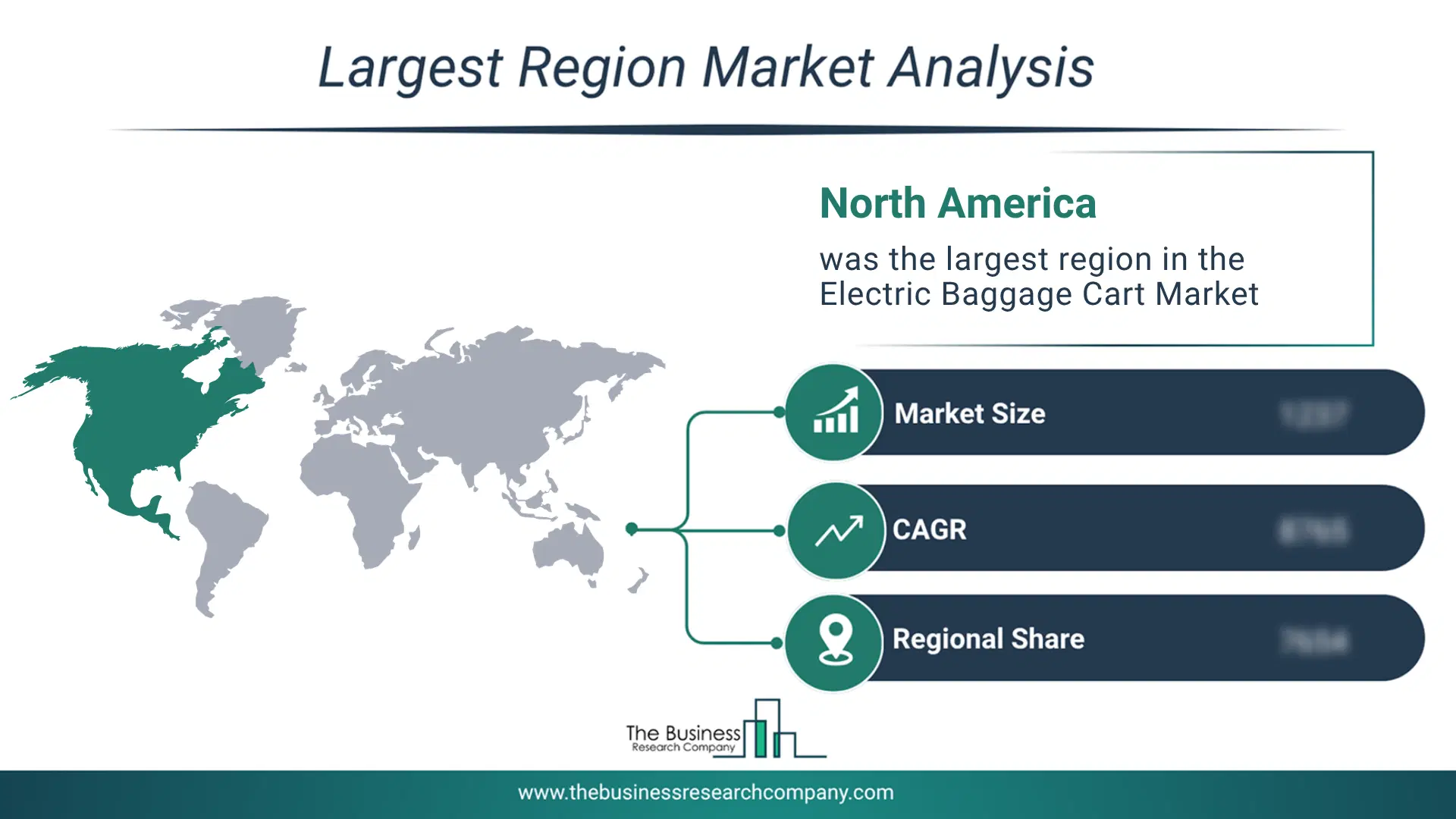
Regional Outlook
North America was the largest region in the electric baggage cart market in 2025. Asia-Pacific is expected to be the fastest-growing region in the forecast period. The regions covered in this market report are Asia-Pacific, South East Asia, Western Europe, Eastern Europe, North America, South America, Middle East, Africa. The countries covered in this market report are Australia, Brazil, China, France, Germany, India, Indonesia, Japan, Taiwan, Russia, South Korea, UK, USA, Canada, Italy, Spain.What Defines the Electric Baggage Cart Market?
The electric baggage cart market consists of sales of battery-powered personnel carriers, electric utility carts, electric maintenance vehicles, and electric passenger shuttles. Values in this market are ‘factory gate’ values, that is, the value of goods sold by the manufacturers or creators of the goods, whether to other entities (including downstream manufacturers, wholesalers, distributors, and retailers) or directly to end customers. The value of goods in this market includes related services sold by the creators of the goods.How is Market Value Defined and Measured?
The market value is defined as the revenues that enterprises gain from the sale of goods and/or services within the specified market and geography through sales, grants, or donations in terms of the currency (in USD unless otherwise specified). The revenues for a specified geography are consumption values that are revenues generated by organizations in the specified geography within the market, irrespective of where they are produced. It does not include revenues from resales along the supply chain, either further along the supply chain or as part of other products.
This chart presents market attractiveness based on a quantitative evaluation of growth, competition, strategic alignment, and risk, offering a clear view of opportunity areas for decision-making. This chart is for illustrative purposes; the full report contains the complete analysis.

This chart highlights the Total Addressable Market (TAM) by estimating the maximum revenue opportunity using an assumption-driven approach, supporting strategic planning and opportunity sizing across markets. The chart is illustrative; the full report provides a more comprehensive analysis.
What Key Data and Analysis Are Included in the Electric Baggage Cart Market Report 2026?
The electric baggage cart market research report is one of a series of new reports from The Business Research Company that provides market statistics, including industry global market size, regional shares, competitors with the market share, detailed market segments, market trends and opportunities, and any further data you may need to thrive in the electric baggage cart industry. The market research report delivers a complete perspective of everything you need, with an in-depth analysis of the current and future state of the industry.Electric Baggage Cart Market Report Forecast Analysis
| Report Attribute | Details |
|---|---|
| Market Size Value In 2026 | $1.4 billion |
| Revenue Forecast In 2030 | $2.04 billion |
| Growth Rate | CAGR of 9.9% from 2026 to 2030 |
| Base Year For Estimation | 2025 |
| Actual Estimates/Historical Data | 2020-2025 |
| Forecast Period | 2026 - 2030 |
| Market Representation | Revenue in USD Billion and CAGR from 2026 to 2030 |
| Segments Covered | Type, Battery Type, Application, End User |
| Regional Scope | Asia-Pacific, Western Europe, Eastern Europe, North America, South America, Middle East, Africa |
| Country Scope | The countries covered in the report are Australia, Brazil, China, France, Germany, India, Indonesia, Japan, Taiwan, Russia, South Korea, UK, USA, Canada, Italy, Spain. |
| Key Companies Profiled | Hangcha Group Co. Ltd., Waev Inc., Sinfonia Technology Co. Ltd., Weihai Guangtai Airport Equipment Co. Ltd., Mallaghan Engineering Ltd., Suzhou Dalu Electric Vehicle Co. Ltd., Motrec International Inc., Harlan Global Manufacturing LLC, DENGE Airport Equipment, Simai S.p.A., Alkè S.r.l., MULAG Fahrzeugwerk Heinz Wössner GmbH u. Co. KG, Tronair Inc., Oshkosh Corporation, Aakash Engineers, Toyota Industries Corporation, Textron Specialized Vehicles, Oshkosh AeroTech LLC, Bradshaw Electric Vehicles |
| Customization Scope | Request for Customization |
| Pricing And Purchase Options | Explore Purchase Options |