
Electric Commercial Vehicles Market Report 2026
Global Outlook – By Propulsion Type (BEV, PHEV, FCEV.), By Vehicle Type (Electric Bus, Electric Truck, Electric Van, Other Vehicle Types), By Battery Type (Lithium-Iron-Phosphate (LFP), Lithium-Nickel-Manganese-Cobalt Oxide (NMC), Other Battery Types) – Market Size, Trends, Strategies, and Forecast to 2030
Electric Commercial Vehicles Market Overview
• Electric Commercial Vehicles market size has reached to $202.35 billion in 2025 • Expected to grow to $682.59 billion in 2030 at a compound annual growth rate (CAGR) of 27.3% • Growth Driver: Surging Demand For Eco-Friendly Vehicles Propels Electric Commercial Vehicle Market Growth • Market Trend: Strategic Partnerships Drive Electric Commercial Vehicle Market Growth • Asia-Pacific was the largest region in 2025 and North America is the fastest growing region.What Is Covered Under Electric Commercial Vehicles Market?
Electric commercial vehicles are electrically powered, self-propelled electric vehicles used for transportation that help reduce greenhouse gas emissions (GHG) and pollution and work with the help of both electric motors working in tandem. The main propulsion types in electric commercial vehicles are BEV, PHEV, and FCEV. Battery electric vehicles operate only on stored electricity, and their main components consist of a high-voltage battery, one or more electric motors (either alternating current [AC] or direct current [DC]), and a controller for managing the power electronics. The vehicle types involved are electric buses, electric trucks, electric pick-up trucks, and electric vans. The battery types involved are lithium-iron-phosphate (left), lithium-nickel-manganese-cobalt oxide (NMC), and others. The technologies involved are battery-electric commercial vehicles, plug-in hybrids, hybrids, and fuel cell electric commercial vehicles.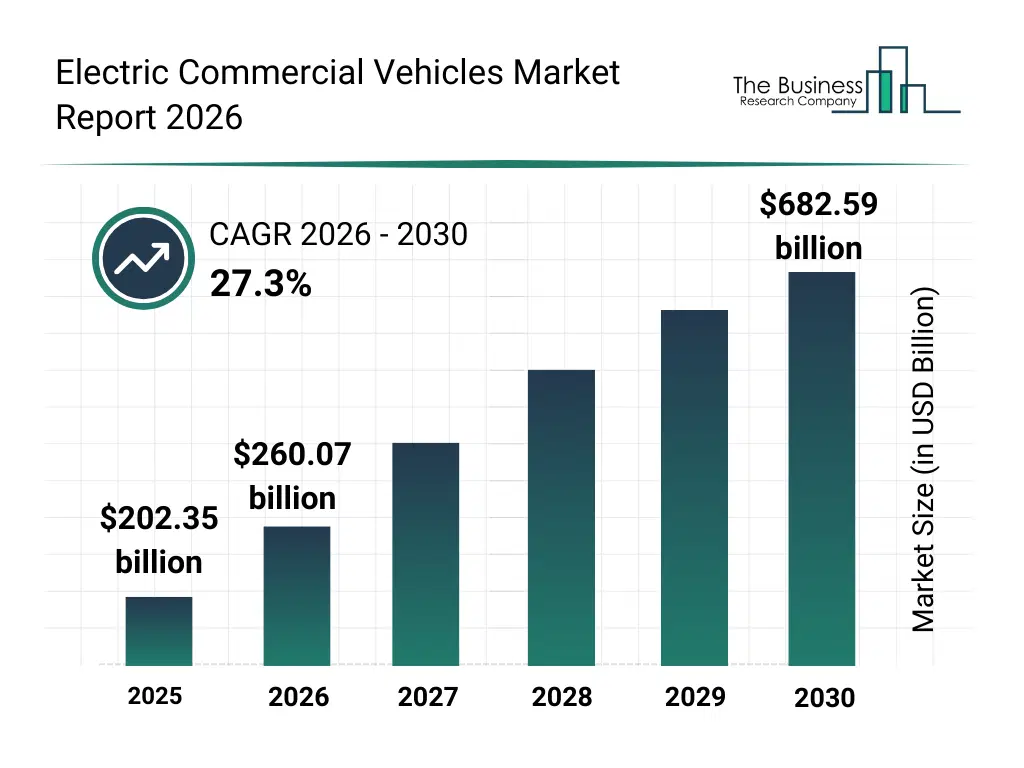
What Is The Electric Commercial Vehicles Market Size and Share 2026?
The electric commercial vehicles market size has grown exponentially in recent years. It will grow from $202.35 billion in 2025 to $260.07 billion in 2026 at a compound annual growth rate (CAGR) of 28.5%. The growth in the historic period can be attributed to emission regulations for fleets, fuel cost volatility, pilot electric fleet deployments, urban delivery demand, government subsidies.What Is The Electric Commercial Vehicles Market Growth Forecast?
The electric commercial vehicles market size is expected to see exponential growth in the next few years. It will grow to $682.59 billion in 2030 at a compound annual growth rate (CAGR) of 27.3%. The growth in the forecast period can be attributed to zero-emission fleet mandates, hydrogen fuel adoption, smart fleet optimization, battery cost reductions, large-scale fleet electrification. Major trends in the forecast period include rapid electrification of commercial fleets, expansion of charging infrastructure for logistics, growth of electric delivery vehicles, adoption of fleet telematics, integration of alternative fuel technologies.
Global Electric Commercial Vehicles Market Segmentation
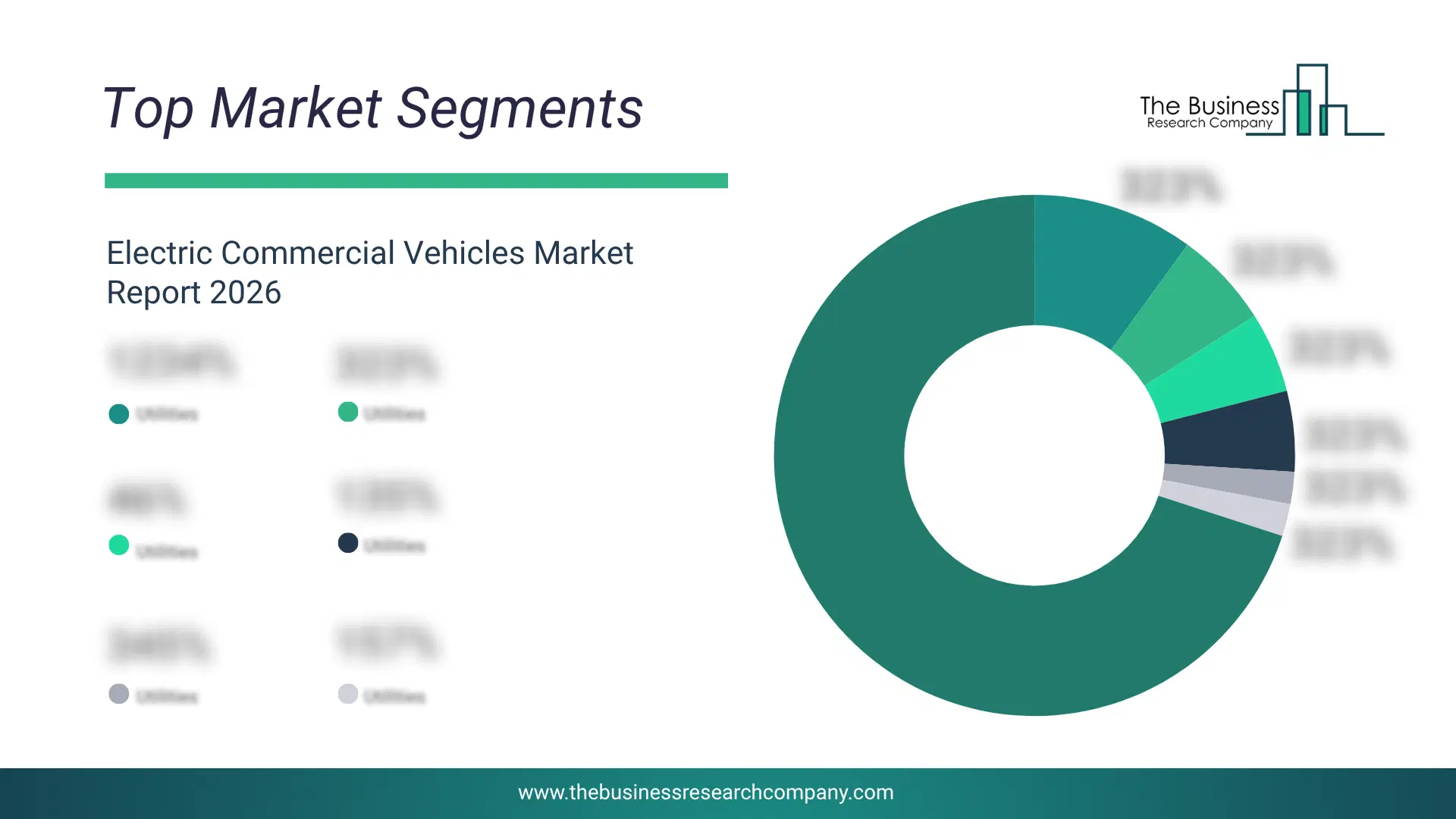
1) By Propulsion Type: BEV, PHEV, FCEV. 2) By Vehicle Type: Electric Bus, Electric Truck, Electric Van, Other Vehicle Types 3) By Battery Type: Lithium-Iron-Phosphate (LFP), Lithium-Nickel-Manganese-Cobalt Oxide (NMC), Other Battery Types Subsegments: 1) By BEV (Battery Electric Vehicle): Light Duty BEVs, Medium Duty BEVs, Heavy Duty BEVs 2) By PHEV (Plug-in Hybrid Electric Vehicle): Light Duty PHEVs, Medium Duty PHEVs, Heavy Duty PHEVs 3) By FCEV (Fuel Cell Electric Vehicle): Light Duty FCEVs, Medium Duty FCEVs, Heavy Duty FCEVsWhat Is The Driver Of The Electric Commercial Vehicles Market?
Increasing demand for eco-friendly vehicles is expected to propel the growth of the electric commercial vehicle market going forward. Eco-friendly vehicles refer to vehicles designed to have a reduced negative impact on the environment compared to traditional internal combustion engine vehicles. These vehicles include electric vehicles, hybrid vehicles, hydrogen vehicles, and natural gas vehicles. For instance, in 2024, according to the International Energy Agency is a France-based autonomous intergovernmental organization, electric vehicle sales in 2023 rose by 3.5 million units compared to 2022, marking a 35% year-on-year growth. Therefore, the increasing demand for eco-friendly vehicles is driving the growth of the electric commercial vehicle industry.Key Players In The Global Electric Commercial Vehicles Market
Major companies operating in the electric commercial vehicles market report include BYD Company Ltd., Zhengzhou Yutong Bus Co. Ltd, Daimler AG, Proterra, VDL Groep BV, Irizar, ZHONGTONGBUS Bus Holding Co., Ltd, Ebusco B.V., Navistar, Inc., Workhorse Group Incorporated, Mahindra Electric, Tata Motors, Ashok Leyland, SAIC Motor, Dongfeng Motor, FAW Group, BAIC Motor, Volkswagen, Renault, Mercedes Benz Motors, MAN Germany, DAF Trucks, Via Motors, Tesla Inc, Hyliion, Ford, General Motors, Bozankaya, Melex Electrovehicles, Jet Motors, El Nasr Automotive Manufacturing Company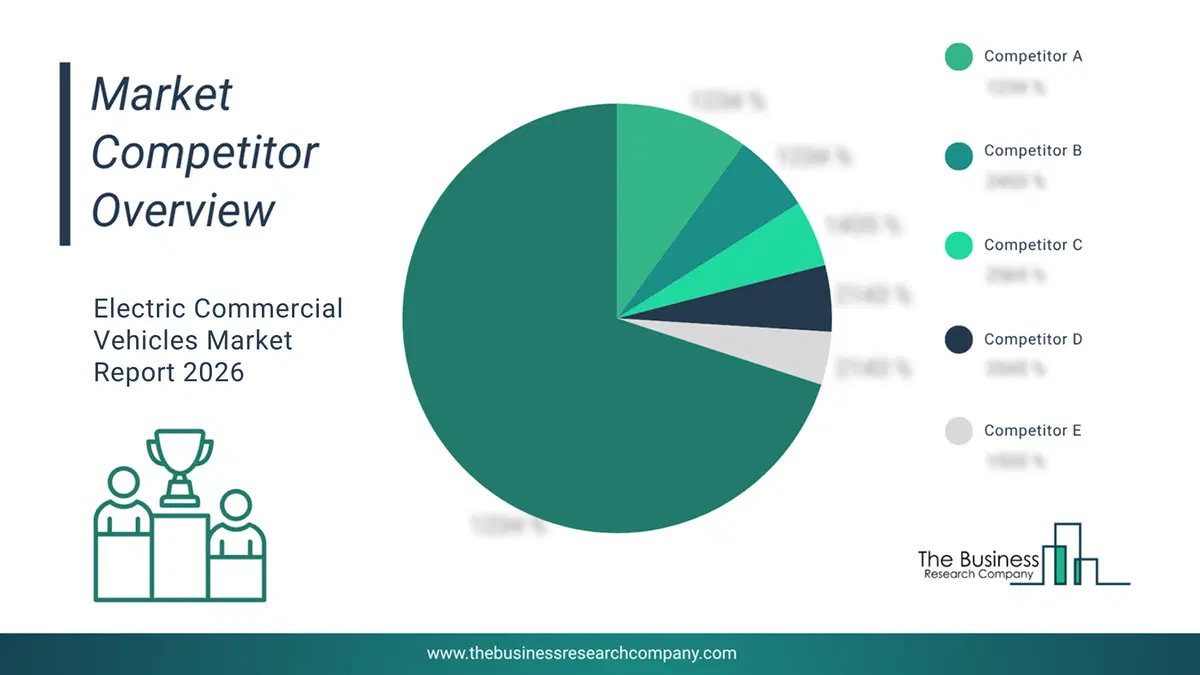
This chart is for illustrative purposes; the full report includes a detailed competitor analysis and comprehensive overview of the top 10 companies in the market.
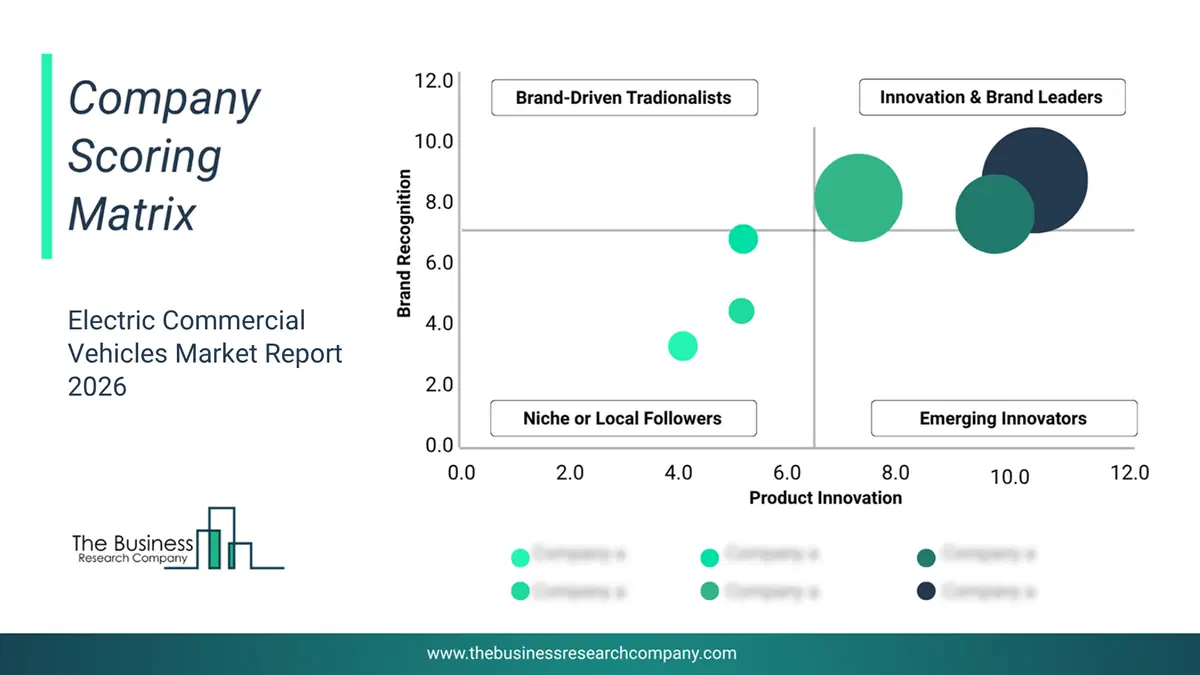
This chart maps companies by product innovation and brand strength, with bubble size indicating relative revenue, helping identify market leaders, challengers, and niche players. This is an illustrative chart; the full report provides a complete and accurate competitive analysis.
Global Electric Commercial Vehicles Market Trends and Insights
Major companies operating in the electric commercial vehicles market are implementing strategic partnerships for the production of electric commercial vehicles. Strategic partnerships in electric commercial vehicles involve the sharing of resources and expertise that enhance the product and multiply the results. It attracts popularity from consumers and other stakeholders, helping to increase the investment while reducing costs. For instance, in July 2024, Uber Technologies Inc., a US-based transportation company, partnered with BYD Co. Ltd., a China-based electronic and automobile company. This partnership seeks to integrate 100,000 new BYD electric vehicles into the Uber platform across major global markets. It is expected that drivers will enjoy competitive pricing and financing options for BYD vehicles through Uber, with plans to expand this initiative to regions including the Middle East, Canada, Australia, and New Zealand.What Are Latest Mergers And Acquisitions In The Electric Commercial Vehicles Market?
In December 2024, Toyoda Gosei Co. Ltd., a Japan-based automotive parts manufacturing company, acquired stake in EV Motors Japan Co. Ltd. (EVM-J) for an undisclosed amount. This acquisition helps the company gain hands-on expertise in the fast-growing commercial EV sector, from development to mass production. By collaborating with EVM-J, Toyoda Gosei expand its knowledge of advanced EV technologies, strengthen its position in next-generation mobility, and drive sustainable growth as the auto industry transitions toward CASE. EV Motors Japan Co. Ltd. (EVM-J) is a Japan-based automobile company that specializes in manufacturing electric vehicle.
Regional Outlook
Asia-Pacific was the largest region in the electric commercial vehicles market in 2025. North America was the second largest region in the global electric commercial vehicles market share. The regions covered in this market report include Asia-Pacific, South East Asia, Western Europe, Eastern Europe, North America, South America, Middle East, Africa. The countries covered in this market report include Australia, Brazil, China, France, Germany, India, Indonesia, Japan, Taiwan, Russia, South Korea, UK, USA, Canada, Italy, SpainWhat Defines the Electric Commercial Vehicles Market?
The electric commercial vehicles market consists of sales of hybrid electric vehicles (HEVs) and extended range electric vehicles (E-REVs). Values in this market are factory gate values, that is the value of goods sold by the manufacturers or creators of the goods, whether to other entities (including downstream manufacturers, wholesalers, distributors and retailers) or directly to end customers. The value of goods in this market includes related services sold by the creators of the goods.How is Market Value Defined and Measured?
The market value is defined as the revenues that enterprises gain from the sale of goods and/or services within the specified market and geography through sales, grants, or donations in terms of the currency (in USD unless otherwise specified). The revenues for a specified geography are consumption values that are revenues generated by organizations in the specified geography within the market, irrespective of where they are produced. It does not include revenues from resales along the supply chain, either further along the supply chain or as part of other products.
This chart presents market attractiveness based on a quantitative evaluation of growth, competition, strategic alignment, and risk, offering a clear view of opportunity areas for decision-making. This chart is for illustrative purposes; the full report contains the complete analysis.

This chart highlights the Total Addressable Market (TAM) by estimating the maximum revenue opportunity using an assumption-driven approach, supporting strategic planning and opportunity sizing across markets. The chart is illustrative; the full report provides a more comprehensive analysis.
What Key Data and Analysis Are Included in the Electric Commercial Vehicles Market Report 2026?
The electric commercial vehicles market research report is one of a series of new reports from The Business Research Company that provides market statistics, including industry global market size, regional shares, competitors with the market share, detailed market segments, market trends and opportunities, and any further data you may need to thrive in the electric commercial vehicles industry. The market research report delivers a complete perspective of everything you need, with an in-depth analysis of the current and future state of the industry.Electric Commercial Vehicles Market Report Forecast Analysis
| Report Attribute | Details |
|---|---|
| Market Size Value In 2026 | $260.07 billion |
| Revenue Forecast In 2030 | $682.59 billion |
| Growth Rate | CAGR of 28.5% from 2026 to 2030 |
| Base Year For Estimation | 2025 |
| Actual Estimates/Historical Data | 2020-2025 |
| Forecast Period | 2026 - 2030 - 2030 |
| Market Representation | Revenue in USD Billion and CAGR from 2026 to 2030 |
| Segments Covered | Propulsion Type, Vehicle Type, Battery Type |
| Regional Scope | Asia-Pacific, Western Europe, Eastern Europe, North America, South America, Middle East, Africa |
| Country Scope | The countries covered in the report are Australia, Brazil, China, France, Germany, India, Indonesia, Japan, Taiwan, Russia, South Korea, UK, USA, Canada, Italy, Spain. |
| Key Companies Profiled | BYD Company Ltd., Zhengzhou Yutong Bus Co. Ltd, Daimler AG, Proterra, VDL Groep BV, Irizar, ZHONGTONGBUS Bus Holding Co., Ltd, Ebusco B.V., Navistar, Inc., Workhorse Group Incorporated, Mahindra Electric, Tata Motors, Ashok Leyland, SAIC Motor, Dongfeng Motor, FAW Group, BAIC Motor, Volkswagen, Renault, Mercedes Benz Motors, MAN Germany, DAF Trucks, Via Motors, Tesla Inc, Hyliion, Ford, General Motors, Bozankaya, Melex Electrovehicles, Jet Motors, El Nasr Automotive Manufacturing Company |
| Customization Scope | Request for Customization |
| Pricing And Purchase Options | Explore Purchase Options |