
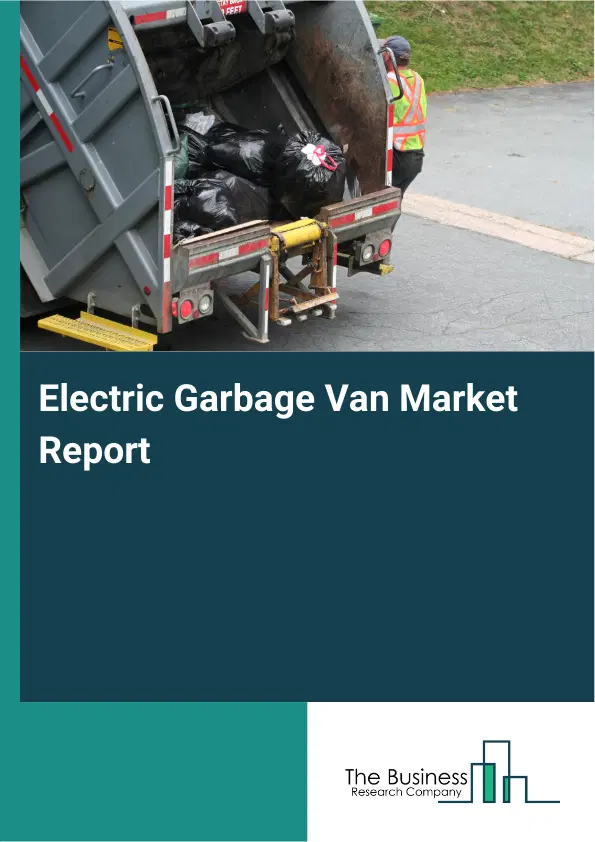
Electric Garbage Van Market Report 2026
Global Outlook – By Product Type (Garbage Tipper; Garbage Cycle eRikshaw; Battery Electric Van; Other Product Types), By Loading Capacity (Less Than 500 Kg; 500 To 800 Kg; More Than 800 Kg), By End User (Commercial Garbage Van; Industrial Garbage Van; Other End Users) – Market Size, Trends, Strategies, and Forecast to 2030
Electric Garbage Van Market Overview
• Electric Garbage Van market size has reached to $0.79 billion in 2025 • Expected to grow to $1.46 billion in 2030 at a compound annual growth rate (CAGR) of 13% • Growth Driver: Growing Adoption Of Emission-Free Vehicles To Boost Electric Garbage Van Market Growth • Market Trend: Advancements In Electrified Transportation Technology • Asia-Pacific was the largest region in 2025.What Is Covered Under Electric Garbage Van Market?
An electric garbage van is a vehicle designed for collecting and transporting waste or recyclables powered by electric batteries rather than traditional internal combustion engines. These vans are typically used by municipal waste management services and private companies to reduce emissions, noise pollution, and operating costs. The main types of products in electric garbage vans are garbage tippers, garbage cycle e-rickshaws, battery electric vans, and others. A garbage tipper is a type of vehicle equipped with a hydraulic mechanism that allows the rear container to be lifted and emptied easily. These tippers are categorized by their load capacities, which range from less than 500 kg to 500 to 800 kg and more than 800 kg, catering to various end users, including commercial garbage vans, industrial garbage vans, and others.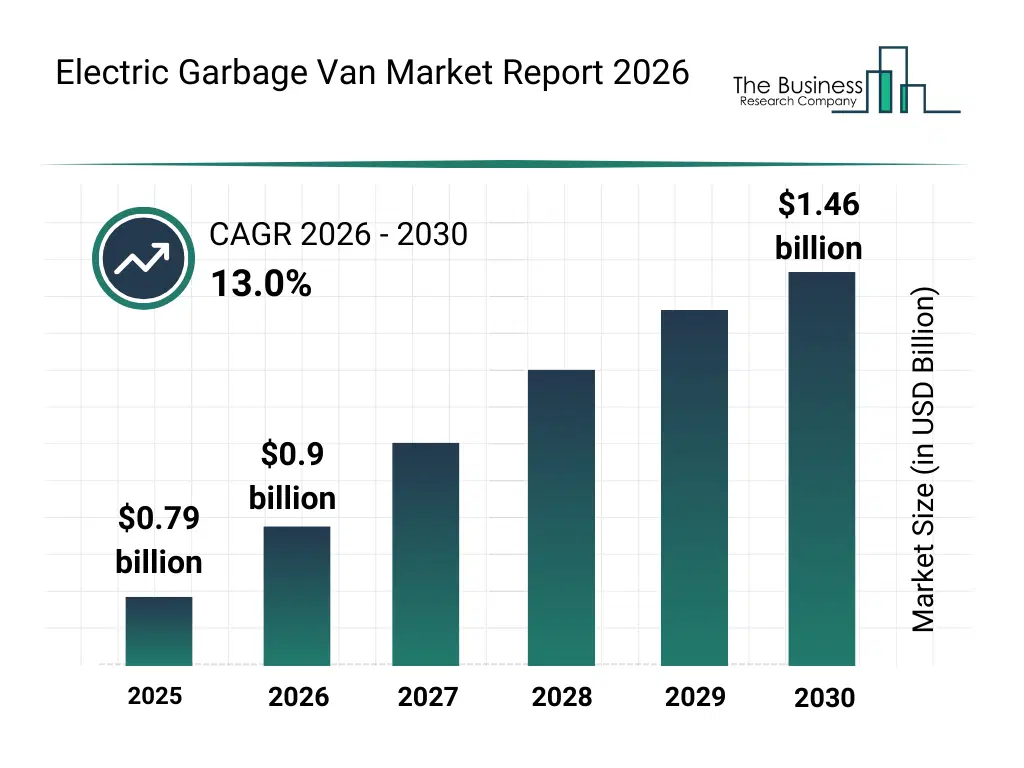
What Is The Electric Garbage Van Market Size and Share 2026?
The electric garbage van market size has grown rapidly in recent years. It will grow from $0.79 billion in 2025 to $0.9 billion in 2026 at a compound annual growth rate (CAGR) of 13.3%. The growth in the historic period can be attributed to expansion of municipal electrification programs, adoption of electric commercial vehicles, rising urban waste generation, improvements in battery performance, availability of charging infrastructure.What Is The Electric Garbage Van Market Growth Forecast?
The electric garbage van market size is expected to see rapid growth in the next few years. It will grow to $1.46 billion in 2030 at a compound annual growth rate (CAGR) of 13.0%. The growth in the forecast period can be attributed to increasing investments in zero-emission municipal fleets, expansion of smart city waste management initiatives, rising focus on lifecycle cost optimization, growth of electric commercial vehicle manufacturing, integration of autonomous waste collection features. Major trends in the forecast period include increasing adoption of battery electric waste collection vehicles, rising integration of smart fleet management systems, growing demand for low-noise urban waste transport, expansion of modular electric waste vehicle designs, enhanced focus on operational cost reduction.
Global Electric Garbage Van Market Segmentation
1) By Product Type: Garbage Tipper, Garbage Cycle eRikshaw, Battery Electric Van, Other Product Types 2) By Loading Capacity: Less Than 500 Kg, 500 To 800 Kg, More Than 800 Kg 3) By End User: Commercial Garbage Van, Industrial Garbage Van, Other End Users Subsegments: 1) By Garbage Tipper: Small Garbage Tipper, Medium Garbage Tipper, Large Garbage Tipper, Rear-Loader Garbage Tipper, Side-Loader Garbage Tipper 2) By Garbage Cycle eRickshaw: Manual Garbage Cycle eRickshaw, Electric Garbage Cycle eRickshaw, Cargo Capacity Variants, Customized Designs 3) By Battery Electric Van: Light-Duty Electric Van, Medium-Duty Electric Van, Heavy-Duty Electric Van, Refrigerated Electric Van, Chassis Cab Electric Van 4) By Other Product Types: Electric Compactors, Electric Street Sweepers, Electric Waste Collection Bins, Electric Waste Segregation SystemsWhat Is The Driver Of The Electric Garbage Van Market?
The growing adoption of emission-free vehicles is expected to drive the electric garbage van market going forward. Emission-free vehicles are vehicles that produce no exhaust emissions during operation and are typically powered by alternative energy sources such as electricity or hydrogen. The emission-free vehicles are adopted due to their environmental benefits, government incentives, and technological advancements that offer lower operating costs and improved energy efficiency. The use of electric garbage vans contributes to the adoption of emission-free vehicles by replacing traditional waste collection trucks with zero-emission alternatives. For instance, in April 2024, according to International Energy Agency (IEA), a France-based intergovernmental organization, the number of new electric vehicles registered worldwide in 2023 was close to 14 million. Sales of electric vehicles increased by 3.5 million in 2023 compared to 2022, and they accounted for approximately 18% of all vehicles sold in 2023, up from 14% in 2022. Therefore, the growing adoption of emission-free vehicles is expected to drive growth in the electric garbage van industry.Key Players In The Global Electric Garbage Van Market
Major companies operating in the electric garbage van market are Mercedes-Benz, Hyundai Motor Company, Tesla Inc., Daimler Trucks, Groupe Renault, Scania Group, Mitsubishi Motors, Iveco Group Company, Hino Motors, MAN Truck & Bus, Oshkosh Corporation, Terex Corporation, Heil Co., Kirchhoff Group, Peterbilt, McNeilus, Proterra, Lion Electric, Autocar Trucks, Bridgepart Truck Manufacturing, GreenPower Motor Company, Bollinger Motors, Curbtender, Cenntro Automotive, Workhorse Group
This chart is for illustrative purposes; the full report includes a detailed competitor analysis and comprehensive overview of the top 10 companies in the market.
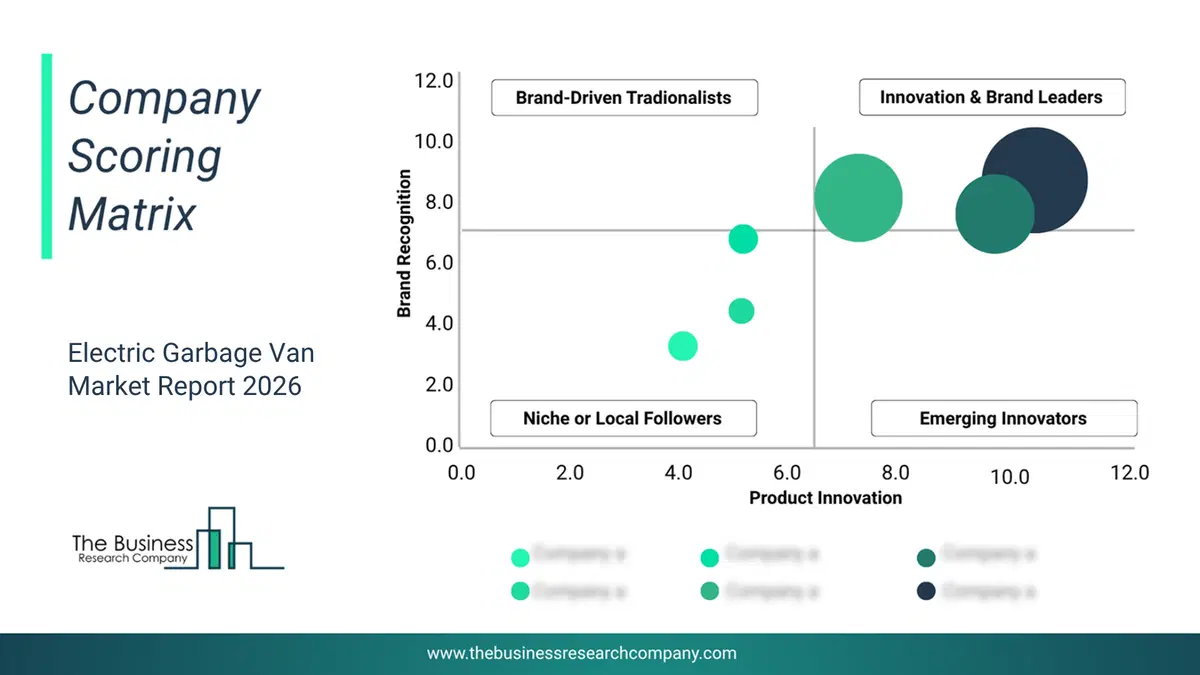
This chart maps companies by product innovation and brand strength, with bubble size indicating relative revenue, helping identify market leaders, challengers, and niche players. This is an illustrative chart; the full report provides a complete and accurate competitive analysis.
Global Electric Garbage Van Market Trends and Insights
Major companies operating in the electric garbage van market are focusing on developing technologically innovative solutions, such as all-electric waste collection vehicles, to reduce emissions, lower operational costs, and improve efficiency in urban waste management. All-electric waste collection vehicles are garbage trucks powered entirely by electricity, providing zero emissions and reduced noise while lowering operational costs and minimizing environmental impact. For instance, in July 2023, Grundon Waste Management, a UK-based waste management company, introduced the UK's first all-electric waste collection vehicle, a Scania model, to provide zero-carbon waste collections in Reading and Newbury. This initiative includes two electric vehicles that are now operational, with one based in Colnbrook, serving commercial customers in London and the Thames Valley, and another in Bristol. These vehicles are powered by electricity generated from the waste they collect, utilizing Grundon's Energy from Waste (EfW) facility, which allows for sustainable operation. In addition to electric vehicles, Grundon is exploring alternative fuels, such as hydrogen and hydrotreated vegetable oil (HVO), to reduce its environmental impact and improve air quality in urban areas.What Are Latest Mergers And Acquisitions In The Electric Garbage Van Market?
In April 2024, Saitama City, a Japan-based City, partnered with JFE Engineering to introduce battery-powered garbage trucks that emit no exhaust. The trucks will be powered by electricity generated from waste at Saitama's Clean Center Osaki, supporting the city's decarbonization goals. JFE Engineering is a Japan-based electric vehicle charger manufacturer.
Regional Outlook
Asia-Pacific was the largest region in the electric garbage van market in 2025. The regions covered in this market report are Asia-Pacific, South East Asia, Western Europe, Eastern Europe, North America, South America, Middle East, Africa. The countries covered in this market report are Australia; Brazil; China; France; Germany; India; Indonesia; Japan; Taiwan; Russia; South Korea; UK; USA; Canada; Italy; Spain.What Defines the Electric Garbage Van Market?
The electric garbage van market consists of sales of front-loading electric garbage vans, side-loading electric garbage vans, dual-purpose electric garbage vans, custom electric garbage vans, and compacting electric garbage vans. Values in this market are ‘factory gate’ values, that is, the value of goods sold by the manufacturers or creators of the goods, whether to other entities (including downstream manufacturers, wholesalers, distributors, and retailers) or directly to end customers. The value of goods in this market includes related services sold by the creators of the goods.How is Market Value Defined and Measured?
The market value is defined as the revenues that enterprises gain from the sale of goods and/or services within the specified market and geography through sales, grants, or donations in terms of the currency (in USD unless otherwise specified). The revenues for a specified geography are consumption values that are revenues generated by organizations in the specified geography within the market, irrespective of where they are produced. It does not include revenues from resales along the supply chain, either further along the supply chain or as part of other products.
This chart presents market attractiveness based on a quantitative evaluation of growth, competition, strategic alignment, and risk, offering a clear view of opportunity areas for decision-making. This chart is for illustrative purposes; the full report contains the complete analysis.

This chart highlights the Total Addressable Market (TAM) by estimating the maximum revenue opportunity using an assumption-driven approach, supporting strategic planning and opportunity sizing across markets. The chart is illustrative; the full report provides a more comprehensive analysis.
What Key Data and Analysis Are Included in the Electric Garbage Van Market Report 2026?
The electric garbage van market research report is one of a series of new reports from The Business Research Company that provides market statistics, including Market Report 2026?global market size, regional shares, competitors with the market share, detailed market segments, market trends and opportunities, and any further data you may need to thrive in the electric garbage van Market Report 2026? The market research report delivers a complete perspective of everything you need, with an in-depth analysis of the current and future state of the Market Report 2026?Electric Garbage Van Market Report Forecast Analysis
| Report Attribute | Details |
|---|---|
| Market Size Value In 2026 | $0.9 billion |
| Revenue Forecast In 2030 | $1.46 billion |
| Growth Rate | CAGR of 13.3% from 2026 to 2030 |
| Base Year For Estimation | 2025 |
| Actual Estimates/Historical Data | 2020-2025 |
| Forecast Period | 2026 - 2030 - 2030 |
| Market Representation | Revenue in USD Billion and CAGR from 2026 to 2030 |
| Segments Covered | Product Type, Loading Capacity, End User |
| Regional Scope | Asia-Pacific, Western Europe, Eastern Europe, North America, South America, Middle East, Africa |
| Country Scope | The countries covered in the report are Australia, Brazil, China, France, Germany, India, Indonesia, Japan, Taiwan, Russia, South Korea, UK, USA, Canada, Italy, Spain. |
| Key Companies Profiled | Mercedes-Benz, Hyundai Motor Company, Tesla Inc., Daimler Trucks, Groupe Renault, Scania Group, Mitsubishi Motors, Iveco Group Company, Hino Motors, MAN Truck & Bus, Oshkosh Corporation, Terex Corporation, Heil Co., Kirchhoff Group, Peterbilt, McNeilus, Proterra, Lion Electric, Autocar Trucks, Bridgepart Truck Manufacturing, GreenPower Motor Company, Bollinger Motors, Curbtender, Cenntro Automotive, Workhorse Group |
| Customization Scope | Request for Customization |
| Pricing And Purchase Options | Explore Purchase Options |