

Electric Passenger Car Market Report 2026
Global Outlook – By Propulsion Type (Battery Electric Vehicle, Plug In Hybrid Electric Vehicle), By Battery Type (Lithium Ion Battery, Nickel Manganese Cobalt Battery, Solid State Battery, Other Battery Types), By Vehicle Class (Hatchback, Sedan, Sport Utility Vehicle, Multi Purpose Vehicle, Luxury Car), By Sales Channel (Original Equipment Manufacturer Dealerships, Online Sales, Third Party Dealers), By End User (Individual Consumers, Fleet Operators, Corporate, Government) – Market Size, Trends, Strategies, and Forecast to 2035
Electric Passenger Car Market Overview
• Electric Passenger Car market size has reached to $489.14 billion in 2025 • Expected to grow to $1987.07 billion in 2030 at a compound annual growth rate (CAGR) of 32.3% • Growth Driver: Rising Fuel Prices Fueling The Growth Of The Market Due To Lower Operating Costs Compared To Conventional Fuel Powered Vehicles • Market Trend: Next-Generation Centralized Computing Revolutionizes Electric Vehicle Performance, Efficiency And Driving Dynamics • Asia-Pacific was the largest region and fastest growing region.What Is Covered Under Electric Passenger Car Market?
An electric passenger car is a passenger road vehicle propelled wholly or predominantly by one or more electric motors, typically powered by rechargeable batteries or other onboard electrical energy storage systems. It produces no direct tailpipe emissions during electric operation and is used for personal, commercial, or institutional transportation. The main propulsion types of electric passenger cars include battery electric vehicles, and plug in hybrid electric vehicles. Battery electric vehicles refer to passenger cars powered entirely by electricity stored in rechargeable batteries, without an internal combustion engine. These vehicles use lithium ion batteries, nickel manganese cobalt batteries, solid state batteries, and other battery types, and are available as hatchbacks, sedans, sport utility vehicles, multi purpose vehicles, and luxury cars. They are sold through original equipment manufacturer dealerships, online sales, and third party dealers and are used end users by individual consumers, fleet operators, corporate users, and government organizations.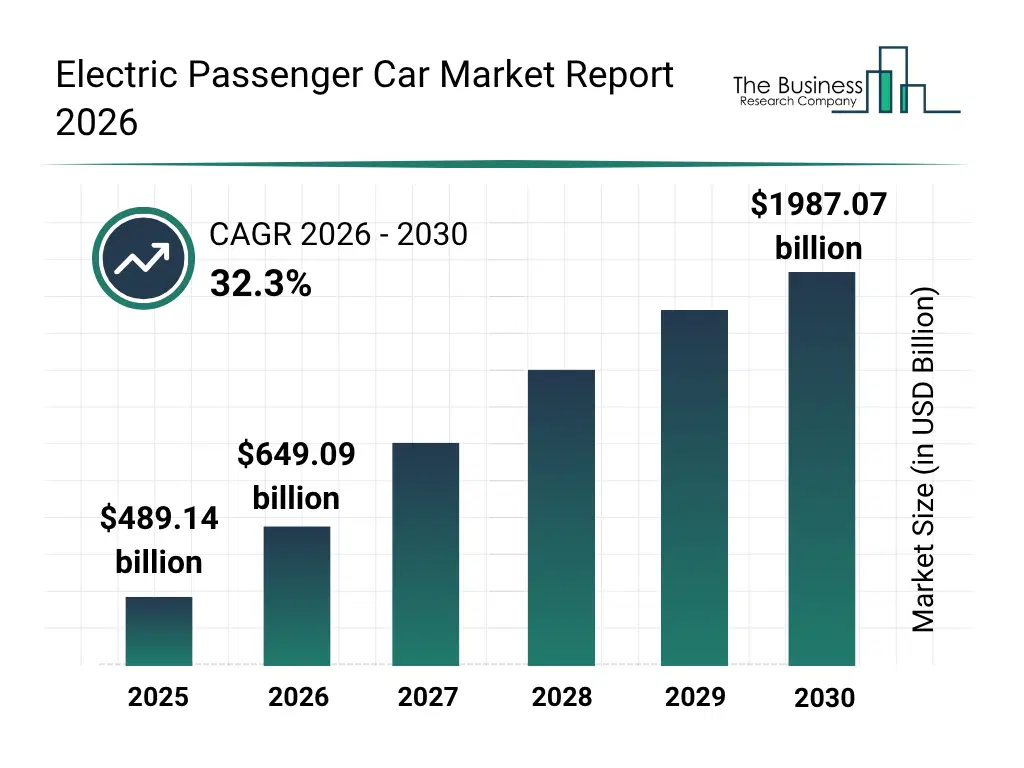
What Is The Electric Passenger Car Market Size and Share 2026?
The electric passenger car market size has grown exponentially in recent years. It will grow from $489.14 billion in 2025 to $649.09 billion in 2026 at a compound annual growth rate (CAGR) of 32.7%. The growth in the historic period can be attributed to increasing government incentives for electric vehicles, rising consumer awareness of vehicle emissions, declining battery costs, expansion of public charging infrastructure, increasing electric vehicle model availability.What Is The Electric Passenger Car Market Growth Forecast?
The electric passenger car market size is expected to see exponential growth in the next few years. It will grow to $1987.07 billion in 2030 at a compound annual growth rate (CAGR) of 32.3%. The growth in the forecast period can be attributed to growing demand for long-range electric passenger cars, increasing investment in ultra-fast charging networks, declining cost of advanced battery technologies, rising adoption of electric vehicle fleets, increasing integration of vehicle-to-grid technologies. Major trends in the forecast period include battery technology advancements, expansion of fast-charging infrastructure, growth of battery swapping systems, increasing electric vehicle driving range, development of vehicle-to-grid technology.Tariff Impact On Electric Passenger Car Market
Tariffs are impacting the electric passenger car market by increasing the cost of imported batteries, semiconductors, electric motors, and other critical vehicle components, raising production and vehicle prices. Battery electric vehicles and plug-in hybrid electric vehicles are particularly affected, with regions such as North America and Europe facing supply-chain pressures due to their reliance on internationally sourced components. Higher tariffs may slow affordability-driven adoption in the short term, but they can also encourage automakers to localize battery and vehicle production, diversify suppliers, and strengthen domestic electric vehicle manufacturing capabilities.
Global Electric Passenger Car Market Segmentation
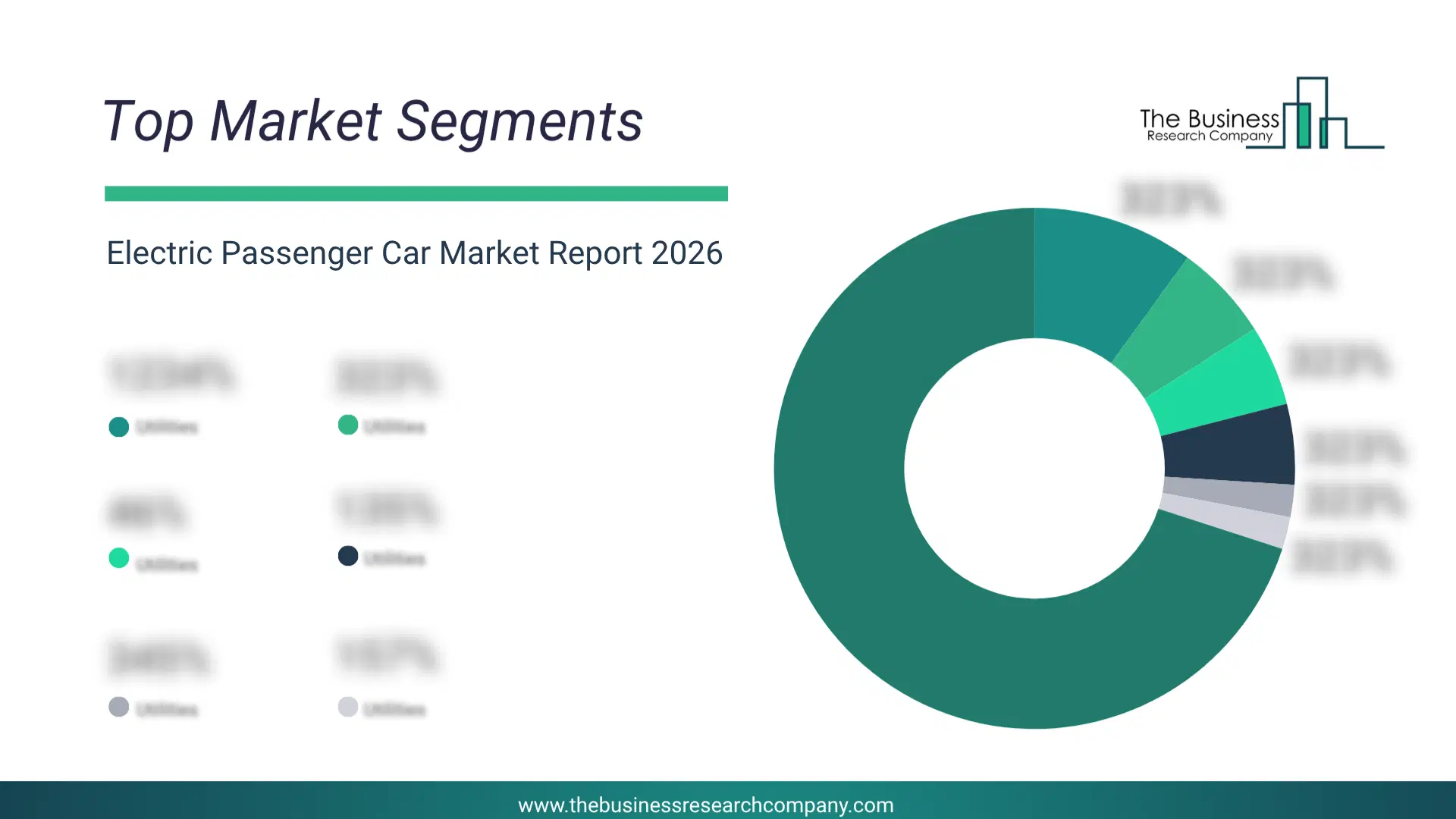
2) By Battery Type: Lithium Ion Battery, Nickel Manganese Cobalt Battery, Solid State Battery, Other Battery Types 3) By Vehicle Class: Hatchback, Sedan, Sport Utility Vehicle, Multi Purpose Vehicle, Luxury Car 4) By Sales Channel: Original Equipment Manufacturer Dealerships, Online Sales, Third Party Dealers 5) By End User: Individual Consumers, Fleet Operators, Corporate, Government Subsegments: 1) By Battery Electric Vehicle: Battery Swap Electric Vehicle, Fixed Battery Electric Vehicle 2) By Plug In Hybrid Electric Vehicle: Series Plug In Hybrid, Parallel Plug In Hybrid, Series Parallel Plug In HybridWhat Is The Driver Of The Electric Passenger Car Market?
The rising fuel prices is expected to propel the growth of the electric passenger car market going forward. Fuel prices are the amounts consumers pay to purchase transportation fuels such as gasoline, diesel, or other petroleum-based fuels, determined by factors including crude oil costs, refining, distribution, taxes, and market supply and demand. Fuel prices are rising due to increasing crude oil prices, as higher global oil production costs and supply constraints raise the cost of refining and distributing transportation fuels. Rising fuel prices encourage consumers to switch to electric passenger cars, as lower electricity and maintenance costs make them a more economical alternative to conventional fuel-powered vehicles over the long term. For instance, in May 2026, according to the Bureau of Transportation Statistics (BTS) is a US-based federal statistical agency, the average fuel price increased to $3.13 per gallon in March 2026, up 30.9% from $2.39 per gallon in February 2026 and 29.9% from $2.41 per gallon in March 2025. Therefore, the rising fuel prices is driving the growth of the electric passenger car industry.Key Players In The Global Electric Passenger Car Market
Major companies operating in the electric passenger car market are Volkswagen AG, Toyota Motor Corporation, Stellantis NV, BMW AG, Mercedes-Benz Group AG, Honda Motor Co Ltd, Hyundai Motor Company, BYD Company Ltd, Tesla Inc, SAIC Motor Corporation Limited, Nissan Motor Co Ltd, Kia Corporation, Renault Group, Geely Automobile Holdings Limited, Volvo Car AB, Great Wall Motor Company Limited, Chongqing Changan Automobile Company Limited, Li Auto Inc, GAC Aion New Energy Automobile Co Ltd, NIO Inc, XPeng Inc, Rivian Automotive Inc, Lucid Group Inc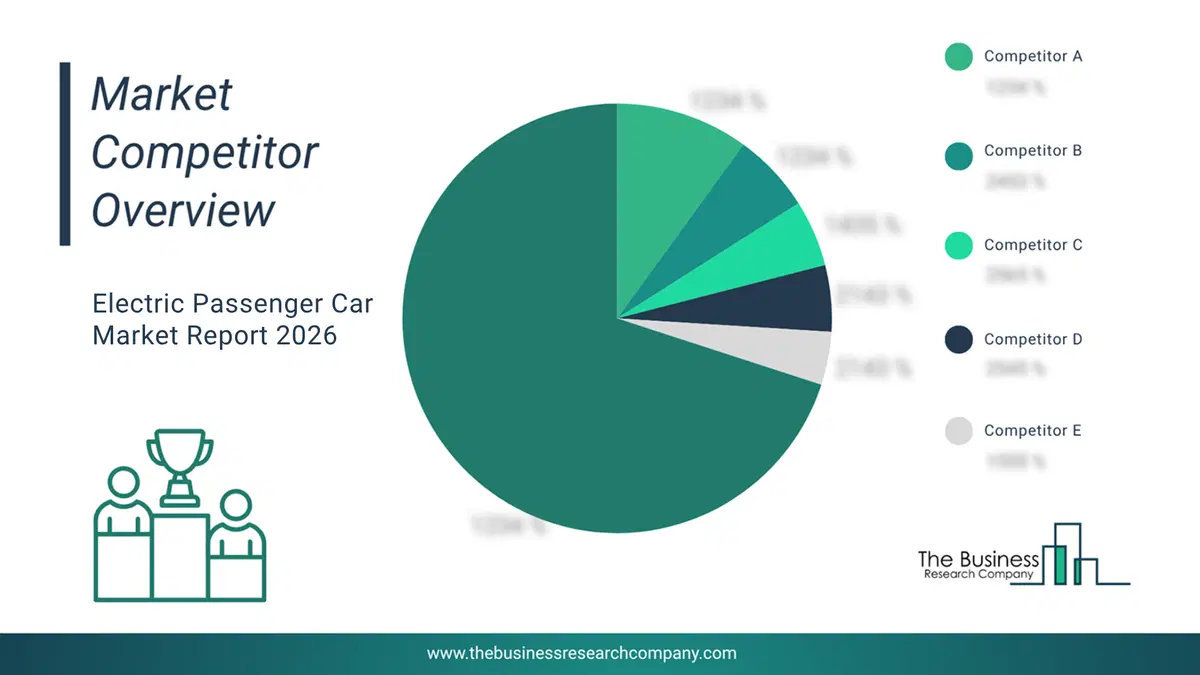
This chart is for illustrative purposes; the full report includes a detailed competitor analysis and comprehensive overview of the top 10 companies in the market.
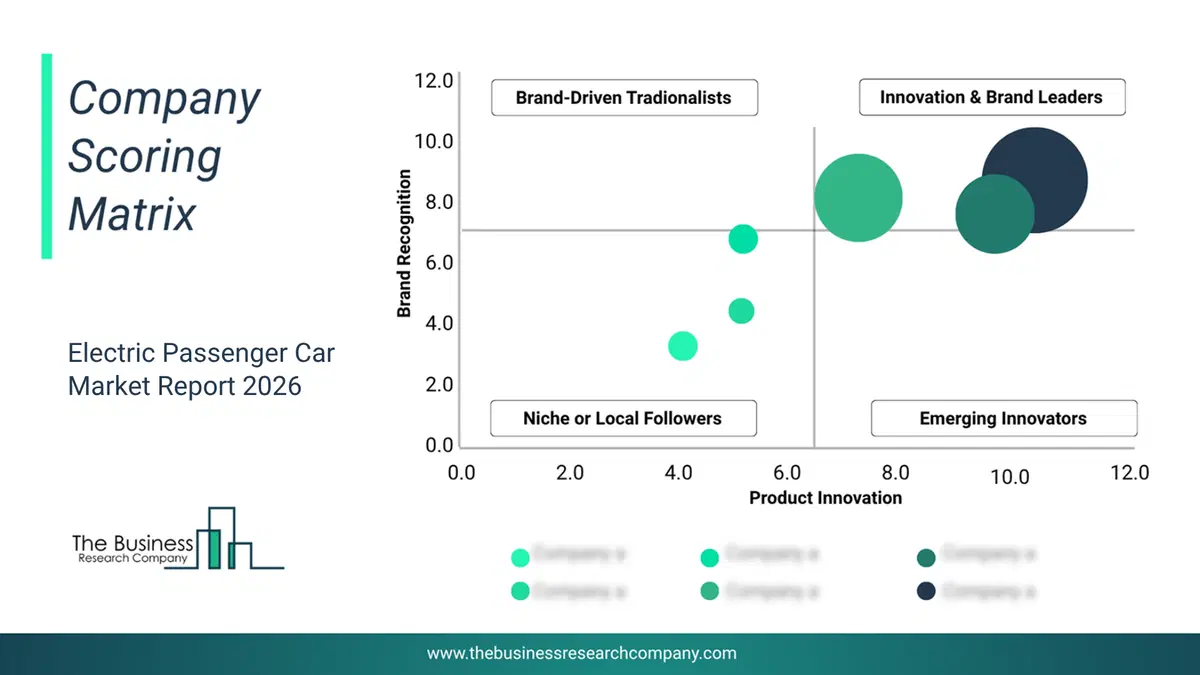
This chart maps companies by product innovation and brand strength, with bubble size indicating relative revenue, helping identify market leaders, challengers, and niche players. This is an illustrative chart; the full report provides a complete and accurate competitive analysis.
Global Electric Passenger Car Market Trends and Insights
Major companies operating in the electric passenger car market are focusing on developing innovative technologies, such as vehicle control computers to enhance driving dynamics, improve energy efficiency, and enable software-defined vehicle architectures. A vehicle control computer is a centralized electronic control system that coordinates critical vehicle functions, including propulsion, braking, steering, charging, and energy management, to optimize vehicle performance, safety, and efficiency. For instance, in February 2025, BMW AG, a Germany-based luxury automobile manufacturer, announced Heart of Joy, a vehicle control computer. The new control unit integrates propulsion, steering, braking, charging, and regenerative braking into a single high-performance computing platform that processes vehicle dynamics information ten times faster than previous systems. It also enables regenerative braking to perform most everyday braking tasks, increasing vehicle efficiency by up to 25% while improving driving precision, stability, and responsiveness.What Are Latest Mergers And Acquisitions In The Electric Passenger Car Market?
In December 2025, Renault Group, a France-based automotive manufacturer, partnered with Ford Motor Company to jointly develop two Ford-branded electric passenger vehicles based on Renault Group's Ampere electric vehicle platform and explore collaboration on selected light commercial vehicles in Europe. With this partnership, both companies aim to strengthen their competitiveness in the European automotive market by leveraging Renault Group's electric vehicle platform, manufacturing capabilities, and industrial scale alongside Ford's vehicle design expertise and brand identity to accelerate affordable electric vehicle development. Ford Motor Company is a US-based provider of passenger cars, electric vehicles, light commercial vehicles, pickup trucks, sport utility vehicles, automotive software, and mobility solutions.
Regional Outlook/Insights
Asia-Pacific was the largest region in the electric passenger car market in 2025. Asia-Pacific is expected to be the fastest-growing region in the forecast period. The regions covered in this market report are Asia-Pacific, South East Asia, Western Europe, Eastern Europe, North America, South America, Middle East, Africa. The countries covered in this market report are Australia, Brazil, China, France, Germany, India, Indonesia, Japan, Taiwan, Russia, South Korea, UK, USA, Canada, Italy, Spain.What Defines the Electric Passenger Car Market?
The electric passenger car market consists of sales of electric compact cars, electric subcompact cars, electric sedans, electric hatchbacks, electric crossovers, electric coupes, electric convertibles, and electric station wagons. Values in this market are factory gate values, that is, the value of goods sold by the manufacturers or creators of the goods, whether to other entities (including downstream manufacturers, wholesalers, distributors, and retailers) or directly to end customers. The value of goods in this market includes related services sold by the creators of the goods.How is Market Value Defined and Measured?
The market value is defined as the revenues that enterprises gain from the sale of goods and/or services within the specified market and geography through sales, grants, or donations in terms of the currency (in USD unless otherwise specified). The revenues for a specified geography are consumption values that are revenues generated by organizations in the specified geography within the market, irrespective of where they are produced. It does not include revenues from resales along the supply chain, either further along the supply chain or as part of other products.
This chart presents market attractiveness based on a quantitative evaluation of growth, competition, strategic alignment, and risk, offering a clear view of opportunity areas for decision-making. This chart is for illustrative purposes; the full report contains the complete analysis.

This chart highlights the Total Addressable Market (TAM) by estimating the maximum revenue opportunity using an assumption-driven approach, supporting strategic planning and opportunity sizing across markets. The chart is illustrative; the full report provides a more comprehensive analysis.
What Key Data and Analysis Are Included in the Electric Passenger Car Market Report 2026?
The electric passenger car market research report is one of a series of new reports from The Business Research Company that provides market statistics, including industry global market size, regional shares, competitors with the market share, detailed market segments, market trends and opportunities, and any further data you may need to thrive in the electric passenger car industry. The market research report delivers a complete perspective of everything you need, with an in-depth analysis of the current and future state of the industry.Electric Passenger Car Market Report Forecast Analysis
| Report Attribute | Details |
|---|---|
| Market Size Value In 2026 | $649.09 billion |
| Revenue Forecast In 2030 | $1987.07 billion |
| Growth Rate | CAGR of 32.3% from 2026 to 2035 |
| Base Year For Estimation | 2025 |
| Actual Estimates/Historical Data | 2020-2025 |
| Forecast Period | 2026 - 2030 |
| Market Representation | Revenue in USD Billion and CAGR from 2026 to 2030 |
| Segments Covered | Propulsion Type, Battery Type, Vehicle Class, Sales Channel, End User |
| Regional Scope | Asia-Pacific, Western Europe, Eastern Europe, North America, South America, Middle East, Africa |
| Country Scope | The countries covered in the report are Australia, Brazil, China, France, Germany, India, Indonesia, Japan, Taiwan, Russia, South Korea, UK, USA, Canada, Italy, Spain. |
| Customization Scope | Request for Customization |
| Pricing And Purchase Options | Explore Purchase Options |