
Electric Rickshaw Battery Market Report 2026
Global Outlook – By Type ( Lead-Acid Batteries, Lithium-Ion Batteries, Nickel-Metal Hydride Batteries, Ultracapacitors), By Capacity ( Less Than 20 Ah, 20-50 Ah, 50-100 Ah, 100-200 Ah, More Than 200 Ah), By Application ( Passenger E-Rickshaws, Cargo E-Rickshaws, E-Rickshaws For Municipal Use, E-Rickshaws For Tourism, Other Applications), By End-User ( Original Equipment Manufacturer (OEM), Aftermarket) – Market Size, Trends, Strategies, and Forecast to 2030
Electric Rickshaw Battery Market Overview
• Electric Rickshaw Battery market size has reached to $1.66 billion in 2025 • Expected to grow to $3.52 billion in 2030 at a compound annual growth rate (CAGR) of 16.1% • Growth Driver: Rising Demand For Electric Vehicles Fueling The Growth Of The Market Due To Increasing Adoption Of Eco-Friendly Transportation • Market Trend: Innovation In Lithium-Ion E-rickshaw Batteries Driving Sustainable Urban Mobility • Asia-Pacific was the largest region and fastest growing region.Market Gains By 2030 – Top Opportunities By Segment
Market Gain identifies the most promising market opportunities by highlighting the segments or products expected to generate the highest incremental revenue growth over the next five years.
What Is Covered Under Electric Rickshaw Battery Market?
Electric rickshaw battery refers to a rechargeable energy storage unit specifically engineered to provide consistent and efficient electrical power to an electric rickshaw’s motor, enabling smooth operation without the need for conventional fuels. These batteries are designed to endure frequent charging and discharging cycles, offer extended driving range, and maintain reliable performance under varying road conditions, supporting cost-effective and environmentally friendly urban transportation. The main types of electric rickshaw batteries are lead-acid batteries, lithium-ion batteries, nickel-metal hydride batteries, zinc-carbon batteries, and ultracapacitors. Lead-acid batteries are traditional, cost-effective power sources widely used in electric rickshaws, valued for their availability and reliability. It includes various capacity types, such as less than 20 Ah, 20-50 Ah, 50-100 Ah, 100-200 Ah, and more than 200 Ah, and finds applications in passenger e-rickshaws, cargo e-rickshaws, e-rickshaws for municipal use, e-rickshaws for tourism, and others. Key end-users include original equipment manufacturers (OEMs) and the aftermarket.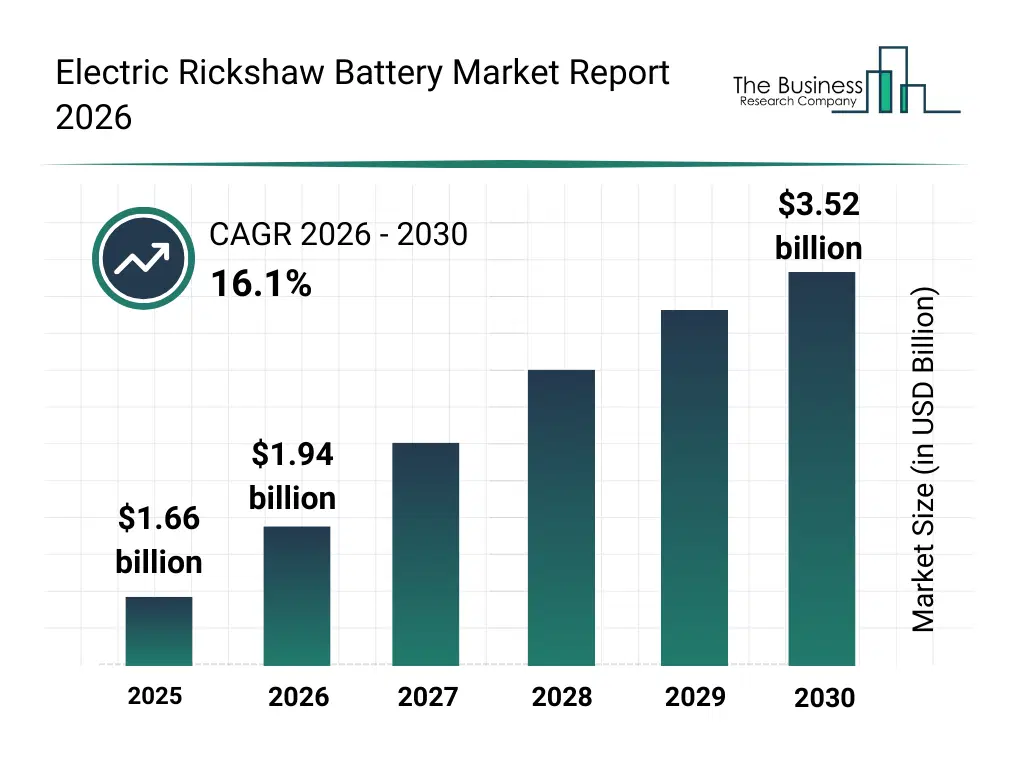
What Is The Electric Rickshaw Battery Market Size 2026 And Growth Rate?
The electric rickshaw battery market size has grown rapidly in recent years. It will grow from $1.66 billion in 2025 to $1.94 billion in 2026 at a compound annual growth rate (CAGR) of 16.4%. The growth in the historic period can be attributed to rising fuel costs, government subsidies for electric vehicles, increasing urbanization, technological advancements in battery design, growing environmental awareness.What Is The Electric Rickshaw Battery Market Growth Forecast?
The electric rickshaw battery market size is expected to see rapid growth in the next few years. It will grow to $3.52 billion in 2030 at a compound annual growth rate (CAGR) of 16.1%. The growth in the forecast period can be attributed to advancements in solid-state batteries, expansion of charging infrastructure, integration with smart grid systems, rising demand for cargo and passenger e-rickshaws, supportive government policies for electric mobility. Major trends in the forecast period include battery energy density improvement, fast charging infrastructure development, battery lifecycle management, lightweight battery materials, modular & swappable battery systems.
Global Electric Rickshaw Battery Market Segmentation
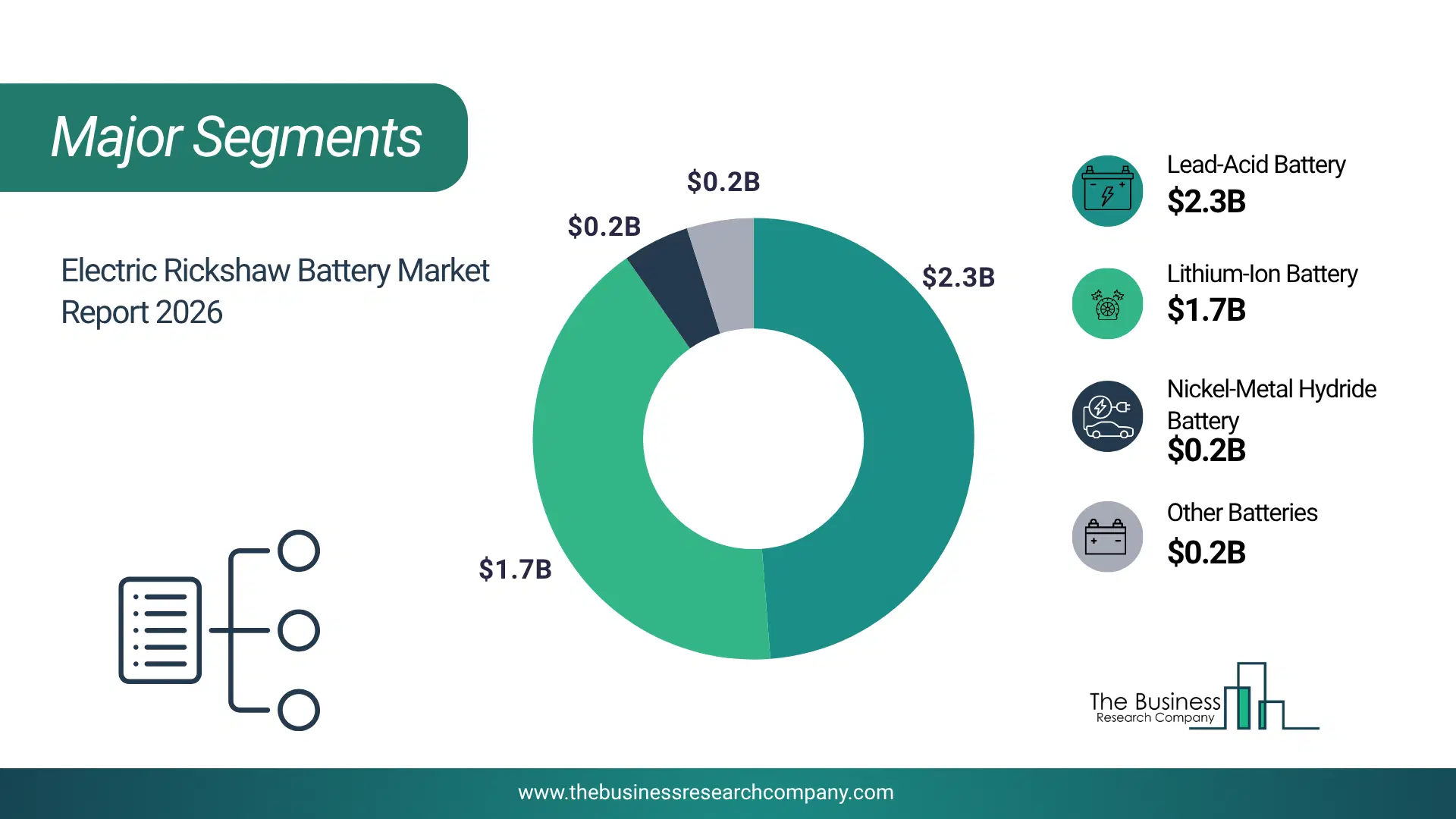
1) By Type: Lead-Acid Batteries, Lithium-Ion Batteries, Nickel-Metal Hydride Batteries, Ultracapacitors 2) By Capacity: Less Than 20 Ah, 20-50 Ah, 50-100 Ah, 100-200 Ah, More Than 200 Ah 3) By Application: Passenger E-Rickshaws, Cargo E-Rickshaws, E-Rickshaws For Municipal Use, E-Rickshaws For Tourism, Other Applications 4) By End-User: Original Equipment Manufacturer (OEM), Aftermarket Subsegments: 1) By Lead-Acid Batteries: Flooded Lead-Acid Batteries, Sealed Lead-Acid Batteries, Deep Cycle Lead-Acid Batteries, Valve Regulated Lead-Acid Batteries 2) By Lithium-Ion Batteries: Lithium Iron Phosphate Batteries, Lithium Nickel Manganese Cobalt Oxide Batteries, Lithium Cobalt Oxide Batteries, Lithium Manganese Oxide Batteries 3) By Nickel-Metal Hydride Batteries: Vented Nickel-Metal Hydride Batteries, Sealed Nickel-Metal Hydride Batteries 4) By Ultracapacitors: Electric Double Layer Capacitors, Hybrid Capacitors, Pseudocapacitors The top segments in the electric rickshaw battery market will be: • Lead-Acid Battery will reach $2.26 billion by 2030. • Lithium-Ion Battery will reach $1.66 billion by 2030. • Nickel-Metal Hydride Battery will reach $0.19 billion by 2030. • Other Batteries will reach $0.13 billion by 2030.What Is The Driver Of The Electric Rickshaw Battery Market?
The rising demand for electric vehicles is expected to propel the growth of the electric rickshaw battery market going forward. Electric vehicles refer to automobiles that run on electric power stored in rechargeable batteries, offering an eco-friendly alternative to traditional fuel-powered vehicles. The demand for electric vehicles is rising as governments worldwide introduce stricter emission regulations and offer incentives to encourage the adoption of cleaner transportation. An electric rickshaw battery is useful for electric vehicles as it stores and supplies the electrical energy required to power the motor, enabling reliable performance, longer driving ranges, and eco-friendly operation while reducing dependence on fossil fuels. For instance, in August 2025, according to the European Automobile Manufacturers Association, a Belgium-based trade association, in July 2025, year-on-year growth was recorded at 39.1% for battery-electric cars and 14.3% for hybrid-electric cars, while plug-in hybrid electric cars marked their fifth straight month of robust expansion with a 56.9% increase. Therefore, the rising demand for electric vehicles is driving the growth of the electric rickshaw battery industry.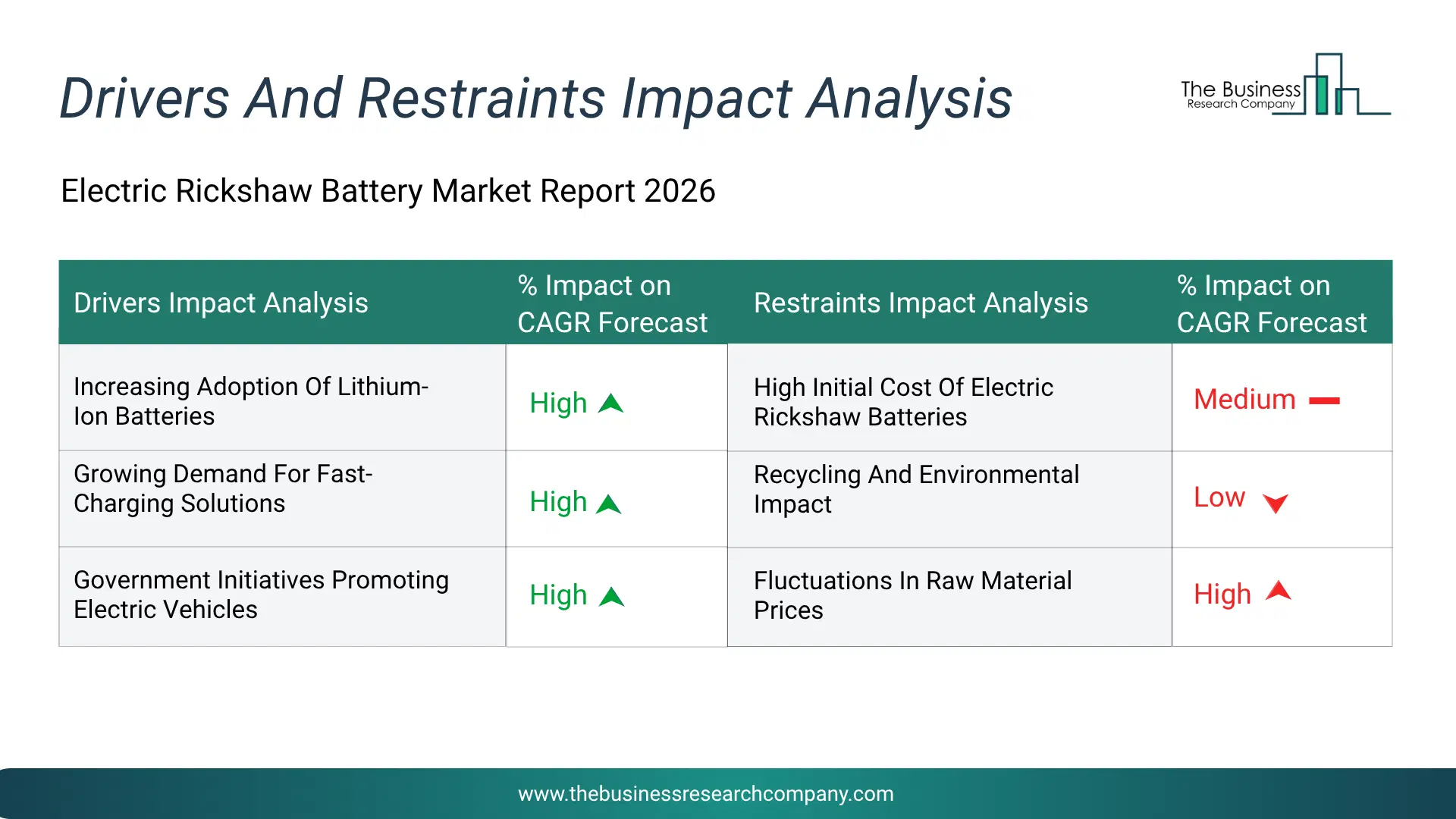
Infographic Chart Showing Key Market Drivers Analysis And Restraints For Electric Rickshaw Battery Market
The chart presents an impact analysis of key drivers and restraints, quantifying their relative influence on the market's growth rate and helping assess the balance between growth enablers and limiting factors. This chart offers a high-level perspective; the full report contains more detailed insights.
How Will The Drivers Impact Growth In The Global Electric Rickshaw Battery Market?
• Increasing Adoption Of Lithium-Ion Batteries (High) – During the forecast period, the increasing adoption of lithium-ion batteries is expected to become a key growth driver for the electric rickshaw battery market by 2030. The rising adoption of lithium-ion batteries is significantly driving growth in the market, as these batteries provide superior energy density, extended service life, and quicker charging capabilities compared to conventional lead-acid alternatives. Their lightweight structure improves vehicle efficiency and increases driving range, enhancing operational reliability and reducing long-term costs for daily users. In addition, falling lithium-ion battery prices and continuous improvements in battery management systems are strengthening performance and affordability. Supportive government policies aimed at promoting clean and sustainable mobility are further accelerating the transition toward lithium-ion technology. • Growing Demand For Fast-Charging Solutions (High) – During the forecast period, the growing demand for fast-charging solutions is expected to emerge as a major factor driving the expansion of the electric rickshaw battery market by 2030. The rising demand for fast-charging solutions is accelerating growth in the electric rickshaw battery market by minimizing charging time and reducing vehicle downtime for operators. Fast-charging capabilities improve operational efficiency, enabling drivers to complete more trips per day and enhance income potential. This advancement increases the practicality and attractiveness of electric rickshaws, particularly in densely populated urban areas where time efficiency is essential. Continuous innovations in battery technology and the expansion of charging infrastructure are further strengthening this trend, making electric rickshaws increasingly competitive with conventional fuel-powered vehicles. • Government Initiatives Promoting Electric Vehicles (High) – During the forecast period, the government initiatives promoting electric vehicles are expected to act as a key growth catalyst for the electric rickshaw battery market by 2030. The increasing integration of battery management systems (bms) is propelling growth in the market by enhancing battery safety, efficiency, and overall reliability. Bms technology continuously monitors battery health, prevents overcharging and deep discharging, and optimizes energy utilization, thereby extending battery lifespan and improving performance. It also supports real-time diagnostics and predictive maintenance, helping operators minimize downtime and reduce operational costs. As safety standards and performance expectations rise, manufacturers are increasingly embedding advanced bms solutions into their battery offerings. Consequently, the expanding adoption of intelligent battery management systems is significantly contributing to market expansion.How Will The Restraints Impact Growth In The Global Electric Rickshaw Battery Market?
• High Initial Cost Of Electric Rickshaw Batteries (Medium) – During the forecast period, the electric rickshaw batteries, especially lithium-ion types, have a high upfront cost compared to conventional lead-acid batteries. This initial investment can be a barrier for small operators and fleet owners, limiting market penetration. Even though the long-term operational savings are significant, the high purchase price restricts adoption. Consequently, this cost factor restrains the overall growth of the electric rickshaw battery market. • Recycling And Environmental Impact (Low) – During the forecast period, the disposal and recycling of electric rickshaw batteries, particularly lithium-ion, pose environmental and regulatory challenges. Improper handling can lead to pollution and safety hazards, increasing compliance and management costs for manufacturers and operators. Limited recycling infrastructure in many regions further complicates sustainable adoption. These environmental concerns act as a restraint on the market’s expansion • Fluctuations In Raw Material Prices (High) – During the forecast period, the fluctuations in raw material prices, such as lithium, cobalt, and nickel, increase production costs for electric rickshaw batteries. These price volatilities make it difficult for manufacturers to maintain stable pricing, affecting profit margins. Higher costs may be passed on to operators, limiting adoption of electric rickshaws. Consequently, raw material price instability acts as a key restraint on the market’s growth.Key Players In The Global Electric Rickshaw Battery Market
Major companies operating in the electric rickshaw battery market are Exide Industries Ltd., Amara Raja Energy & Mobility Ltd., Luminous Power Technologies Pvt. Ltd., Okaya Power Pvt. Ltd., Leoch International Technology Ltd., Livfast Batteries Pvt. Ltd., Eastman Auto & Power Ltd., Tata Autocomp GY Batteries Pvt. Ltd., Radix Electro Systems Pvt. Ltd., Pilot Industries Ltd., Renewways Energy Corp., Max Volt Energy Industries Ltd., Bentork Industries LLP, Amaze Technologies Inc., Litpax Technology Pvt. Ltd., Sparco Batteries Pvt. Ltd., Syrex Batteries, Z-Power Impex Pvt. Ltd., Limra Battery, HBL Power Systems Ltd., Su-Kam Power Systems, BYD Co. Ltd., Contemporary Amperex Technology Co. Ltd. (CATL), Panasonic Energy Co., Ltd., LG Energy Solution Ltd., Samsung SDI Co., Ltd.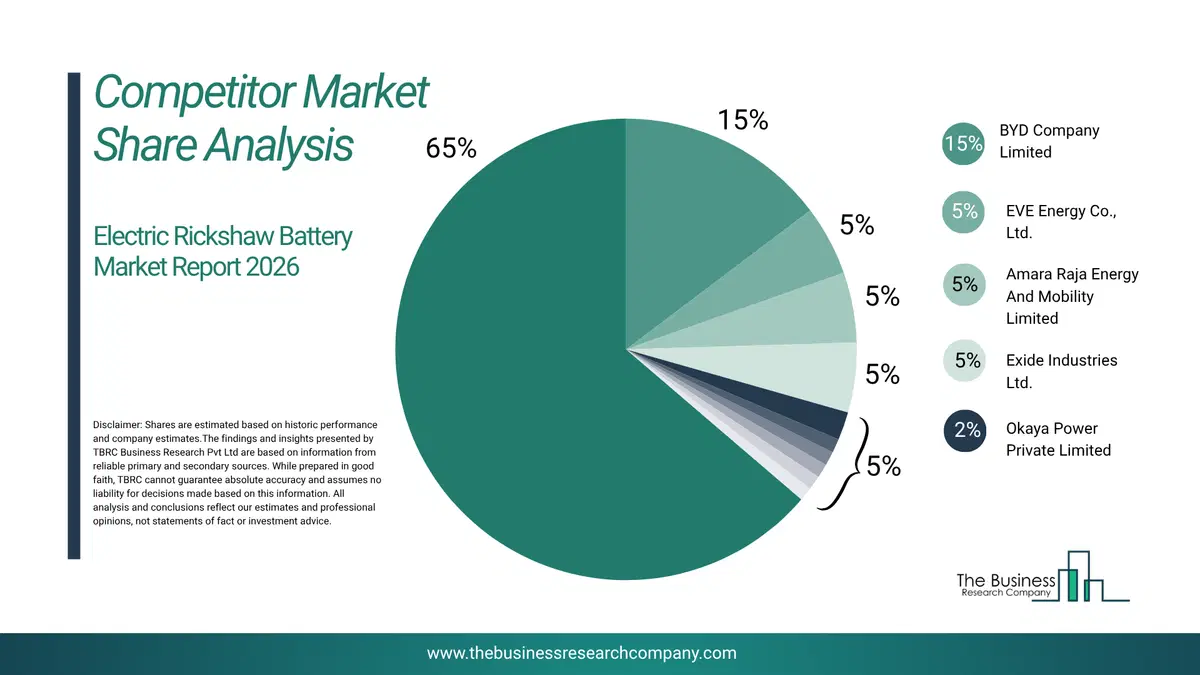
This chart is for illustrative purposes; the full report includes a detailed competitor analysis and comprehensive overview of the top 10 companies in the market.
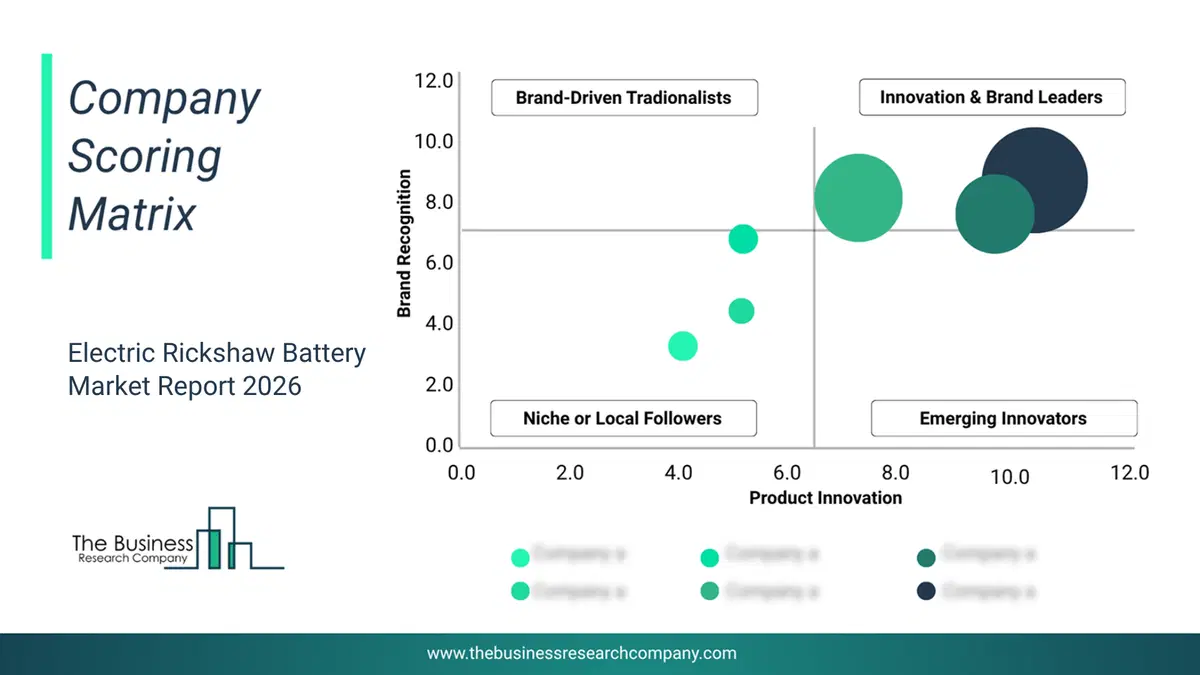
This chart maps companies by product innovation and brand strength, with bubble size indicating relative revenue, helping identify market leaders, challengers, and niche players. This is an illustrative chart; the full report provides a complete and accurate competitive analysis.
Global Electric Rickshaw Battery Market Trends and Insights
Major companies operating in the electric rickshaw battery market are focusing on developing innovative solutions, such as lithium-ion e-rickshaw batteries, to enhance energy efficiency, extend battery life, reduce charging time, and support the growing demand for sustainable urban mobility. Lithium-ion e-rickshaw batteries refer to advanced rechargeable battery systems that use lithium-ion technology to power electric rickshaws, offering higher energy density, faster charging, and longer lifespans compared to conventional lead-acid batteries. For instance, in July 2025, MASSIMO, an India-based battery manufacturing company, launched its next-generation MileMax Lithium-ion E-rickshaw Batteries, designed specifically to accelerate India’s green mobility revolution. These batteries come with a robust 3-year warranty and offer extended battery backup, longer operational life, lightweight design, and zero maintenance. They empower e-rickshaw owners with better speed, enhanced savings, and reliable performance. The MileMax battery is available in two smart variants that involve one with built-in IoT and GPS tracking, and another with Bluetooth connectivity for real-time monitoring.What Are Latest Mergers And Acquisitions In The Electric Rickshaw Battery Market?
In September 2024, Neuron Energy, an India-based company specializing in the manufacturing of lithium-ion batteries for e-rickshaws, partnered with Pointo to lease lithium-ion batteries for commercial e-rickshaws in India. This collaboration aims to advance sustainable electric mobility in India by providing a consistent supply of high-quality lithium-ion batteries through a leasing model for commercial e-rickshaws, thereby replacing traditional lead-acid batteries and enhancing the electric mobility infrastructure in key regions like Kolkata, Bihar, and Uttar Pradesh. Pointo is an India-based clean-tech company that provides a comprehensive battery management ecosystem for electric vehicles.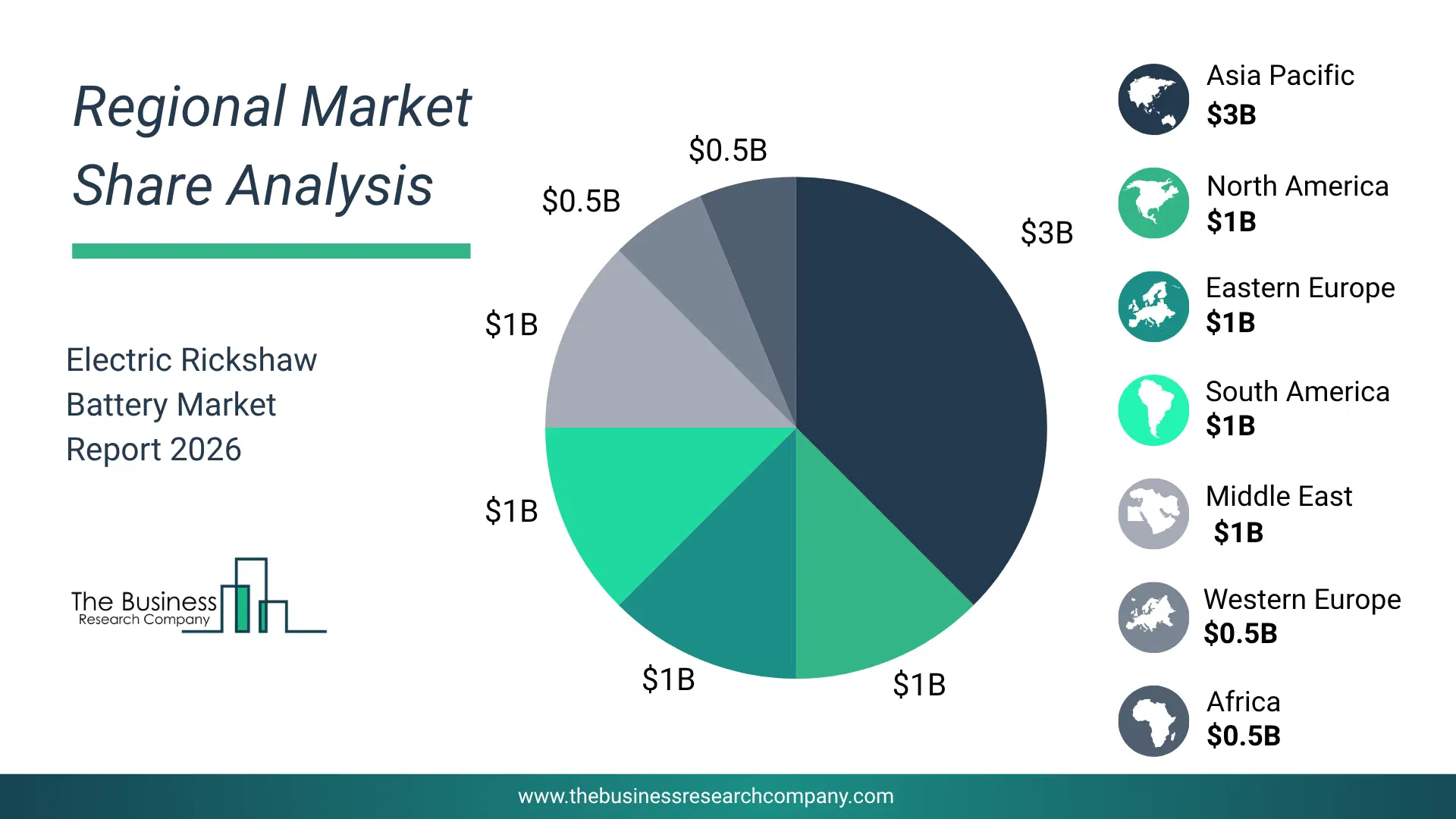
Regional Outlook
Asia-Pacific was the largest region in the electric rickshaw battery market in 2025. Asia-Pacific is expected to be the fastest-growing region in the forecast period. The regions covered in this market report are Asia-Pacific, South East Asia, Western Europe, Eastern Europe, North America, South America, Middle East, Africa. The countries covered in this market report are Australia, Brazil, China, France, Germany, India, Indonesia, Japan, Taiwan, Russia, South Korea, UK, USA, Canada, Italy, Spain.What Defines the Electric Rickshaw Battery Market?
The electric rickshaw battery market consists of sales of electric double layer capacitors, hybrid capacitors, pseudocapacitors, battery chargers, and battery management systems. Values in this market are ‘factory gate’ values, that is, the value of goods sold by the manufacturers or creators of the goods, whether to other entities (including downstream manufacturers, wholesalers, distributors, and retailers) or directly to end customers. The value of goods in this market includes related services sold by the creators of the goods.How is Market Value Defined and Measured?
The market value is defined as the revenues that enterprises gain from the sale of goods and/or services within the specified market and geography through sales, grants, or donations in terms of the currency (in USD unless otherwise specified). The revenues for a specified geography are consumption values that are revenues generated by organizations in the specified geography within the market, irrespective of where they are produced. It does not include revenues from resales along the supply chain, either further along the supply chain or as part of other products.
This chart presents market attractiveness based on a quantitative evaluation of growth, competition, strategic alignment, and risk, offering a clear view of opportunity areas for decision-making. This chart is for illustrative purposes; the full report contains the complete analysis.

This chart highlights the Total Addressable Market (TAM) by estimating the maximum revenue opportunity using an assumption-driven approach, supporting strategic planning and opportunity sizing across markets. The chart is illustrative; the full report provides a more comprehensive analysis.
What Key Data and Analysis Are Included in the Electric Rickshaw Battery Market Report 2026?
The electric rickshaw battery market research report is one of a series of new reports from The Business Research Company that provides market statistics, including industry global market size, regional shares, competitors with the market share, detailed market segments, market trends and opportunities, and any further data you may need to thrive in the electric rickshaw battery industry. The market research report delivers a complete perspective of everything you need, with an in-depth analysis of the current and future state of the industry.Electric Rickshaw Battery Market Report 2026 Market Report Forecast Analysis
| Report Attribute | Details |
|---|---|
| Market Size Value In 2026 | $1.94 billion |
| Revenue Forecast In 2030 | $3.52 billion |
| Growth Rate | CAGR of 16.1% from 2026 to 2030 |
| Base Year For Estimation | 2025 |
| Actual Estimates/Historical Data | 2020-2025 |
| Forecast Period | 2026 - 2030 |
| Market Representation | Revenue in USD Billion and CAGR from 2026 to 2030 |
| Segments Covered | Type, Capacity, Application, End-User |
| Regional Scope | Asia-Pacific, Western Europe, Eastern Europe, North America, South America, Middle East, Africa |
| Country Scope | The countries covered in the report are Australia, Brazil, China, France, Germany, India, ... |
| Key Companies Profiled | Exide Industries Ltd., Amara Raja Energy & Mobility Ltd., Luminous Power Technologies Pvt. Ltd., Okaya Power Pvt. Ltd., Leoch International Technology Ltd., Livfast Batteries Pvt. Ltd., Eastman Auto & Power Ltd., Tata Autocomp GY Batteries Pvt. Ltd., Radix Electro Systems Pvt. Ltd., Pilot Industries Ltd., Renewways Energy Corp., Max Volt Energy Industries Ltd., Bentork Industries LLP, Amaze Technologies Inc., Litpax Technology Pvt. Ltd., Sparco Batteries Pvt. Ltd., Syrex Batteries, Z-Power Impex Pvt. Ltd., Limra Battery, HBL Power Systems Ltd., Su-Kam Power Systems, BYD Co. Ltd., Contemporary Amperex Technology Co. Ltd. (CATL), Panasonic Energy Co., Ltd., LG Energy Solution Ltd., Samsung SDI Co., Ltd. |
| Customization Scope | Request for Customization |
| Pricing And Purchase Options | Explore Purchase Options |