
Electric Sport Utility Vehicle (SUV) Market Report 2026
Global Outlook – By Vehicle Type (Compact Electric Sport Utility Vehicles, Mid Size Electric Sport Utility Vehicles, Full Size Or Large Electric Sport Utility Vehicles, Luxury Electric Sport Utility Vehicles), By Propulsion Type (Battery Electric Vehicle, Plug In Hybrid Electric Vehicle), By Vehicle Range Type (Up To 250 Miles, 250–500 Miles, Above 500 Miles), By Drive Type (All Wheel Drive, Front Wheel Drive, Rear Wheel Drive), By Sales Channel Type (Original Equipment Manufacturer Or Direct Sales, Dealership Network, Online Sales) – Market Size, Trends, Strategies, and Forecast to 2035
Electric Sport Utility Vehicle (SUV) Market Overview
• Electric Sport Utility Vehicle (SUV) market size has reached to $499.51 billion in 2025 • Expected to grow to $1629.11 billion in 2030 at a compound annual growth rate (CAGR) of 26.6% • Growth Driver: Rising Demand For Zero-Emission Vehicles Is Driving The Market Due To Increasing Sustainable Mobility Adoption And Supportive Regulations • Market Trend: Advancements In Electric 7-Seater SUVs For Spacious, Connected, And High-Performance Electric Mobility • Europe was the largest region in 2025 and Asia-Pacific is the fastest growing region.What Is Covered Under Electric Sport Utility Vehicle (SUV) Market?
An electric sport utility vehicle (SUV) is a passenger vehicle with the body style and utility characteristics of an SUV that is propelled by one or more electric motors, typically powered by a rechargeable battery system. It provides electrically driven mobility with no direct tailpipe emissions during operation and is used for personal, commercial, recreational, and fleet transportation. The main vehicle types of electric sport utility vehicles (SUV) include compact electric sport utility vehicles, mid size electric sport utility vehicles, full size or large electric sport utility vehicles, and luxury electric sport utility vehicles. Compact electric sport utility vehicles refer to smaller electric SUVs designed to provide efficient urban mobility while offering higher seating positions and flexible interior space. These vehicles are powered by battery electric vehicles and plug in hybrid electric vehicles, and are available with ranges of up to 250 miles, 250–500 miles, and above 500 miles. They are offered with all wheel drive, front wheel drive, and rear wheel drive systems and are sold through original equipment manufacturer or direct sales, dealership networks, and online sales.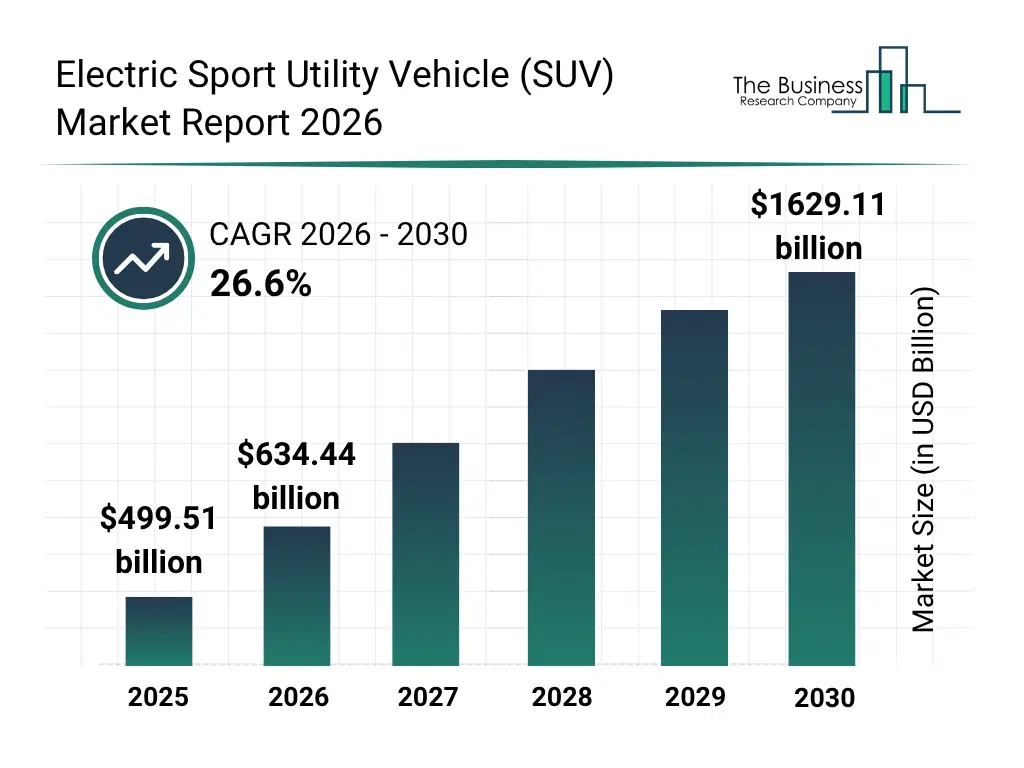
What Is The Electric Sport Utility Vehicle (SUV) Market Size and Share 2026?
The electric sport utility vehicle (SUV) market size has grown exponentially in recent years. It will grow from $499.51 billion in 2025 to $634.44 billion in 2026 at a compound annual growth rate (CAGR) of 27.0%. The growth in the historic period can be attributed to rising consumer adoption of electric vehicles, increasing availability of electric SUV models, government incentives for electric vehicle purchases, growing environmental awareness among consumers, expansion of public charging infrastructure.What Is The Electric Sport Utility Vehicle (SUV) Market Growth Forecast?
The electric sport utility vehicle (suv) market size is expected to see exponential growth in the next few years. It will grow to $1629.11 billion in 2030 at a compound annual growth rate (CAGR) of 26.6%. The growth in the forecast period can be attributed to declining battery costs, increasing demand for long-range electric SUVs, expansion of fast-charging networks, growing consumer preference for premium electric SUVs, increasing investment in electric vehicle manufacturing capacity. Major trends in the forecast period include expansion of long-range electric SUVs, growth of three-row electric SUVs, increasing adoption of all-wheel-drive electric SUVs, development of high-performance electric SUVs, expansion of electric SUV online sales.Tariff Impact On Electric Sport Utility Vehicle (SUV) Market
Tariffs are impacting the electric sport utility vehicle market by increasing the cost of imported batteries, semiconductors, electric motors, and other critical vehicle components, raising manufacturing and vehicle prices. Battery electric vehicles and premium electric SUVs are particularly exposed, with North America, Europe, and Asia-Pacific affected by interconnected automotive and battery supply chains. Higher import costs may slow affordability and market adoption, but tariffs can also encourage automakers to localize battery and vehicle production, diversify suppliers, and strengthen domestic electric vehicle manufacturing capabilities.
Global Electric Sport Utility Vehicle (SUV) Market Segmentation
2) By Propulsion Type: Battery Electric Vehicle, Plug In Hybrid Electric Vehicle 3) By Vehicle Range Type: Up To 250 Miles, 250–500 Miles, Above 500 Miles 4) By Drive Type: All Wheel Drive, Front Wheel Drive, Rear Wheel Drive 5) By Sales Channel Type: Original Equipment Manufacturer Or Direct Sales, Dealership Network, Online Sales Subsegments: 1) By Compact Electric Sport Utility Vehicles: Crossover Electric Sport Utility Vehicles, Urban Electric Sport Utility Vehicles 2) By Mid Size Electric Sport Utility Vehicles: Two Row Mid Size Electric Sport Utility Vehicles, Three Row Mid Size Electric Sport Utility Vehicles, Performance Mid Size Electric Sport Utility Vehicles 3) By Full Size Or Large Electric Sport Utility Vehicles: Three Row Full Size Electric Sport Utility Vehicles, Off Road Electric Sport Utility Vehicles, Family Oriented Electric Sport Utility Vehicles 4) By Luxury Electric Sport Utility Vehicles: Premium Luxury Electric Sport Utility Vehicles, Ultra Luxury Electric Sport Utility Vehicles, High Performance Luxury Electric Sport Utility VehiclesWhat Is The Driver Of The Electric Sport Utility Vehicle (SUV) Market?
The rising demand for zero-emission vehicles is expected to propel the growth of the electric sport utility vehicle (SUV) market going forward. Zero-emission vehicles are automobiles that produce no tailpipe emissions during operation, typically powered by battery electric or hydrogen fuel cell technologies, helping reduce greenhouse gas emissions and improve air quality. The rising demand for zero-emission vehicles is driven by stricter emission regulations, supportive government incentives, expanding charging infrastructure, and increasing consumer preference for sustainable transportation. Rising demand for zero emission vehicles encourages more consumers to choose electric SUVs, as they combine emission free driving with the spaciousness, practicality, and performance expected from sport utility vehicles. For instance, in July 2026, according to the U.S. Energy Information Administration, a US-based government agency, combined sales of hybrid, plug-in hybrid, and battery electric vehicles (BEVs) reached 24% of total new light-duty vehicle sales in the second quarter of 2026 (2Q26), up from 22% in the second quarter of 2025 (2Q25). Therefore, the rising demand for zero-emission vehicles is propelling the growth of the electric sport utility vehicle (SUV) industry.Key Players In The Global Electric Sport Utility Vehicle (SUV) Market
Major companies operating in the electric sport utility vehicle (suv) market are Volkswagen AG, Toyota Motor Corporation, Ford Motor Company, General Motors Company, Stellantis N.V., Mercedes-Benz Group AG, Honda Motor Co. Ltd., Hyundai Motor Company, BYD Company Limited, Tesla Inc., SAIC Motor Corporation Limited, Nissan Motor Co. Ltd., Kia Corporation, Renault S.A., Volvo Car Corporation, Tata Motors Limited, Chery Automobile Co. Ltd., Subaru Corporation, Mahindra & Mahindra Limited, Li Auto Inc., NIO Inc., Rivian Automotive Inc., Lucid Group Inc.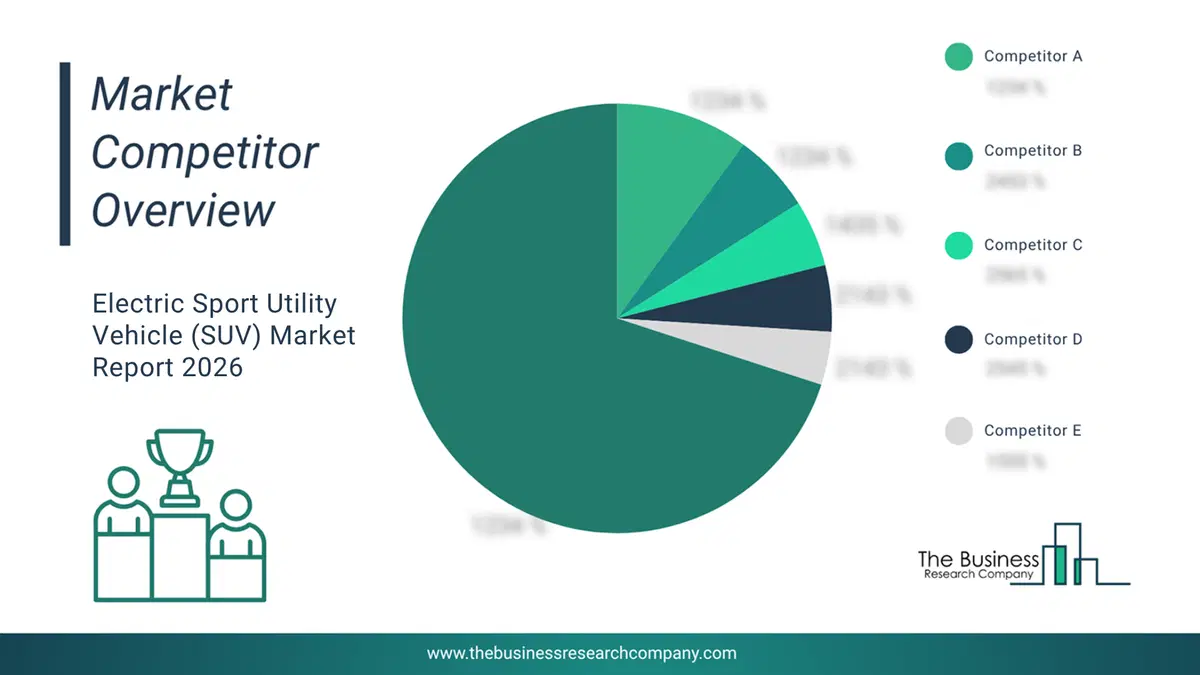
This chart is for illustrative purposes; the full report includes a detailed competitor analysis and comprehensive overview of the top 10 companies in the market.
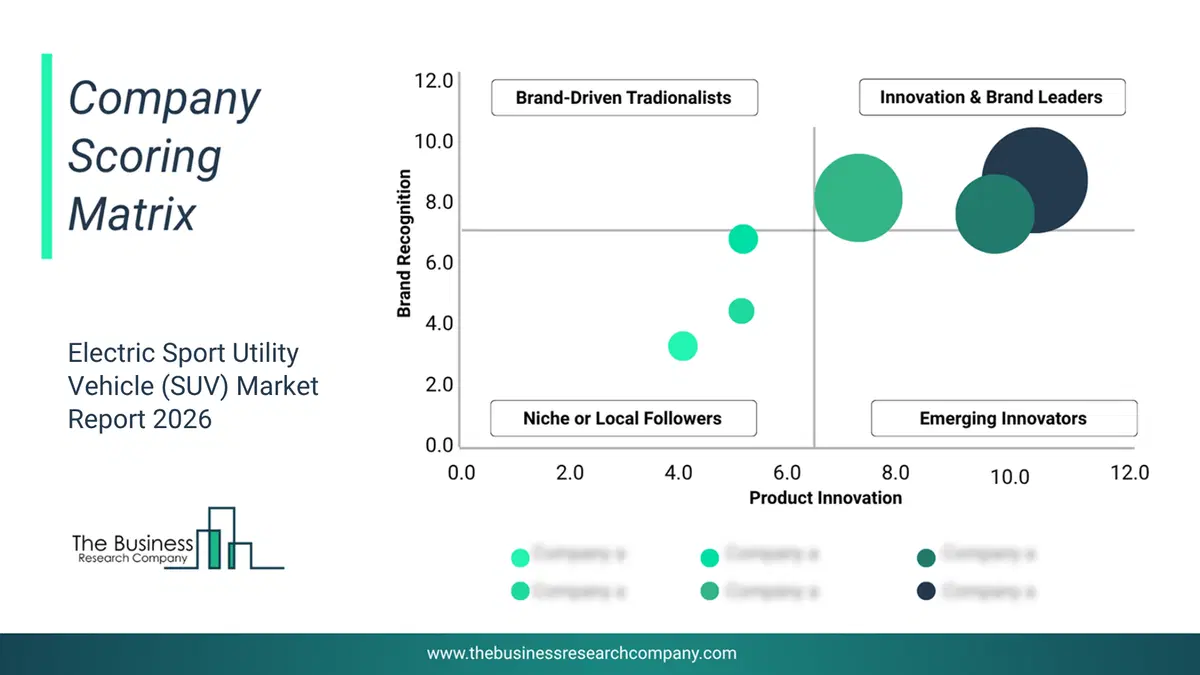
This chart maps companies by product innovation and brand strength, with bubble size indicating relative revenue, helping identify market leaders, challengers, and niche players. This is an illustrative chart; the full report provides a complete and accurate competitive analysis.
Global Electric Sport Utility Vehicle (SUV) Market Trends and Insights
Major companies operating in the electric sport utility vehicle (SUV) market are focusing on developing innovative electric vehicles such as, electric 7-seater SUVs to provide spacious, high-performance, connected, and technologically advanced electric mobility for families and long-distance users. Electric 7-Seater SUVs are battery-electric sport utility vehicles designed with three-row seating, high-capacity battery systems, advanced electric powertrains, intelligent connectivity, and driver-assistance technologies. For instance, in November 2025, Mahindra & Mahindra Ltd., an India-based automotive company, unveiled the XEV 9S, an electric 7-seater SUV built on the INGLO electric-origin platform. The vehicle offers battery options of 59 kWh, 70 kWh, and 79 kWh, with the 79 kWh version providing up to 210 kW of power and 380 Nm of torque, along with a claimed real-world range of 500 km. The SUV incorporates intelligent adaptive suspension, L2+ advanced driver assistance systems with five radars and one vision camera, driver and occupant monitoring, augmented-reality head-up display, automated parking assistance, and connected features supported by 5G connectivity. Its three-row cabin provides extensive passenger and cargo space, while comfort features include ventilated seats, powered second-row seating, panoramic skyroof, wireless charging, and multi-zone climate functions. The XEV 9S also supports rapid charging, with the 79 kWh battery capable of charging from 20% to 80% in approximately 20 minutes using a 180 kW DC charger.What Are Latest Mergers And Acquisitions In The Electric Sport Utility Vehicle (SUV) Market?
In July 2026, Ford Motor Company, a US-based automotive manufacturer, partnered with Geely Automobile Holdings to establish a joint venture for manufacturing next-generation multi-energy passenger vehicles, including electric sport utility vehicles, at Ford's Valencia plant in Spain. With this partnership, both companies aim to enhance manufacturing efficiency, strengthen their presence in the European low- and zero-emission vehicle market, optimize production costs, and expand their electric sport utility vehicle portfolios through shared engineering and manufacturing capabilities. Geely Automobile Holdings is a China-based automotive manufacturer that designs, develops, manufactures, and sells passenger vehicles, including battery electric vehicles, hybrid vehicles, sport utility vehicles, sedans, and related automotive technologies.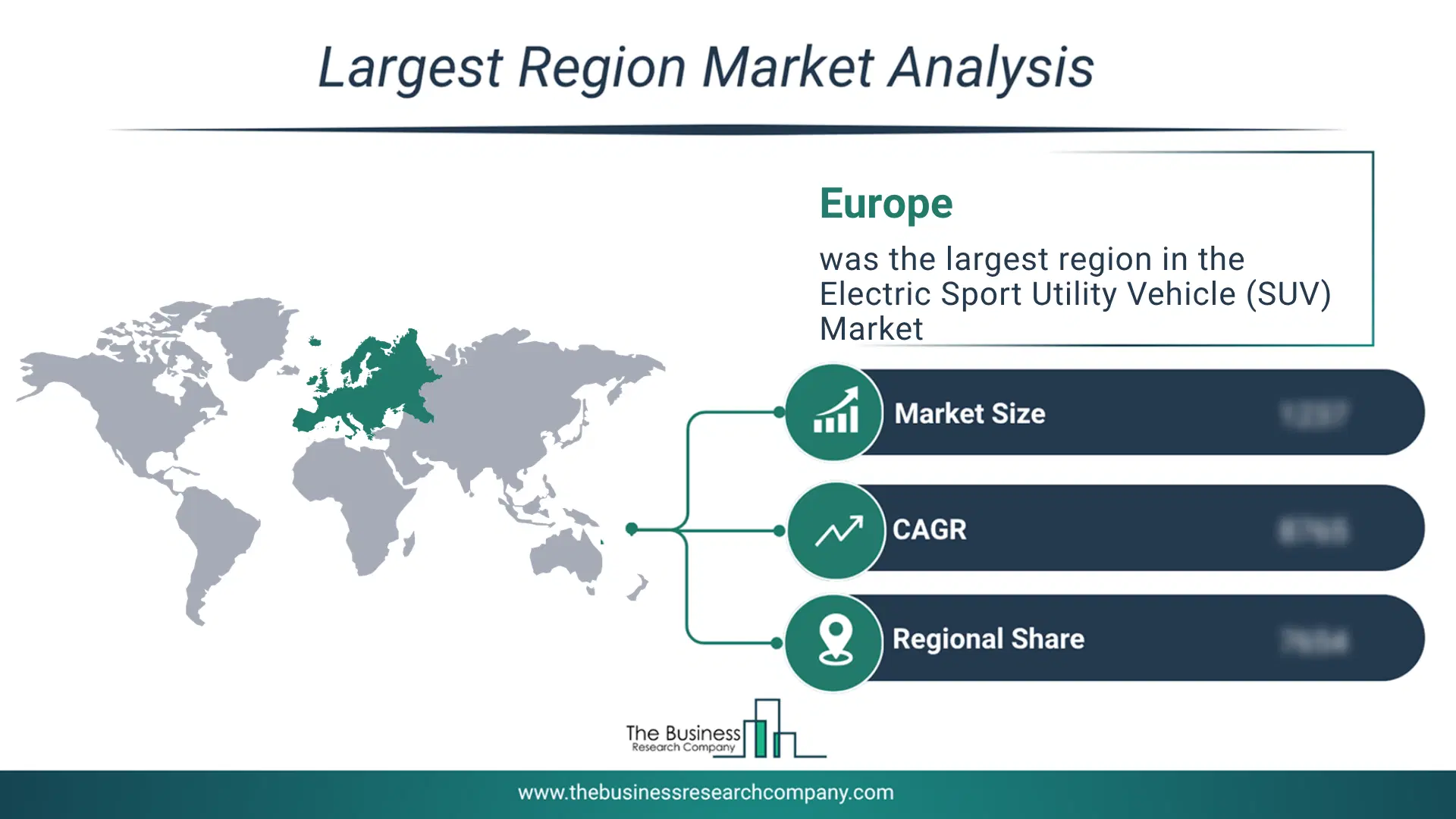
Regional Outlook/Insights
Europe was the largest region in the electric sport utility vehicle (SUV) market in 2025. Asia-Pacific is expected to be the fastest-growing region in the forecast period. The regions covered in this market report are Asia-Pacific, South East Asia, Western Europe, Eastern Europe, North America, South America, Middle East, Africa. The countries covered in this market report are Australia, Brazil, China, France, Germany, India, Indonesia, Japan, Taiwan, Russia, South Korea, UK, USA, Canada, Italy, Spain.What Defines the Electric Sport Utility Vehicle (SUV) Market?
The electric sport utility vehicle (SUV) market consists of sales of compact electric SUVs, midsize electric SUVs, full-size electric SUVs, electric crossover SUVs, luxury electric SUVs, performance electric SUVs, off-road electric SUVs, and electric utility SUVs. Values in this market are ‘factory gate’ values, that is, the value of goods sold by the manufacturers or creators of the goods, whether to other entities (including downstream manufacturers, wholesalers, distributors, and retailers) or directly to end customers. The value of goods in this market includes related services sold by the creators of the goods.How is Market Value Defined and Measured?
The market value is defined as the revenues that enterprises gain from the sale of goods and/or services within the specified market and geography through sales, grants, or donations in terms of the currency (in USD unless otherwise specified). The revenues for a specified geography are consumption values that are revenues generated by organizations in the specified geography within the market, irrespective of where they are produced. It does not include revenues from resales along the supply chain, either further along the supply chain or as part of other products.
This chart presents market attractiveness based on a quantitative evaluation of growth, competition, strategic alignment, and risk, offering a clear view of opportunity areas for decision-making. This chart is for illustrative purposes; the full report contains the complete analysis.

This chart highlights the Total Addressable Market (TAM) by estimating the maximum revenue opportunity using an assumption-driven approach, supporting strategic planning and opportunity sizing across markets. The chart is illustrative; the full report provides a more comprehensive analysis.
What Key Data and Analysis Are Included in the Electric Sport Utility Vehicle (SUV) Market Report 2026?
The electric sport utility vehicle (suv) market research report is one of a series of new reports from The Business Research Company that provides market statistics, including industry global market size, regional shares, competitors with the market share, detailed market segments, market trends and opportunities, and any further data you may need to thrive in the electric sport utility vehicle (suv) industry. The market research report delivers a complete perspective of everything you need, with an in-depth analysis of the current and future state of the industry.Electric Sport Utility Vehicle (SUV) Market Report Forecast Analysis
| Report Attribute | Details |
|---|---|
| Market Size Value In 2026 | $634.44 billion |
| Revenue Forecast In 2030 | $1629.11 billion |
| Growth Rate | CAGR of 26.6% from 2026 to 2035 |
| Base Year For Estimation | 2025 |
| Actual Estimates/Historical Data | 2020-2025 |
| Forecast Period | 2026 - 2030 |
| Market Representation | Revenue in USD Billion and CAGR from 2026 to 2030 |
| Segments Covered | Vehicle Type, Propulsion Type, Vehicle Range Type, Drive Type, Sales Channel Type |
| Regional Scope | Asia-Pacific, Western Europe, Eastern Europe, North America, South America, Middle East, Africa |
| Country Scope | The countries covered in the report are Australia, Brazil, China, France, Germany, India, Indonesia, Japan, Taiwan, Russia, South Korea, UK, USA, Canada, Italy, Spain. |
| Customization Scope | Request for Customization |
| Pricing And Purchase Options | Explore Purchase Options |