
Electric Vehicle (EV) Batteries Market Report 2026
Global Outlook – By Battery Type ( Lithium-Ion, Lead-Acid, Nickel-Metal Hydride, Others), By Vehicle Type ( Passenger Vehicles, Commercial Vehicles), By Propulsion ( Battery Electric Vehicle (BEV), Plug-In Hybrid Electric Vehicle (PHEV), Hybrid Electric Vehicles, Fuel Cell Electric Vehicles.) – Market Size, Trends, Strategies, and Forecast to 2030
Electric Vehicle (EV) Batteries Market Overview
• Electric Vehicle (EV) Batteries market size has reached to $88.36 billion in 2025 • Expected to grow to $242.11 billion in 2030 at a compound annual growth rate (CAGR) of 22.5% • Growth Driver: Increasing Sales Of Electric Vehicles (EVs) Driving The Market Growth Due To Government Incentives • Market Trend: Advancements In Electric Vehicle Battery Technology • Asia-Pacific was the largest region in 2025 and Western Europe is the fastest growing region.What Is Covered Under Electric Vehicle (EV) Batteries Market?
Electric vehicle batteries are defined as batteries that are used to power electronic vehicles and are rechargeable in nature. These batteries support the clean energy initiative as they don’t emit any harmful gases which cause damage to the environment. The main types of battery used in electric vehicle are lithium-ion, lead-acid, nickel-metal hydride, sodium-ion, and others. The lithium-ion are used in electric vehicle for safer and more stable movement than liquid li-ion batteries. The electric vehicle batteries are used two types of vehicles such as passenger and commercial vehicles and available in two types of propulsion such as battery electric vehicle and plug-in hybrid electric vehicle.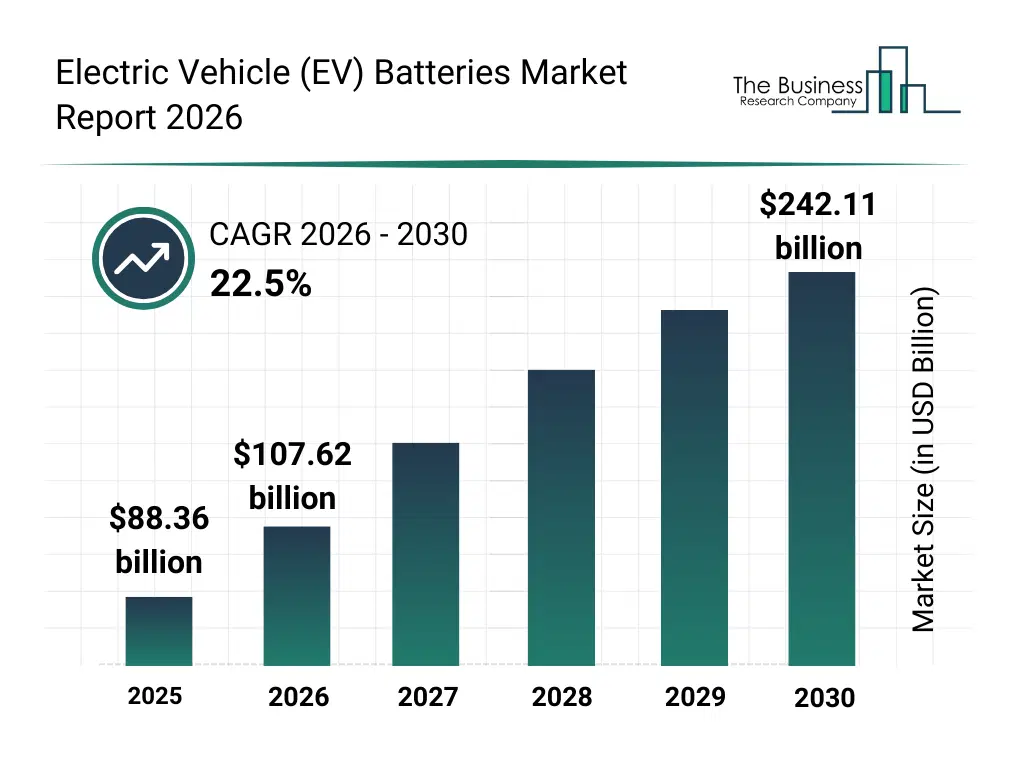
What Is The Electric Vehicle (EV) Batteries Market Size 2026 And Growth Rate?
The electric vehicle (EV) batteries market size has grown exponentially in recent years. It will grow from $88.36 billion in 2025 to $107.62 billion in 2026 at a compound annual growth rate (CAGR) of 21.8%. The growth in the historic period can be attributed to rising adoption of passenger electric vehicles, development of lithium-ion manufacturing capacity, improvements in cell energy density and cost declines, supportive government incentives for electrification, growth in global EV charging infrastructure.What Is The Electric Vehicle (EV) Batteries Market Growth Forecast?
The electric vehicle (EV) batteries market size is expected to see exponential growth in the next few years. It will grow to $242.11 billion in 2030 at a compound annual growth rate (CAGR) of 22.5%. The growth in the forecast period can be attributed to expansion of gigafactories and localized cell production, increased demand for solid-state and next-gen batteries, stricter regulations on battery recycling and producer responsibility, growth in commercial EV fleets and heavy-duty electrification, scaling of battery-as-a-service and subscription models. Major trends in the forecast period include advances in high-energy-density cell chemistries, fast-charging infrastructure compatibility, growth of battery second-life and repurposing markets, vertical integration of battery cell manufacturing, emphasis on cell-to-pack and pack-level thermal management.
Global Electric Vehicle (EV) Batteries Market Segmentation
1) By Battery Type: Lithium-Ion, Lead-Acid, Nickel-Metal Hydride, Others 2) By Vehicle Type: Passenger Vehicles, Commercial Vehicles 3) By Propulsion: Battery Electric Vehicle (BEV), Plug-In Hybrid Electric Vehicle (PHEV), Hybrid Electric Vehicles, Fuel Cell Electric Vehicles. Subsegments: 1) By Lithium-Ion Batteries: Lithium Iron Phosphate (LiFePO4), Lithium Nickel Manganese Cobalt (NMC), Lithium Nickel Cobalt Aluminum Oxide (NCA), Lithium Manganese Oxide (LMO), Other Lithium-Ion Variants 2) By Lead-Acid Batteries: Flooded Lead-Acid (FLA), Absorbed Glass Mat (AGM), Gel Lead-Acid 3) By Nickel-Metal Hydride Batteries: Standard Nickel-Metal Hydride, Advanced Nickel-Metal Hydride 4) By Others: Solid-State Batteries, Flow Batteries, Other Emerging Battery TechnologiesWhat Is The Driver Of The Electric Vehicle (EV) Batteries Market?
The increasing sales of electric vehicles (EVs) is expected to propel the growth of the electric vehicle (EV) batteries market going forward. Electric vehicle sales refer to the number of battery electric vehicles and plug-in hybrid electric vehicles purchased by consumers for transportation purposes. The rising sales of electric vehicles due to government policy support and financial incentives, as federal tax credits and state-level rebates reduce the upfront cost of EVs, making them more affordable and accessible to a broader range of consumers. Growing electric vehicle sales support the need for advanced battery systems as each EV requires a large-capacity lithium-ion battery pack to power the vehicle, creating proportional demand for battery manufacturing and supply. For instance, in January 2024, according to the U.S. Department of Energy, a US-based federal agency, plug-in electric vehicle sales increased from 6.8% of all light-duty vehicle sales in 2022 to 9.1% in 2023, reflecting a growth of 2.3 percentage points in market share. Therefore, increasing sales of electric vehicles (EVs) is driving the growth of the electric vehicle (EV) batteries industry.Key Players In The Global Electric Vehicle (EV) Batteries Market
Major companies operating in the electric vehicle (EV) batteries market are LG Energy Solution Ltd, Samsung SDI Co. Ltd, SK Innovation Co. Ltd, Panasonic Corporation, Contemporary Amperex Technology Co. Ltd, BYD Co. Ltd, GS Yuasa Corporation, Tianneng Power International Ltd, SVOLT Energy Technology Co, Ltd, EVTronic, Britishvolt, Aceleron, Williams Advanced Engineering, Zenobe, Northvolt, Verkor, Italvolt, Fortum, ElecSys, Volkswagen, BMW, Groupe Renault, SAFT, AKOM, InoBat Auto, Ligier Group, Polaris Industries, Skoda Auto, Proterra, BMZ Inc, Microvast, Romeo Power, Quantumscape Corporation, Horwin, Byvin, HDK Electric Vehicles, Shandong Shifeng (Group), Speedway Electric, Eleksa EV, Melex Electrovehicles, Mazibuko Motor Company, El Nasr Automotive Manufacturing Company, Jet Motors
This chart is for illustrative purposes; the full report includes a detailed competitor analysis and comprehensive overview of the top 10 companies in the market.
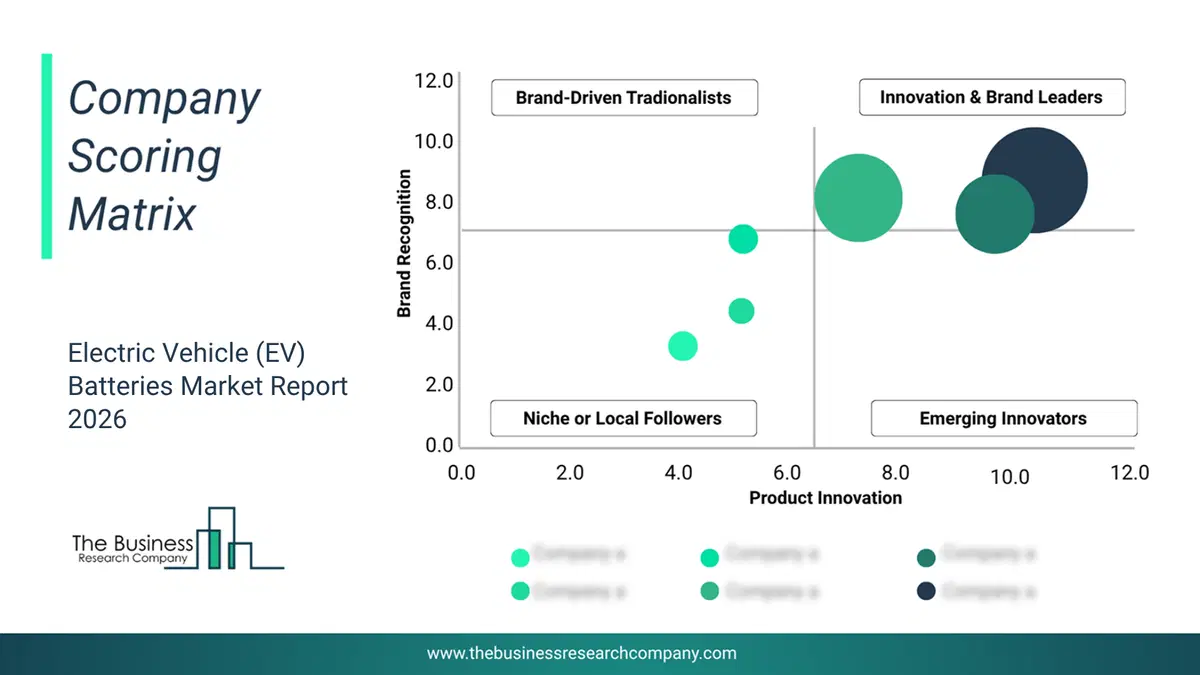
This chart maps companies by product innovation and brand strength, with bubble size indicating relative revenue, helping identify market leaders, challengers, and niche players. This is an illustrative chart; the full report provides a complete and accurate competitive analysis.
Global Electric Vehicle (EV) Batteries Market Trends and Insights
Major companies operating in the electric vehicle (EV) batteries market are developing technologically advanced products, such as lithium iron phosphate (LiFePO4) batteries, to provide superior safety, long cycle life, thermal stability, and high discharge rates. A lithium iron phosphate (LiFePO4) battery is a type of rechargeable lithium-ion battery known for its safety, thermal stability, long cycle life, and high power output, making it suitable for applications in electric vehicles, renewable energy storage, and portable devices. For instance, in June 2024, Geely, a China-based automobile manufacturer, launched the Aegis Short Blade Battery. The Aegis Short Blade Battery boasts an energy density of 192 Wh/kg and an impressive cycle life of up to 3,500 cycles, enabling it to power vehicles for approximately 1 million kilometers with minimal impact on range. With a service life of up to 50 years, this battery significantly enhances the longevity and residual value of used cars. It effectively addresses the issue of high internal resistance found in many long blade batteries by utilizing long, thin carbon nanotubes to create a ""highway"" for ion transmission, along with additives that improve film permeability for easier lithium ion movement between electrodes. Consequently, the Aegis Short Blade Battery offers superior fast-charging capabilities, with an average charging time of just 17 minutes and 4 seconds to reach 80 percent capacity at a charging rate of 2.45 C, compared to the 26 minutes and 1.61 C rate typical of other long blade batteries with similar capacity.What Are Latest Mergers And Acquisitions In The Electric Vehicle (EV) Batteries Market?
In January 2024, Allkem Limited., an Australia-based lithium producing company, merged with Livent to form Arcadium Lithium plc, a leading, vertically integrated lithium chemicals producer. With this merger, the combined company aims to leverage its scale, resources, and complementary assets to meet growing industry demand, enhance operational flexibility, lower costs, and accelerate long-term growth across the lithium value chain. Livent Corporation is a US-based lithium chemicals company that specializes in producing high-performance lithium compounds for batteries, pharmaceuticals, and other industrial applications.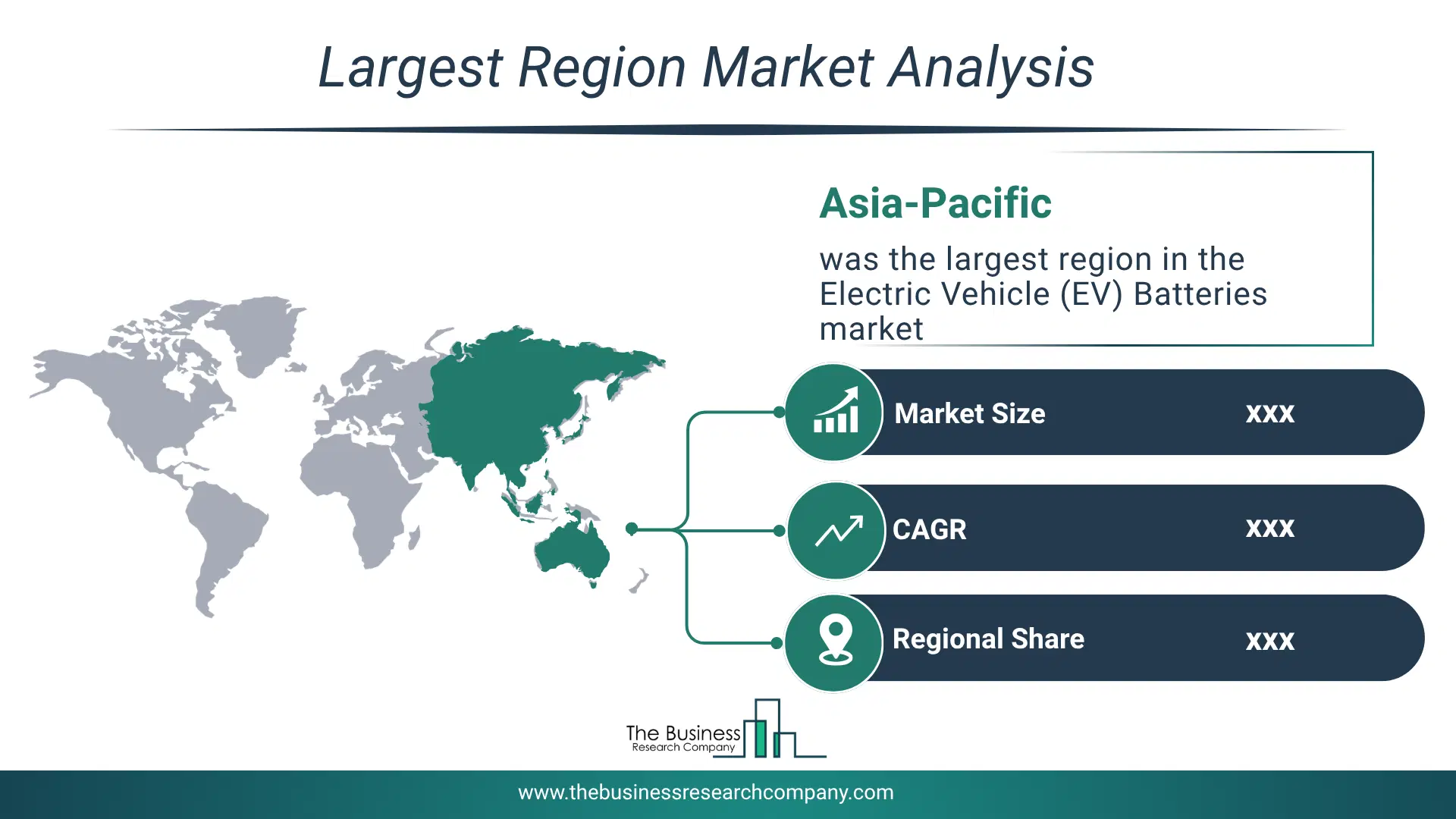
Regional Outlook
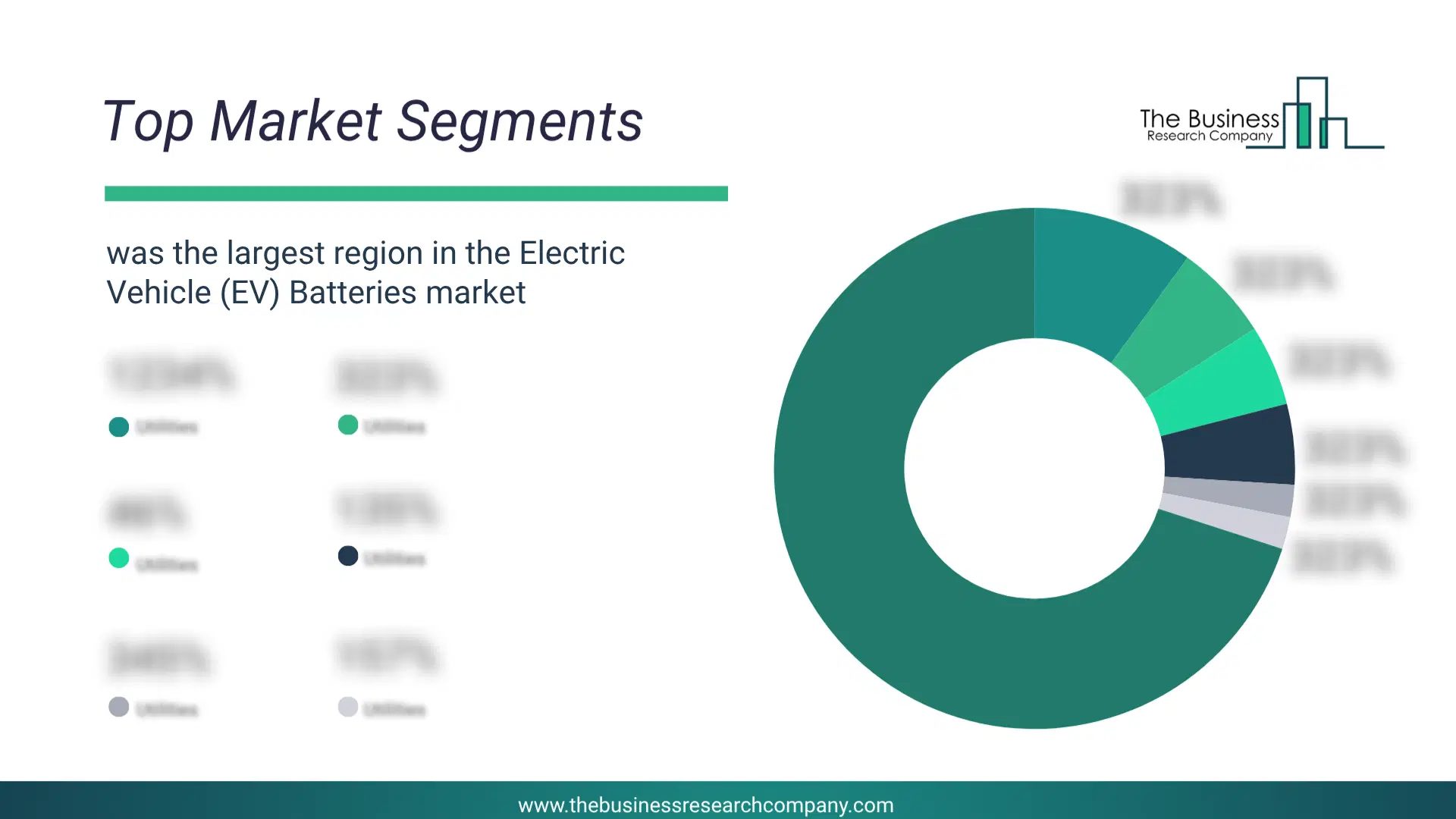
Asia-Pacific was the largest region in the electric vehicle batteries market in 2025. Western Europe was the second-largest region in the global electric vehicle batteries market share. The regions covered in this market report are Asia-Pacific, South East Asia, Western Europe, Eastern Europe, North America, South America, Middle East, Africa. The countries covered in this market report are Australia, Brazil, China, France, Germany, India, Indonesia, Japan, Taiwan, Russia, South Korea, UK, USA, Canada, Italy, Spain.What Defines the Electric Vehicle (EV) Batteries Market?
The electric vehicle batteries market consists of sales of lithium-ion batteries, lead-acid batteries, nickel-metal hydride batteries, sodium-ion batteries, and other electric vehicle (EV) batteries. Values in this market are factory gate values, that is the value of goods sold by the manufacturers or creators of the goods, whether to other entities (including downstream manufacturers, wholesalers, distributors and retailers) or directly to end customers. The value of goods in this market includes related services sold by the creators of the goods.How is Market Value Defined and Measured?
The market value is defined as the revenues that enterprises gain from the sale of goods and/or services within the specified market and geography through sales, grants, or donations in terms of the currency (in USD unless otherwise specified). The revenues for a specified geography are consumption values that are revenues generated by organizations in the specified geography within the market, irrespective of where they are produced. It does not include revenues from resales along the supply chain, either further along the supply chain or as part of other products.
This chart presents market attractiveness based on a quantitative evaluation of growth, competition, strategic alignment, and risk, offering a clear view of opportunity areas for decision-making. This chart is for illustrative purposes; the full report contains the complete analysis.

This chart highlights the Total Addressable Market (TAM) by estimating the maximum revenue opportunity using an assumption-driven approach, supporting strategic planning and opportunity sizing across markets. The chart is illustrative; the full report provides a more comprehensive analysis.
What Key Data and Analysis Are Included in the Electric Vehicle (EV) Batteries Market Report 2026?
The electric vehicle (ev) batteries market research report is one of a series of new reports from The Business Research Company that provides market statistics, including industry global market size, regional shares, competitors with the market share, detailed market segments, market trends and opportunities, and any further data you may need to thrive in the electric vehicle (ev) batteries industry. The market research report delivers a complete perspective of everything you need, with an in-depth analysis of the current and future state of the industry.Electric Vehicle (EV) Batteries Market Report Forecast Analysis
| Report Attribute | Details |
|---|---|
| Market Size Value In 2026 | $107.62 billion |
| Revenue Forecast In 2030 | $242.11 billion |
| Growth Rate | CAGR of 22.5% from 2026 to 2030 |
| Base Year For Estimation | 2025 |
| Actual Estimates/Historical Data | 2020-2025 |
| Forecast Period | 2026 - 2030 |
| Market Representation | Revenue in USD Billion and CAGR from 2026 to 2030 |
| Segments Covered | Battery Type, Vehicle Type, Propulsion |
| Regional Scope | Asia-Pacific, Western Europe, Eastern Europe, North America, South America, Middle East, Africa |
| Country Scope | The countries covered in the report are Australia, Brazil, China, France, Germany, India, Indonesia, Japan, Taiwan, Russia, South Korea, UK, USA, Canada, Italy, Spain. |
| Key Companies Profiled | LG Energy Solution Ltd, Samsung SDI Co. Ltd, SK Innovation Co. Ltd, Panasonic Corporation, Contemporary Amperex Technology Co. Ltd, BYD Co. Ltd, GS Yuasa Corporation, Tianneng Power International Ltd, SVOLT Energy Technology Co, Ltd, EVTronic, Britishvolt, Aceleron, Williams Advanced Engineering, Zenobe, Northvolt, Verkor, Italvolt, Fortum, ElecSys, Volkswagen, BMW, Groupe Renault, SAFT, AKOM, InoBat Auto, Ligier Group, Polaris Industries, Skoda Auto, Proterra, BMZ Inc, Microvast, Romeo Power, Quantumscape Corporation, Horwin, Byvin, HDK Electric Vehicles, Shandong Shifeng (Group), Speedway Electric, Eleksa EV, Melex Electrovehicles, Mazibuko Motor Company, El Nasr Automotive Manufacturing Company, Jet Motors |
| Customization Scope | Request for Customization |
| Pricing And Purchase Options | Explore Purchase Options |