
Electric Vehicle Charging Infrastructure Market Report 2026
Global Outlook – By Charger Type (Slow Charger, Fast Charger), By Charging Type (Alternative Current Charging, Direct Current Charging), By Connector Type (CHAdeMO, Combined Charging System (CCS), Other Connector Types), By Charging Level (Level 1, Level 2, Level 3), By Application (Residential, Commercial, Other Applications) – Market Size, Trends, Strategies, and Forecast to 2030
Electric Vehicle Charging Infrastructure Market Overview
• Electric Vehicle Charging Infrastructure market size has reached to $73.16 billion in 2025 • Expected to grow to $249.87 billion in 2030 at a compound annual growth rate (CAGR) of 27.8% • Growth Driver: Electric Vehicle Sales Surge Propels Electric Vehicle Charging Infrastructure Market • Market Trend: Advanced Fleet Optimization Solutions Enhance Efficiency and Sustainability of Charging Operations • Asia-Pacific was the largest region in 2025 and Europe is the fastest growing region.Market Gains By 2030 – Top Opportunities By Segment
Market Gain identifies the most promising market opportunities by highlighting the segments or products expected to generate the highest incremental revenue growth over the next five years.
What Is Covered Under Electric Vehicle Charging Infrastructure Market?
Electric vehicle charging infrastructure refers to the network of charging stations and related components that enable the charging of electric vehicles, facilitating widespread adoption by providing a convenient and accessible power supply. It includes public and private charging stations and the supporting electrical grid infrastructure. The main charger types in electric vehicle charging infrastructure are slow chargers and fast chargers. An electric vehicle slow charger is a charging station that delivers a lower power output, taking a longer time to recharge the vehicle's battery compared to fast chargers, which are commonly used for overnight charging at home or in locations where quick charging is not essential, providing a convenient and cost-effective option for maintaining electric vehicle battery levels. The charging type is categorized into alternative current charging, direct current charging, which uses connector types known as CHAdeMO, combined charging system (CCS), and others to provide different levels of charging, including Level 1, Level 2, and Level 3 in applications such as residential, commercial, and others.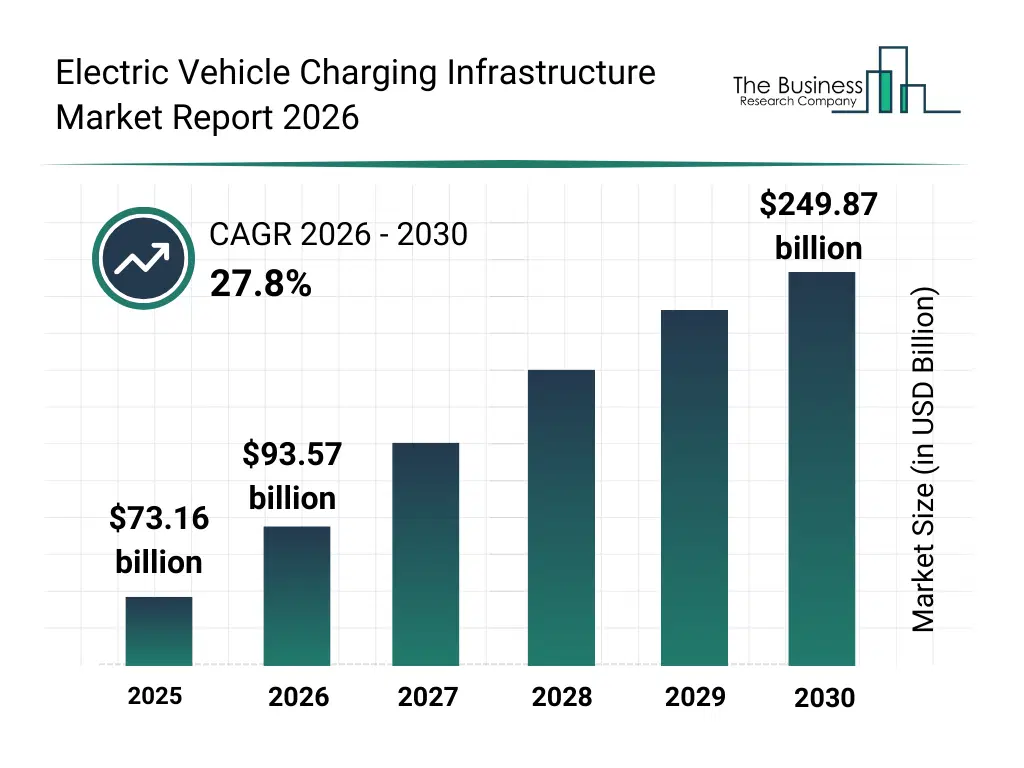
What Is The Electric Vehicle Charging Infrastructure Market Size and Share 2026?
The electric vehicle charging infrastructure market size has grown exponentially in recent years. It will grow from $73.16 billion in 2025 to $93.57 billion in 2026 at a compound annual growth rate (CAGR) of 27.9%. The growth in the historic period can be attributed to ev adoption growth, early public charging deployment, grid electrification initiatives, government charging incentives, pilot fast charging projects.What Is The Electric Vehicle Charging Infrastructure Market Growth Forecast?
The electric vehicle charging infrastructure market size is expected to see exponential growth in the next few years. It will grow to $249.87 billion in 2030 at a compound annual growth rate (CAGR) of 27.8%. The growth in the forecast period can be attributed to smart city investments, ultra-fast charging demand, vehicle-to-grid integration, renewable energy integration, expansion of highway charging corridors. Major trends in the forecast period include expansion of fast and ultra-fast charging networks, growth of public charging infrastructure, integration of smart grid technologies, rising deployment of dc fast chargers, growth of home charging installations.
Global Electric Vehicle Charging Infrastructure Market Segmentation
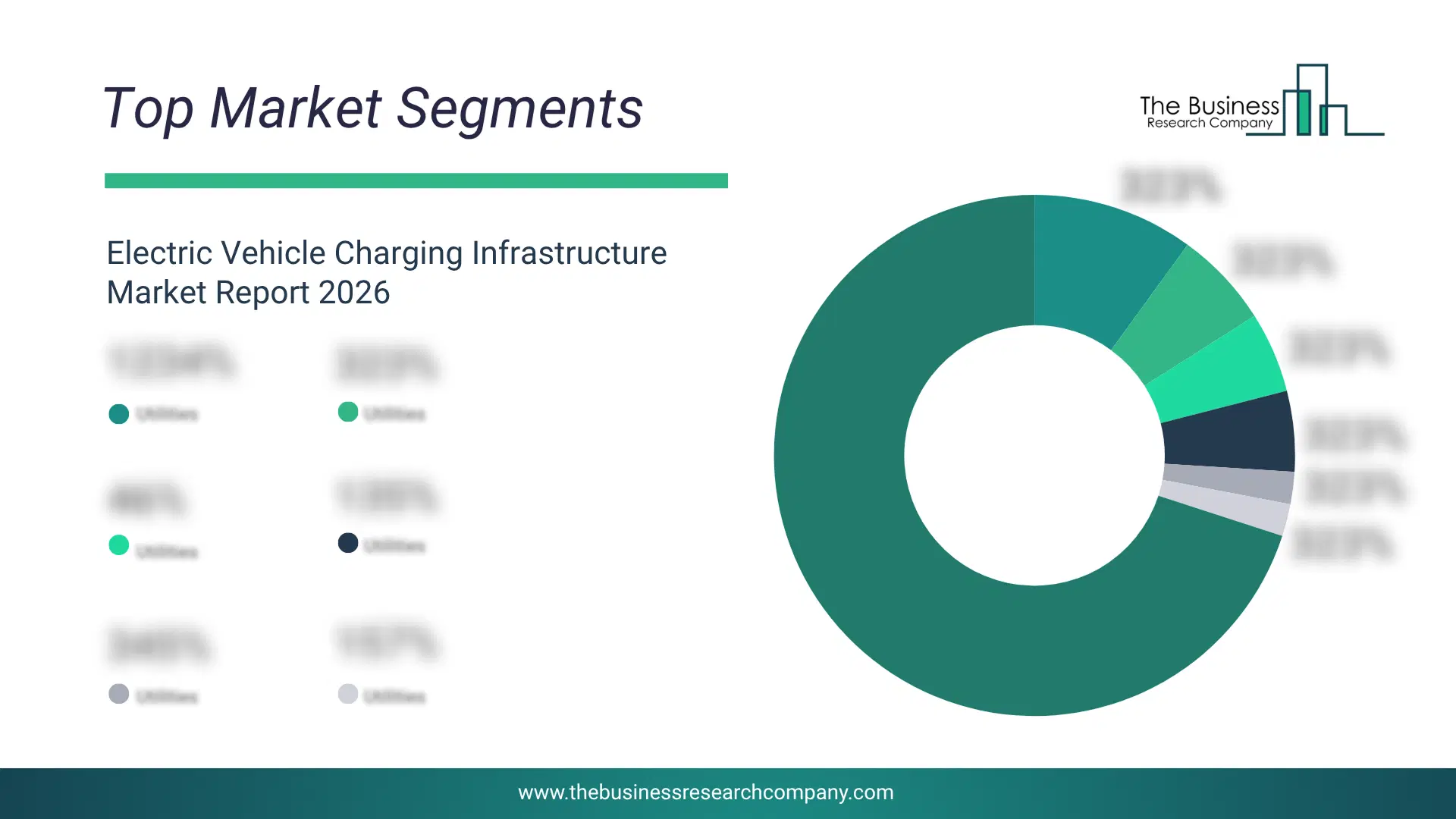
1) By Charger Type: Slow Charger, Fast Charger 2) By Charging Type: Alternative Current Charging, Direct Current Charging 3) By Connector Type: CHAdeMO, Combined Charging System (CCS), Other Connector Types 4) By Charging Level: Level 1, Level 2, Level 3 5) By Application: Residential, Commercial, Other Applications Subsegments: 1) By Slow Charger: Level 1 Charger (120V AC), Level 2 Charger (240V AC) – Residential Applications 2) By Fast Charger: Level 2 Charger (240V AC) – Commercial Applications, DC Fast Charger (DCFC), Ultra-Fast Charger (350+ kW), Supercharger (Tesla-Specific Fast Charging) The top segments in the electric vehicle charging infrastructure market will be: • Slow Charger will reach $149.47 Billion by 2030. • Fast Charger will reach $98.61 Billion by 2030.What Is The Driver Of The Electric Vehicle Charging Infrastructure Market?
The rising sales of electric vehicles are expected to propel the growth of the electric vehicle charging infrastructure market in the future. An electric vehicle refers to a vehicle that is powered by electricity stored in batteries or obtained from an external source, such as charging stations, rather than relying on internal combustion engines. The rising sales of electric vehicles can be attributed to increasing environmental awareness, government incentives, advancements in battery technology, decreasing costs of production, and a growing emphasis on sustainable transportation alternatives. Electric vehicles utilize charging infrastructure to replenish the battery energy, enabling convenient and efficient access to power for extended driving ranges. For instance, in 2024, according to International Energy Agency (IEA), a France‑based intergovernmental organization, global electric car sales exceeded 17 million units, representing a more than 25% increase compared to the previous year, and pushing EVs to account for over 20% of all new cars sold worldwide. Therefore, the rising sales of electric vehicles are driving the growth of the electric vehicle charging infrastructure industry.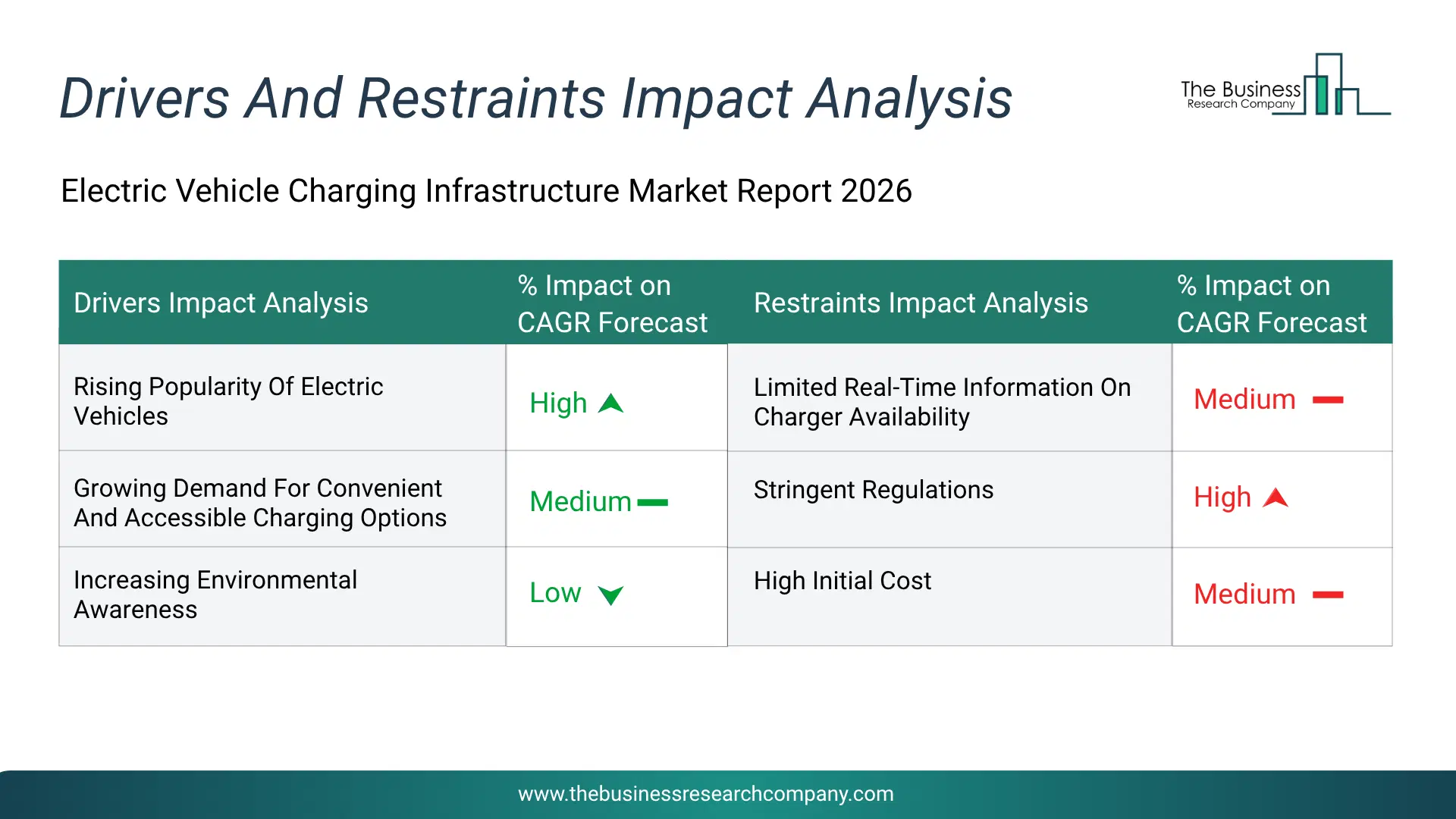
Infographic Chart Showing Key Market Drivers Analysis And Restraints For Electric Vehicle Charging Infrastructure Market
The chart presents an impact analysis of key drivers and restraints, quantifying their relative influence on the market's growth rate and helping assess the balance between growth enablers and limiting factors. This chart offers a high-level perspective; the full report contains more detailed insights.
How Will The Drivers Impact Growth In The Global Electric Vehicle Charging Infrastructure Market?
• Rising Popularity Of Electric Vehicles (High) – During the forecast period, the rising popularity of electric vehicles is expected to become a key growth driver for the electric vehicle charging infrastructure market by 2030. The increasing adoption of electric passenger cars, two-wheelers, and commercial vehicles is creating a strong need for widespread and reliable charging networks. As vehicle electrification accelerates across both developed and emerging markets, demand for charging points across urban, suburban, and highway locations is rising significantly. Charging infrastructure providers are therefore expanding their networks to meet growing usage requirements and reduce range anxiety among users. This trend is strengthening long-term infrastructure demand and utilization rates. • Growing Demand For Convenient And Accessible Charging Options (Medium) – During the forecast period, the growing demand for convenient and accessible charging options is expected to emerge as a major factor driving the expansion of the electric vehicle charging infrastructure market by 2030. Consumers are increasingly prioritizing ease of access to charging stations across residential complexes, workplaces, retail centers, and public locations. This is encouraging the deployment of distributed and user-friendly charging solutions that minimize waiting time and improve charging availability. Service providers are focusing on enhancing network density and optimizing station locations to improve overall customer experience. The shift toward seamless and accessible charging ecosystems is reinforcing market expansion. • Increasing Environmental Awareness (Low) – During the forecast period, the increasing environmental awareness is expected to act as a key growth catalyst for the electric vehicle charging infrastructure market by 2030. Rising concerns about climate change and air pollution are encouraging the transition toward cleaner transportation solutions, including electric mobility. This shift is driving the need for supporting infrastructure that enables efficient and widespread EV usage. Organizations and consumers alike are aligning with sustainability goals, leading to higher adoption of charging solutions integrated with renewable energy sources. The growing focus on reducing carbon footprints is accelerating infrastructure deployment across regions.How Will The Restraints Impact Growth In The Global Electric Vehicle Charging Infrastructure Market?
• Limited Real-Time Information On Charger Availability (High) – During the forecast period, limited real-time information on charger availability acts as a key restraint in the electric vehicle charging infrastructure market by reducing user convenience and trust. When EV users cannot easily access accurate data about charger status, location, or wait times, it leads to uncertainty and range anxiety. This discourages potential buyers from adopting electric vehicles, indirectly slowing infrastructure demand. Additionally, the lack of integrated digital platforms and standardized communication systems limits efficient network utilization. Charging station operators may also face inefficiencies due to uneven usage patterns. As a result, the absence of reliable real-time information hampers user experience and restricts market growth. Overcoming this challenge requires advanced software solutions and better data-sharing frameworks. • Stringent Regulations (Medium) – During the forecast period, stringent regulations present a significant barrier to the growth of the electric vehicle charging infrastructure market. Compliance with varying regional standards, safety requirements, and permitting processes can delay the installation and deployment of charging stations. These regulatory complexities increase project timelines and administrative burdens for companies entering the market. Additionally, frequent policy changes and lack of uniform standards across regions create uncertainty for investors and stakeholders. Smaller players may find it particularly difficult to navigate these regulatory frameworks. This slows down infrastructure expansion and limits market participation. Consequently, strict regulatory environments act as a constraint on the pace of market development. • High Initial Cost (Low) – During the forecast period, high initial cost is a major restraint affecting the expansion of the electric vehicle charging infrastructure market. Setting up charging stations requires substantial investment in equipment, installation, grid upgrades, and land acquisition. These high upfront expenses can deter new entrants and limit the scalability of existing players. Moreover, the return on investment may take time due to gradual EV adoption rates in some regions. Maintenance and operational costs further add to the financial burden. Small and medium enterprises may struggle to secure funding for such capital-intensive projects. As a result, high initial costs slow down the widespread deployment of charging infrastructure and hinder overall market growth.Key Players In The Global Electric Vehicle Charging Infrastructure Market
Major companies operating in the electric vehicle charging infrastructure market report include Shell plc, PG and E Corp., Engie SA , Pod Point Ltd., Tesla Motors Inc., Siemens AG, General Electric Company, BYD Company, RWE AG, Schneider Electric SE, ABB Group, Eaton Corporation, Infineon Technologies AG, Delta Electronics Inc., Delphi Automotive LLP, TGOOD Global Ltd., Leviton Manufacturing Co. Inc., Alfen NV, AeroVironment Inc., Phihong USA Corp., Efacec Electric Mobility, LS Power Development LLC, Polarium Energy Solutions AB, ChargePoint Inc., Blink Charging, EVgo, SemaConnect Inc., BP Chargemaster Inc., ClipperCreek Inc., Greenlots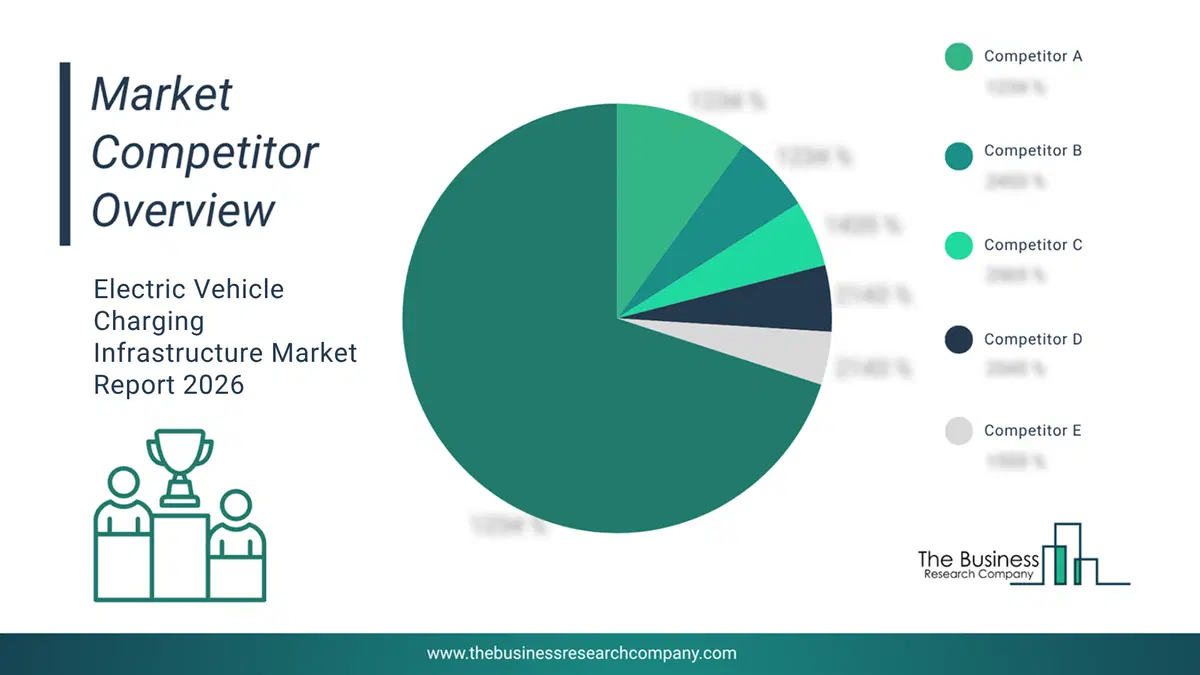
This chart is for illustrative purposes; the full report includes a detailed competitor analysis and comprehensive overview of the top 10 companies in the market.
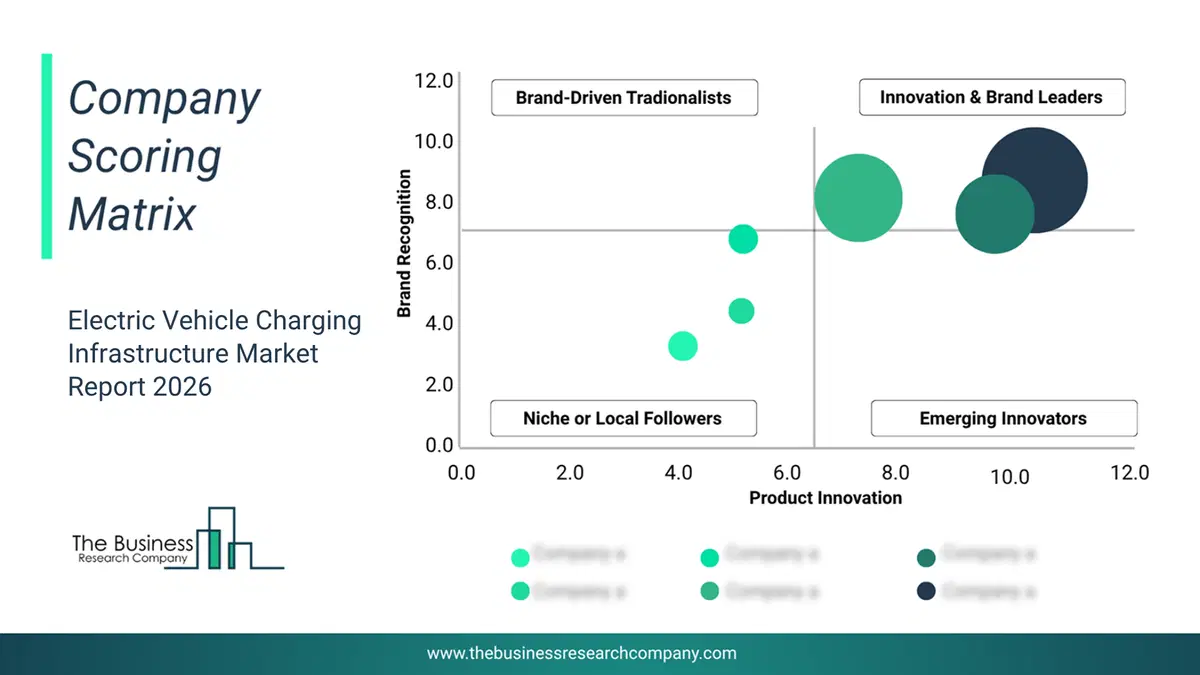
This chart maps companies by product innovation and brand strength, with bubble size indicating relative revenue, helping identify market leaders, challengers, and niche players. This is an illustrative chart; the full report provides a complete and accurate competitive analysis.
Global Electric Vehicle Charging Infrastructure Market Trends and Insights
Major companies operating in the electric vehicle charging infrastructure market are focusing on developing advanced software platforms, such as fleet optimization solutions, to enhance charging efficiency, reduce downtime, and improve operational management across multiple sites. Fleet optimization software refers to a digital solution that monitors, schedules, and manages charging operations for electric vehicle fleets, enabling operators to maximize utilization, predict maintenance needs, and integrate renewable energy sources. For instance, in November 2025, ChargePoint Inc., a US-based provider of electric vehicle charging solutions, launched its next-generation ChargePoint Platform, a flexible software solution designed to manage EV charging operations from a single site to global networks. The platform features AI-driven optimization, adaptive load management, dynamic energy pricing, real-time insights, and cross-charger compatibility, supporting operators in achieving efficient, scalable, and sustainable charging infrastructure.What Are Latest Mergers And Acquisitions In The Electric Vehicle Charging Infrastructure Market?
In March 2023, Shell USA, Inc., a US-based energy company and subsidiary of Shell plc, acquired Volta Inc. for $160 million. Through this acquisition, Shell aims to expand its public electric vehicle (EV) charging network across the United States, integrating Volta’s existing infrastructure of over 3,000 charge points and development pipeline of 3,400 additional stations to support the growing demand for EV charging. Volta Inc. is a US-based company that provides public EV charging solutions at destination sites, including shopping centers, grocery stores, and pharmacies, while also generating advertising revenue through digital screens embedded in the charge points.
Regional Outlook
Asia-Pacific was the largest region in the electric vehicle charging infrastructure market in 2025. Europe is expected to be the fastest-growing region in the forecast period. The regions covered in this market report include Asia-Pacific, South East Asia, Western Europe, Eastern Europe, North America, South America, Middle East, Africa. The countries covered in this market report include Australia, Brazil, China, France, Germany, India, Indonesia, Japan, Taiwan, Russia, South Korea, UK, USA, Canada, Italy, SpainWhat Defines the Electric Vehicle Charging Infrastructure Market?
The electric vehicle charging infrastructure market consists of revenues earned by entities providing alternative current charging, and direct current charging. The market value includes the value of related goods sold by the service provider or included within the service offering. The electric vehicle charging infrastructure market also includes sales of charging hardware, charging network software, charging cables and payment systems. Values in this market are ‘factory gate’ values, that is the value of goods sold by the manufacturers or creators of the goods, whether to other entities (including downstream manufacturers, wholesalers, distributors and retailers) or directly to end customers. The value of goods in this market includes related services sold by the creators of the goods.How is Market Value Defined and Measured?
The market value is defined as the revenues that enterprises gain from the sale of goods and/or services within the specified market and geography through sales, grants, or donations in terms of the currency (in USD unless otherwise specified). The revenues for a specified geography are consumption values that are revenues generated by organizations in the specified geography within the market, irrespective of where they are produced. It does not include revenues from resales along the supply chain, either further along the supply chain or as part of other products.
This chart presents market attractiveness based on a quantitative evaluation of growth, competition, strategic alignment, and risk, offering a clear view of opportunity areas for decision-making. This chart is for illustrative purposes; the full report contains the complete analysis.

This chart highlights the Total Addressable Market (TAM) by estimating the maximum revenue opportunity using an assumption-driven approach, supporting strategic planning and opportunity sizing across markets. The chart is illustrative; the full report provides a more comprehensive analysis.
What Key Data and Analysis Are Included in the Electric Vehicle Charging Infrastructure Market Report 2026?
The electric vehicle charging infrastructure market research report is one of a series of new reports from The Business Research Company that provides market statistics, including industry global market size, regional shares, competitors with the market share, detailed market segments, market trends and opportunities, and any further data you may need to thrive in the electric vehicle charging infrastructure industry. The market research report delivers a complete perspective of everything you need, with an in-depth analysis of the current and future state of the industry.Electric Vehicle Charging Infrastructure Market Report Forecast Analysis
| Report Attribute | Details |
|---|---|
| Market Size Value In 2026 | $93.57 billion |
| Revenue Forecast In 2030 | $249.87 billion |
| Growth Rate | CAGR of 27.9% from 2026 to 2030 |
| Base Year For Estimation | 2025 |
| Actual Estimates/Historical Data | 2020-2025 |
| Forecast Period | 2026 - 2030 |
| Market Representation | Revenue in USD Billion and CAGR from 2026 to 2030 |
| Segments Covered | Charger Type, Charging Type, Connector Type, Charging Level, Application |
| Regional Scope | Asia-Pacific, Western Europe, Eastern Europe, North America, South America, Middle East, Africa |
| Country Scope | The countries covered in the report are Australia, Brazil, China, France, Germany, India, Indonesia, Japan, Taiwan, Russia, South Korea, UK, USA, Canada, Italy, Spain. |
| Key Companies Profiled | Shell plc, PG and E Corp., Engie SA , Pod Point Ltd., Tesla Motors Inc., Siemens AG, General Electric Company, BYD Company, RWE AG, Schneider Electric SE, ABB Group, Eaton Corporation, Infineon Technologies AG, Delta Electronics Inc., Delphi Automotive LLP, TGOOD Global Ltd., Leviton Manufacturing Co. Inc., Alfen NV, AeroVironment Inc., Phihong USA Corp., Efacec Electric Mobility, LS Power Development LLC, Polarium Energy Solutions AB, ChargePoint Inc., Blink Charging, EVgo, SemaConnect Inc., BP Chargemaster Inc., ClipperCreek Inc., Greenlots |
| Customization Scope | Request for Customization |
| Pricing And Purchase Options | Explore Purchase Options |